
You open a Mushaf, see letters marked in red, green, and blue, and have no idea why. That’s the whole point of a tajweed quran colour coded system: every color flags a specific pronunciation rule, so you know exactly when to elongate a sound, hide a letter, or merge it into the next one, without memorizing a textbook first.
If you’re searching for this, you probably want a straight answer to one question: what does each color actually mean? A color coded tajweed quran typically uses distinct shades for rules like ikhfa, idgham, qalqalah, and madd, turning abstract Arabic grammar into something you can recognize on sight. That visual shortcut is exactly why teachers recommend it for beginners and why it speeds up correct recitation habits early on.
In this article, we’ll break down the standard color scheme used across most colour coded tajweed quran editions, explain what each rule means in practice, and show you how to use this system alongside proper guidance. Color coding helps you spot patterns, but it works best paired with a live teacher who can correct your pronunciation in real time, which is exactly the kind of one-to-one support Quranytime’s Tajweed courses are built around.
Why the color-coded Tajweed Quran matters for your recitation
Recitation errors aren’t just cosmetic, and many learners eventually ask whether mispronouncing the Quran is a sin. Skipping a madd, missing a ghunnah, or mispronouncing a qalqalah letter can shift meaning or simply sound wrong to a trained ear. A quran tajweed color coded page catches these issues before they turn into habits, because your eyes register the rule the moment you see the color, long before your brain finishes parsing the grammar behind it. That’s a real advantage for anyone learning outside a classroom, where there’s no teacher sitting beside you to stop you mid-sentence.
A color-coded Quran turns invisible pronunciation rules into something you can see and correct on the spot.
Catching mistakes before they become habits
Most self-taught reciters develop the small reading errors learners repeat most early and keep them for years, simply because nobody flagged them. With tajweed color coded markings, you notice the ikhfa or idgham cue every single time you pass over it, which reinforces the correct sound through repetition rather than guesswork. Over weeks of practice, that repetition builds muscle memory the same way flashcards build vocabulary.

Learning tajweed faster than traditional methods
Traditional tajweed instruction, like most beginner guides to Quran recitation, usually starts with rule names, exceptions, and Arabic terminology before you ever apply anything to real verses. Color coding flips that order. You apply the rule first, by recognizing the color, and learn the terminology later once the pattern already feels familiar. For adult beginners and parents teaching children, this shortcut matters, because it keeps motivation high while the theory catches up. It also explains why a quran with tajweed color coded page tends to get recommended so often for new reciters rather than advanced students who already read fluently.
How to read the colors in a Tajweed Quran
Opening a color coded quran tajweed page for the first time can feel overwhelming, but the system follows a consistent logic once you know where to look. Each color sits directly on the letter or letter combination it affects, not as a separate footnote, so you read the verse normally and let the color guide your mouth as you go. Most editions include a legend on the inside cover or first page that maps each shade to its rule, and it’s worth memorizing that key before you start reciting rather than flipping back mid-verse.
The colors aren’t decoration, they’re instructions embedded directly in the text you’re already reading.
Here’s the basic reading process:
- Scan the verse once silently, noting any colored letters ahead.
- Recite slowly, applying the rule tied to each color as you reach it.
- Repeat the same line two or three times until the colored cues feel automatic.
- Cross-check with a teacher or audio recitation when a color’s exact application feels unclear.
This routine works whether you’re using a printed quran with color coded tajweed or a digital version on an app.
Common color-coding systems and what each color means
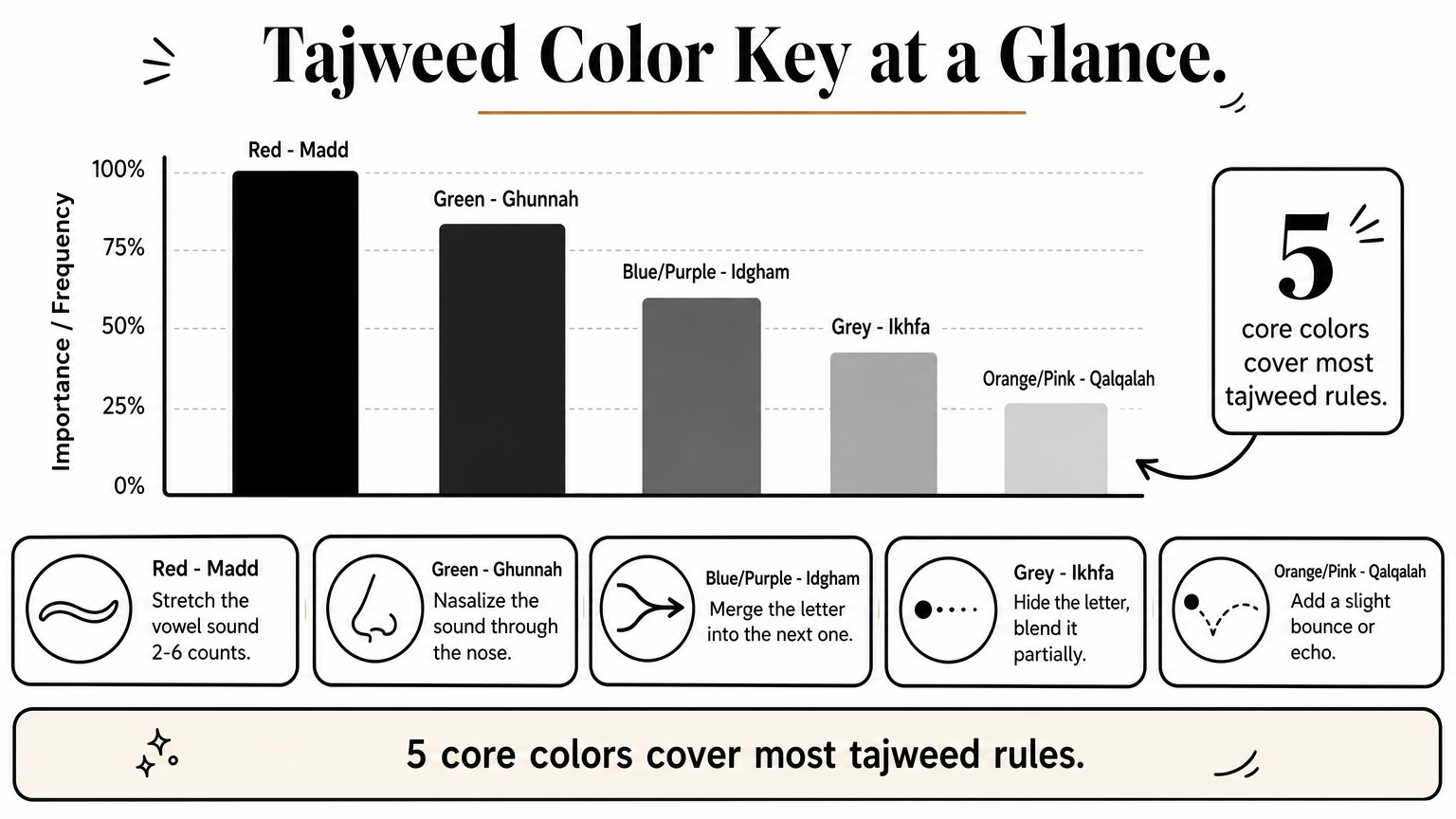
Publishers don’t all agree on the same palette, so a tajweed color coded quran from one printer might use pink for qalqalah while another uses orange. Still, most editions converge around a shared logic: warm colors flag nasal sounds, cool colors flag elongation, and a distinct shade marks letters that get swallowed or hidden. Knowing the general pattern helps you adapt quickly even when the exact hex code changes between editions.
Once you learn one color system, switching to another takes minutes, not months.
Here’s a typical breakdown you’ll see across popular color coded quran tajweed editions:
| Color | Rule | What it signals |
|---|---|---|
| Red | Madd (elongation) | Stretch the vowel sound 2-6 counts |
| Green | Ghunnah | Nasalize the sound through the nose |
| Blue/Purple | Idgham | Merge the letter into the next one |
| Grey | Ikhfa | Hide the letter, blend it partially |
| Orange/Pink | Qalqalah | Add a slight bounce or echo |
Memorize this key before you recite, since guessing mid-verse breaks your rhythm and defeats the purpose of the visual shortcut.
How to use it without becoming dependent on the colors
Colors are a crutch, and crutches are fine until you need to walk without one. A color coded tajweed quran teaches you the rules faster, but if you never learn to recognize the underlying letter combinations without the visual cue, you’ll struggle the moment you pick up a plain black-and-white Mushaf, which is what most mosques and printed copies actually use.
The goal isn’t to read colors forever, it’s to eventually see the rule even when the color disappears.
Guard against dependency with a few habits you can build into how you practise Tajweed at home:
- Practice the same passage from a plain Mushaf after mastering it in color.
- Say the rule name aloud as you recite, not just the color.
- Test yourself monthly on uncolored pages to check real retention.
A quran color coded tajweed edition works best as a training wheel, not a permanent feature. Once a rule feels automatic, and you can spot ikhfa or qalqalah without the colored hint, you’re ready to lean on plain text more often. That transition usually takes a few months of steady practice, faster with a teacher checking your progress along the way.
Choosing between a printed Quran, an app, or a teacher
A printed colour coded tajweed quran works well for quiet, offline study, but it’s static. Apps add audio playback, repeat buttons, and sometimes tap-to-hear pronunciation for each colored rule, which helps when you’re unsure how a qalqalah actually sounds versus how it looks. Neither format, though, corrects your mouth position or catches a mispronounced makhraj, and that matters most with the Arabic sounds English speakers struggle with, because a screen or a page can’t listen back to you.

Colors show you the rule, but only a teacher can confirm you’re actually applying it correctly.
Matching the format to your learning stage
Beginners often start with an app for convenience, move to a printed quran with colour coded tajweed for focused practice, and add guided Quran reading and Tajweed lessons once they’re ready for real feedback. Here’s a rough guide:
| Format | Best for | Limitation |
|---|---|---|
| Printed Mushaf | Distraction-free reading | No audio feedback |
| App | Audio cues, portability | Can’t hear your recitation |
| Live teacher | Real-time correction | Requires scheduling |
Most serious learners eventually use all three together rather than picking just one.
Putting the colors into practice
A tajweed quran colour coded edition gives you a fast, visual way to learn pronunciation rules that would otherwise take months of dry memorization. Red for madd, green for ghunnah, grey for ikhfa: once that key clicks, you start reading with far more confidence than a plain Mushaf ever gives a beginner. But colors alone won’t fix a mispronounced letter or confirm your makhraj is correct. That part still needs a real ear listening to you recite.
Quranytime’s Tajweed instructors work with students at every stage, whether you’re starting with a colored Mushaf at home or already reading fluently and refining your recitation. They’ll spot what the colors can’t catch and build a plan around your actual level, not a generic lesson plan. If you’re ready to move past guesswork, start with a free Quran and Tajweed assessment and get matched with a teacher who fits how you learn.