
You want a Quran that shows you how to recite and what the words mean, all on one page. A tajweed Quran with English translation and transliteration does that. It uses color-coded letters to mark the rules, adds a line-by-line English translation, and spells out Arabic sounds in Latin letters. For a beginner, that combination can turn a closed book into a daily habit.
Here is the short answer. Choose an edition with a clear color key on every page, a readable Arabic script, and a translation you can follow. Treat transliteration as a bridge, not a destination. It helps you start, but it cannot teach the throat letters or the length of a vowel by itself.
This article explains what these editions contain, how the color rules work, and how print, PDF, and online versions differ. You will also see which sizes and features suit children, adult beginners, and Hifz students. At Quranytime Academy, our Al-Azhar-trained teachers see these books in lessons every week, so we also cover how to pair your Quran with live correction.
Why a Tajweed Quran with translation and transliteration helps
Each layer in this kind of book solves a different problem. Color shows you which rule applies to a letter. Translation tells you what the words mean. Transliteration gives you a way to start sounding them out. Together they keep you reading instead of stalling on the first page.

What each layer does
Think of the three layers as a team. Each one covers a gap the others leave open, and each one has a limit you should know about before you buy.
| Layer | What it gives you | What it cannot do |
|---|---|---|
| Tajweed color coding | Shows rules like ghunnah and madd at a glance | Teach you the actual sound |
| English translation | Gives the meaning of each verse | Replace the Arabic text |
| Transliteration | Lets you sound out words from day one | Capture letters like ع and ق accurately |
Who gets the most from it
Adult beginners starting Quran from zero benefit first. A tajweed Quran with English translation lets you read a verse, then check its meaning right away. That builds motivation in the first weeks, when most people quit, and it links recitation to understanding instead of treating it as sound alone.
Families gain too. Children can’t name qalqalah or ikhfa yet, but a color key makes the rules visible before the vocabulary arrives. A tajweed Quran with English transliteration also gives newer readers a safe first step while the Arabic alphabet is still unfamiliar. If you want a tajweed Quran with meaning translation in English for memorization, the translation helps you hold the context of each verse you learn.
Color shows you the rule, translation gives you the meaning, and a teacher makes the sound right.
How to choose the right edition for your needs
Editions differ more than their covers suggest. Judge any tajweed Quran English translation by your goal, not by price, and check one sample page before you commit.
Features worth checking
Open the sample page first. Rules are hard to remember early on, so you need a color key on every spread, not just in the front matter. Then confirm the Arabic script is large and evenly spaced.
- Quran book English translation in plain modern English, such as Sahih International
- Transliteration that marks long vowels
- Color rules that stay readable in print or on a screen
Size and layout by learner
| Learner | Best fit |
|---|---|
| Child | Lightweight book, large Arabic font |
| Adult beginner | Line-by-line transliteration, medium size |
| Hifz student | Fixed page layout, translation kept separate |
Hifz students should keep the page layout fixed, because memory attaches to where a verse sits, and that matters inside a steady Quran memorization routine. Beginners do better with translation beside each line, since it removes flipping back and forth.
Pick the Quran you can comfortably read for ten minutes every day, not the one that looks most impressive on the shelf.
How to read the color-coded tajweed rules
Colors only help if you know what each one asks you to do. In a tajweed Quran with English translation and transliteration, the colors sit on the Arabic letters themselves, so it helps to know what the colors mean in a tajweed Quran. You read the color before the letter, then apply the rule as you recite.
Learn the key before the colors
Publishers do not agree on one palette. Green may mean ghunnah in one book and madd in another, so always use the key printed in your own edition. Start with four rules and ignore the rest for your first month.
Master four colors well before you try to read all of them.
| Rule | What you do |
|---|---|
| Madd | Stretch the vowel longer |
| Ghunnah | Hold a nasal sound for about two counts |
| Qalqalah | Add a light echo on ق ط ب ج د when silent |
| Ikhfa | Soften the noon sound and nasalize it |
A simple routine for each verse
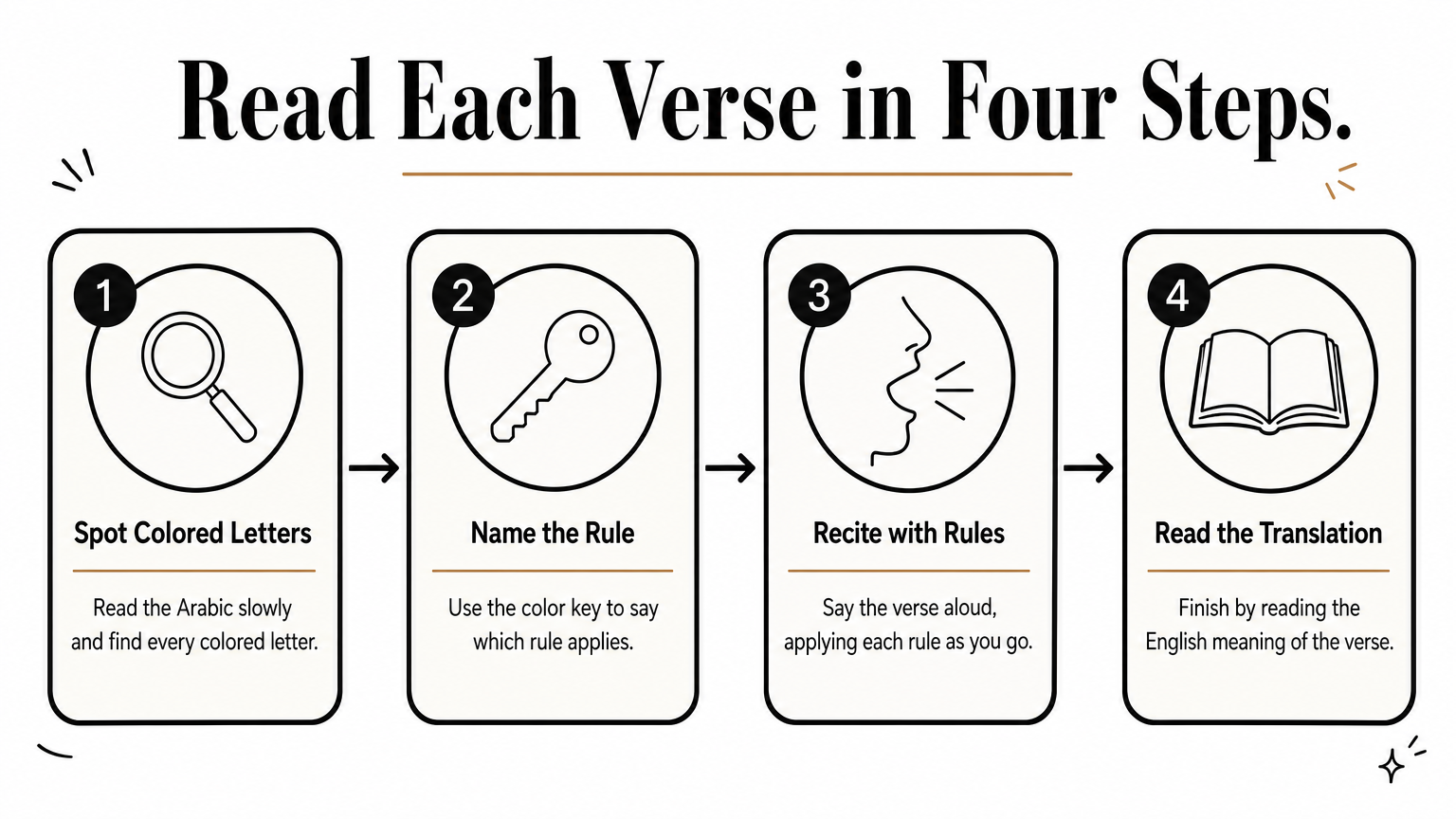
Practice works best in small steps. Take one verse at a time and say the rule out loud before you recite.
- Read the Arabic slowly and spot each colored letter.
- Name the rule using the key.
- Recite the verse, applying each rule.
- Read the English translation last.
How to use transliteration without becoming dependent on it
Reading Quran with transliteration works like training wheels. Use it with a plan and you gain confidence fast. Lean on it forever and you never learn the Arabic letters.

Set a clear timeline
Most adult beginners can learn the Arabic letters and their shapes in four to eight weeks with a teacher. Plan to phase transliteration out in that window, and track your progress weekly.
- Weeks 1 to 2: read the Arabic first, then check the transliteration.
- Weeks 3 to 4: cover the transliteration with a card and peek only when stuck.
- Weeks 5 to 8: read the Arabic alone and use transliteration only to verify.
Know where it fails
Latin letters blur Arabic sounds. The letter "h" can stand for ه or ح, and "k" hides the gap between ق and ك. A tajweed Quran: English transliteration edition cannot fix that, because the page has no voice.
Use transliteration to start reading, and a teacher to stop guessing.
Recording yourself helps. Play it back against a qualified reciter, or have a teacher listen live. That is how you catch errors in throat letters and vowel length before they become habits, which is where Quran pronunciation for English speakers usually goes wrong.
Where to find print, PDF, online and app versions
Format matters as much as content. Each one suits a different routine, so decide where you will read before you decide what to buy.
Comparing the four formats
| Format | Best for | Watch out for |
|---|---|---|
| Daily practice, children | Fixed size, heavier | |
| A free, quick trial | Blurry colors, small screens | |
| Online | Searching verses, audio | Needs internet, distractions |
| App | Commuting, audio sync | Missing color rules |
Print wins for steady practice. Paper has no notifications, and you can pencil notes beside a rule. A free PDF is a fair way to test an edition, but zoom in on the colors first, because compression often blurs them. Apps add audio, so confirm the color rules appear and are not replaced by plain text.
Buying or downloading safely
Start with the publisher’s own site or a major retailer such as Amazon, where the Look Inside preview lets you check the color key before you pay. When you search for a tajweed Quran with English translation and transliteration online, prefer sources that name the publisher and the translator. Random uploads often carry typos in the Arabic, and that is a risk you should not accept.
Whatever the format, check the source of the Arabic text before you check the price.
Once you pick a version, stick with it. Switching editions every month resets your visual memory of where the rules appear.
Choosing a Quran you will actually use
The best tajweed Quran with English translation and transliteration is the one you open every day. Look for a color key on every page, a clear Arabic script, and a translation you understand. Use transliteration as a short bridge into the Arabic letters, then let it go. Pick one edition, stick with it, and read for ten minutes a day.
Books can show you the rule, but they cannot hear you. A teacher fixes the throat letters, vowel lengths, and nasal sounds that print will never explain. That is why live correction turns a good edition into steady progress.
If you are unsure which edition or path fits you, book a free Quran and Tajweed assessment class with Quranytime Academy. A qualified teacher will check your level, recommend a learning path, and show you how to use your Quran from the first lesson.