A good tajweed rules chart does three things. It groups the rules into a few families, shows the trigger letters and counts for each, and gives a Quran example you can recite aloud. This chart covers eight groups. If you are a beginner, start with makharij, noon sakinah and tanween, and madd, because they appear on every page of the Quran. If you already read fluently and want polish, spend your time on qalqalah, tafkheem and tarqeeq, and waqf.
Most charts online fail at the same point. They show a grid of colored boxes but never explain why a rule applies, so you memorize letters without hearing the sound. Others assume you already know what ghunnah or sukoon means. Here, every term is defined when it first appears, and every rule gets the same three parts: how it works, examples to recite, and the mistake to avoid. All the charts are plain tables on this page, so you can print them or save the page as a PDF.
At Quranytime Academy we teach these rules in live, one-to-one tajweed lessons for children and adults. A chart tells you what to do, but only a teacher’s ear tells you whether you are doing it. Use the chart to learn the rules, then have a qualified teacher check your recitation.
Tajweed rules chart at a glance
Teachers count tajweed rules differently, from nine broad categories to fourteen or more, but the content is the same. This chart uses eight groups, which keeps every core rule in one place without splitting hairs. Each group has its own numbered section after this one.
One-page chart of the eight rule groups
| # | Rule group | What it governs | Key detail |
|---|---|---|---|
| 1 | Makharij | Where each letter is produced | 17 articulation points in 5 regions |
| 2 | Noon sakinah and tanween | What happens to the noon sound | Izhar, idgham, iqlab, ikhfa |
| 3 | Meem sakinah | A meem carrying sukoon | Ikhfa, idgham and izhar shafawi |
| 4 | Noon and meem mushaddad | A doubled noon or meem | Ghunnah for 2 counts |
| 5 | Madd | Stretching vowel sounds | 2, 4, 5 or 6 counts |
| 6 | Qalqalah | The echo on five letters | ق ط ب ج د |
| 7 | Tafkheem and tarqeeq | Heavy and light letters | 7 always-heavy letters |
| 8 | Waqf and ibtida | Stopping and restarting | Mushaf stop signs |
Three terms appear throughout. Sukoon is the small circle above a letter, meaning the letter carries no vowel. Ghunnah is the nasal sound that resonates in the nose. A count is one beat, about the time of a short vowel.
One chart cannot replace listening, but it can tell you exactly what to listen for.
Print it or save it as a PDF
Every table here is plain text, so the page prints cleanly. Open your browser’s print dialog, choose Save as PDF as the destination, and switch to a horizontal layout so the wide tables stay on one line. Many learners print the pages and keep them inside the mushaf cover. Others keep the PDF on a phone to check a rule between lessons.
A saved tajweed rules chart in PDF form is still only a reference. Color-coding your own mushaf works better, with one color per rule group. When you recite and see the color, you recall the rule without hunting through a table.
The order to study the rules in
Beginners learn tajweed best one group at a time, in this order:
- Makharij, so every letter starts from the right place.
- Noon sakinah and tanween, the most frequent rules in the Quran.
- Natural madd, then the longer madd types.
- Meem sakinah and the doubled noon and meem.
- Qalqalah, tafkheem and tarqeeq.
- Waqf and ibtida, once you read in longer stretches.
Spend 10 to 15 minutes a day on a single group and recite a short surah that contains it before moving on. Listening to a skilled reciter before you recite matters as much as reading the rule.
1. Makharij: the 17 articulation points
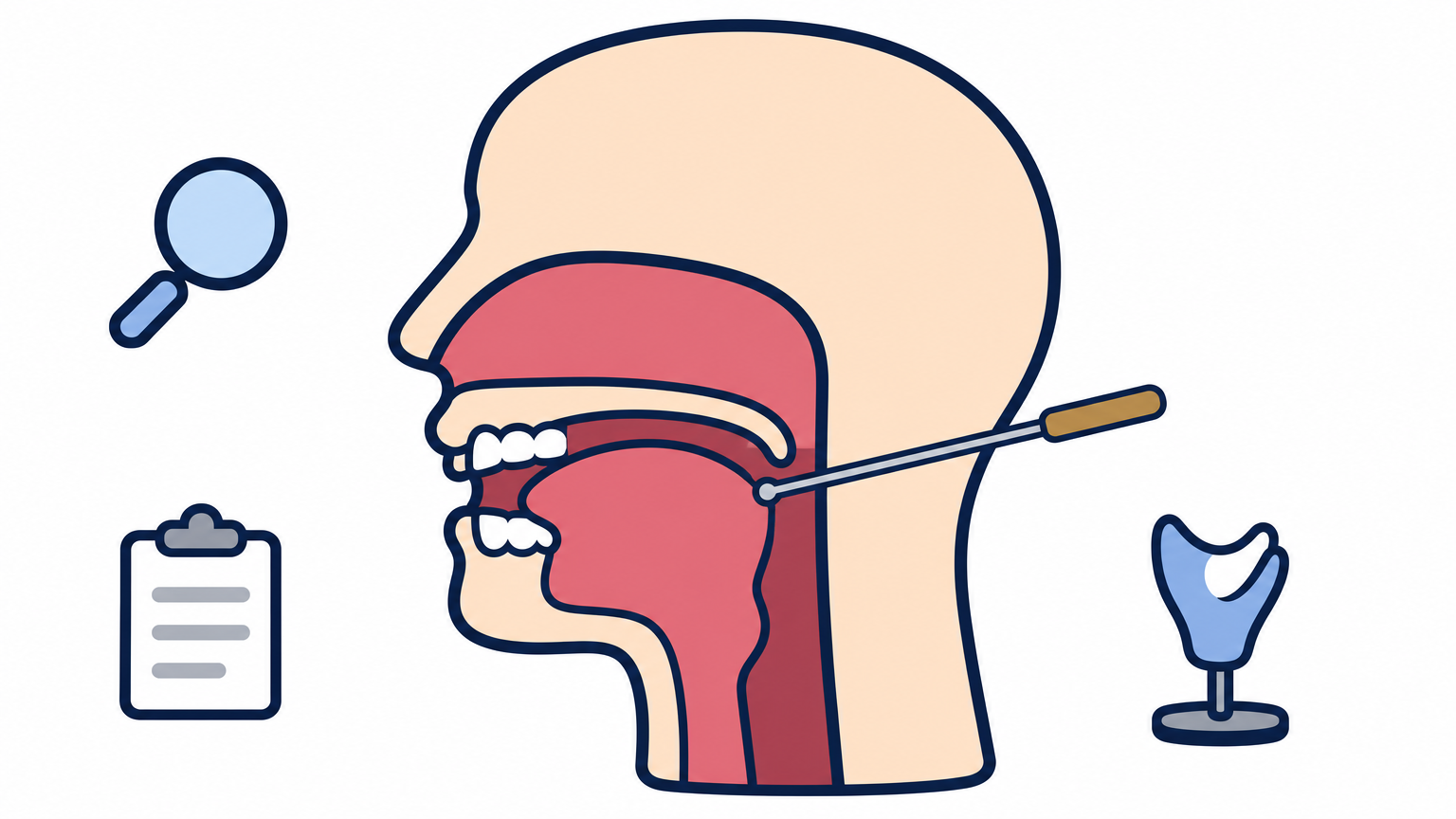
Makharij are the places in the throat, mouth, lips and nose where each Arabic letter is produced, and there are 17 of them in five regions. A letter said from the wrong place becomes a different letter, so this group comes before every other rule.
How the rule works
Each region has a fixed number of exit points, and each point serves specific letters. The throat has three points, ordered from deepest to nearest the mouth. The tongue has ten points and carries most of the alphabet.
| Region | Points | Letters |
|---|---|---|
| Al-Jawf, the empty space of mouth and throat | 1 | Madd letters ا و ي |
| Al-Halq, the throat | 3 | ء ه (deepest), ع ح (middle), غ خ (nearest the mouth) |
| Al-Lisan, the tongue | 10 | 18 letters: ق ك ج ش ي ض ل ن ر ط د ت ص ز س ظ ذ ث |
| Ash-Shafatayn, the lips | 2 | ف (lower lip and upper teeth), ب م و (both lips) |
| Al-Khayshoom, the nasal cavity | 1 | Ghunnah |
A wrong exit point means a wrong letter, which is why makharij come before every other rule.
Examples to recite
These pairs differ only by where the letter starts:
- قَلْب (qalb, heart) and كَلْب (kalb, dog). The ق starts at the back of the tongue, and the ك slightly forward.
- تِين (tin, fig) and طِين (tin, clay). The ط is heavy, with the tongue raised toward the palate.
- حَ and هَ. The ح comes from the middle of the throat, and the ه from the deepest point.
Common mistake
English speakers often soften throat letters into the nearest familiar sound. The ع becomes a plain "a", and the ق becomes a "k". Arabic has sounds with no English equivalent, so you have to build the muscle memory on purpose.
To fix it, say the letter with a short fatha, then between two vowels, and record yourself. Compare the recording with a reciter such as Mishary Alafasy or Mahmoud Khalil Al-Husary. You cannot easily hear your own exit-point errors, which is where one-to-one correction helps most.
2. Noon sakinah and tanween: four rules
When a noon with sukoon or a tanween meets the next letter, one of four rules applies, and the next letter alone decides which. Tanween is the doubled vowel mark at the end of a word (ً ٍ ٌ) that adds a noon sound.
How the rule works
Find the letter after the noon or tanween, then read across the table.
| Rule | Meaning | Next letter | What you do |
|---|---|---|---|
| Izhar | Clear | ء ه ع ح غ خ | Say the noon clearly, no ghunnah |
| Idgham with ghunnah | Merge | ي ن م و | Merge into the next letter, ghunnah 2 counts |
| Idgham without ghunnah | Merge | ل ر | Merge fully, no ghunnah |
| Iqlab | Convert | ب | Turn the noon into a hidden meem, ghunnah 2 counts |
| Ikhfa | Hide | The other 15: ت ث ج د ذ ز س ش ص ض ط ظ ف ق ك | Hide the noon, ghunnah 2 counts |
The six idgham letters are remembered with the word يرملون. One exception matters: when the noon and an idgham letter sit in the same word, as in دُنْيَا and بُنْيَان, you pronounce the noon clearly.
Look at the letter after the noon, and the rule follows.
Examples to recite
- Izhar: مَنْ آمَنَ (man aamana, 2:62)
- Idgham with ghunnah: مَنْ يَقُولُ (2:8) and خَيْرًا يَرَهُ (99:7)
- Idgham without ghunnah: مِنْ رَبِّهِمْ (2:5)
- Iqlab: مِنْ بَعْدِ and سَمِيعٌ بَصِيرٌ
- Ikhfa: مِنْ شَرِّ (113:2)
Common mistake
Ikhfa is the rule learners get wrong most often. They either say the noon fully, which turns it into izhar, or merge it completely, which turns it into idgham. In ikhfa the tongue does not touch the noon’s exit point, and the nasal hum carries the sound into the next letter.
Practice with مِنْ شَرِّ, then listen to a reciter say it three times. Notice where the sound sits between a clear noon and a full merge. Then try the same on a phrase of your own choosing, and ask a teacher to confirm it.
3. Meem sakinah: three rules
A meem with sukoon follows three rules, called shafawi, meaning "of the lips", and the next letter again decides which one applies. They mirror the noon rules but with far fewer cases.
How the rule works
Only two letters change the sound. A ب triggers ikhfa, a م triggers idgham, and 26 other letters leave the meem clear.
| Rule | Next letter | What you do |
|---|---|---|
| Ikhfa shafawi | ب | Hide the meem with lips lightly closed, ghunnah 2 counts |
| Idgham shafawi | م | Merge the two meems into one doubled meem, ghunnah 2 counts |
| Izhar shafawi | The other 26 letters | Say the meem clearly, no ghunnah |
Take extra care before و and ف, where lips tend to close early and hide the meem by accident.
Only ب and م change a meem sakinah, and the other 26 letters leave it clear.
Examples to recite
- Ikhfa shafawi: تَرْمِيهِمْ بِحِجَارَةٍ (105:4)
- Idgham shafawi: لَهُمْ مَا يَشَاءُونَ
- Izhar shafawi: أَلَمْ تَرَ (105:1) and عَلَيْهِمْ غَيْرِ (1:7)
Common mistake
Learners often carry the noon habit over to the meem and hide it before every letter. Only the ب allows that. For all other letters, the meem should be heard in full.
Try أَلَمْ تَرَ slowly. The lips close for the meem, release, and the next letter begins. If the sound drifts into the nose, you are hiding a meem that should be clear.
4. Noon and meem mushaddad: the full ghunnah
A noon or meem carrying a shaddah is pronounced with a full ghunnah of two counts, and this is the strongest ghunnah in tajweed. The rule never changes, whatever letter comes next.
How the rule works
The shaddah means the letter is doubled, and the nasal sound lasts for the whole doubled letter. Hold the ghunnah, not the vowel.
| Letter | Rule | Counts | Examples |
|---|---|---|---|
| ن with shaddah | Full ghunnah | 2 | إِنَّ, النَّاسِ, الْجَنَّةِ |
| م with shaddah | Full ghunnah | 2 | ثُمَّ, عَمَّ |
The ghunnah stays even when you stop on the letter, so do not let it drop at the end of a verse or phrase.
Hold the nasal sound of a doubled noon or meem for two full counts, every time.
Examples to recite
- إِنَّ (inna), with the doubled noon held for two counts
- ثُمَّ (thumma), with the doubled meem held the same way
- عَمَّ يَتَسَاءَلُونَ (78:1)
Common mistake
The usual error is stretching the vowel that follows instead of the nasal sound, which turns inna into something like "innaaa". The other error is rushing the doubled letter into a single noon.
Say إِنَّ with your fingers on the side of your nose. You should feel the vibration through the full two counts, and the vowel after it should stay short.
5. Madd: elongation rules and counts
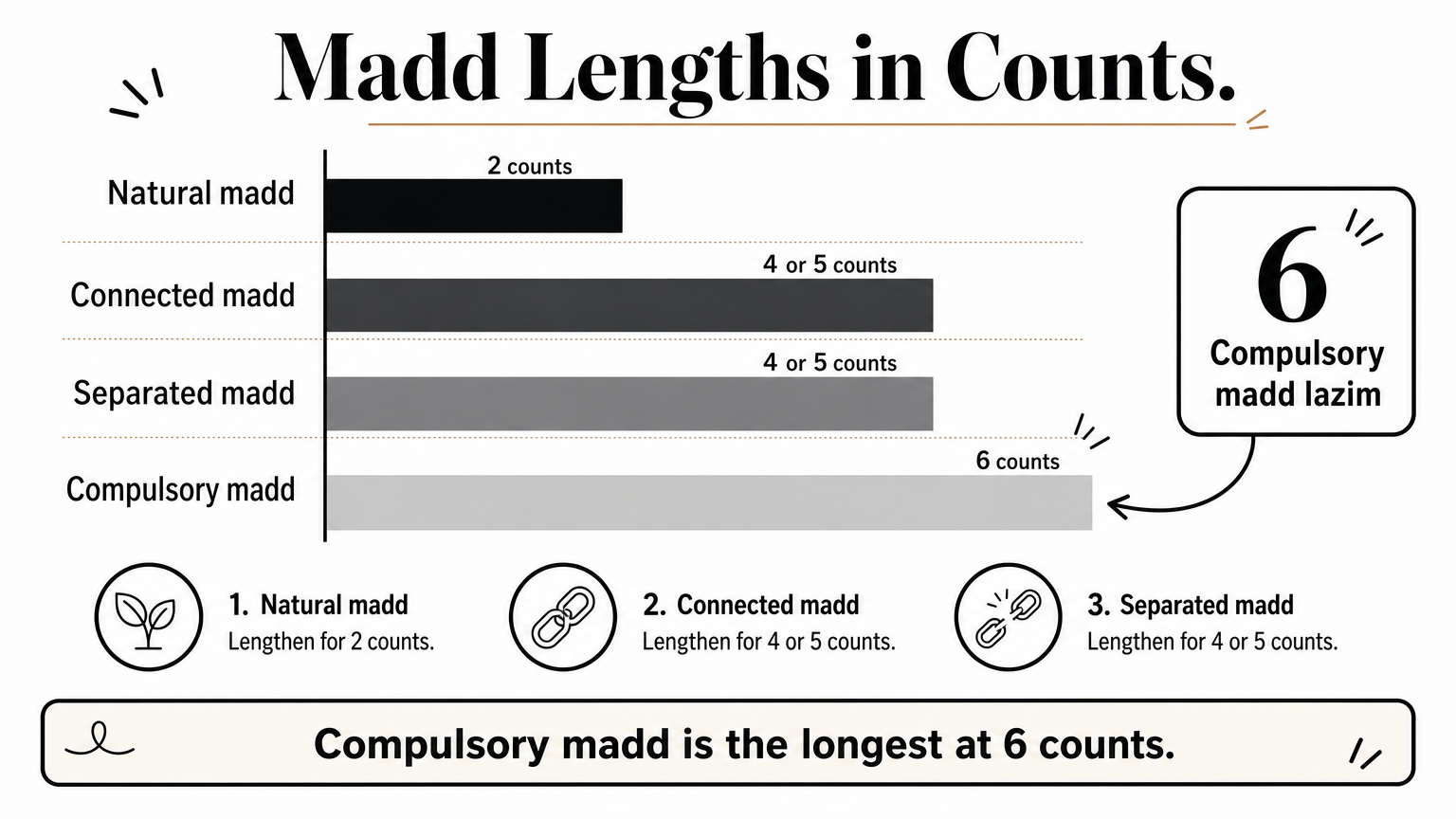
Madd is the stretching of a vowel sound, and its length is measured in counts: 2, 4, 5 or 6 depending on what follows the madd letter. Madd letters are an alif after a fatha, a waw with sukoon after a damma, and a ya with sukoon after a kasra.
How the rule works
Two questions decide the length: what follows the madd letter, and are you stopping?
| Type | Trigger | Counts | Example |
|---|---|---|---|
| Madd asli (natural) | No hamza or sukoon after | 2 | قَالَ, يَقُولُ, قِيلَ |
| Madd muttasil (connected) | Hamza in the same word | 4 or 5 | جَاءَ |
| Madd munfasil (separated) | Madd letter ends a word, hamza starts the next | 4 or 5 | إِنَّا أَعْطَيْنَاكَ |
| Madd lazim (compulsory) | Permanent sukoon or shaddah after | 6 | الضَّالِّينَ |
| Madd arid lis-sukoon | Madd letter before the last letter, when you stop | 2, 4 or 6 | الرَّحِيمِ |
Teachers vary slightly on munfasil, so follow your teacher’s choice and stay consistent.
Keep every madd of the same type the same length throughout a recitation.
Examples to recite
- Natural: قَالَ (qaala), held for 2 counts
- Connected: جَاءَ, held for 4 or 5 counts, and never shorter
- Compulsory: الضَّالِّينَ (1:7), held for 6 counts
- Stopping on الرَّحِيمِ, where you may choose 2, 4 or 6
Common mistake
Beginners stretch natural madd to four counts because it sounds beautiful, then rush the compulsory madd where six counts are required. Both break the pattern the rules exist to protect.
Tap the counts on your knee at an even pace while you recite. Start with a fixed set of verses, such as Surah Al-Fatiha, and keep the beat steady from the first madd to the last.
6. Qalqalah: the echo on five letters
Qalqalah is a slight echo or bounce on five letters when they carry sukoon, and the letters are ق ط ب ج د, remembered as قُطْبُ جَدٍّ. The echo is a release of the letter, not an added vowel.

How the rule works
The echo grows with how firmly you stop. Teachers describe two or three levels, but the practical rule is simple: the more you stop, the bigger the echo.
| Level | When it happens | Strength | Example |
|---|---|---|---|
| Minor | The letter has sukoon inside a verse and you keep reading | Light | قَدْ أَفْلَحَ (23:1) |
| Major | You stop on the letter, so it becomes sakin | Stronger | الْفَلَقِ (113:1), أَحَدٌ (112:1) |
| Strongest | You stop on the letter and it carries a shaddah | Strongest | تَبَّ (111:1) |
The firmer the stop on a qalqalah letter, the bigger the echo.
Examples to recite
- Minor: قَدْ أَفْلَحَ, with a light bounce on the د
- Major: stopping on الْفَلَقِ, with a clear bounce on the ق
- Strongest: stopping on وَتَبَّ at the end of 111:1, with the biggest echo
Common mistake
The most common error is adding a vowel after the letter, so the echo becomes "buh" or "dah". A good echo has no vowel. It is a quick release of the sound.
Say قَدْ and let the tongue spring away from the palate without pushing air into a vowel. Then say it again at the end of a verse with a longer pause and notice the bigger bounce.
7. Tafkheem and tarqeeq: heavy and light letters
Tafkheem is a heavy, full-mouth pronunciation and tarqeeq is a light, thin one. Seven letters are always heavy, while ر and the ل in the word Allah change with context.
How the rule works
The tongue raises toward the roof of the mouth for heavy letters and stays low and forward for light ones. The seven always-heavy letters are خ ص ض غ ط ق ظ, remembered as خُصَّ ضَغْطٍ قِظْ.
| Case | Heavy | Light |
|---|---|---|
| Always-heavy letters | خ ص ض غ ط ق ظ, with any vowel | None |
| The letter ر | After fatha or damma: رَبِّ | After kasra: رِزْقًا |
| The ل in Allah | After fatha or damma: رَسُولُ اللَّهِ, قَالَ اللَّهُ | After kasra: بِسْمِ اللَّهِ |
All other letters are light. The ر has further cases when it carries sukoon, which are best learned with a teacher.
Seven letters are always heavy, and ر and the ل in Allah depend on the vowel before them.
Examples to recite
- Heavy: خَلَقَ (96:1), الصَّلَاةَ, قُلْ
- Light: سَلَامٌ, زَكَاةٍ
- Heavy ر and light ر: رَبِّ against رِزْقًا
- Light ل in بِسْمِ اللَّهِ against heavy ل in رَسُولُ اللَّهِ
Common mistake
Non-Arabic speakers usually thin out the heavy letters, so ص sounds like س and ق like a plain "k". Many also make the ل in بِسْمِ اللَّهِ heavy, because they know the rule for other forms of the word.
For each pair, record yourself and listen for fullness. A heavy letter should sound as if it fills the mouth, while a light one stays thin and bright.
8. Waqf and ibtida: stopping and starting
Waqf is a brief stop with a breath, and ibtida is the restart. Both exist to keep the meaning intact: you stop where the sense is complete and restart where it is clear. The Madani mushaf marks these places with small signs above the text.
How the rule works
Each sign tells you what the stop means.
| Sign | Meaning | What you do |
|---|---|---|
| مـ | Necessary stop | Stop here |
| لا | Do not stop | Continue |
| ج | Either is allowed | Stop or continue |
| قلى | Stopping is better | Stop if you need a breath |
| صلى | Continuing is better | Continue if you can |
When you stop, the final vowel falls away and the letter takes sukoon. A tanween fatha becomes a long alif (عَلِيمًا is read as aleemaa), and a ة becomes ه (رَحْمَةٌ is read as rahmah).
Stop where the meaning is complete, and restart where it makes sense.
Examples to recite
- Stopping at الرَّحِيمِ at the end of verse 1:3, then restarting at مَالِكِ
- عَلِيمًا, with the stop turning the tanween into a long alif
- رَحْمَةٌ, with the stop turning the ة into ه
Common mistake
Readers often run out of breath and stop in the middle of a phrase, which can separate a word from the one it depends on. Restarting on a word that cannot stand alone makes it worse.
Plan your breaths before you recite. Mark the stop signs in your mushaf, check the verse ends, and practice a surah in long stretches so you stop only at signs and verse ends.
Where to go after the chart
Tajweed comes down to eight groups: where letters start, what noon and meem do, how long vowels stretch, when letters echo, which ones are heavy, and where you stop. Learn them one at a time and recite a short surah for each. The chart tells you what to do, and your ears and a teacher confirm you are doing it.
If you want someone to listen to your recitation and point out what to fix, book a free tajweed assessment class. You will recite live with a teacher one to one, and no previous knowledge is needed. Afterward, they will recommend a path that fits your level.