
Tajweed rules of the Quran are the pronunciation rules that tell you where each Arabic letter is formed, how it should sound, and how sounds change or lengthen when letters meet. The word tajweed comes from an Arabic root meaning "to make better." Applied to the Quran, it means giving every letter its due so that you recite the way the text was taught and passed down. The rules fall into three groups: articulation points, letter characteristics, and rules for letters in combination, such as merging, hiding, echoing, lengthening, and stopping.
This guide gives you the whole beginner picture in one place. You will see why the rules matter and whether they are required, how to learn them in a sensible order, and what each core rule does, with Arabic examples from the Quran. We finish with a short surah worked through rule by rule, so you can see how everything fits into a real recitation.
At Quranytime Academy, our teachers are Al-Azhar graduates with Ijazah, and they teach these same rules in live, one-to-one lessons. Use this article as a map, and use a teacher to check your ear.
Why the tajweed rules matter when you recite the Quran
The rules matter because they keep the words accurate, because the Quran itself asks for measured recitation, and because the Prophet (peace be upon him) described a great reward for the person who works at it. Each reason is practical, so here they are one at a time.

Tajweed protects the sound and the meaning
Allah says, "and recite the Quran with measured recitation" (73:4). Arabic has letters that sound alike to a new learner, and swapping them can produce a different word. The letters ع (ayn) and ء (hamza) are a classic pair: عَلِمَ means "he knew," while أَلِمَ means "he felt pain."
Vowels carry meaning too. In Al-Fatihah (1:7), أَنْعَمْتَ means "You bestowed." Changing the last vowel to أَنْعَمْتُ would mean "I bestowed." Tajweed gives you the tools to avoid slips like these: where letters come from, how long to hold a sound, and where to pause.
Is tajweed mandatory?
Scholars divide recitation errors into two kinds. Clear mistakes change a letter, a vowel, or the meaning, as in the أَنْعَمْتَ example above. Most scholars hold that avoiding these is required. Subtle mistakes are lapses in refinement, such as a rushed ghunnah or a shortened madd. Views on these vary, and many scholars treat careful tajweed as strongly recommended and as the proper way to recite.
For your own situation, ask a qualified teacher or scholar. As a learner, the practical order is simple: remove the clear errors first, then refine.
Tajweed is the discipline that keeps every letter, vowel, and pause true to how the Quran was taught.
The reward for reciting well, and for trying
A hadith reported by A’ishah in Sahih al-Bukhari and Sahih Muslim says that the one who is skilled in reciting the Quran will be with the noble and obedient angels. The one who recites while struggling and stumbling will have a double reward.
This matters most if you are a beginner. Your effort is seen even while your recitation is imperfect, so a halting start is no reason to wait.
How to learn and apply tajweed rules as a beginner
Learn the rules in a fixed order, one at a time, and practice each on short surahs while a teacher or trusted reciter checks your sound. Reading the Quran with tajweed rules is a skill of the mouth and the ear, so a list of definitions will not get you there alone.
Learn the basic rules of tajweed in this order
This sequence builds each rule on the one before it. The later rules assume you already hear the earlier ones.
- Letters and their sounds. Learn the Arabic letters, the three short vowels, sukoon, shaddah, and the articulation points, including heavy and light letters.
- Noon sakinah and tanween. These appear in almost every line, so they pay back fastest.
- Meem sakinah and ghunnah. These reuse the logic of step 2 with fewer letters.
- Madd. Learn to lengthen the long vowels by the right count.
- Qalqalah. Learn the light echo on five letters.
- Stopping and starting. Learn the waqf signs and how to end a breath without changing meaning.
Give each step a week or two of daily practice, even if it is only 15 minutes. There is no deadline, and moving on too early is the most common reason rules fall apart later.
Why a teacher matters more than a book
You cannot hear your own mistakes well. A teacher hears that your ghunnah is too short or your ق sounds like a ك, and corrects it on the spot. Recitation is also an oral tradition, which is why a qualified teacher usually holds an Ijazah, a license that traces their recitation back through a chain of teachers.
At Quranytime, lessons are live and one-to-one, and no previous knowledge is needed to start. A free assessment class lets a teacher listen to your level and recommend where to begin.
You cannot hear your own mistakes well, so the fastest way to improve is to let a qualified ear listen to you.
A daily practice routine
Follow this home practice loop for each rule you study:
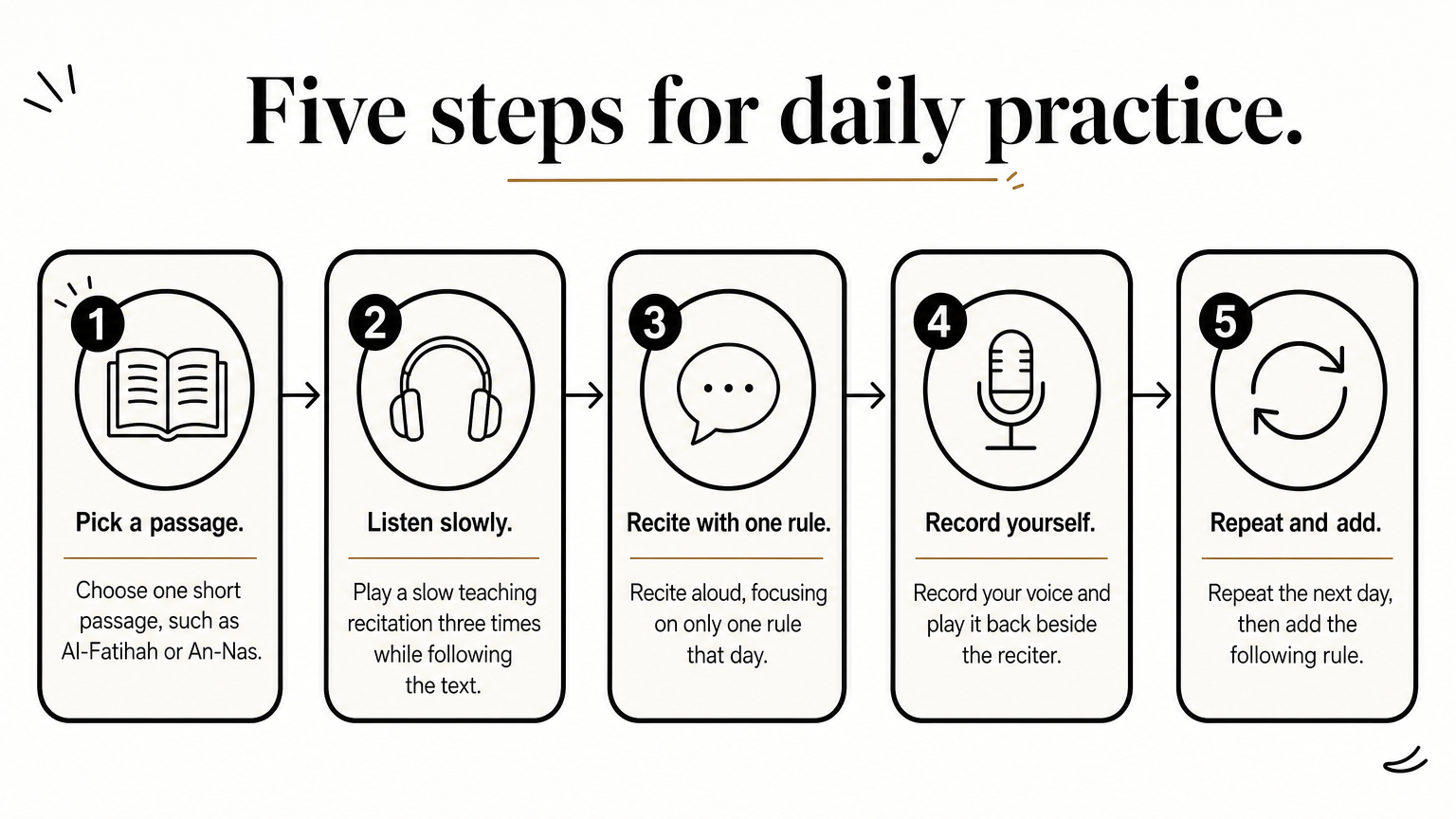
- Pick one short passage, such as Al-Fatihah or Surah An-Nas.
- Listen to a slow teaching recitation, such as Mahmoud Khalil Al-Husary’s, three times while you follow the text.
- Recite aloud and focus on only one rule that day, for example madd.
- Record yourself and play it back next to the reciter.
- Repeat the next day, then add the following rule.
A color-coded tajweed mushaf can help you spot rules while you build recognition. Plan to move to a plain mushaf once the colors stop teaching you anything new.
Beginner mistakes to catch early
Most early errors come from the same few habits:
- Rushing, which flattens madd and ghunnah.
- Stretching every long vowel the same length, whatever the rule.
- Adding ghunnah where the rule does not call for it.
- Pronouncing heavy letters like ص and ط with a light, thin sound.
- Ignoring stop signs and breathing wherever you run out of air.
- Learning only from videos, with nobody listening to you.
What the tajweed rules cover: a map of the basics
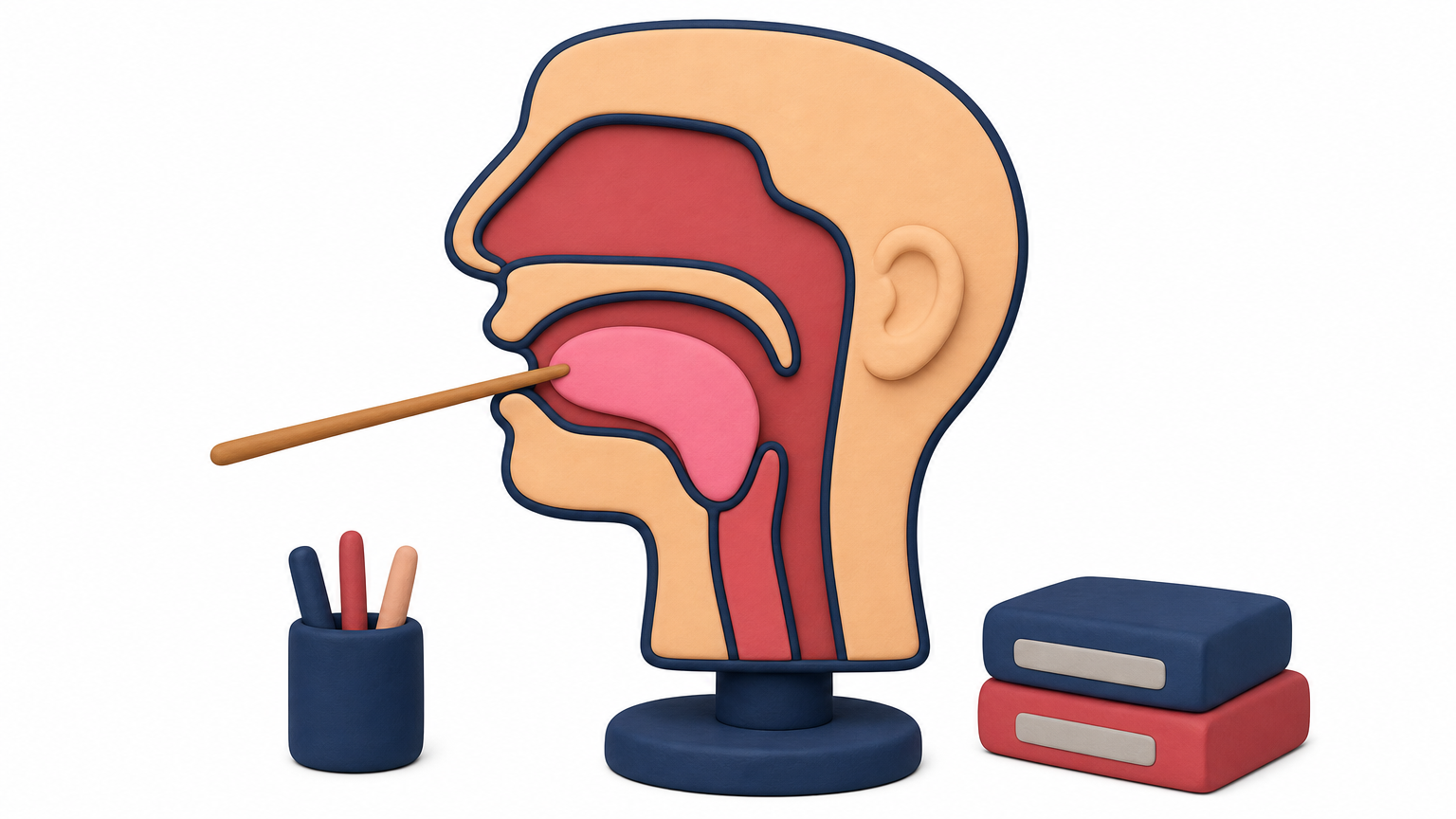
The tajweed rules fall into three types: where letters are formed, how they sound, and what happens when they meet. Knowing this map answers the question "what are the tajweed rules?" before you meet any single rule.
The three types of tajweed rules
| Type | What it covers | Example |
|---|---|---|
| Articulation points (makharij) | Where each letter is formed: throat, tongue, lips, nasal passage, open space of the mouth | Telling ع from ء, or ق from ك |
| Characteristics (sifat) | How a letter sounds: heavy or light, echoing, nasal | Heavy ط, light ت, echo on ب |
| Rules in combination (ahkam) | What happens when letters meet: noon and meem rules, madd, qalqalah, stopping | Idghaam, ikhfaa, madd |
The rules in this guide follow the Hafs ‘an Asim reading, the narration most widely read today. Other recitation traditions differ in some details, which is one more reason to follow a teacher.
Where letters come from and how they sound
The letters come from five areas: the throat, the tongue, the lips, the nasal passage, and the open space of the mouth and throat. Together they hold 17 articulation points. The throat has three levels and six letters: ء ه ع ح غ خ. The nasal passage produces ghunnah, and the open space is where the long vowels of madd live. The tongue holds most of the remaining letters, which is why the tongue is the hardest area to master.
Characteristics add a second layer. Seven letters are heavy, pronounced with the back of the tongue raised: خ ص ض غ ط ق ظ. The usual memory aid is خُصَّ ضَغْطٍ قِظْ.
Two letters switch between heavy and light. The letter ر is heavy with a fatha or damma and light with a kasra. The lam in the name of Allah is heavy after a fatha or damma, as in رَسُولُ اللَّهِ, and light after a kasra, as in بِسْمِ اللَّهِ.
Every later rule depends on first knowing where a letter is formed and whether it is heavy or light.
Noon sakinah, tanween, and meem sakinah rules
These rules decide what happens when a noon or meem with no vowel meets the next letter. They come up constantly, so they are the heart of any basic list of tajweed rules.
What noon sakinah, tanween, and ghunnah mean
A noon sakinah is the letter ن carrying a sukoon (نْ). Tanween is the doubled vowel at the end of a noun (ـً ـٍ ـٌ), which adds a noon sound. Ghunnah is the nasal sound produced in the nose, held for about two counts. One count is roughly the time it takes to fold one finger.
The four rules of noon sakinah and tanween
What you do depends on the letter that follows. The 28 letters split into 6, 4, 2, 1, and 15, so you only need to memorize the small groups.
| Rule | Letters that follow | What you do | Example |
|---|---|---|---|
| Izhaar (clear) | ء ه ع ح غ خ | Say the noon clearly, no ghunnah | مِنْ عِنْدِ اللَّهِ |
| Idghaam with ghunnah (merge) | ي ن م و | Merge into the next letter with ghunnah | مَن يَعْمَلْ (99:7) |
| Idghaam without ghunnah | ل ر | Merge fully, no ghunnah | هُدًى مِّن رَّبِّهِمْ (2:5) |
| Iqlaab (convert) | ب | Noon becomes a meem sound with ghunnah, then the ب | سَمِيعًا بَصِيرًا (4:58) |
| Ikhfaa (hide) | The other 15 letters: ت ث ج د ذ ز س ش ص ض ط ظ ف ق ك | Hide the noon with ghunnah, tongue in position for the next letter | مِن شَرِّ مَا خَلَقَ (113:2) |
One exception trips up beginners. When the noon and the idghaam letter sit in the same word, as in الدُّنْيَا, بُنْيَانٌ, صِنْوَانٌ, and قِنْوَانٌ, you pronounce the noon clearly and do not merge. Only a noon at the end of one word meeting a letter at the start of the next merges.
Memorize the small groups, six for izhaar, four for idghaam with ghunnah, two for idghaam without, and one for iqlaab, and the fifteen ikhfaa letters follow automatically.
Noon and meem with shaddah
When ن or م carries a shaddah, hold a full ghunnah of about two counts. Examples include إِنَّ and ثُمَّ. The ghunnah stays even if you stop on the letter. Lengthen the nasal sound, not the letter’s vowel.
The three rules of meem sakinah
A meem with sukoon has three rules, set by the letter that follows:
| Rule | Letter that follows | What you do | Example |
|---|---|---|---|
| Ikhfaa shafawi | ب | Hide the meem lightly with ghunnah | رَبَّهُم بِهِمْ (100:11) |
| Idghaam shafawi | م | Merge the two meems with ghunnah | أَطْعَمَهُم مِّن جُوعٍ (106:4) |
| Izhaar shafawi | The other 26 letters | Say the meem clearly, no ghunnah | أَلَمْ تَرَ (105:1) |
Take extra care with izhaar when the next letter is و or ف. Beginners tend to blur the meem into them, and the rule asks you to keep your lips closed on the meem before moving on.
Madd, qalqalah, and stopping rules with examples
Madd controls how long you hold a sound, qalqalah adds a light echo, and the stopping rules decide where a breath can safely end. These rules give recitation its rhythm, and with the rules above they make up the core of tajweed for a beginner.
Madd: how long to hold a long vowel
The madd letters are alif after a fatha, waw with sukoon after a damma, and ya with sukoon after a kasra. A madd letter is held for two counts by default, and some conditions make it longer.
| Type | Trigger | Counts | Example |
|---|---|---|---|
| Natural (tabii) | Madd letter with no hamza or sukoon after it | 2 | قَالَ، يَقُولُ، قِيلَ |
| Connected (muttasil) | Madd letter then hamza in the same word | 4 or 5 | جَاءَ (110:1) |
| Separated (munfasil) | Word ends with madd letter, next word starts with hamza | 4 or 5 | يَا أَيُّهَا |
| Temporary (aarid) | Madd letter before the last letter, when you stop | 2, 4, or 6 | الْعَالَمِينَ |
| Necessary (lazim) | Madd letter then a permanent sukoon or shaddah | 6 | الضَّالِّينَ (1:7) |
| Leen | Waw or ya with sukoon after a fatha, when you stop | 2, 4, or 6 | خَوْفٍ، قُرَيْشٍ |
Some teachers allow slightly different lengths for the 4 or 5 count rules, so follow the count your teacher uses and stay consistent.
Two counts is the default, and only a hamza or a permanent sukoon or shaddah after the madd letter makes it longer.
Qalqalah: the light echo
Qalqalah applies to five letters, ق ط ب ج د, when they carry a sukoon. The memory aid is قُطْبُ جَدٍّ. You release a slight bounce of sound, without adding a vowel. In the middle of a word the echo is light, as in اقْرَأْ (96:1) and يَجْعَلُ. When you stop on a qalqalah letter, as on أَحَدٌ at the end of Surah Al-Ikhlas verse 1, the echo is stronger.
Stopping and starting signs
Stopping rules protect the meaning. Stopping in the wrong place can make a sentence say something it does not. These are the signs you will meet most:
| Sign | Meaning | What you do |
|---|---|---|
| مـ | Compulsory stop | Stop here |
| لا | Do not stop | Continue |
| ج | Permissible stop | Stop or continue, both are correct |
| قلى | Stopping is preferred | Stop if you can |
| صلى | Continuing is preferred | Continue if you can |
| ∴ ∴ | Embracing stop | Stop at one of the pair, not both |
When you stop on a word, its last vowel usually becomes a sukoon. A tanween fatha becomes an alif sound, as in أَفْوَاجًا.
Putting the rules together in Surah Al-Falaq
Here are the first three verses, worked through rule by rule.
- 113:1, قُلْ أَعُوذُ بِرَبِّ الْفَلَقِ. In أَعُوذُ you hold a natural madd for 2 counts. If you stop on الْفَلَقِ, the ق is heavy and takes a qalqalah echo.
- 113:2, مِن شَرِّ مَا خَلَقَ. The noon of مِنْ meets ش, so you apply ikhfaa. The ما is a natural madd of 2 counts. Stopping on خَلَقَ gives qalqalah again.
- 113:3, وَمِن شَرِّ غَاسِقٍ إِذَا وَقَبَ. The ikhfaa repeats on مِن شَرِّ. The tanween of غَاسِقٍ meets the hamza of إِذَا, so you apply izhaar. Stopping on وَقَبَ gives qalqalah on ب.
Three short verses already use five rules. That is why daily practice on short surahs works better than trying to cover long passages quickly.
Where to go from here
The tajweed rules of the Quran come down to three questions. Where does this letter come from? What happens when it meets the next one? How long do I hold it, and where do I stop? Learn them in order, practice on short surahs, and record yourself. Remove the clear mistakes first, then refine.
You do not need to master every detail alone. If you want a teacher to listen to your recitation and point you to the right starting rule, book a free assessment class with Quranytime Academy.