

Imagine hearing “The cup filled” and then asking, “With what?” Or “This route is greater” and asking, “Greater in what respect?” Arabic often answers that missing-information question with a noun called tamyiz (تَمْيِيز). Instead of naming another participant, it specifies a quantity, substance, or respect in which a statement is true.
This lesson is a practical investigation of that clarifying job. It concentrates on measurements and whole-sentence meaning, rather than repeating a complete number chart. You will build information cards, compare alternative constructions, and explain why two words with the same ending can do different jobs. Composed classroom examples are identified throughout. Read the Quran examples in their full verses when studying their meaning.
The missing-information experiment
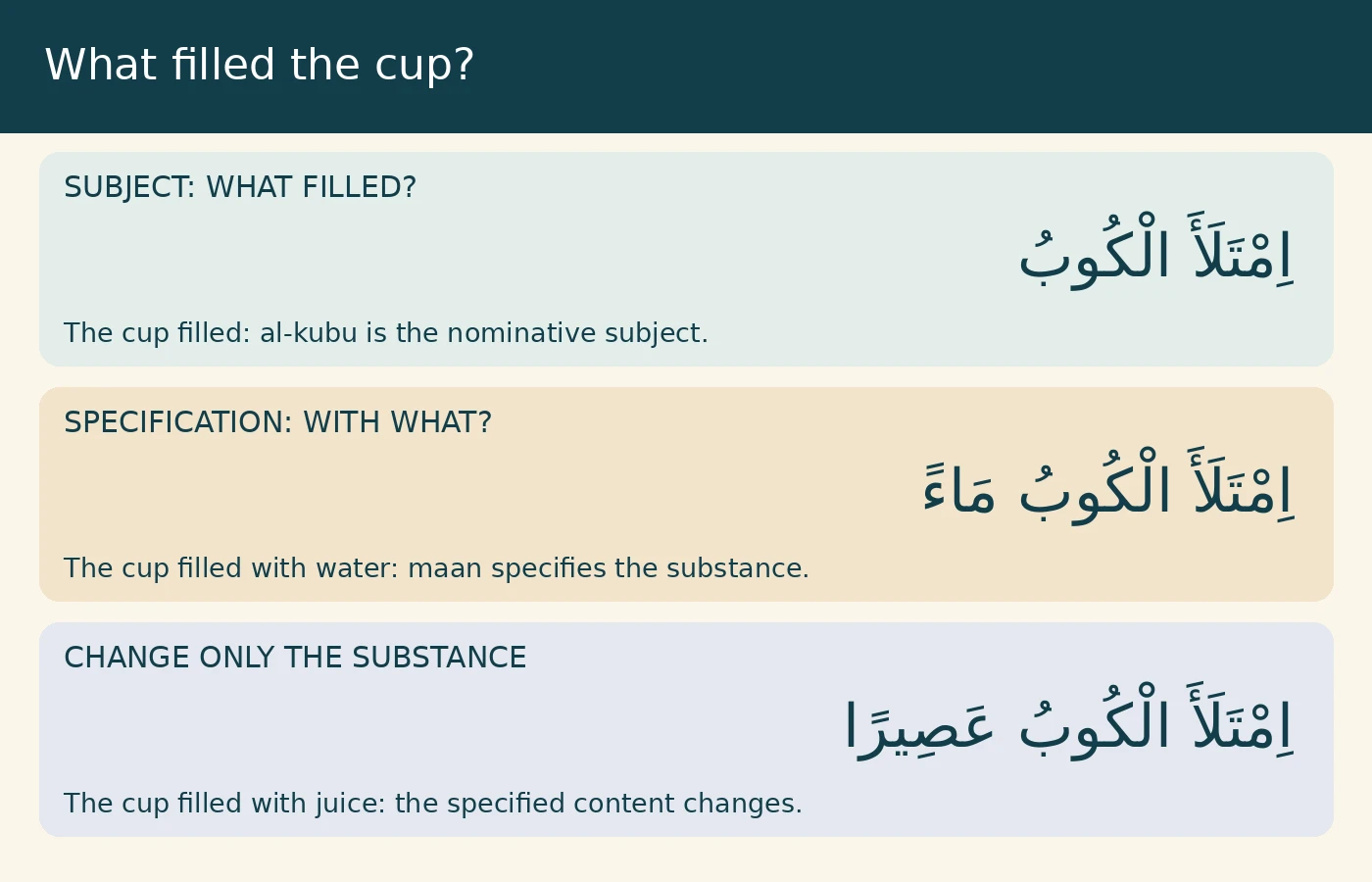
Begin with the composed sentence اِمْتَلَأَ الْكُوبُ مَاءً — “The cup filled with water.” الْكُوبُ is the subject: the cup is what filled. مَاءً specifies the substance involved. The sentence does not mean that water was a direct object being acted upon by an agent called “the cup.” Calling every final accusative noun an object would hide the relationship.
Now cover مَاءً. You still have a grammatical statement, but less information about its content. Uncover the noun and ask what ambiguity it resolves. You can replace it with عَصِيرًا in the composed اِمْتَلَأَ الْكُوبُ عَصِيرًا — “The cup filled with juice.” The event and subject remain, while the specified substance changes.
That is a stronger learning exercise than merely circling tanwin. In ordinary regular singular examples, an indefinite accusative noun may end in -an, but the ending alone does not establish tamyiz. Direct objects, circumstances, and other constructions may have that ending too. Use the Arabic case-ending guide to separate grammatical case from the particular role a noun performs.
Two places where clarification is needed
A quantity or measure needs a name
In a composed measurement example, شَرِبْتُ كُوبًا مَاءً means “I drank a cupful of water.” كُوبًا provides a measure, and مَاءً tells us what is measured. This is different from saying that you drank the physical cup. A contextually understood measure can be followed by a specification of its contents. Formal grammar calls this family tamyiz al-dhat or tamyiz al-mufrad.
Numbers also create this need: “twenty” leaves the counted category unstated until a noun supplies it. But number constructions have their own case and agreement patterns. Do not generalize one number example to every number. Use Arabic numbers and counting for that separate task. Here the central question is what the specifying noun adds, whether the head is a number or a measure.
The relationship of a whole statement needs clarification
In اِزْدَادَ الْمُعَلِّمُ خِبْرَةً — “The teacher increased in experience” — there is no measuring-container noun immediately before خِبْرَةً. Instead, the final noun explains the respect in which an increase occurred. This is a composed example of tamyiz al-nisbah, specification of a relationship or sentence.
Write the incomplete English thought “The teacher increased in ___.” Experience fills the semantic gap without becoming a second person in the story. The same observation helps when translating: an English preposition such as “in” or “with” can express the Arabic relationship naturally, even though the Arabic noun does not have a written preposition before it.
Do not confuse a state with a respect
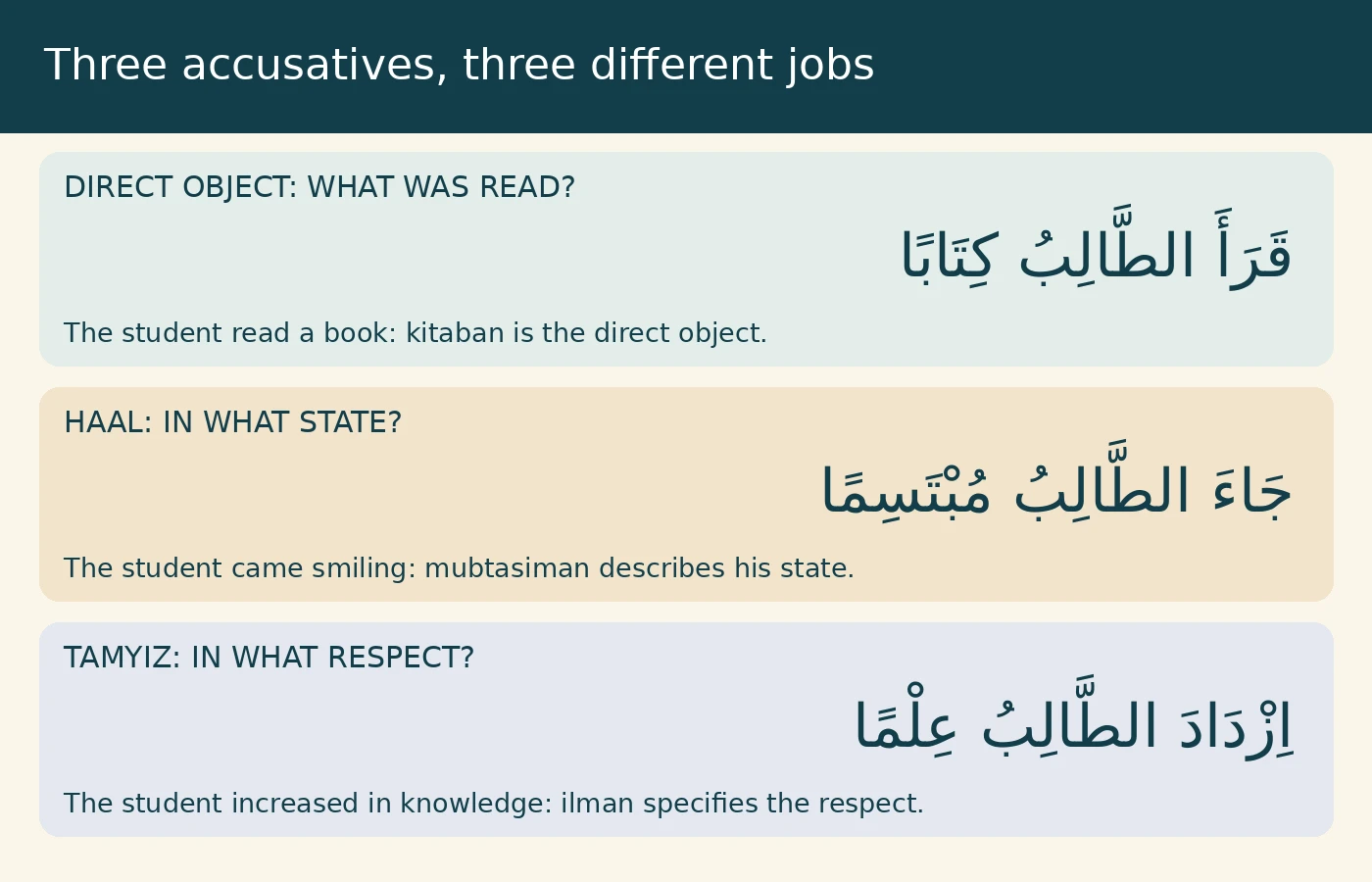
Compare the composed جَاءَ الطَّالِبُ مُبْتَسِمًا, “The student came smiling,” with اِزْدَادَ الطَّالِبُ عِلْمًا, “The student increased in knowledge.” مُبْتَسِمًا describes the student’s state during arrival. عِلْمًا specifies what increased. Both are indefinite accusative expressions, but they answer different questions.
For the first, ask “In what state did the student come?” For the second, ask “In what respect did the student increase?” These questions are diagnostic prompts, not universal definitions that settle every difficult sentence. Read the verb’s meaning and the relationship of the noun to the whole clause. Our lesson on time, place and manner expressions introduces the neighboring role called haal.
Try a third comparison: قَرَأَ الطَّالِبُ كِتَابًا — “The student read a book.” كِتَابًا is what was read: a direct object. It does not specify the substance of filling, the amount of a measure, or the respect of an increase. The guide to subjects and objects in Arabic helps establish that distinction.
Three ways to express a cupful of water
Compare these composed formal-Arabic phrases: كُوبًا مَاءً, كُوبَ مَاءٍ, and كُوبًا مِنَ الْمَاءِ. In a suitable sentence, each can communicate a quantity of water, but their internal constructions differ. The first uses an accusative specifying noun; the second is idafa; the third explicitly introduces a preposition.
In شَرِبْتُ كُوبَ مَاءٍ, “I drank a cupful of water,” كُوبَ is the first member of the construct phrase and has no tanwin. مَاءٍ is genitive as its dependent. In شَرِبْتُ كُوبًا مِنَ الْمَاءِ, مِن introduces the following genitive noun. The larger message is similar, but you should not give all three phrases an identical word-by-word parse.
Practise explaining the differences without assuming that one construction is always preferable. The guide to idafa covers the construct relationship, while the lesson on Arabic prepositions explains governed genitive phrases. When editing formal prose, choose a construction that you can form accurately and that fits the register and context.
This comparison also prevents a pronunciation mistake. If you retain tanwin on the head of an idafa while using its genitive dependent, you have mixed two patterns. Read each complete phrase rather than swapping individual endings at random. The grammatical construction determines which endings belong together.
A comparison can leave its dimension unstated
Read the composed sentence هَذَا الطَّرِيقُ أَكْثَرُ طُولًا — “This route is greater in length.” طُولًا supplies the dimension being compared. Without it, “greater” could leave a reader asking what kind of greatness is intended. A specifying noun can narrow an otherwise broad comparison.
This is a grammar exercise, not a claim that this expanded expression is always the most natural everyday choice. Arabic can also express the idea more directly using أَطْوَلُ, “longer.” Comparing the two helps you see that grammatical analysis and stylistic preference are different questions. A sentence can illustrate a valid relationship while another wording better suits a conversation.
For a more natural classroom comparison, خَالِدٌ أَكْثَرُ مِنِّي خِبْرَةً means “Khalid is more experienced than I am.” خِبْرَةً states the respect of the comparison. Do not translate أَكْثَرُ alone and discard the following noun: that noun carries the information that makes the comparison useful.
Quran reading: specify the word, then keep the context
Quran 69:32 includes سَبْعُونَ ذِرَاعًا. The Quranic Arabic Corpus specification documentation illustrates the dependency between the number and ذِرَاعًا, the unit “cubits.” This is a focused example of a specifying noun identifying what the number measures. It does not require turning the verse into a general-purpose counting exercise; read the whole verse and its surrounding passage.
A different kind of example appears in Quran 19:4: وَاشْتَعَلَ الرَّأْسُ شَيْبًا. The wording presents the head as having flared with grayness. شَيْبًا specifies the respect or content of the vivid expression, rather than naming an ordinary object of burning. Minia University’s Arabic grammar teaching material discusses this as a tamyiz example. Keep its metaphor and the supplication’s context in view; a literal English fragment cannot convey the whole passage.
When using a word-by-word resource, distinguish a morphology label from a syntactic explanation. “Accusative noun” identifies case and word class. “Tamyiz specifying a measurement” gives a relationship. A useful annotation records both. If the tool shows only morphology, do not pretend that it has supplied the full syntactic argument.
Build an information desk exercise
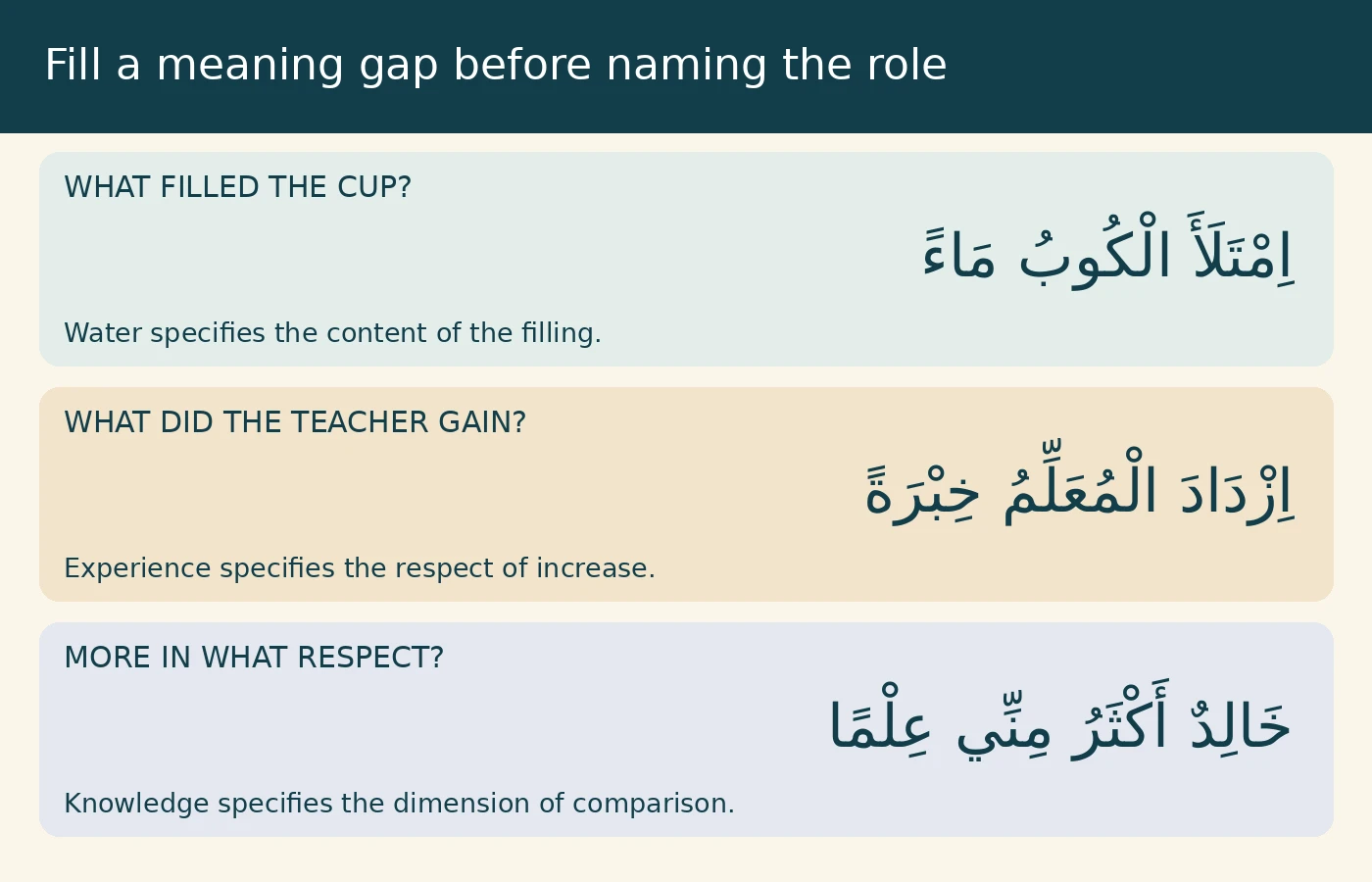
Draw three blank cards headed “container,” “change,” and “comparison.” On the container card, write اِمْتَلَأَ الْكُوبُ and leave space for the substance. On the change card, write اِزْدَادَ الْمُعَلِّمُ and leave space for the respect of increase. On the comparison card, write خَالِدٌ أَكْثَرُ مِنِّي and leave space for what is being compared.
Use مَاءً, خِبْرَةً, and عِلْمًا as a small word bank, but do not assume that every word must be used only once. Several meanings are possible in different contexts. Explain the sentence you build in ordinary English. If the meaning is implausible, reconsider your selection before spending time on the ending.
Possible answers include اِمْتَلَأَ الْكُوبُ مَاءً, اِزْدَادَ الْمُعَلِّمُ خِبْرَةً, and خَالِدٌ أَكْثَرُ مِنِّي عِلْمًا. These mean, respectively, that the cup filled with water, the teacher gained experience, and Khalid has more knowledge than the speaker. State what each final noun specifies. Do not accept “it ends in -an” as the explanation.
Correct the analysis, not just the vowel
Judge these four explanations. First: “Every accusative noun after a verb is tamyiz.” False; a direct object is one obvious counterexample. Second: “A word meaning water must always be genitive.” False; its role depends on the construction. Third: “The word after a measurement always has the same form.” False; compare the three cupful constructions above. Fourth: “English may need a preposition to express an Arabic tamyiz.” True; natural translation does not have to reproduce the Arabic syntax word for word.
For each wrong explanation, invent one short correction using an example already in the lesson. This is more revealing than replacing the word “always” with “sometimes.” You should be able to name the construction that makes the original rule fail. Keep the corrected example beside the explanation so the rule stays attached to actual language.
Change the construction without changing the substance
Use water as a constant and perform a small rewriting task. Start with اِمْتَلَأَ الْكُوبُ مَاءً. Now make water the subject of a different sentence: الْمَاءُ بَارِدٌ, “The water is cold.” Next, make it a direct object: شَرِبْتُ الْمَاءَ, “I drank the water.” Finally, place it after a preposition: فِي الْمَاءِ, “in the water.” You have kept the same substance while changing its grammatical job.
The contrast is especially helpful if your vocabulary notes contain only isolated dictionary forms. A dictionary tells you about a word’s meanings and forms, but its entry does not determine every role that word can take in a sentence. The guide to using a Quran dictionary explains how lexical investigation fits into reading. Add a phrase to the vocabulary entry so that meaning and construction stay connected.
After writing the four examples, ask someone to shuffle them. For each occurrence of water, explain which word or relationship determines its form. Do not answer in the original order from memory. If you can explain the subject and object but struggle with the specification example, return to the cup’s filling: the cup is the thing that fills, and water states the content involved.
For a final check, translate your explanation back into simple Arabic or English without using the term tamyiz. Saying “This tells us what the cup filled with” shows that you understand the contribution. The technical name can then make your explanation precise. A label is useful when it summarizes an understood relationship; it is less useful when it replaces the relationship entirely.
Bring one useful question to your next lesson
Choose a sentence that contains a clear event and one possible specifying noun. Mark the subject, then write the information that remains unclear without the final expression. Ask your teacher whether your proposed noun clarifies a quantity, an entire relationship, or something else. A question about that dependency is more useful than asking for a translation of the isolated word.
The neutral references for this lesson are the Corpus documentation above, Al Jazeera Learning Arabic’s specificative lesson, and Minia University’s teaching material on accusatives. They support the terminology and selected patterns; the card activities and composed examples here are teaching exercises. To practise identifying the relationship in your own reading, Book a Free Trial Class. Bring a sentence you can explain and a sentence where an accusative ending has misled you.