

English grammar groups words such as yesterday, here, and quickly under “adverbs.” In Quranic Arabic, the useful question is more precise: what job does this expression do in its sentence? Traditional Arabic grammar commonly describes time and place expressions as ẓarf al-zamān (ظرف الزمان) and ẓarf al-makān (ظرف المكان). A word describing the state or manner of an action is often analyzed as ḥāl (حال). This guide uses adverbial as a learner-friendly umbrella, but keeps those Arabic labels distinct.
The distinction matters when you read a verse: several different roles can have an accusative ending, and an English translation may use an adverb even when Arabic grammar names the construction differently. Read the clause first, ask what the expression contributes, and only then name its role.
Start with the sentence, not the English label
First locate the main event and its participants. Is the clause organized around a verb, or is it a nominal sentence? Recognizing that structure makes it easier to see what a nearby expression modifies. If you need a refresher, review the guides to Arabic verbal sentences and Arabic nominal sentences.
Then ask three simple questions: when? (مَتَى؟), where? (أَيْنَ؟), or how / in what state? (كَيْفَ؟). The answers help you form a hypothesis; they do not replace grammatical analysis. The site’s guide to Arabic question words can help with the first two prompts and other useful interrogatives.
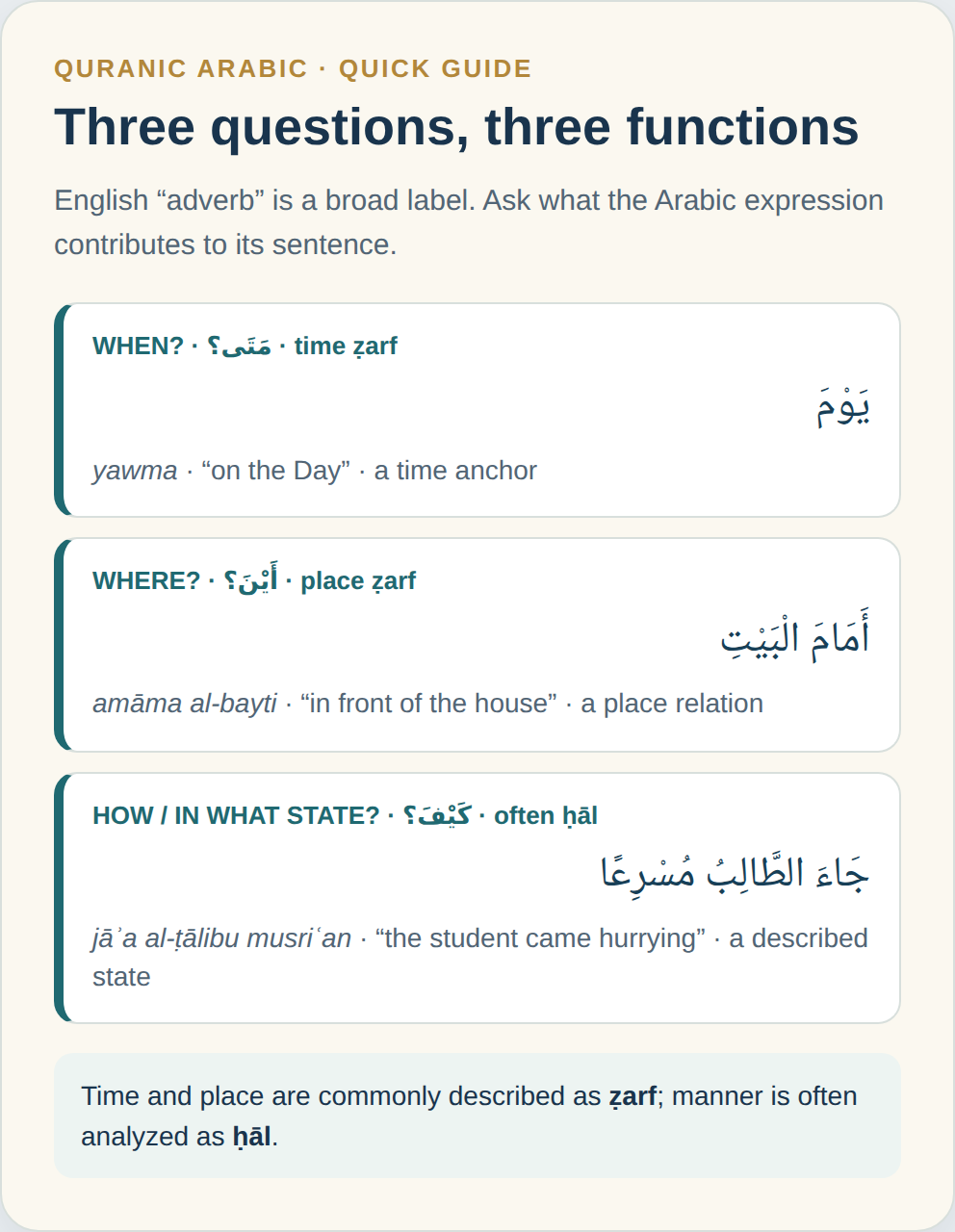
Time: ẓarf al-zamān — “when?”
A time expression can tell when an event takes place or how long it lasts. In the learner sentence قَرَأْتُ الدَّرْسَ صَبَاحًا (qaraʾtu al-darsa ṣabāḥan, “I read the lesson in the morning”), صَبَاحًا answers “when?” and functions as a time adverbial. In سَنَلْتَقِي غَدًا (san altaqī ghadan, “We will meet tomorrow”), غَدًا supplies the time.
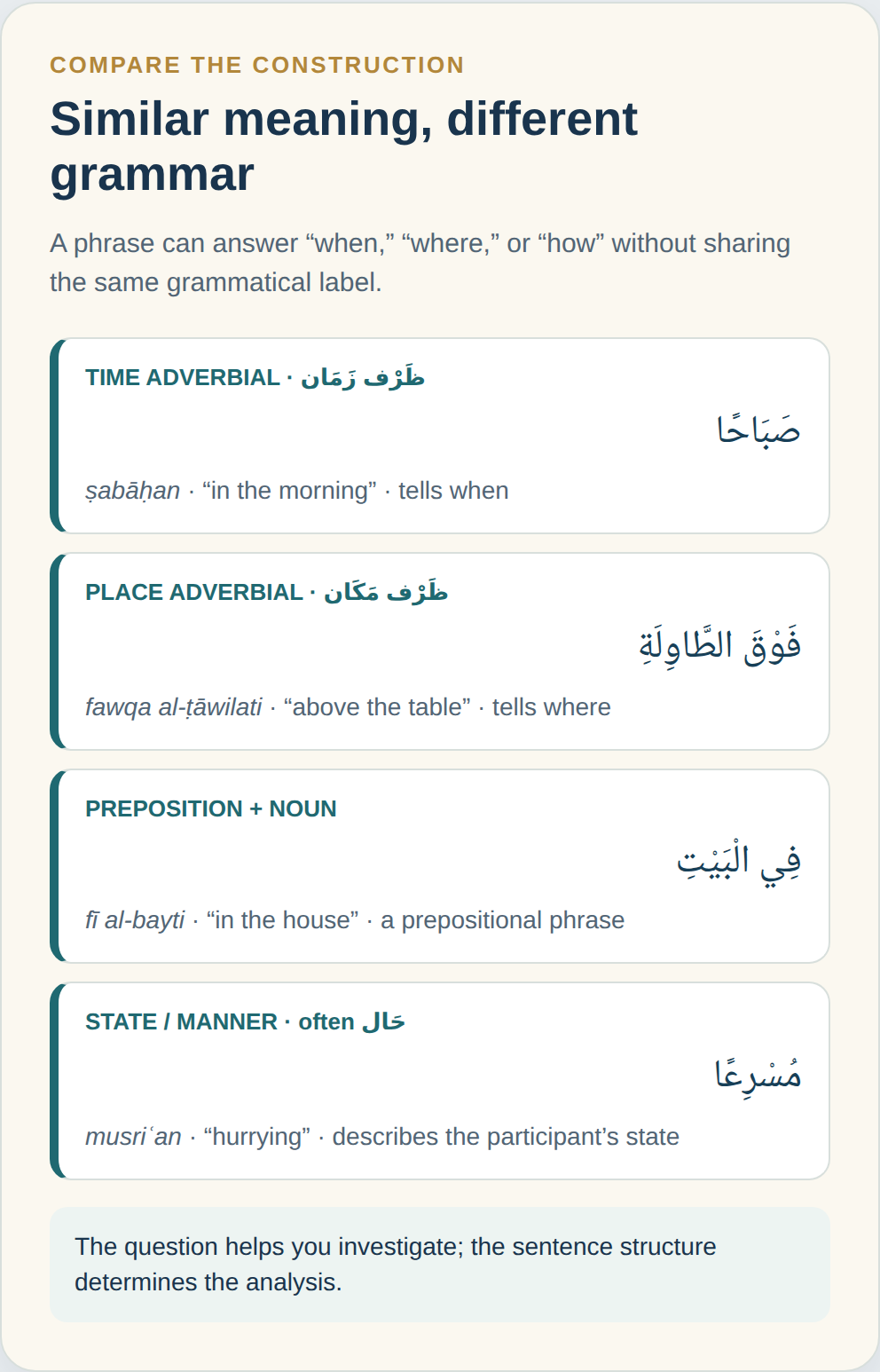
Words such as يَوْم (day), لَيْلَة (night), صَبَاح (morning), and غَد (tomorrow) may function this way, depending on the sentence. But not every time phrase is a ẓarf noun: فِي اللَّيْلِ (“during the night”) begins with the preposition فِي. Compare its structure with the examples in the guide to Arabic prepositions.
Place: ẓarf al-makān — “where?”
Place expressions locate an event, object, or person. In وَضَعْتُ الْكِتَابَ فَوْقَ الطَّاوِلَةِ (waḍaʿtu al-kitāba fawqa al-ṭāwilati, “I put the book above the table”), فَوْقَ answers “where?” and is a place adverbial; the following noun is in a genitive relationship with it. Similarly, جَلَسْتُ أَمَامَ الْبَيْتِ means “I sat in front of the house,” with أَمَامَ locating the sitting.
Now compare عَلَى الطَّاوِلَةِ (“on the table”). Here عَلَى is a preposition followed by a genitive noun. The phrase gives location, but its construction is a prepositional phrase, not the same pattern as the adverbial noun فَوْقَ. In a nominal sentence, a whole prepositional phrase can serve as the predicate, so the phrase’s role in the larger clause still matters.
Manner: when English says “quickly,” Arabic may use ḥāl
In جَاءَ الطَّالِبُ مُسْرِعًا (jāʾa al-ṭālibu musriʿan, “The student came hurrying / quickly”), مُسْرِعًا describes the student’s state while coming. Traditional grammar commonly calls this a ḥāl, not a time or place ẓarf. A ḥāl is often indefinite and accusative, but those clues are not a complete definition; interpret the word’s relationship to the rest of the sentence.
Also distinguish a ḥāl from an adjective that identifies or describes a noun. Compare the sentence’s intended meaning and agreement pattern, rather than relying on an English gloss alone. Quranytime’s lesson on Arabic adjective agreement reviews how adjectives match the nouns they describe.
Three common reading traps
Trap 1: “It is accusative, so it must be an adverb.” A direct object may also be accusative, as كِتَابًا is in “I read a book.” Determine whether the word is the thing affected by the verb, a time/place expression, or a description of someone’s state. Trap 2: “It tells where, so it is a ẓarf.” A phrase beginning with a preposition can answer “where?” too; the answer to a meaning question does not by itself identify the construction. Trap 3: “The English translation uses an adverb, so Arabic has an adverb.” Translation is a helpful bridge, but Arabic analysis may call the expression a ḥāl, a ظرف, or a prepositional phrase. Keep the Arabic role and English wording separate in your notes.
In an unvocalized text, some short vowels and case endings are not written, so learners may not see a final fatḥa on the page. That does not make analysis impossible: use word order, particles, agreement, lexical meaning, and the surrounding clause together. But if the structure remains uncertain, record more than one plausible reading and check a reliable grammar explanation rather than treating an English translation as proof.
A Quranic example: يَوْمَ in 73:14
Consider the opening of Surah al-Muzzammil 73:14: يَوْمَ تَرْجُفُ الْأَرْضُ وَالْجِبَالُ — “On the Day the earth and the mountains shake …” The word يَوْمَ (yawma, “on the Day”) supplies the time frame for what follows. The Quranic Arabic Corpus analysis of 73:14:1 identifies it as a time adverbial noun (ظَرْف زَمَان) in the accusative.
The case ending is consistent with that analysis, but it is not the whole argument. Its meaning, its connection to the event, and its position in the clause all help explain why it answers “when?” If you want to check a word’s root or lexical range, the guide to using a Quran dictionary explains how to investigate meaning without confusing a dictionary gloss with a full syntactic parse.
Listen for verse 73:14 near 1:48; the Arabic word highlighting makes the time expression easy to follow.
Why an accusative ending alone is not enough
Look at قَرَأْتُ كِتَابًا صَبَاحًا (“I read a book in the morning”). Both كِتَابًا and صَبَاحًا end with fatḥatayn, but they do different jobs: the book is what was read, while the morning tells when. Identifying the subject, verb, object, and surrounding phrases is therefore essential. The article on Arabic case endings is a useful companion, but case and function should be read together.
Likewise, a conjunction such as وَ (“and”) may connect a phrase or clause without itself being an adverbial. When a short connecting word changes how clauses relate, see the guide to Quranic Arabic conjunctions. A useful parse separates the connector, the clause, and any time, place, or state expression within it.
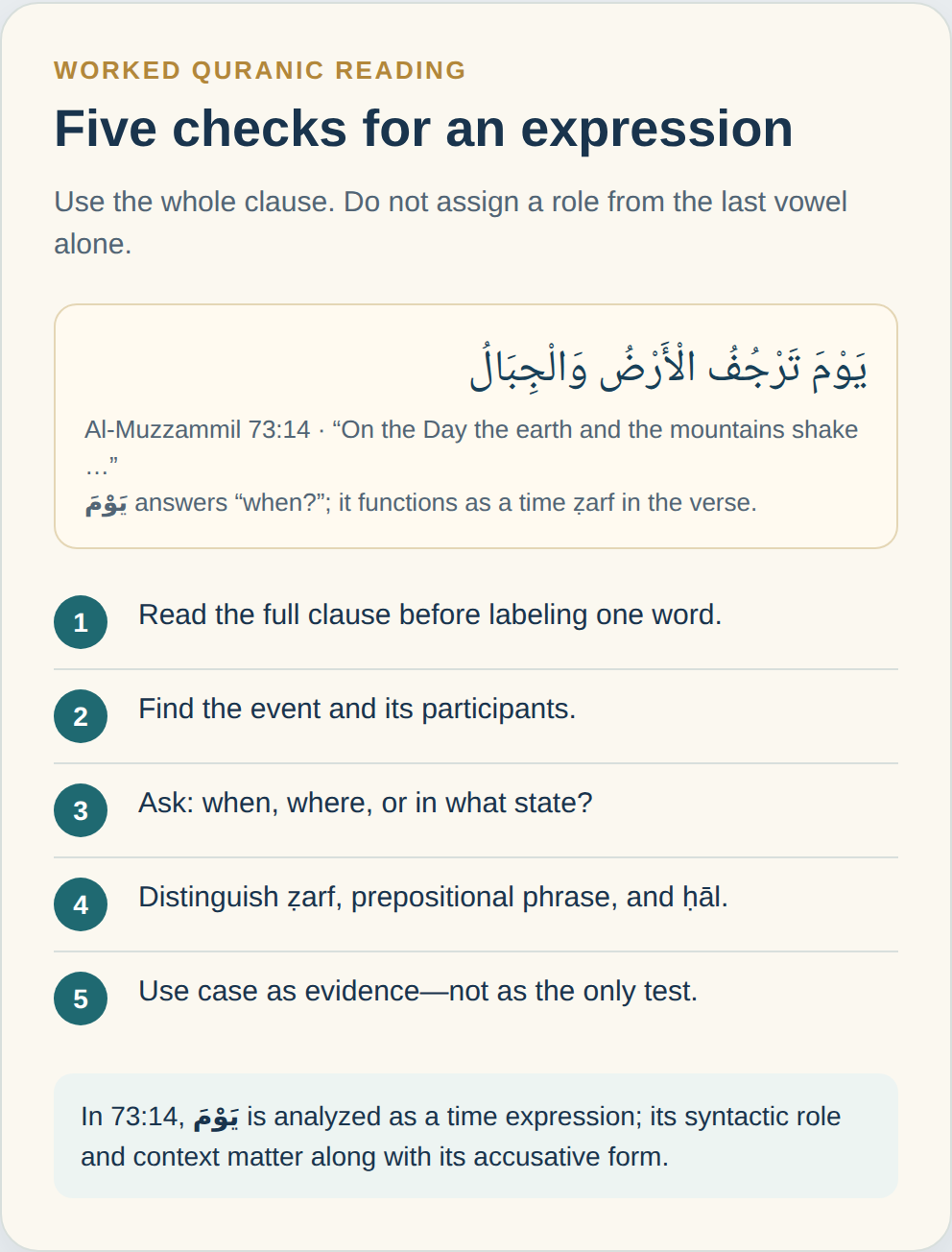
A five-step method for reading a verse
- Read the whole clause. Do not assign a role from one word in isolation.
- Find the event and its participants. Identify the verb or nominal sentence framework; the guides above can help.
- Ask the function question. Does the expression tell when, where, or the state in which someone acts?
- Check the construction. Is it an adverbial noun such as يَوْمَ, a prepositional phrase such as فِي اللَّيْلِ, or a ḥāl describing a participant?
- Use case as evidence, not a shortcut. Then translate the whole clause and see whether your analysis fits the context.
Try the method on the practice sentence انْتَظَرْتُ صَبَاحًا أَمَامَ الْبَيْتِ (“I waited in the morning in front of the house”). صَبَاحًا gives the time; أَمَامَ الْبَيْتِ gives the place. In a different clause, مُسْرِعًا may describe a person’s state, rather than locating the action in time or space. These are teaching examples, not Quran quotations.
Guided practice: identify the function
Read each complete sentence, ask the function question, and name the construction:
- وَصَلَ الْمُسَافِرُ لَيْلًا — “The traveler arrived at night.” Ask when? لَيْلًا is a time expression.
- يَجْلِسُ الْوَلَدُ تَحْتَ الشَّجَرَةِ — “The boy sits beneath the tree.” Ask where? تَحْتَ locates the sitting; compare it with a preposition phrase such as فِي الْبَيْتِ.
- عَادَ الطَّالِبُ مُبْتَسِمًا — “The student returned smiling.” Ask in what state? مُبْتَسِمًا describes the student during the return.
These are composed practice sentences, not Quran quotations. Notice also how a similar-looking word can have a different role in another structure: جَاءَ طَالِبٌ مُسْرِعٌ (“A hurried student came”) uses مُسْرِعٌ as an adjective agreeing with the indefinite noun, while جَاءَ الطَّالِبُ مُسْرِعًا (“The student came hurrying”) presents a state through a ḥāl. Meaning, agreement, and case work as clues together.
Key takeaway
For Quranic reading, treat “adverb” as a starting question, not a final label. Time and place expressions are commonly analyzed as ẓarf; manner may be analyzed as ḥāl; and a prepositional phrase can also answer where or when. Grammar depends on the expression’s job in its sentence, so read the clause, inspect its construction, and let the case ending support—not replace—your reasoning.
If you would like a teacher to help you practise this kind of Quranic Arabic parsing, you can book a free Quran and Arabic trial class.