
Knowing what breaks wudu can make everyday worship calmer. A sensation, a drop of blood, a brief nap, or ordinary contact may raise the same worry: do I need to start my ablution again? The answer depends on what actually happened—and, for some cases, on the school of Islamic law you follow.
This guide separates clear, commonly recognized invalidators from issues where scholars differ. It draws on Qur’an 5:6, hadith, and specific answers from Islam Question & Answer (IslamQA). IslamQA’s conclusions are attributed to that source; they should not be mistaken for a claim that every school gives the same ruling. For a personal case, follow a qualified scholar who understands your tradition and circumstances.
First: what wudu is—and what it is not
Wudu is the prescribed minor ablution associated with prayer. In Qur’an 5:6, Allah commands washing the face and arms, wiping the head, and washing the feet when believers rise for prayer; the verse also distinguishes the state of major impurity, for which a full bath is required. It provides for tayammum in specified circumstances when water is unavailable or cannot be used. Read the text of Qur’an 5:6.
That distinction matters: not every loss of wudu calls for ghusl. For example, ordinary urination or passing wind is treated as a minor-purity issue, whereas janabah (major ritual impurity following sexual intercourse or seminal emission) requires ghusl before prayer. Qur’an 5:6 expressly names full purification for janabah. A person should not confuse a need to renew wudu with a need to bathe.
Wudu is not a general measure of cleanliness. Touching something impure may require washing that place or clothing, but the contact itself is not automatically an invalidator of wudu. An IslamQA answer on passing wind, “Things that invalidate wudu,” identifies wind that actually exits the back passage, rather than internal gas movement or a mere feeling that something might have happened.
What breaks wudu? Commonly recognized cases
1. Urine or stool, or wind from the back passage
Urine and stool, and wind that actually exits from the back passage, are central examples of events that require renewed purification for prayer. A sound or smell is not a ritual requirement for proof: the Prophet’s instruction about sound or smell addresses doubt, not every possible way a person can know an emission occurred. If you clearly know that wind passed, renew wudu even if it made no sound. If you only feel movement or pressure inside and cannot tell that anything exited, do not turn a suspicion into certainty.
IslamQA’s cited explanation says wind must come out of the back passage; gas that shifts internally without exiting does not itself invalidate wudu. For repeated or unusual discharge, the precise ruling can depend on what the fluid is and the person’s health. Avoid diagnosing it from a general article. Ask a qualified scholar, and seek medical advice when symptoms warrant it.
2. Deep sleep that removes awareness
Sleep is more nuanced than “any nap breaks wudu.” IslamQA’s article, “Does Sleeping Break Wudu?”, records disagreement and reports different approaches among the Hanafi, Shafi‘i, Hanbali, and Maliki schools. As this answer reports, the Hanafi and Shafi‘i positions distinguish sitting with the backside firmly on the ground from other postures: sleep in the former position does not break wudu, but otherwise it does. The Hanbali position exempts light sleep while sitting or standing; the Maliki view distinguishes a great deal of sleep from a little sleep regardless of posture.
IslamQA favors the view that deep sleep invalidates wudu when a person would not notice if something passed, while light dozing with awareness remaining does not, whether lying down, sitting, or leaning. The answer reconciles reports about sleep with a report that Companions’ heads nodded while waiting for prayer and they prayed without renewing wudu. This is IslamQA’s preferred analysis, not a statement that every school formulates the test identically. If you follow a madhhab, use its guidance—especially for dozing while seated, leaning, or travelling.
3. Sexual intercourse or seminal emission: ghusl, not simply wudu
When janabah occurs, the obligation is ghusl, a full ritual bath, not merely another wudu. Qur’an 5:6 states, “if you are in a state of full impurity, then take a full bath” (translation at Quran.com). If water is unavailable or its use is harmful, the same verse gives the basis for tayammum, with details to be learned from a scholar. Do not assume that performing wudu alone resolves janabah.
If seminal fluid or another discharge occurs without intercourse, details can depend on its nature and the circumstances. The distinction between maniy (semen), madhiy (pre-ejaculatory fluid), and other discharges matters in classical rulings. For an uncertain or recurring bodily symptom, describe exactly what happened to a qualified scholar rather than applying a broad rule by guesswork.
Common questions with scholarly differences
Does touching a non-mahram woman break wudu?
There is a real interpretive difference, including over the Qur’anic phrase rendered “or you have been in contact with women” in Qur’an 5:6. IslamQA’s comparative answer, “Does Touching a Woman Invalidate Wudu?”, outlines three positions: a Shafi‘i view that qualifying contact invalidates whether or not there is desire; a Hanafi view that ordinary touch itself does not invalidate; and Maliki and Hanbali positions connecting the ruling to desire. The question concerns touching a non-mahram woman; whether such contact is permissible is a separate question from whether it invalidates wudu. The precise conditions and exceptions within a school need their own explanation. The answer then favors the view that touch alone does not invalidate wudu, whether with or without desire, interpreting the verse’s “contact” as intercourse and citing reports about the Prophet touching A’ishah during prayer.
That is IslamQA’s conclusion and evidence-based argument—not a universal consensus. Since the consequences affect ordinary family life and prayer, follow the school you practice rather than switching answers according to convenience. If you are learning how to perform prayer, Quranytime’s step-by-step Salah Guide is a learning aid, not a ruling on this disagreement. You can also explore Arabic words used in salah to better understand familiar prayer phrases.
Does touching your private part break wudu?
Scholars also differ about touching private parts and about how to reconcile hadith reports that appear to point in different directions. IslamQA’s discussion, “Does Touching the Private Part Invalidate Wudu?”, presents several views: invalidation, no invalidation, invalidation when touched with desire, and the view that renewing wudu is recommended. The answer recommends wudu after touching the penis in all cases. It considers the view that touching with desire invalidates wudu very strong, but says it cannot affirm the obligation definitively and advises renewing wudu as a precaution. Its question concerns touching during ghusl. It says touching the buttocks or surrounding areas does not invalidate wudu, while touching the anus is a separate disputed question.
Because the evidence is treated differently by recognized scholars, do not present one of these views as unanimous. If you follow a madhhab, ask about its rule for direct skin contact, barriers, and desire. Accidental contact during washing or changing is not a reason to panic; apply the position you have been taught.
Does bleeding break wudu?
A small cut, nosebleed, or blood draw does not automatically mean that wudu is broken. IslamQA’s answer, “Does Bleeding Break Wudu?”, says it knows of no evidence that bleeding from parts of the body other than the vagina invalidates wudu, while noting that some scholars held that excessive blood loss does. For excessive bleeding, the answer says renewing wudu is good as a precaution, not an obligation under its basic ruling; it does not define an amount.
Blood on skin or clothing raises a separate question of removing impurity before prayer. That is distinct from whether the ablution itself was invalidated. Vaginal bleeding and ongoing medical conditions have their own detailed rulings; do not infer them from an answer about a cut or nosebleed.
Does eating camel meat break wudu?
This is another well-known difference. IslamQA’s answer, “Does Eating Camel Meat Break Your Wudu?”, favors renewing wudu after camel meat, citing reports in Sahih Muslim and Sunan Abu Dawud. It also explicitly notes that the majority of scholars take the opposite view. So it is accurate to say that IslamQA adopts the view that camel meat requires wudu; it is not accurate to call that the uncontested position.
IslamQA distinguishes camel meat from the broader question of food cooked over fire, which it considers abrogated by later evidence. For practical worship, follow the guidance of your school or teacher. If you do not know the school-specific ruling and want to avoid dispute before prayer, renewing wudu is a simple option—but do not turn that personal caution into a claim that everyone must do so.
What does not automatically break wudu?
Several everyday events are often mistaken for invalidators. Changing clothes does not, by itself, break wudu. Washing a child, touching ordinary impurity, or getting blood on the skin is not automatically the same as losing ritual ablution. Internal gas sensations without anything exiting are not the same as confirmed passing wind. Each is a separate question; if a specific school treats a particular circumstance differently, follow reliable school-based guidance.
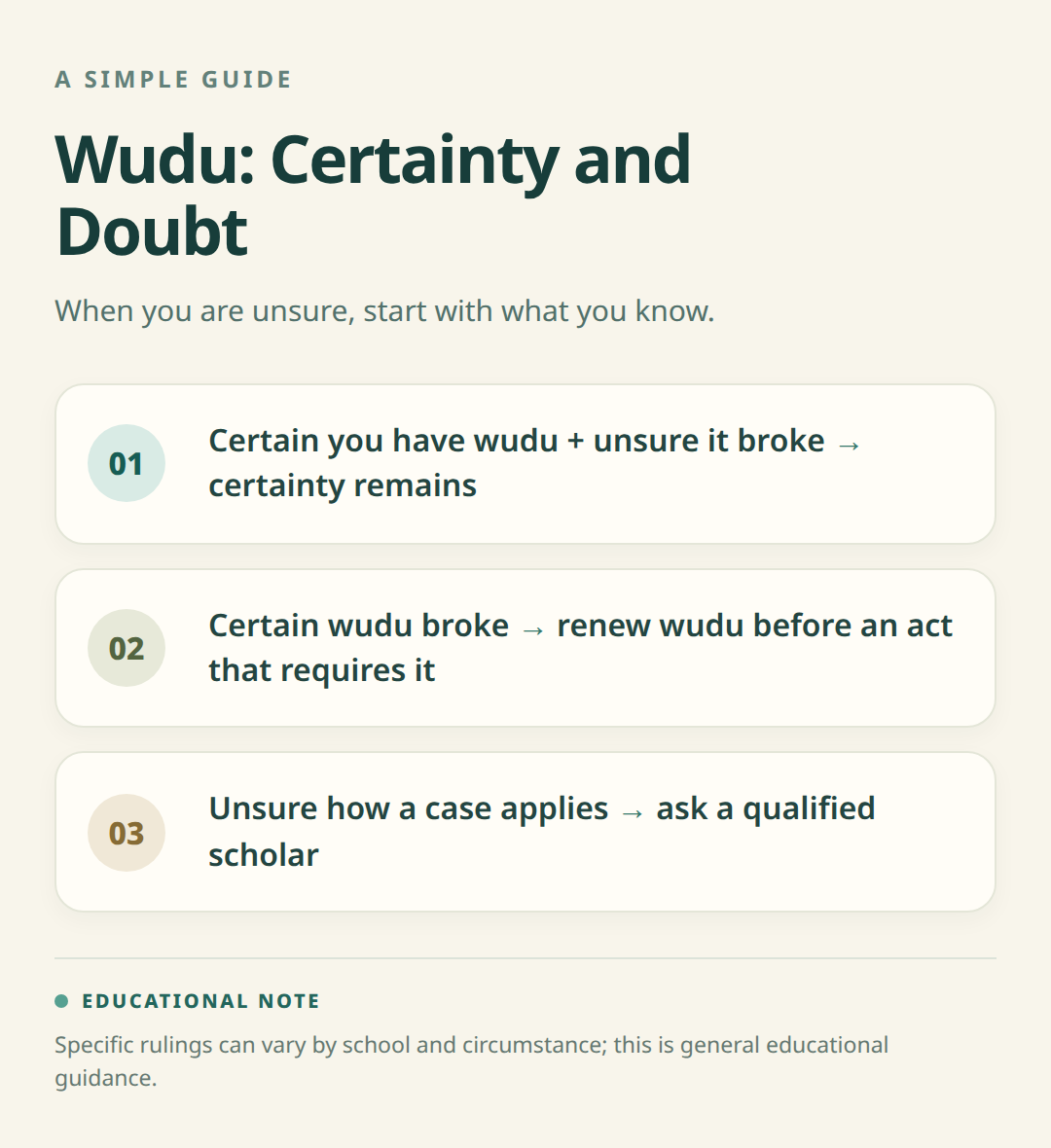
Most importantly, mere doubt does not cancel a state of wudu that you know you had. Sahih Muslim 361 reports that when a worshipper was unsure whether something had happened during prayer, the Prophet said not to leave unless he heard a sound or perceived a smell. The principle applied by scholars is that certainty is not removed by doubt. The wording about sound or smell is an example in the hadith, not a requirement to ignore clear knowledge gained another way.
IslamQA’s answer on doubts about wudu says that if you are certain you made wudu and only suspect that it broke, you may treat your wudu as continuing. It advises people troubled by recurring waswas (intrusive doubts) not to keep repeating ablution for every worry. Conversely, when you know an invalidator occurred, renew wudu. For relevant questions about Quran recitation and handling a printed copy, see Quranytime’s separate guide to reading Quran without wudu; the rules for prayer and recitation should not be collapsed into one question. A related article considers reading Quran without hijab separately from the covering requirements of salah.
What to do next: a steady, practical process
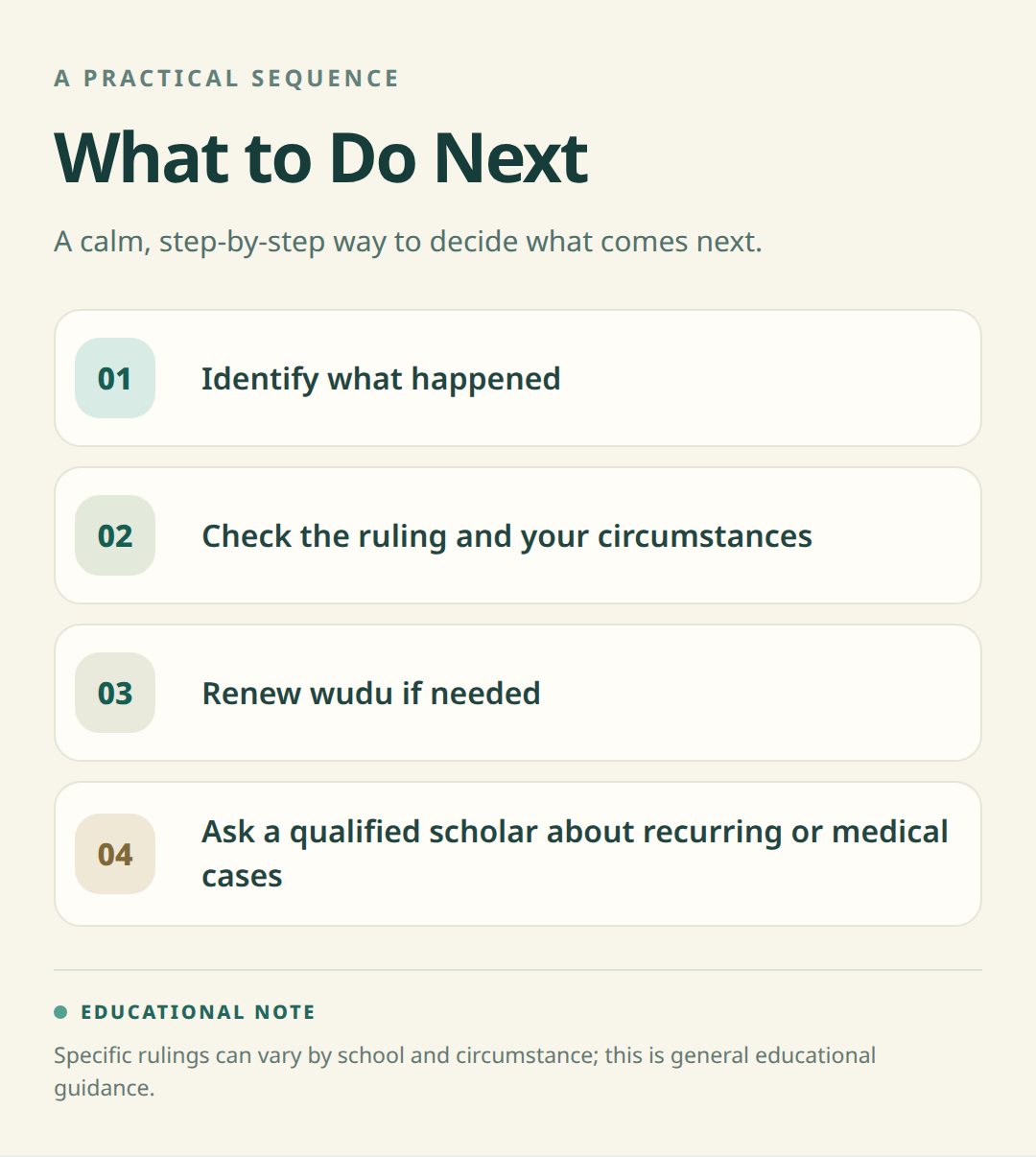
- Name what happened. Was there a definite emission, deep loss of awareness, a touch, blood, or only a sensation? Avoid adding assumptions.
- Separate certainty from doubt. If you knew you had wudu and cannot establish that it ended, retain the original certainty. Sahih Muslim 361 and IslamQA’s explanation support this approach.
- Check the kind of purification involved. Ordinary minor invalidators call for wudu. Janabah calls for ghusl. Illness or lack of usable water may bring tayammum into consideration; consult Qur’an 5:6 and ask about your situation.
- Use a reliable ruling in context. For touch, sleep, bleeding, and camel meat, note the school-specific distinction rather than treating a single web answer as consensus.
- Ask about recurring or medical cases. Ongoing leakage, discharge, incontinence, severe waswas, or a new symptom needs personal guidance from a qualified scholar; medical symptoms may also need a clinician.
If you renew wudu, do it calmly and with the method you have been taught. Once ready to pray, our Tashahhud pronunciation guide can help you prepare for a later part of salah. These learning resources are not authorities for resolving a fiqh disagreement.
Finding guidance for a personal situation
A general article cannot account for every medical condition or every detail in a school of law. Before asking, note whether the event was certain, what type of discharge or contact occurred, and whether the issue is occasional or persistent. A teacher can then explain which ruling applies without you having to repeatedly search for an answer in moments of worry. If there is pain, a new symptom, or continuing leakage, a clinician can help with the health side while a qualified scholar addresses worship.
A clear takeaway
The most helpful answer to “what breaks wudu?” begins with certainty: a known event is different from a worry. Actual urination or stool, or wind exiting the back passage, are straightforward examples; deep sleep is treated with attention to awareness and school-specific details. Janabah requires ghusl. Touching a woman, touching private parts, bleeding, and eating camel meat involve recognized differences, and IslamQA’s preferred views should be attributed rather than described as universal.
When uncertain, keep the state you know, consult a reliable scholar for the school you follow, and avoid repeating wudu because of every passing sensation. A sound answer should bring clarity, not make worship harder.