

Arabic prepositions are small words with a large effect: they tell you where an action begins, where it is directed, or how one thing relates to another. In Quranic Arabic, recognizing a particle such as مِنْ (min, “from”) or فِي (fī, “in”) helps divide a line into meaningful phrases. This beginner’s guide groups eight common particles by their central sense, shows which ones attach to the next word, and explains the genitive ending you may notice in fully vowelled text.
Quick answer: what are Arabic prepositions?
In traditional Arabic grammar, a ḥarf al-jarr is a particle that governs a following noun or pronoun in the genitive case, called majrūr. Common forms include مِنْ (from), إِلَى (to), فِي (in), and the attached prefixes بِـ, لِـ, and كَـ. English glosses are starting points, not one-to-one translations; read each particle with its sentence.
Eight common Arabic particles of jarr
This chart is a beginner’s map, not a complete list of every particle or sense. The last column shows whether the particle is normally written separately or joined to the next word.
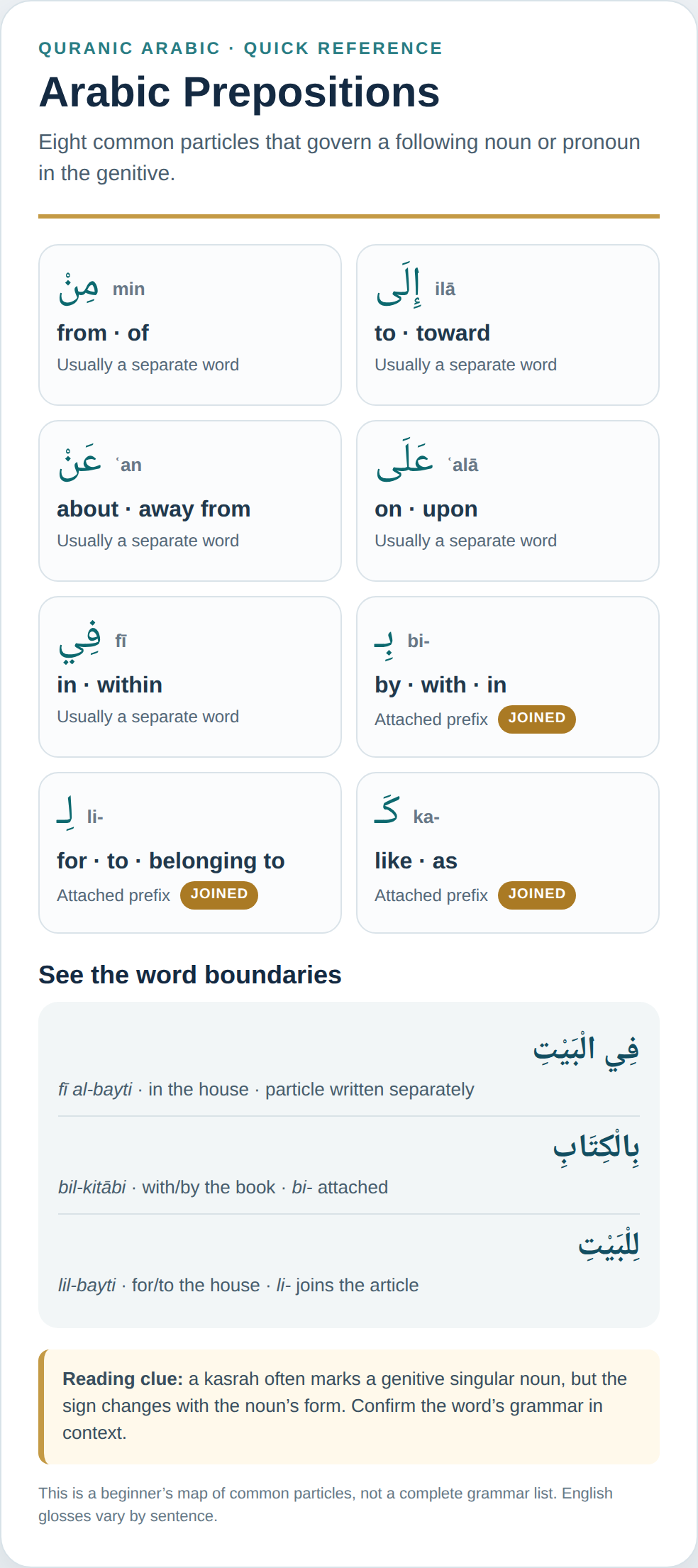
How the most useful particles work
1. مِنْ (min): from, of, or among
Min can mark a source or part of a whole. جِئْتُ مِنَ الْمَدِينَةِ (jiʾtu mina l-madīnati) means “I came from the city.” Before a word beginning with hamzat al-waṣl, such as al-, you may hear a short linking vowel: mina l-. The particle remains a separate written word.
2. إِلَى (ilā): to or toward
Ilā often marks a destination or endpoint: ذَهَبْنَا إِلَى الْمَسْجِدِ (dhahabnā ilā al-masjidi), “We went to the mosque.” It stays separate from the following word. Do not confuse it with li-, which may also be translated “to” but often expresses purpose, benefit, or belonging.
3. عَنْ (ʿan): about, away from, or concerning
ʿAn can express separation or a topic. تَحَدَّثْتُ عَنْ الدَّرْسِ (taḥaddathtu ʿan al-darsi) means “I spoke about the lesson.” In Quranic passages its sense depends on the nearby verb and words, so do not choose “about” automatically.
4. عَلَى (ʿalā): on, upon, or against
ʿAlā often describes position or direction. In الْكِتَابُ عَلَى الْمَكْتَبِ (al-kitābu ʿalā al-maktabi), “The book is on the desk,” it introduces the location phrase. “Upon” or “against” may fit better in other contexts.
5. فِي (fī): in, within, or concerning
Fī often expresses containment: فِي الْبَيْتِ (fī al-bayti), “in the house.” It stays separate from the following noun, which takes the genitive role. In a recited phrase, keep fī attached in meaning to the word it governs even though Arabic writes them as two words.
6. بِـ (bi-): by, with, in, or through
Bi- is a prefix attached to the next word: بِالْقَلَمِ (bil-qalami) can mean “with/by the pen.” A clear Quran example is قُلْ أَعُوذُ بِرَبِّ النَّاسِ (“Say: I seek refuge in the Lord of mankind,” Qur’an 114:1): bi- joins rabb, which is genitive. The Quranic Arabic Corpus’s word-by-word analysis of 114:1 identifies the prefix as a preposition and rabb as a genitive noun. In a dense line, inspect the first letter before looking a word up; the prefix can be easy to miss.
7. لِـ (li-): for, to, or belonging to
Li- also attaches and may signal benefit, purpose, possession, or relation. With al-, it changes the written form: لِلْبَيْتِ (lil-bayti) combines li- and al-bayt (“the house”). In لِلَّهِ (lillāhi), read the prefix as part of the word shape and let the sentence determine the best English gloss.
8. كَـ (ka-): like or as
Ka- introduces a comparison and joins the following word. كَالْقَمَرِ (kal-qamari) means “like the moon.” Read the prefix and noun together before deciding how the comparison relates to the rest of the sentence.
What does the genitive ending show?
A particle of jarr places the following noun in the genitive. Many singular nouns show a kasrah beneath the final consonant, as in فِي الْبَيْتِ (fī al-bayti). The sign is not always a kasrah: a dual may use -ayni, a sound masculine plural -īna, and some diptotes a fatḥa. Treat the particle as a clue, then identify the noun’s form.
The governed word may instead be a pronoun suffix: فِيهِ (fīhi, “in it/him”), لَهُ (lahu, “for him/to him”), or مِنْهُمْ (minhum, “from among them”). Such suffixes are not visibly declined like nouns; grammarians describe them as “in the position of genitive.” Some long-vowel particles also adjust before a suffix: إِلَى becomes إِلَيْهِ (ilayhi, “to him”), and عَلَى becomes عَلَيْهِ (ʿalayhi, “upon him”). For more, see Quranytime’s beginner chart of Arabic pronouns for Quranic reading.
Separate particles, attached prefixes, and look-alikes
Min, ilā, ʿan, ʿalā, and fī are usually separate; the three prefixes in this chart—bi-, li-, and ka-—join the next word. Other particles can also attach, so this is not a complete inventory. With the definite article, bi- and ka- keep the written alif (بِالْبَيْتِ، كَالْبَيْتِ), while li- combines as لِلْبَيْتِ. In connected speech, the initial alif sound of al- is not pronounced after a preceding word. English prepositions do not map neatly onto Arabic grammar: فَوْقَ (above), تَحْتَ (under), and بَيْنَ (between) often function as place nouns or adverbials. A following noun may be genitive through an iḍāfa construction, not because the first word is a ḥarf al-jarr. Analyze maʿa (“with”) in context as well.
Quranytime’s broader Arabic grammar overview introduces related parts of speech, and its guide to Quranic Arabic versus Modern Standard Arabic can help you keep your learning goal in view.
A practical way to spot a phrase in a verse
- Look for a separate particle or short prefix. Check whether a word begins with bi-, li-, or ka-.
- Read the particle with what follows. Treat fī al-bayt as one phrase, not as unrelated vocabulary items.
- Notice the noun ending. A kasrah can be a genitive clue, but the exact sign depends on the noun form.
- Connect the phrase to the clause. Ask whether it gives a source, destination, location, means, topic, or comparison.
- Check context before translating. The particle may have several glosses; read the full verse and a trusted translation.
Keep a verb and its particle together when you study meaning. Arabic often uses familiar combinations that English learners cannot predict from an isolated gloss; for example, تَحَدَّثَ عَنْ (taḥaddatha ʿan) means “to speak about.” When you look up a verb, check whether it commonly appears with a particular particle, and record the phrase rather than memorizing the particle alone.
Compare the separate form مِنَ الْمَدِينَةِ (mina l-madīnati, “from the city”) with attached بِالْكِتَابِ (bil-kitābi, “with/by the book”). Use a grammar observation as a reading aid, not as a substitute for tafsīr or a teacher’s explanation of a verse.
Common mistakes to avoid
- Memorizing only one English gloss instead of reading the sentence.
- Missing an attached prefix when scanning a long word.
- Assuming every genitive noun ends with the same kasrah mark.
- Calling every Arabic location word a particle of jarr.
- Translating a fragment without checking its full clause and verse.
Build a small practice routine
Choose a short passage you are already studying. Mark familiar particles, then underline the noun or pronoun they govern. For each phrase, note the particle, its likely relationship, and any visible genitive sign. Listen to a reliable recitation while following the text; focus on word boundaries rather than speed. Add just two or three examples to a review card each day. Quranytime’s beginner Quranic Arabic vocabulary study plan supports spaced review, while its introduction to Quranic Arabic roots and patterns shows another way to connect a word with its context.
Keep the eight forms in the chart nearby, watch for the attached prefixes, and ask a teacher when a grammatical observation affects how you understand a verse. If you are also learning to form basic questions in Arabic, Quranytime’s guide to Arabic question words offers another focused practice set.
Case endings and pauses are different
Grammar helps you identify a word’s case, but it is not a stopping rule. In connected recitation, a fully vowelled text shows short case endings; at a pause (waqf), a final short vowel is generally not pronounced as it is in connected reading, and other word endings follow their own stopping rules. Follow the printed mushaf and a qualified teacher for recitation decisions. Quranytime’s guide to six Quran waqf signs explains how to recognize common pause marks.
Video lesson
This slide-based lesson uses Arabic-and-English text and examples to explain ḥurūf al-jarr, with phrases relevant to Quranic reading. Pause to identify attached forms and genitive endings.