
When an Arabic verse contains الَّذِي, الَّتِي, or الَّذِينَ, the word is usually a sign that a description is coming. These are Arabic relative pronouns: forms often translated as “who,” “which,” or “that.” They connect a person, group, or thing to a clause that tells us more about it. Learning to spot that connection can make a long Quranic sentence easier to follow without translating every word in isolation.
This guide focuses on the most useful specific relative pronouns for Quranic-Arabic beginners, the forms they take, and a simple way to trace the clause after each one. The goal is reading recognition, not a complete course in Arabic syntax or tafsir. A relative pronoun can appear after an explicit noun, or it can stand on its own to mean “the one who” or “those who.”
What an Arabic relative pronoun does
In Arabic grammar, a specific relative pronoun is called an ism mawṣūl (اسم موصول). It introduces a descriptive clause called the ṣilat al-mawṣūl (صلة الموصول). In English, compare “the student who studied” or “the book that I read.” The bold words after “who” or “that” give information about the student or book.
In Arabic, the same reading move is helpful: find the relative-pronoun form, ask what person or thing it points to, then read the following words as a connected description. The noun or referent being described is often called the antecedent. It may be immediately before the pronoun, as in a phrase meaning “the man who arrived.” But it is not always an explicit nearby noun: الَّذِينَ آمَنُوا means “those who believed,” with الَّذِينَ itself naming the group.
Do not stop at the relative pronoun when translating. The meaning usually becomes clear only after you have read its clause. Also avoid forcing one English word onto every occurrence: depending on context, an Arabic relative pronoun can be rendered “who,” “which,” “that,” “the one who,” or “those who.”
Start with the forms you will meet most
The main specific forms match a definite antecedent in gender and number. For most beginners, three forms are the best starting point: الَّذِي for masculine singular, الَّتِي for feminine singular, and الَّذِينَ for masculine or mixed plural. The dual has separate masculine and feminine forms, and the endings change with grammatical case. Feminine plural forms also vary in the texts you may encounter.
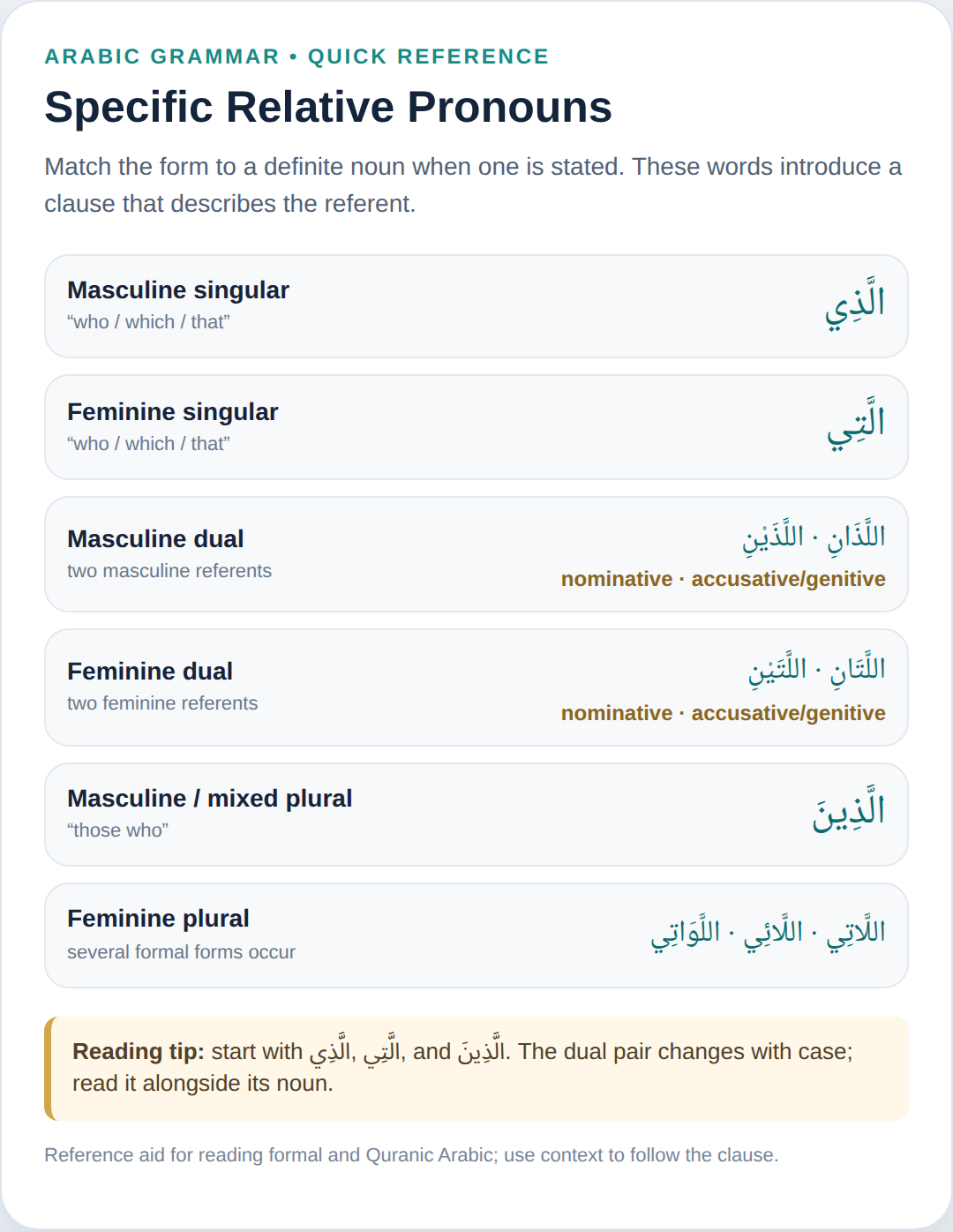
The chart is a recognition aid, not a substitute for reading the full sentence. A particularly useful detail is the dual: the nominative forms end in ـانِ, while the accusative and genitive forms end in ـيْنِ. For a first reading pass, do not let the full paradigm distract you from the common singular and plural forms. You can revisit the case endings when the sentence role is clear.
You may also meet relative uses of مَنْ (“whoever / the one who”) and مَا (“what / that which”). These words can serve other grammatical functions too, so context matters. This page concentrates on the specific forms beginning with الـ.
A four-step method for following the clause
Use the same short routine whenever you see a likely relative pronoun in a verse:
- Mark the form. Is it الَّذِي, الَّتِي, الَّذِينَ, or a dual or feminine-plural form?
- Find the referent. Look left for a noun that the pronoun describes. If none is stated, test whether the pronoun itself means “the one(s) who.”
- Read forward as a unit. Identify the action or statement that completes the description. Do not decide the clause boundary from a stop mark alone; read the words and their grammatical connection.
- Look for a returning pronoun. The clause may contain a subject understood from the verb or a suffix such as ـهُ or ـها that points back to the referent.
For example, in a simple practice sentence, جَاءَ الطَّالِبُ الَّذِي نَجَحَ means “The student who succeeded came.” Start with الَّذِي, connect it to الطَّالِبُ, then read نَجَحَ as the description. The verb’s form carries an understood masculine singular subject referring to that student.
Three Quran examples to read by function
Seeing the forms in context helps more than memorizing an isolated list. The following short excerpts show a masculine singular form, a feminine singular form, and a masculine plural form. Read each excerpt as a connected unit; the translations below are brief learning glosses rather than full translations of the surrounding verses.
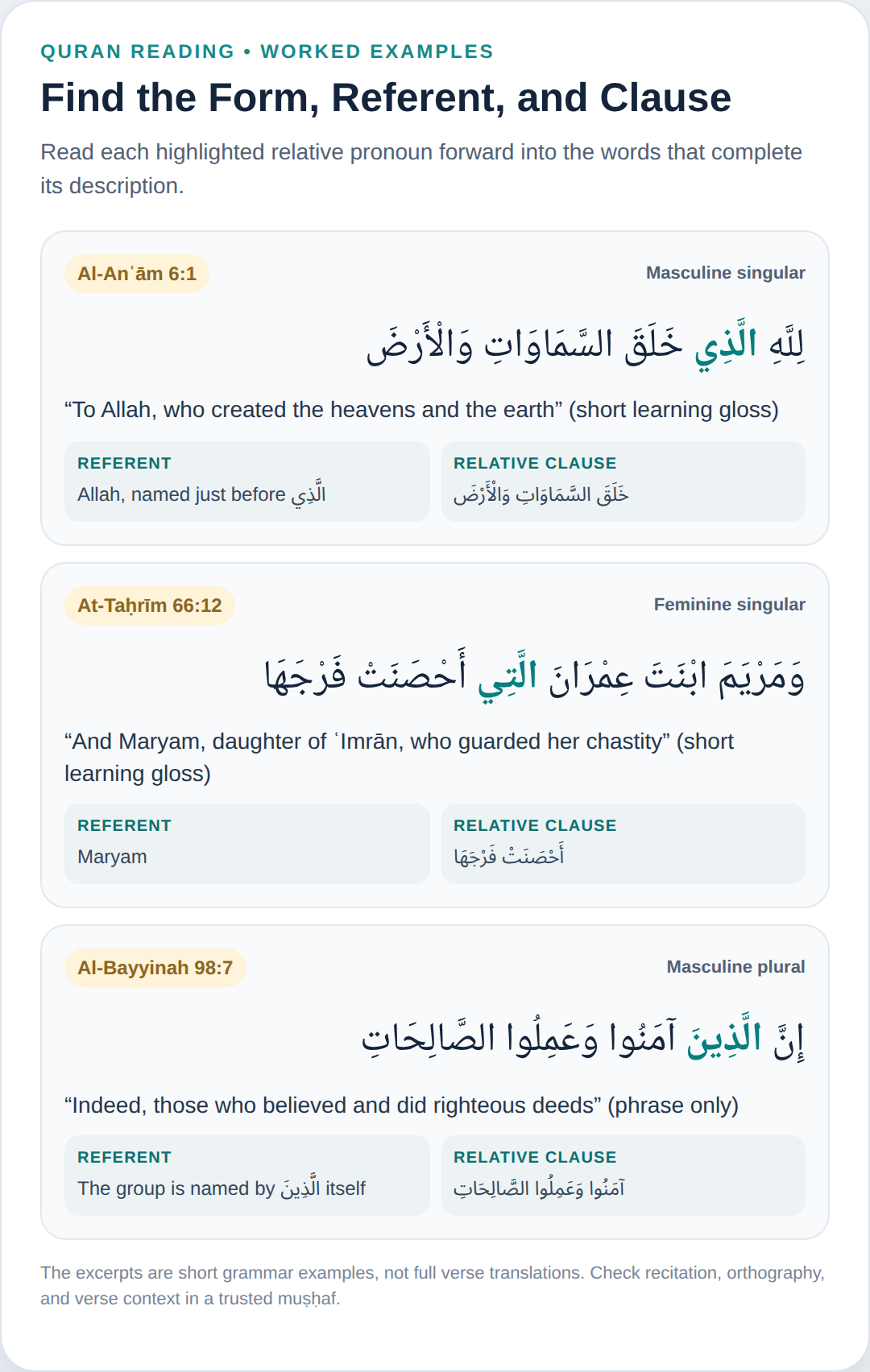
In Al-Anʿām 6:1, الَّذِي follows the reference to Allah in لِلَّهِ. The phrase خَلَقَ السَّمَاوَاتِ وَالْأَرْضَ means “created the heavens and the earth.” The relative pronoun is masculine singular, and the verb’s third-person masculine singular form supplies the understood subject.
In At-Taḥrīm 66:12, الَّتِي describes Maryam. The following words أَحْصَنَتْ فَرْجَهَا mean “guarded her chastity.” The feminine singular form aligns with Maryam; the verb أَحْصَنَتْ is feminine singular. The suffix ـهَا in فَرْجَهَا means “her” and refers to Maryam as the possessor of the noun.
In Al-Bayyinah 98:7, الَّذِينَ means “those who.” It is not preceded by a separate noun; the relative pronoun itself names the group. The clause آمَنُوا وَعَمِلُوا الصَّالِحَاتِ means “believed and did righteous deeds.” A word-by-word grammar entry identifies الَّذِينَ here as a masculine plural relative pronoun. For another Quran example, compare the annotated words in the Quranic Arabic Corpus entry for Al-Anʿām 6:1.
When the clause contains a pronoun that points back
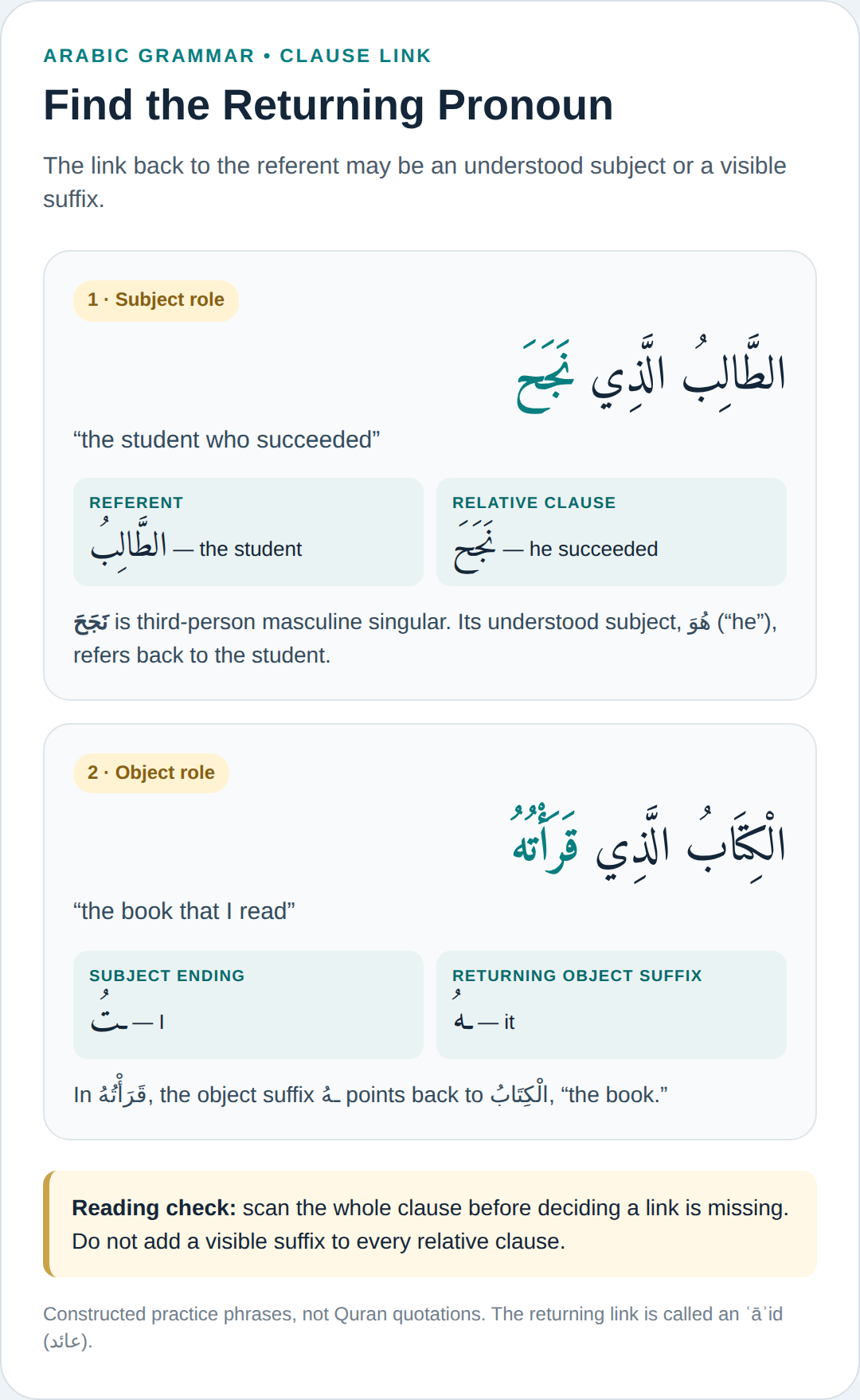
Some relative clauses include a small pronoun that returns to the noun being described. Arabic grammarians call this link an ʿāʾid (عائد). It may be built into a verb as an understood subject, or appear visibly as a suffix when the referent is an object or follows a preposition.
In the everyday example الْكِتَابُ الَّذِي قَرَأْتُهُ مُفِيدٌ, “The book that I read is useful,” the suffix ـهُ in قَرَأْتُهُ means “it” and points back to “the book.” In الرَّجُلُ الَّذِي تَحَدَّثْتُ مَعَهُ, “the man with whom I spoke,” the suffix after مَعَ supplies the link. These examples show why it is helpful to scan the whole clause rather than stop at the first verb.
Not every clause displays a separate suffix. If the antecedent is the subject of the action, the verb may carry the returning subject implicitly, as in the earlier example الطَّالِبُ الَّذِي نَجَحَ. The absence of a separate written pronoun does not automatically mean the connection is missing.
Do not confuse relative pronouns with personal pronouns
A personal pronoun identifies a participant—“I,” “you,” “he,” “she,” or “they”—or appears as an attached ending such as ـهُ. A relative pronoun does a different job: it introduces a clause that describes a referent. In الَّذِينَ آمَنُوا, الَّذِينَ means “those who,” while the plural subject within آمَنُوا is carried by its verb ending. The two grammatical clues are connected, but they are not the same word or function.
If you need to review subject pronouns and attached suffixes, see the site’s guide to Arabic pronouns for Quranic reading. If a clause also contains a preposition, the beginner guide to Arabic prepositions can help you recognize what follows it. And when the describing element is a single adjective rather than a full clause, compare the Arabic adjective-agreement examples.
Common mistakes to avoid
- Translating the form before reading its clause. Recognize الَّذِي first, then read forward to see what is being said about the referent.
- Assuming a noun must always come immediately before it. In الَّذِينَ آمَنُوا, the phrase means “those who believed”; the group is expressed by the relative pronoun itself.
- Mixing up relative and personal pronouns. الَّذِينَ introduces “who” content; هُمْ is the independent personal pronoun “they.”
- Forgetting the dual forms change with case. Read the antecedent and the relative form together; do not swap اللَّذَانِ and اللَّذَيْنِ without checking the sentence role.
- Assuming every feminine plural has one spelling. You may encounter more than one feminine plural form; focus on recognizing its function and verify an unfamiliar form in a grammar reference.
- Turning a grammar clue into a complete interpretation. A relative clause helps you follow sentence structure, but grammar alone does not replace a reliable translation, tafsir, or teacher when a verse’s meaning is difficult.
A quick self-check
Try identifying the form and the clause before reading the answer. In الَّتِي أَحْصَنَتْ, is the form masculine or feminine, and which word tells you what happened? In الَّذِينَ آمَنُوا, is a separate noun required before the relative pronoun? In الْكِتَابُ الَّذِي قَرَأْتُهُ, what does the final ـهُ point back to?
Answers: الَّتِي is feminine singular, and أَحْصَنَتْ tells us the action. الَّذِينَ can stand for “those who” without an earlier noun. In the last phrase, ـهُ (“it”) refers back to الْكِتَابُ, “the book.”
For steady practice, take one short phrase at a time: circle the relative form, mark the noun or group it describes, draw a bracket around the clause, and note any returning pronoun. Then read the entire phrase aloud with a teacher or trusted recitation recording, keeping grammar study separate from decisions about pronunciation. The Quranic Arabic vocabulary study plan and the site’s fluency guide can help you build that habit gradually. For broader sequencing, use the Quranic Arabic learning roadmap rather than trying to learn every grammar label at once.
Watch a short lesson
This separate lesson gives another explanation of Arabic relative-pronoun forms. Use it as a supplement to the examples above, and check any unfamiliar Quranic wording against a reliable text.