
Arabic harakat are the small marks that guide you through the short vowel sounds and pauses inside a written word. If you are learning to read the Quran, recognizing them helps you sound out a fully marked word instead of guessing from its letters alone. This guide teaches one focused skill: identify fatha, kasra, damma, sukoon and tanween, then use them to read simple Quran examples more carefully.
Take the marks one at a time. The English sound hints below are approximate; Arabic sounds are best learned by listening and repeating with a qualified reciter or teacher. A mark is a reading cue, not a complete lesson in tajweed, grammar, or where to stop.
What are harakat in Quran reading?
Harakat is a common name for vowel marks, often called diacritics in English. In Quranic Arabic, these marks make short-vowel and other reading information visible on the letters. The Quranic Arabic Corpus describes Quran text as explicitly diacritic-marked and fully vowelized, unlike much everyday Modern Standard Arabic writing, which often leaves short vowels unmarked; it notes that the marks reduce ambiguity. Read the Quranic Arabic Corpus documentation for this description.
When you look at a marked letter, ask two questions: which letter is this, and what mark is attached to it? If the letter shapes themselves are still new, begin with Quranytime’s step-by-step Arabic alphabet lesson. Then return to the same letter and notice how its sound changes when the mark changes. For the broader beginner sequence, see our seven-step guide to reading the Quran; this page focuses on decoding the marks themselves.
Fatha, kasra and damma: the three short vowels
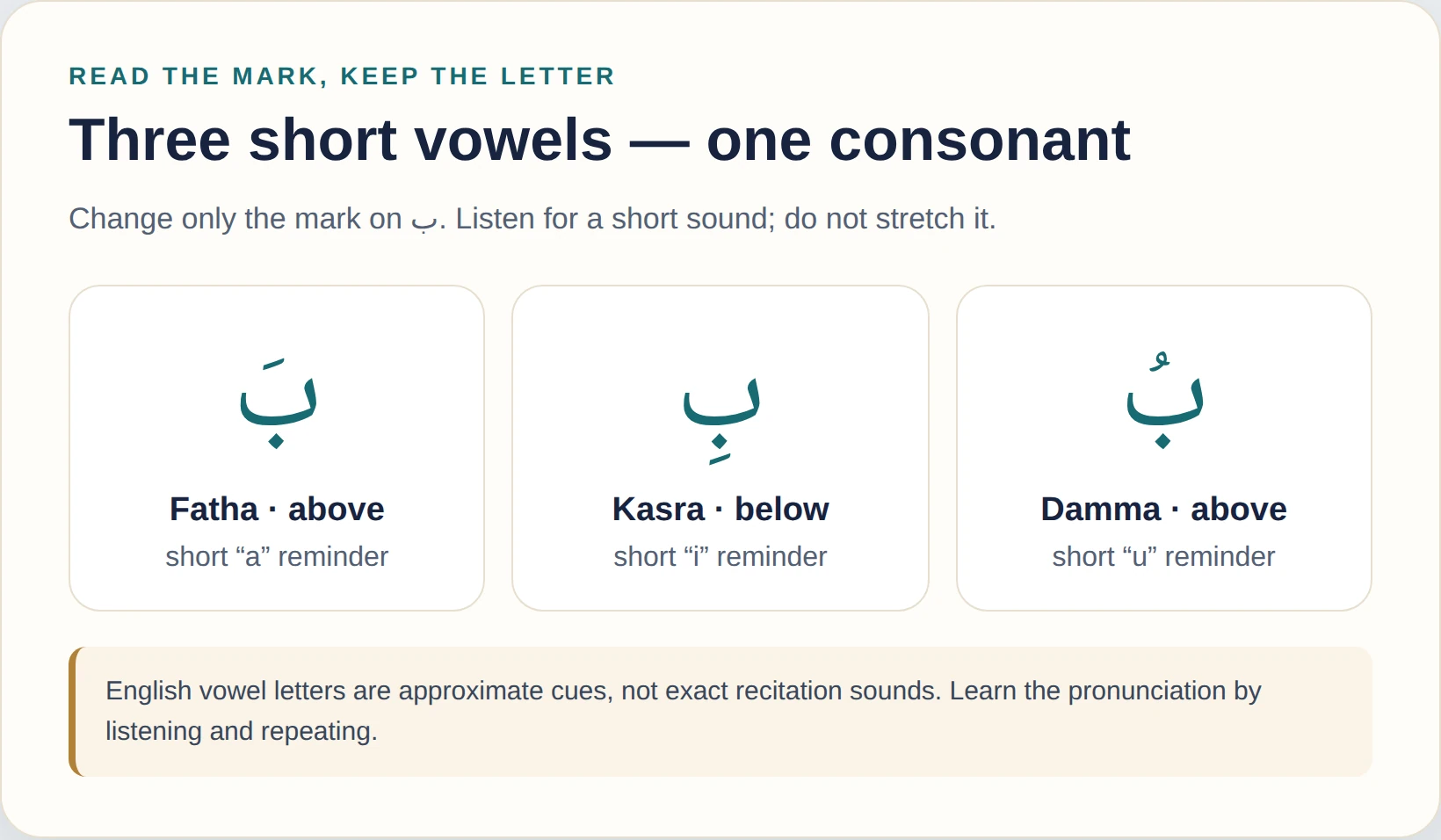
Start with the letter ب (baa). A fatha is a short diagonal stroke above the letter: بَ. It gives a short vowel often approximated as “a.” A kasra is a short stroke below: بِ, often approximated as “i.” A damma is a small curl above: بُ, often approximated as “u.” Keep the letter the same and change only the mark. This makes the contrast easier to hear and see.
These English vowels are reminders, not exact phonetic instructions. Do not turn a short mark into a long “aa,” “ee,” or “oo.” Lengthening uses other spelling and recitation cues; Quranytime’s guide to madd in Quran recitation treats that separate topic. Read each marked letter briefly, then listen to a reliable recitation and repeat it without forcing an English accent onto the sound.
Sukoon: a consonant without a short vowel after it
Sukoon is the small circle-like mark ْ placed above a letter. It shows that the consonant is read without an added short vowel after it. The consonant is still pronounced; what you leave out is the extra a, i, or u that a beginner may be tempted to insert.
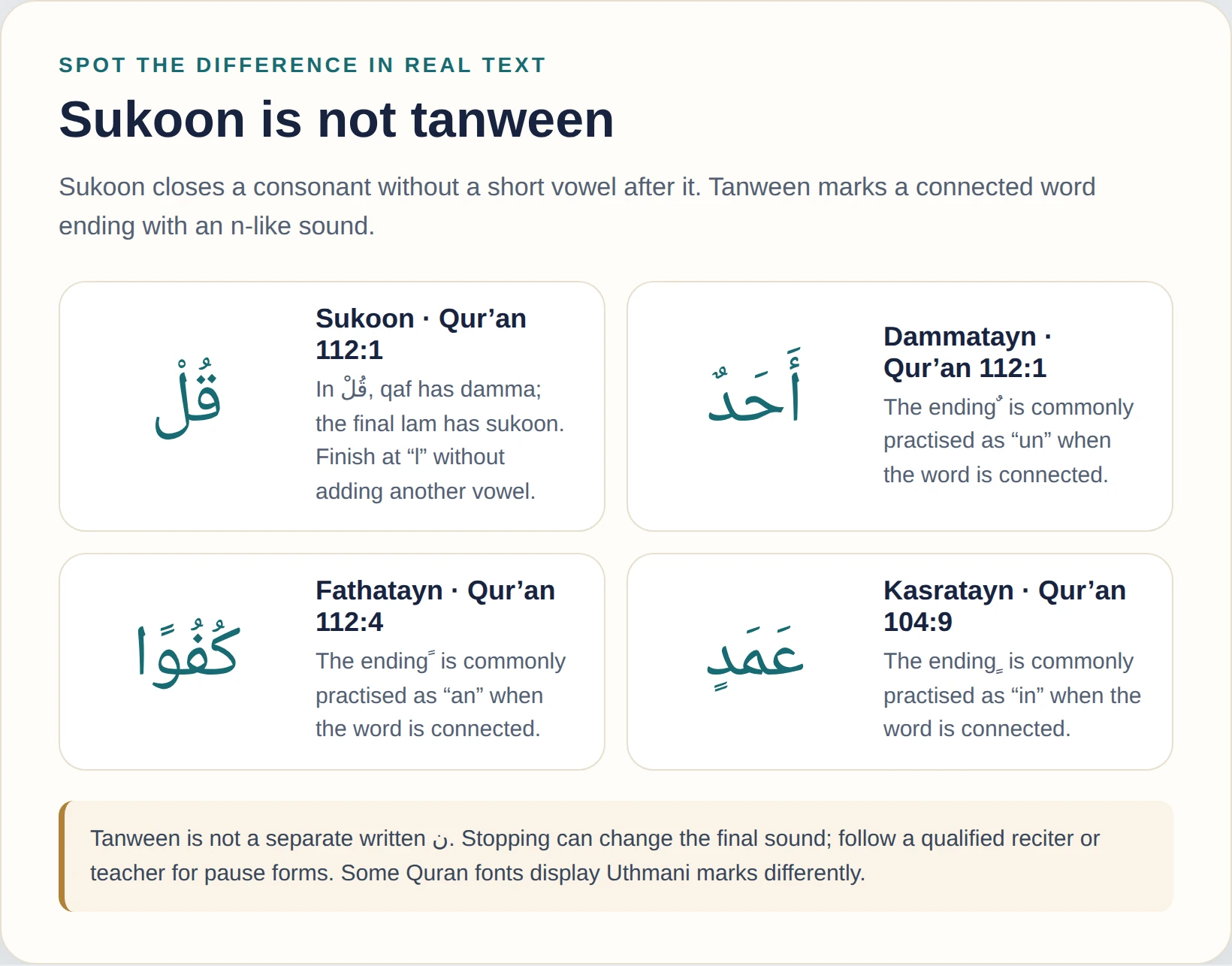
Notice the difference between بَ and بْ. In the first, baa carries a short “a” sound. In the second, baa has no short vowel after it. A Quran example is قُلْ in Al-Ikhlas 112:1. The qaf has damma, giving “qu”; the final lam has sukoon, so finish the word at the consonant rather than adding another syllable. Say it slowly, then at a natural pace: “qul,” not “qu-li.”
To practise, say a short-vowelled sound, then close on a sukoon-marked consonant: بَ…بْ. Keep the second sound clean and brief. If you cannot hear whether you are adding a vowel, listen to the same word in a trusted recitation, pause, and imitate the ending. For related doubling, see the separate lesson on shaddah; shaddah and sukoon are different marks and should not be swapped.
Tanween: three vowel endings with an n-like sound
There are three tanween marks: fathatayn ً, kasratayn ٍ, and dammatayn ٌ. In connected reading, the three are commonly introduced with the sound reminders “an,” “in,” and “un.” Tanween is not an extra written letter ن. Learn the mark on the word and hear how it joins to what follows.
For real Quran examples, أَحَدٌ in Al-Ikhlas 112:1 ends with dammatayn, while كُفُوًا in 112:4 has fathatayn. In a standard Arabic display, عَمَدٍ in Al-Humazah 104:9 shows kasratayn; a Uthmani-script edition may render some Quranic marks with a different glyph. These examples help you spot the marks, not practise a grammar rule. When you stop at a word, the final sound can change according to the stopping rules. Use a teacher or trusted recitation for stop forms rather than applying “an/in/un” mechanically.
Some printed and digital Qurans use Uthmani-script marks that look different from the plain Arabic signs on a classroom chart. Keep the text and its listening model together, and ask a qualified teacher when a symbol in your edition is unfamiliar. Do not replace a Quran-specific sign with a typed mark or edit the sacred text just to make it resemble a chart.
Marks can be tiny on a phone. Zoom in rather than guessing, read from right to left, and check whether each sign is above or below its letter. Dots, shaddah and recitation symbols may sit close together, so isolate one letter at a time until you can recognize the pattern comfortably.
One easy mistake is to hear tanween and imagine a separate ن has been added to the written word. Instead, look at the paired vowel sign and listen to the connected sound. Another mistake is to read every ending the same way. Compare ٌ, ٍ and ً slowly, naming the mark before you pronounce the word.
A simple method for sounding out a Quran word
Use the same sequence each time so you do not guess from memory. First, identify the base letter. Second, name the mark above or below it. Third, say the short sound without stretching it. Fourth, join the marked letters in order. Finally, check the word in a recitation or with a teacher, especially if the script or pause mark is unfamiliar.
Try this with قُلْ: name qaf and its damma, then lam and its sukoon, then blend the sounds. Repeat with أَحَدٌ: move letter by letter, notice the short marks, and give the final tanween its connected-reading sound. Do not race through a whole verse while the individual cues are still unclear. Accurate small chunks make fluent reading easier later. Quranytime’s advice on building Quran reading fluency without rushing can help you keep accuracy ahead of speed.
Seven days of short practice
Five to ten focused minutes is enough for a practice round. Use a familiar, fully marked line, a clear audio model, and a notebook to record only one thing you want to improve. Stop before you become tired and begin guessing.
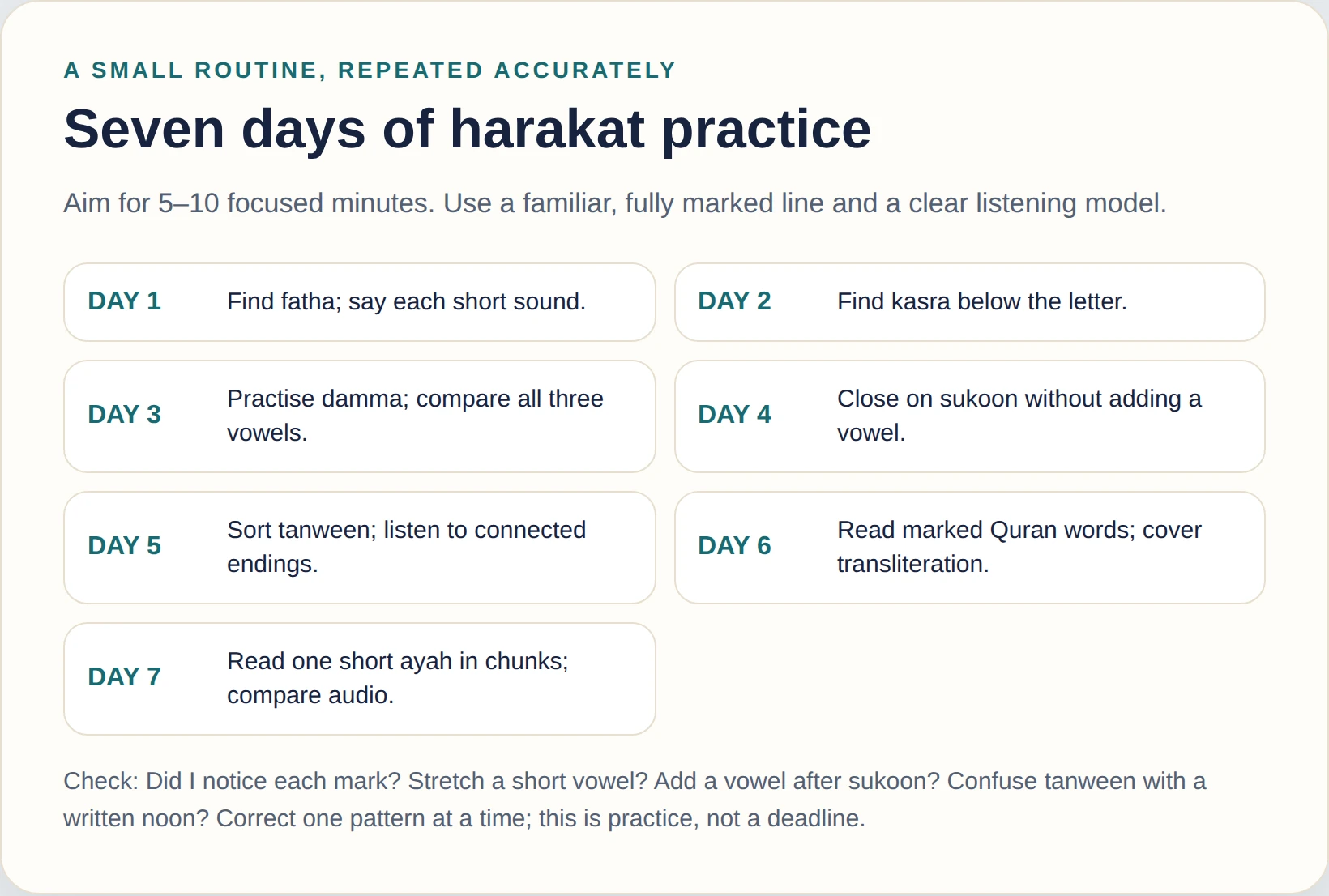
- Day 1: Find fatha on familiar letters and read each one briefly.
- Day 2: Practise kasra. Point to the mark below before saying the sound.
- Day 3: Practise damma and compare it with fatha and kasra.
- Day 4: Find sukoon in short words such as قُلْ. Finish the consonant without adding a vowel.
- Day 5: Sort the three tanween signs, then listen to the connected sound in a word.
- Day 6: Read a few familiar Quran words. Cover any transliteration and identify the marks first.
- Day 7: Read one short, fully marked ayah in small chunks, then compare with a trusted recitation.
At the end of each session, ask: Did I notice every mark? Did I stretch a short vowel? Did I add a vowel after sukoon? Did I confuse tanween with a written noon? Correct one pattern at a time. If your mistakes repeat, make a note and ask a teacher to listen. A clear Quran recitation self-checklist can help you keep practice observations specific rather than simply saying “I read badly.”
Learn from a guided example
This separate lesson demonstrates basic Arabic vowel signs and Quran-reading practice. Watch the marks on screen, pause before the example answer, and try to name each mark yourself. The video is a practice aid, not a substitute for feedback on your own recitation.
When to ask for help
If you are unsure whether you pronounced a mark correctly, replay the same short example and compare it with a qualified reciter. Do not change the Quranic text or rely on a font alone to decide how a word sounds. A teacher can listen for the exact point where a short vowel becomes too long, where a vowel is added after sukoon, or where a tanween ending needs attention. For guided feedback, you can book a free trial class for Quran and Arabic reading.
Keep the goal modest: identify the mark, pronounce the sound carefully, and verify one short example. As those steps become familiar, move to longer passages and separate topics such as shaddah, madd, or stopping rules. Harakat practice is a foundation for reading, not a shortcut around learning with a reliable recitation model.