
Quranic Arabic dictionary guide
A reliable lookup starts with the whole verse
Learning how to use a Quran dictionary means more than typing a few letters and accepting the first English gloss. A good lookup protects the exact Quranic form, identifies how that form works in its sentence, and then checks whether the suggested meaning fits the verse. This Quran dictionary guide is a repeatable method for beginners who want to look up Arabic words in the Quran without turning a quick search into a guess about interpretation.
Start with the exact word you see
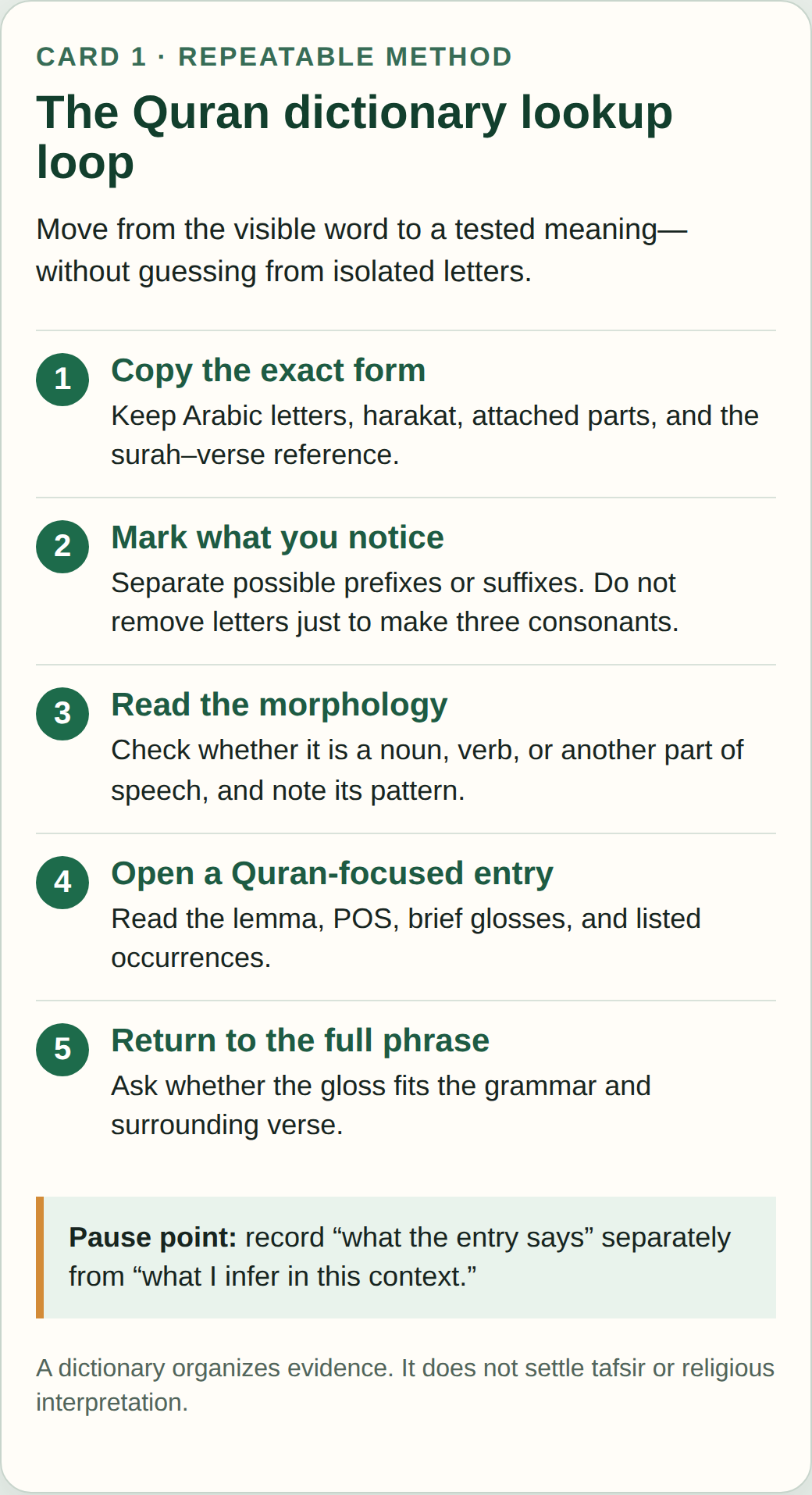
Before opening a dictionary, copy the word exactly as it appears in the verse. Preserve its Arabic letters, harakat when available, attached prefixes or suffixes, and the verse reference. Do not silently replace a word with a familiar-looking cousin. A search result is a lead; the verse itself is the evidence you are studying.
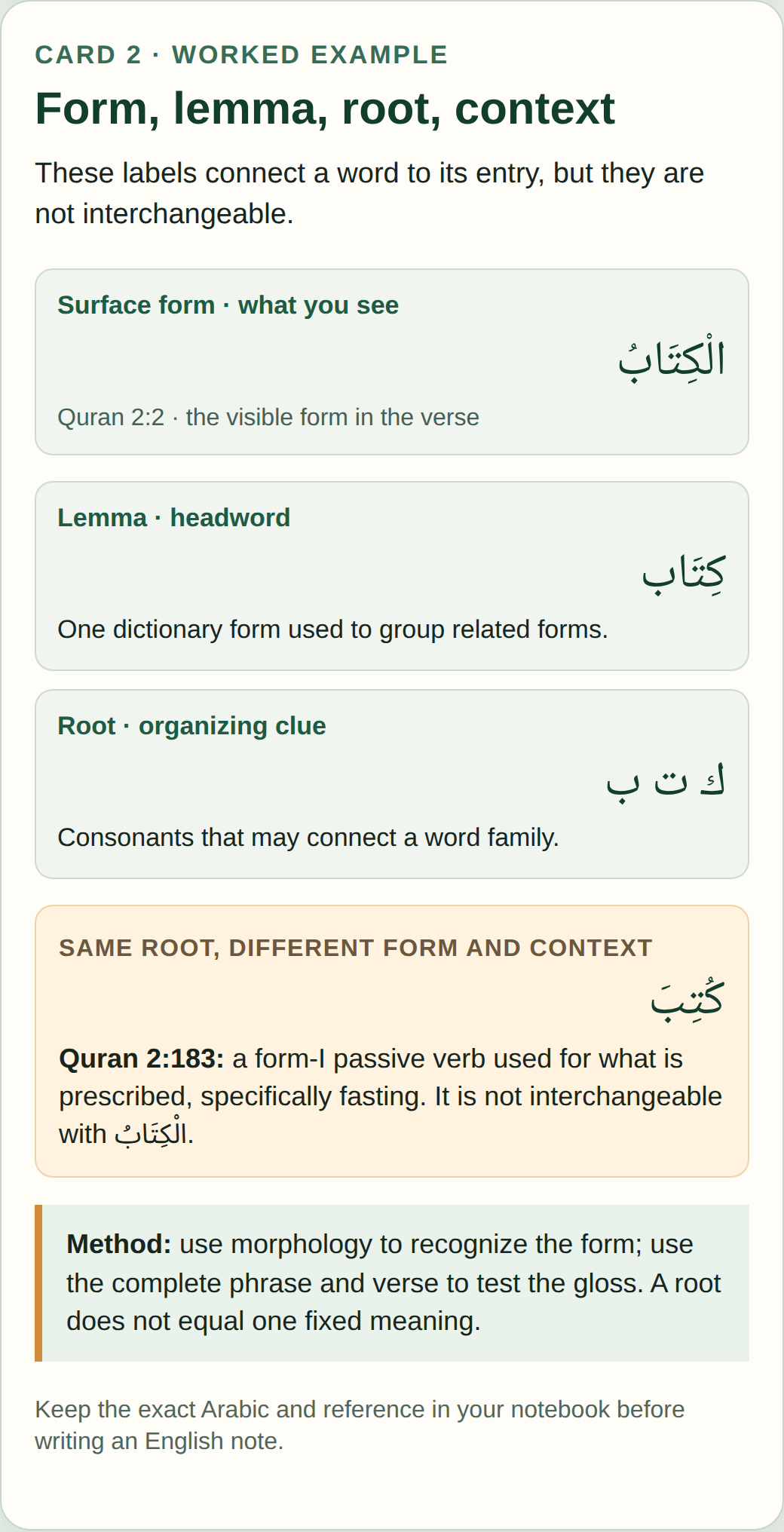
On a phone, take a screenshot or copy the word into a note, then keep three labels beside it: surface form, lemma, and root. The surface form is the actual written form in this verse. The lemma is the dictionary headword or normalized lexical item used to group related forms. The root is a smaller set of consonants that can help organize vocabulary. These labels answer different questions and must not be collapsed into one.
Use morphology, not arbitrary letter removal
Arabic words can carry information through patterns, prefixes, suffixes, case endings, number, gender, tense, voice, and attached pronouns. Therefore, finding a root is a morphology task, not a game of deleting the first or last letter until three consonants remain. Read the word’s pattern and grammatical clues. If you are unsure, record the uncertainty rather than inventing a root.
A beginner-friendly sequence is: notice the consonants and vowel marks; identify any attached material; ask whether the word is a noun, verb, adjective, or particle; then compare the form with a trusted Quran-focused reference. An introduction to Quranic Arabic roots and patterns can help you recognize patterns, while a guide to Arabic verb forms in Quranic Arabic can clarify why a verb has extra letters. Neither replaces checking the complete verse.
Choose the right kind of reference
A general Arabic dictionary may include modern usage, regional vocabulary, technical senses, and examples that are not the Quran’s usage. A Quran-focused dictionary or corpus is usually a better first stop when your question begins with a verse. It can show where a form occurs and how the Quran’s vocabulary is distributed. A general dictionary may be useful later for wider language study, but label that wider information clearly.
When comparing tools, look for transparent entries: the Arabic form, transliteration if useful, part of speech, grammatical or morphological information, brief glosses, occurrences, and links back to verses. “Common meaning” is not the same as “meaning in this verse.” If a tool gives only an English word without its Arabic form or references, treat it as a prompt for further checking.
Read the entry in a deliberate order
First confirm the Arabic spelling and vocalization. Next read the lemma or headword, then the part of speech (POS). A noun, verb, and verbal noun related to one root may behave differently. Read the listed glosses without assuming they are full translations. Finally, inspect occurrences and open at least one complete verse. This is the core of a practical Quranic Arabic dictionary method.
For grammar support, you can review a guide to Arabic verb conjugation or a quick explanation of Arabic harakat for Quran reading. These resources can help you notice a form, but they do not turn a gloss into a final religious conclusion.
Worked example: ك ت ب and the limits of a root
Consider the root ك ت ب. In a Quran dictionary entry, one related noun is كِتَاب (kitāb). In Quran 2:2, the surface form is الْكِتَابُ. The initial ال is the definite article attached to the noun, and the final vowel mark reflects its grammatical setting. The entry’s brief gloss may be “the Book,” but the sentence and surrounding passage tell you how to understand that phrase in context.
The same root also appears in the form-I passive verb كُتِبَ in Quran 2:183. In that verse, the form is used for something prescribed, specifically the fast. The shared root can suggest a broad relationship involving writing, recording, or prescribing, but it does not make الْكِتَابُ and كُتِبَ interchangeable. Their forms, grammatical roles, and verse contexts differ.
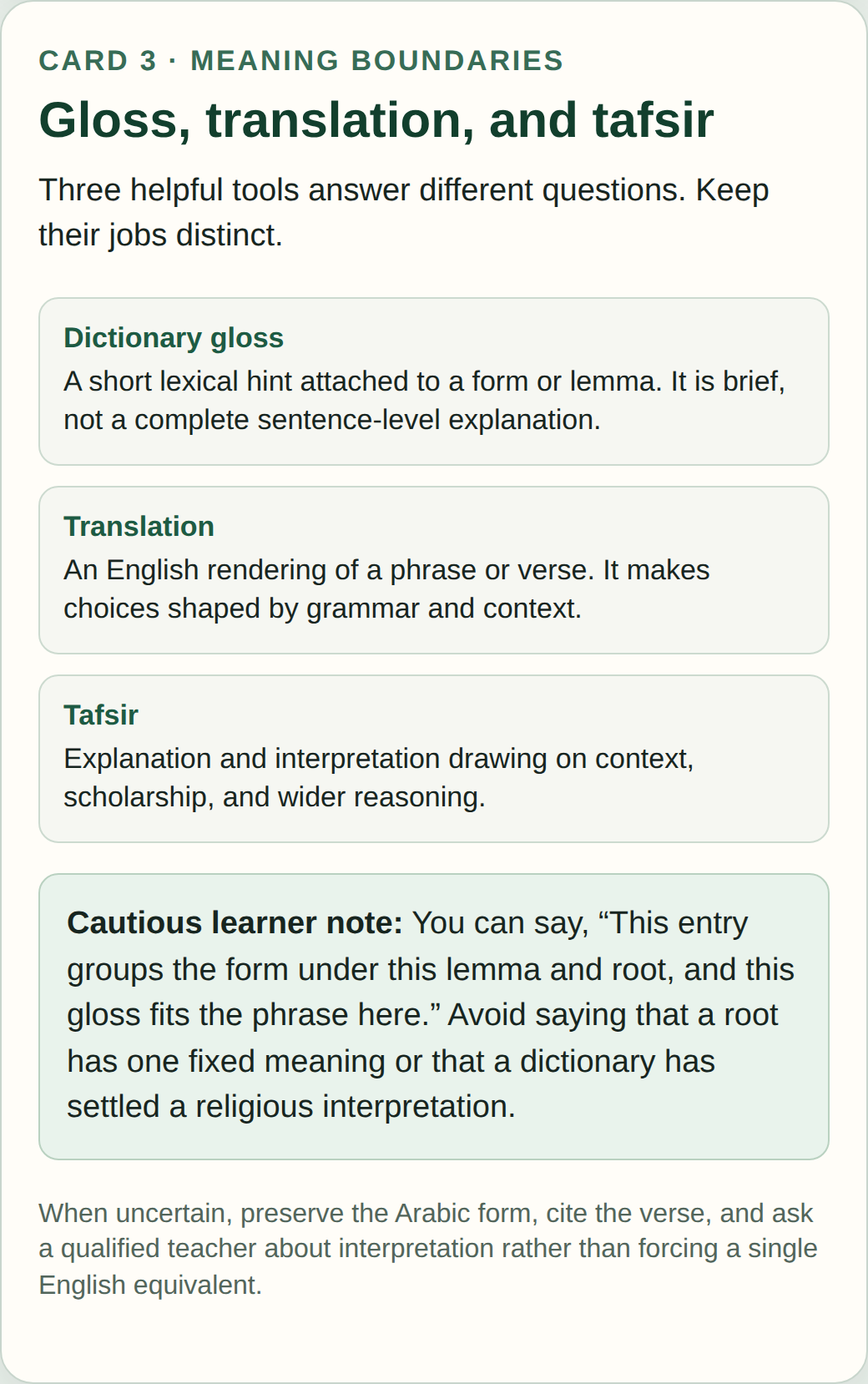
This example also shows why a dictionary is not a translation machine. The corpus describes translations as brief glosses and warns that context changes meaning. Read the entry, then read the whole phrase and verse. Do not claim that a root has one fixed meaning, and do not claim that a dictionary settles a question of tafsir or religious interpretation. For a direct lookup, use the Quran dictionary entry for root ك ت ب, then return to the verse text.
Test the full phrase and context
After you have a possible lemma and gloss, read the complete phrase around the word. Ask: what is the word doing grammatically? Is it definite, indefinite, singular, plural, active, passive, or attached to a pronoun? What words govern or describe it? Does the proposed gloss sound natural in this sentence? Are nearby verses using the same form in a related or different way?
If you remember only an English idea or a few words, verify the passage before quoting it. The guide on finding a Quran verse from remembered meaning or words can support that search. Once you locate the verse, replace the memory with the exact Arabic form and reference.
Make a small lookup notebook
Use one note per word. Write the surah and verse first. On the next lines record: exact surface form; a careful transliteration only if it helps; lemma; root if reasonably established; POS and pattern; brief dictionary gloss; your one-sentence context observation; and a question you still have. Add the date or source name when comparing tools. This keeps a useful distinction between what the reference states and what you are inferring.
A simple checklist is: copy the form, mark attached material, identify morphology, open the entry, read POS and gloss, check occurrences, test the whole phrase, and pause before interpretation. A Quran reflection journal for beginners can give you a place to keep the context observation separate from personal reflection.
What to do when the lookup feels unclear
Sometimes a search returns several possible forms, an unfamiliar transliteration, or a root you do not recognize. Start again from the verse rather than choosing the shortest English answer. Check whether a definite article, preposition, conjunction, pronoun, or case ending is attached. Then compare the displayed Arabic with your copied form one character at a time. A mismatch may be a different lemma, a different vocalization, or simply a search tool normalizing the input.
If two glosses seem possible, write both down and test each against the sentence. Look at the word’s grammatical job and the words immediately around it before consulting broader explanations. If the form is a verb, ask who or what is acting, whether the form is active or passive, and whether tense or aspect matters. If it is a noun, ask whether definiteness, number, or a governing preposition changes the natural English rendering. This disciplined pause is more useful than forcing certainty.
For study, revisit the same entry in a few different verses and note what stays stable and what changes. Stable features may include the lemma or part of speech; changing features may include inflection, voice, or contextual gloss. Your notes should make that variation visible. The aim is not to memorize a root as a translation, but to become more accurate at recognizing forms and asking better questions.
Watch a lookup, then practise
A short screen demonstration can make the sequence easier to remember: copy the form, open the entry, compare occurrences, and return to the verse. Use the player supplied with this article and pause it at each step.
If you want guided practice with reading and vocabulary, you can book a free Quran and Arabic trial class. Bring one word and its verse reference so you can practise the lookup process with feedback.
Dictionary, translation, and tafsir are different tools
A dictionary organizes word forms and gives short lexical information. A translation renders a passage into another language, often making choices that depend on grammar and context. Tafsir engages with explanation, context, scholarship, and interpretation. They can inform one another, but one cannot be substituted for another. Your safest beginner habit is to state exactly what you learned: “This entry groups this form under this lemma and root, and the verse context suggests this gloss here.”
Keep learning steadily rather than collecting isolated roots. A Quranic Arabic vocabulary study plan can help you revisit forms over time. The goal is not to force every word into a single English equivalent. It is to read the Quranic form accurately, use morphology responsibly, and let the full phrase constrain your first understanding.