
Running out of breath during a long ayah can make you feel that you must hurry, force the last words, or hold your breath until the verse ends. You do not need to turn recitation into a breath-holding test. Good breath control for Quran recitation means reading at a manageable pace, planning suitable places to pause, and restarting in a way that keeps the words connected in meaning.
This guide offers a calm practice method and a simple response for the moment your breath runs short. It is not a medical breathing program or a personal ruling about every stopping place. Use your mushaf’s pause marks and ask a qualified Quran teacher to help with places where the meaning or restart is unclear.
Do you have to finish an ayah in one breath?
No. IslamWeb’s answer to this specific question says that a reciter does not have to continue to the end of an ayah or a complete meaning when a hindrance such as running out of breath makes a pause necessary. It also explains that, when resuming, the reader should start at a permissible point so the meaning and sequence remain connected. Read its guidance on pausing when a Quranic verse will not fit in one breath. For personal circumstances or a difficult passage, ask a qualified teacher or scholar rather than treating a short article as an individual fatwa.
This matters because trying to reach the end at any cost can make you rush, blur letters, or squeeze a sound that needs its proper length. A short, thoughtful pause is better than turning the final words into a race. Learning how the stopping signs in your mushaf are explained is a useful next step, but a sign should be read in its context and according to the notation system you are studying.
Breath control for Quran recitation: what it means
In this setting, breath control is planning how much text to recite comfortably before you need air. It is not about seeing how long you can hold your breath, stretching every verse into one breath, or making your voice louder. A comfortable breath lets you finish the words you chose to read without changing their sounds just to keep going.
It helps to separate three things. Pace is how quickly you read. Breath planning is deciding where a manageable recitation phrase can end. Waqf and ibtida concern where to stop and where it is suitable to begin again. They affect one another, but a breath exercise cannot decide the meaning of a passage for you. Use teacher guidance when unsure.
If your reading speeds up near the end of a breath, return to a comfortable pace and shorten the practice phrase. Quranytime’s guide to building Quran reading fluency without rushing can help you practise steadiness separately from the question of where to pause.
Prepare a comfortable recitation phrase
Use a short passage you already know, or one your teacher has assigned. Keep your mushaf open so the written words and pause marks—not a guess based on a recording—guide the session.
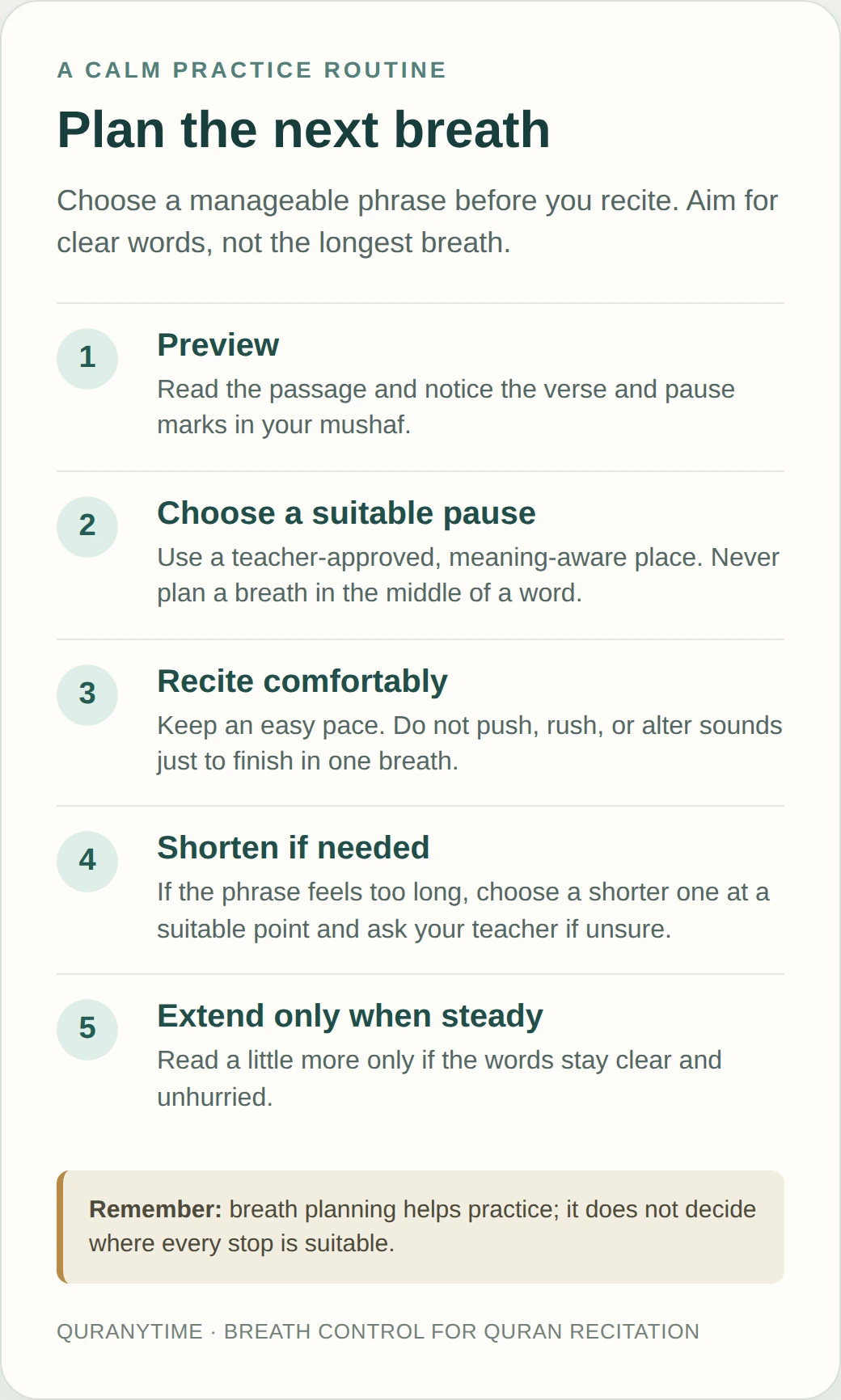
- Preview the passage. Read it silently once. Notice the verse boundaries and the pause signs in your copy. If you do not know what a mark means, note it and ask your teacher; symbols and teaching conventions should not be treated as interchangeable.
- Choose one approved pause. Mark a place your teacher has confirmed is suitable. Avoid planning to breathe in the middle of a word, and do not assume every sign or verse ending gives the same instruction.
- Recite the phrase comfortably. Breathe normally before it, relax your shoulders, and read without pushing your voice or lengthening sounds just to use more air. The goal is accurate, comfortable recitation, not a record distance.
- Shorten it if needed. If breath becomes uncomfortable before the planned pause, stop at a suitable word boundary if you can and choose a shorter phrase next time. If unsure whether the place is suitable, mark it for teacher feedback.
- Extend only when steady. Once the short phrase feels easy and accurate, try a little more text at a natural pace. If the last words become rushed, return to the shorter version. Progress means reading calmly, not avoiding every pause.
For the wider practice session, you can adapt Quranytime’s short, focused Tajweed-at-home routine. Keep the breath goal small: one assigned passage and one suitable pause to review.
Where should you pause when the breath runs short?
There is no single pause mark that solves every breath problem. The appropriate point depends on the words around it, the reading you are learning, and the conventions shown in your mushaf. A teacher can help you identify a nearby stopping point that does not leave the listener with a misleading or unfinished connection.
When planning ahead, look first for a pause your teacher has explained, then practise the preceding phrase so you can reach it without rushing. If the phrase is still too long, shorten the recitation unit at another suitable point with guidance. Do not move a stop simply because a line ends on the printed page; line layout and meaning do not always coincide.
Also keep a special pause distinct from a breath pause. A saktah is a brief, prescribed pause without taking a breath in particular locations in the Hafs reading; it is not a place to stop and take a full breath whenever you feel short of air. Quranytime’s guide to the four commonly taught Hafs saktah pauses explains that separate topic.
One way to practise listening is the listen–pause–check method for Quran audio: follow the written passage, listen to a manageable phrase, pause the audio, and read it yourself. Use a clearly identified, comfortable recording. Audio can model pace, but it cannot tell you whether a stop is suitable for your particular passage.
What to do if you unexpectedly need air
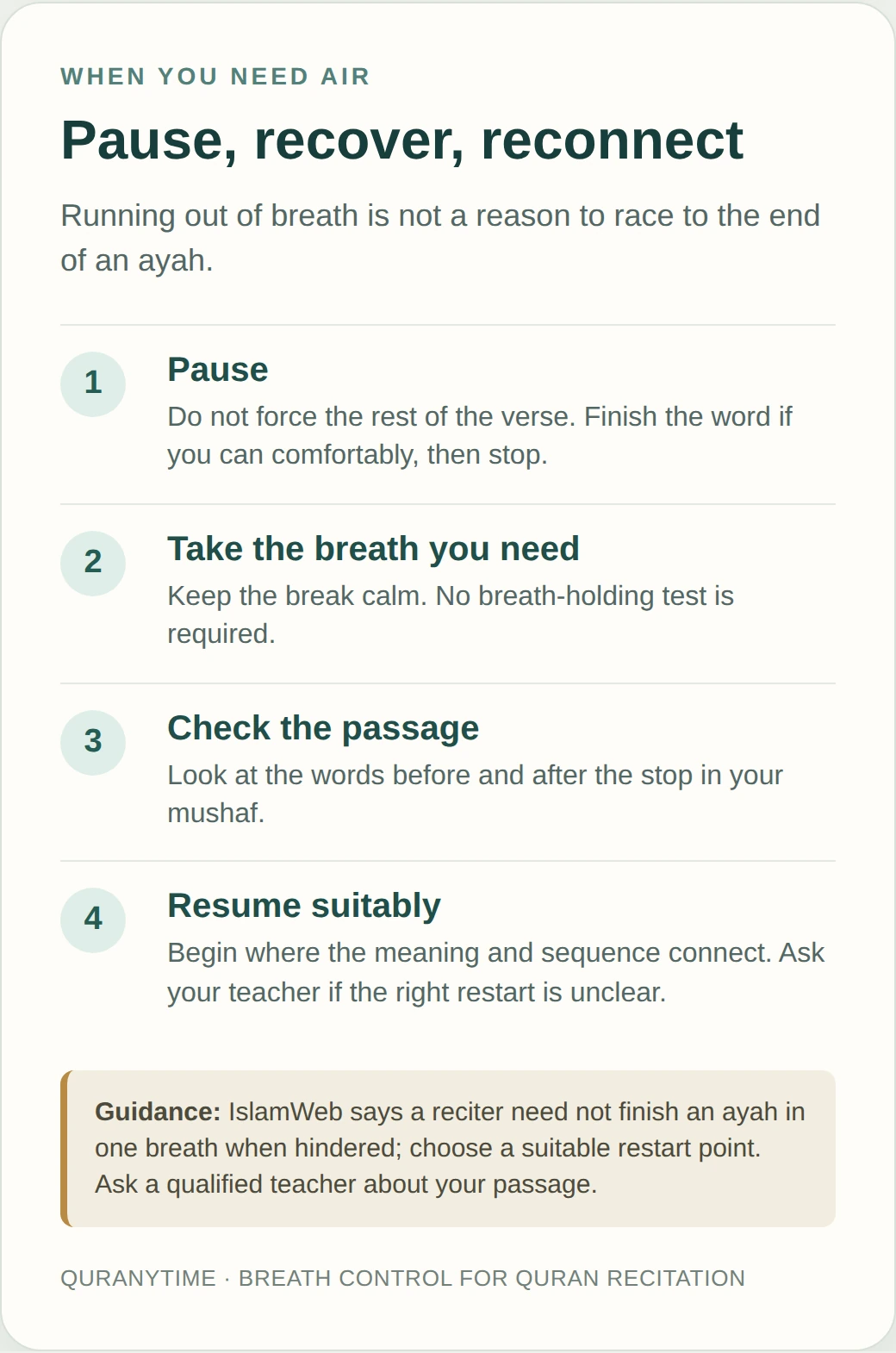
If you realise you are running short of breath, do not panic or try to force a sound. Finish the word you are reading if you can do so comfortably, pause, and take the air you need. Then consider where the reading can appropriately resume. If you do not know, ask your teacher to show you a safe restart point for that passage.
- Pause without pushing yourself to finish the whole verse.
- Recover comfortably; do not turn the break into a breath-holding contest.
- Check the preceding and following words in your mushaf.
- Resume from a point your teacher has confirmed keeps the meaning and sequence connected. If needed, repeat from an earlier suitable point rather than attaching a fragment in a confusing way.
The pause-and-resume guidance above is about preserving a sound connection, not following a rigid rule to repeat a fixed number of words. If your class uses a particular notation or practice convention, ask your teacher to explain it.
Keep Tajweed steady instead of chasing a long breath
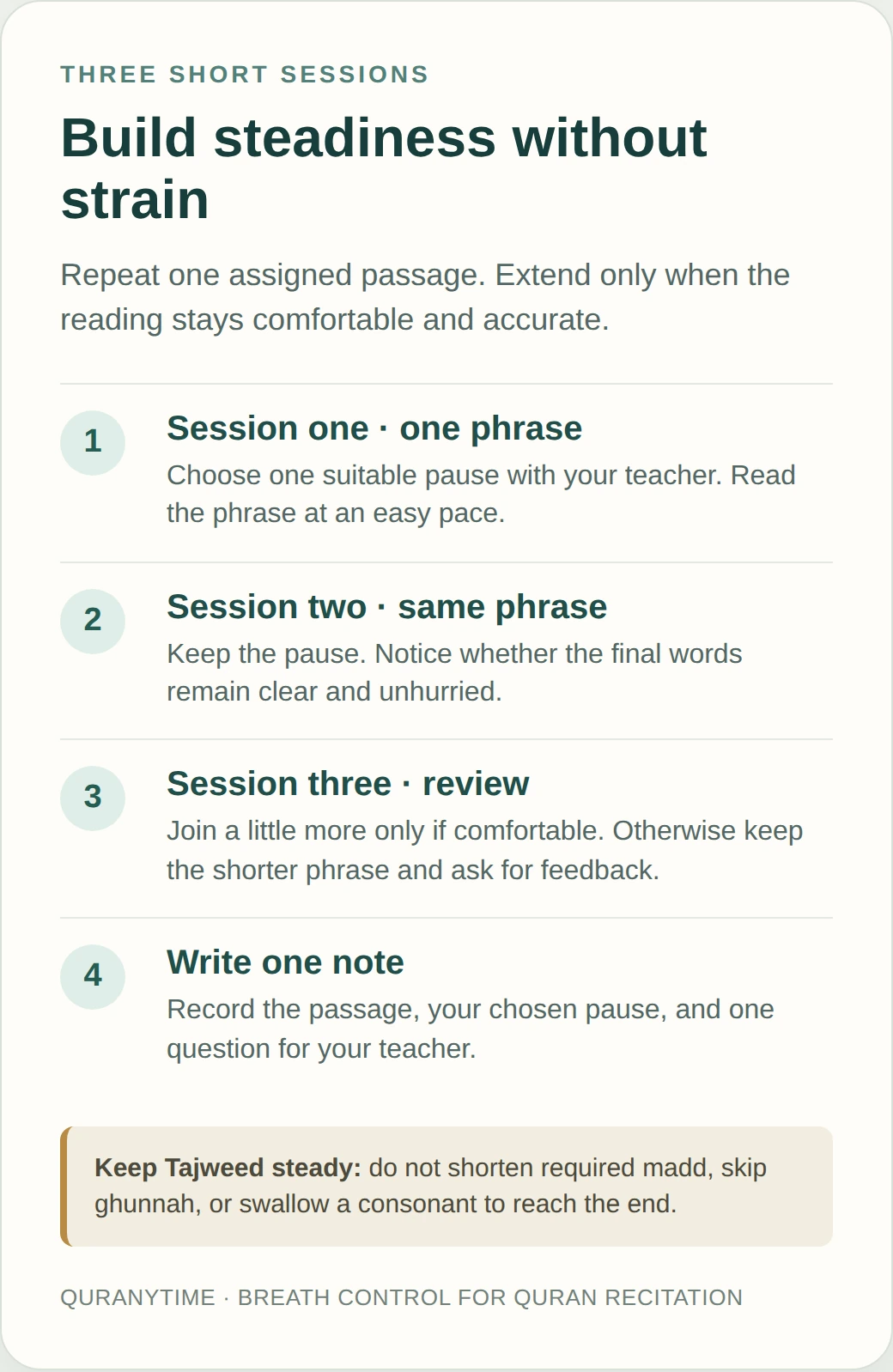
Do not shorten a required madd, skip a nasal sound, or swallow a consonant simply to reach the end of a phrase. Keep the letter and vowel clear at the pace you can manage. If you cannot complete the phrase comfortably while preserving the sound, use a shorter phrase next time or stop at a suitable point.
Likewise, do not copy a highly ornamented performance as a breath target. A reciter’s pace and melody may differ from the steady model you need for practice. Choose audio that lets you hear the words clearly, and follow the reading your teacher has assigned. If a question is about a rule rather than breath, note the word and ask about that rule directly.
A useful review tool is to record a short Quran passage for specific teacher feedback. Ask one focused question, such as whether your chosen pause is suitable or whether you rushed the ending. A recording is a prompt for feedback, not a substitute for a teacher’s correction.
A short practice plan
Practise for a few comfortable minutes rather than repeating until your voice or breathing feels strained. Begin with one passage and one phrase. Keep the first repetition slow enough to read accurately. On a second repetition, keep the same pause and notice whether the final words remain clear. Only make the phrase longer when that feels easy.
After the session, write down the passage, the pause you practised, and one question for your teacher. If the same spot repeatedly makes you rush, divide the practice into shorter parts. A simple note helps distinguish a breath-planning problem from a pronunciation question or uncertainty about the stop itself.
If you want help matching your reading pace to suitable pause points, you can book your free trial class with a Quran teacher. Bring the passage that feels difficult so your teacher can hear what happens and guide the next step.
Common questions
Should I practise holding my breath longer?
No breath-holding contest is needed for Quran recitation. Practise reading a manageable phrase calmly, and stop when you need air. This guide does not make medical claims or prescribe respiratory exercises.
Can I stop at any word if I run out of breath?
If a pause is unavoidable, do not force yourself to continue. But the place where you resume should keep the meaning and sequence connected. Ask a qualified teacher to show suitable points in the passage you are learning.
Should I breathe at every verse ending?
Not as a universal breath rule. Verse endings are visible reference points, but your pace, the next words, and the recitation guidance matter. Follow your mushaf and teacher rather than assuming every verse needs the same breathing pattern.
Make comfort and meaning part of the practice
Plan a short phrase, read it at an easy pace, and lengthen the practice only when its words remain clear. If breath runs out, pause rather than rushing, then resume from a point that keeps the passage connected. A teacher can help you choose those points and preserve Tajweed while you build steadier recitation.