
Starting a Quran recitation can involve more than opening the mushaf and reading the first word. Readers often ask how to say the istiʿādhah and basmalah, whether to pause between them, and what changes when they move from one surah to the next. This guide explains the commonly taught Hafs ʿan ʿĀṣim sequence in plain language, with a simple practice method. It is a reading guide, not a legal ruling or a substitute for a teacher listening to your recitation.
Quick answer: before beginning a recitation, the reader seeks refuge with Allah, then says the basmalah when starting most surahs. There are four recognized ways to pause or join the istiʿādhah, basmalah, and first verse. Between most surahs, the basmalah is read in three accepted connection patterns; the fourth possible pattern is avoided. At the transition from Al-Anfal to At-Tawbah, the basmalah is not inserted. Learn the pattern your teacher uses and apply it consistently.
First, distinguish a session opening from a surah opening
Two moments can look similar on the page but answer different questions. The istiʿādhah is the seeking-refuge phrase recited before reading the Quran; An-Nahl 16:98 tells the reader, “When you recite the Quran, seek refuge with Allah from Satan, the accursed.” The basmalah is the phrase “In the name of Allah, the Most Compassionate, the Most Merciful.” In the Hafs reading practice described here, it is said before the opening of each surah except At-Tawbah.
If you begin a session at the start of a surah, you are dealing with all three pieces: istiʿādhah, basmalah, and the opening verse. If you reach another surah during the same continuous reading, the question is how to connect the end of the previous surah, the basmalah, and the new opening. At-Tawbah is the familiar exception. Starting from the middle of a surah is a separate practical case; do not assume that every session or stopping situation uses an identical sequence. Follow the mushaf and the specific instruction given by a qualified Quran teacher.
This distinction also helps keep a historical question separate from a recitation exercise. Quranytime’s article on why Surah At-Tawbah begins without the basmalah discusses the written opening and the early report about the surah’s arrangement. The present guide focuses on what a learner does when starting or connecting a reading.
Four ways to begin with istiʿādhah and basmalah
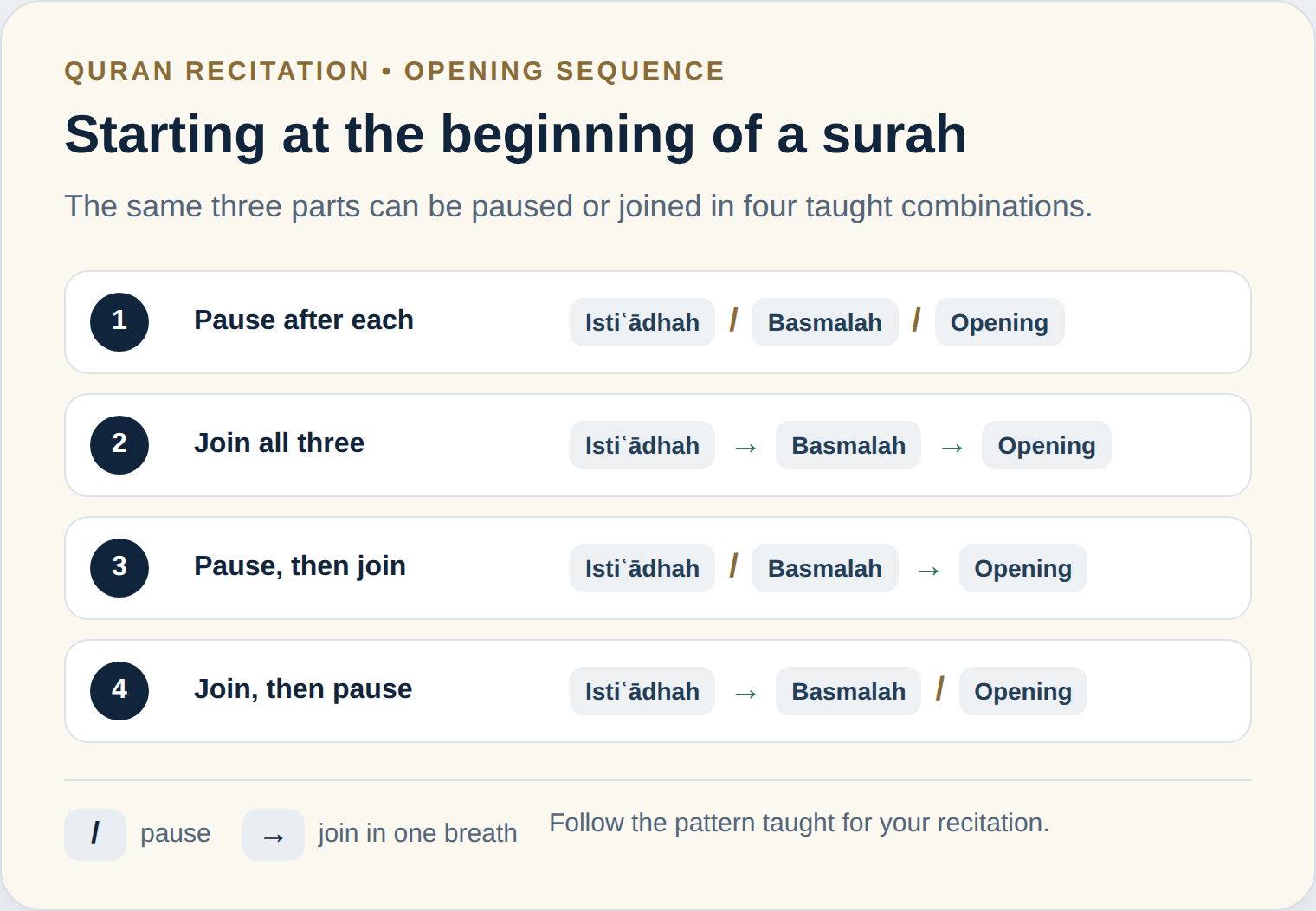
When you start at the beginning of a surah, the three elements are the istiʿādhah, the basmalah, and the surah’s first words. In a lesson, teachers often describe a pause as a stop that gives you a breath, and a join as continuing smoothly in the same breath. Using “/” for a pause and “→” for a join makes the four patterns easier to compare:
- Pause after each part: istiʿādhah / basmalah / opening verse. Each phrase is kept separate.
- Join all three: istiʿādhah → basmalah → opening verse, continuing without a pause between them.
- Pause after the istiʿādhah, then join the rest: istiʿādhah / basmalah → opening verse.
- Join the first two, then pause: istiʿādhah → basmalah / opening verse.
These are patterns for connecting the phrases, not four different wordings. Read every word and vowel according to the mushaf and the recitation you are learning. A visible pause is meaningful: if you join two parts, use the connected reading taught by your teacher rather than silently changing the final sound as though you had stopped. If you pause, apply the proper stopping form. Learners wanting a broader foundation can review the beginner’s guide to Tajweed rules in the Quran.
Which pattern should a beginner choose? Follow the one demonstrated in your class. Pausing between the parts can make the sequence easy to hear while you are learning; joining requires careful attention to the ending and the first word that follows. The goal is not to perform a complicated breath pattern. It is to keep the phrases in the right order and recite them accurately. Ask the teacher to model the version expected in your reading tradition before trying all four.
What happens when you move between two surahs?
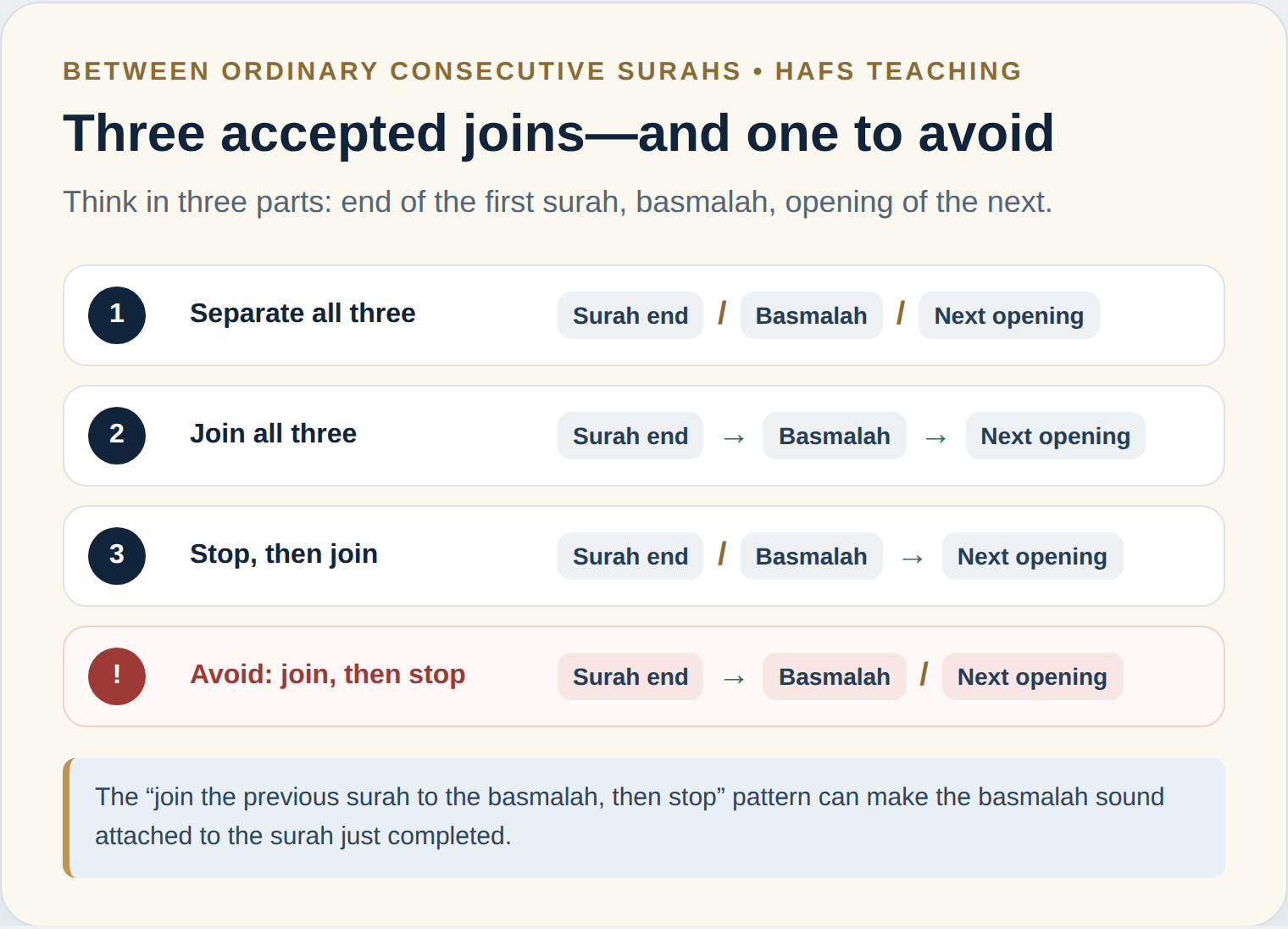
When a reader finishes one surah and continues directly into the next, the basmalah normally appears between them in the Hafs practice described by specialist Tajweed references. There are three accepted ways to handle the boundary:
- Separate all three: stop after the final verse of the first surah, recite the basmalah and stop, then begin the next surah.
- Join all three: connect the end of the first surah to the basmalah and continue into the next surah in one breath, observing the appropriate connected reading.
- Stop, then join the basmalah to the next surah: complete the first surah and pause; then recite the basmalah and continue into the opening of the following surah.
There is one joining pattern to avoid: do not attach the end of the previous surah to the basmalah, then stop before the next surah. That pause can make the basmalah sound as if it belongs to the surah just completed. Remember the boundary as three parts—end of previous surah, basmalah, opening of next—and practise only the transitions your teacher has shown you.
Ending a verse and joining the next phrase also means attention to breath and stopping signs. A pause mark in the mushaf and a breath you take for comfort are not automatically the same thing. Quranytime’s guide to six Quran waqf signs explains how to read common stop symbols, while its article on breath control without rushing covers pacing and choosing a manageable place to pause.
The special transition from Al-Anfal to At-Tawbah
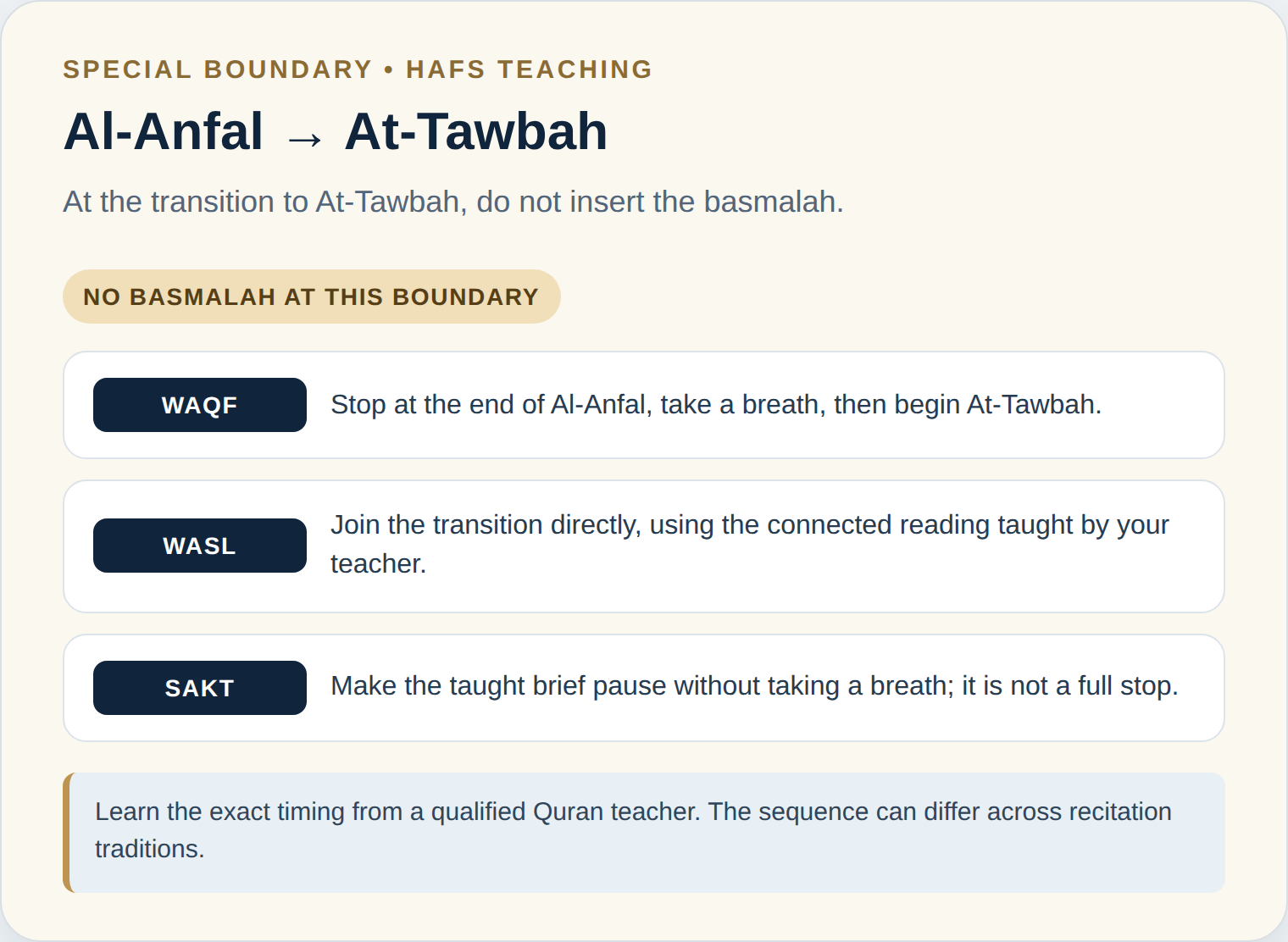
At the beginning of At-Tawbah, the printed mushaf does not place a basmalah before verse 9:1. For that reason, do not insert the basmalah between Al-Anfal and At-Tawbah when you reach the transition. The two surahs are adjacent in the mushaf, but the usual “previous surah, basmalah, next surah” pattern does not apply at this boundary.
In the commonly taught Hafs method, teachers describe three ways to make this transition: stop and take a breath after Al-Anfal before starting At-Tawbah; join the final passage of Al-Anfal directly to the opening of At-Tawbah; or make the taught short breathless pause, called sakt. The exact performance should be demonstrated by your teacher. A sakt is not the same as an ordinary stop with a breath, and it should not be improvised wherever you want. Quranytime’s Hafs guide to the four Quran saktahs explains the distinction between a breathless pause and a full stop.
If you are asking why At-Tawbah has no prefixed basmalah, that is a different question from how to read into it. Keep the two questions distinct and use a teacher for the recitation method being practised. This avoids confusing the historical explanation of a page layout with a rule about joining the words aloud.
A short practice routine for a new surah
Practise with a short, familiar surah such as Al-Ikhlas followed by Al-Falaq. First identify the three parts on paper: the end of Al-Ikhlas, the basmalah, and the opening of Al-Falaq. Ask your teacher to read one correct example slowly. Then mark the pauses with slashes and the joins with arrows. Work through the three permitted patterns for moving between ordinary consecutive surahs, one at a time; do not try to change the pattern halfway through a breath.
Next, listen once without reading, then follow in the mushaf. Recite the boundary at a comfortable pace. If you stop, make a clear stop and take the breath you need; if you join, keep the flow and follow the connected endings shown by your teacher. Record a short sample only if your teacher has invited recordings for feedback. The aim is to make the boundary accurate and steady, not to imitate a professional reciter’s breath length.
When you are learning a new stopping sign or transition, use a small practice loop: name the three parts, choose one taught pattern, recite it, and check where you breathed. The Quranytime guide on practising Tajweed at home between lessons offers ideas for keeping review short and repeatable. If you are unsure what you heard, write down the exact surah pair and ask your instructor; these tips for asking your Quran teacher can help you describe the point clearly.
Common mistakes to avoid
- Confusing the two phrases: istiʿādhah and basmalah have different places in the sequence. Keep their names and order clear.
- Adding a basmalah before At-Tawbah: in this Hafs transition, the basmalah is omitted. Do not confuse that with the separate question of why the surah’s written opening differs.
- Using the forbidden “join, then stop” boundary: between ordinary surahs, do not join the previous ending to the basmalah and then pause before the next opening.
- Treating a sakt as a breath stop: a brief breathless pause is not interchangeable with stopping and inhaling. Learn its timing from a recitation teacher.
- Making every pause the same: a verse-end stop, a printed waqf sign, a breath break, and a sakt do not all mean the same thing. Use the relevant rule rather than guessing.
- Over-focusing on speed: rushing can blur the phrase boundary. Tartil and measured recitation are helpful reminders to keep a calm, deliberate pace.
Rules of joining are best heard as well as read. The video below gives a lesson on istiʿādhah and basmalah combinations and common mistakes. Use it as a listening aid, then confirm the version you follow with your own qualified teacher. You can book your free Quran and Arabic trial class to ask about your starting sequence and receive guidance suited to your level.
One reliable way to remember the sequence
For a new session at a surah opening, think: istiʿādhah, basmalah, surah. Choose one of the four taught ways to pause or join those pieces. When continuing between ordinary surahs, think: previous ending, basmalah, next opening—and use one of the three accepted patterns, not the join-then-stop pattern. When reaching At-Tawbah after Al-Anfal, leave out the basmalah and follow the taught stop, join, or sakt method. If your mushaf, qira’ah, or teacher gives a specific approach, follow that rather than combining instructions from unrelated tutorials.
For one specialist teaching resource that covers the opening combinations and links to the related between-surah lesson, see AboutTajweed’s section on seeking refuge and the basmalah in recitation. Different recitation traditions can have distinct details, so the examples in this article are deliberately framed around the commonly taught Hafs practice, not every qira’ah.