

Surah At-Tawbah is the only surah in the Qur’an whose printed opening does not begin with Bismillahir-Rahmanir-Rahim. The careful answer is that the visible Mushaf gives us this fact, while the strongest early report about its arrangement describes how the Companions handled the relationship between Al-Anfal and Bara’ah (At-Tawbah). Later explanations often connect the missing prefixed basmala with the surah’s stern opening, but that reflection should not be presented as a single definitively established reason. In this article, we will separate what you can see on the page, what was reported about the compilation, and what readers have inferred from the surah’s message.
What is unusual about the opening?
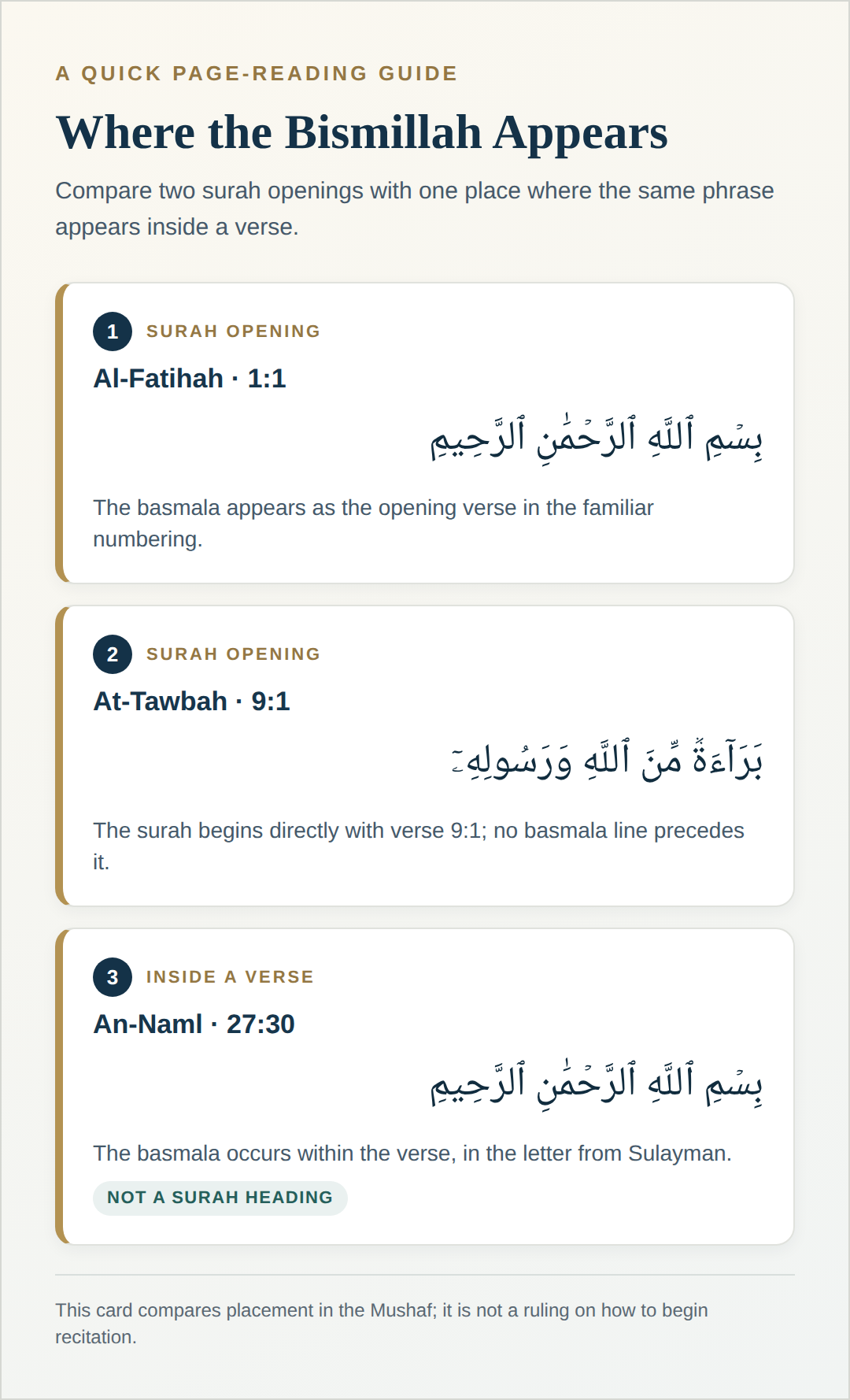
Most readers meet a surah after the basmala has been written above its first verse. Al-Fatihah, for example, begins with the basmala as its first verse in the familiar numbering tradition. At-Tawbah is different: its first displayed words are بَرَآءَةٞ مِّنَ ٱللَّهِ وَرَسُولِهِۦٓ, meaning a declaration of disavowal from Allah and His Messenger. There is no basmala line before verse 9:1 in the Mushaf.
That does not mean the basmala is absent from the Qur’an. It appears at the beginning of other surahs and also inside the Qur’anic text. An-Naml 27:30 includes the basmala within the letter of Sulayman, rather than as a separate heading before a surah. The page-level difference is therefore specific and meaningful to observe: At-Tawbah has no prefixed basmala, while the basmala remains part of the Qur’anic text elsewhere.
What does the early report say?
The clearest well-known explanation comes from a report of Ibn Abbas asking Uthman ibn Affan about two matters: why Al-Anfal and Bara’ah were placed together, and why the basmala was not written between them. Uthman explained that the Messenger of Allah received revelations over time, and that when verses came to him, he directed the scribes where they belonged. Al-Anfal and Bara’ah appeared similar in subject matter, and the distinction between them was not made clear to the Companions in the same way as the boundaries of other surahs. Because of that apparent connection, they were placed next to one another without a basmala line separating them.
This report is recorded in Jami’ at-Tirmidhi 3086, where the report is labelled Hasan. It is important to describe its scope accurately. It gives a recorded account of how Uthman explained the arrangement and the absence of the written basmala between the two surahs. It does not turn every later spiritual interpretation into a historical fact, nor does it require us to claim knowledge of an unseen intention beyond what the report conveys.
Readers who want to place the question within the Qur’an’s larger structure may find it useful to review how many surahs the Qur’an contains and how surah order differs from the order in which revelation came. Looking at the whole arrangement can help us notice the text without forcing a simple slogan onto one unusual page.
Why do people connect it with the surah’s tone?
At-Tawbah opens with a serious public declaration concerning treaties, accountability, and the conduct of groups in conflict with the Muslim community. For that reason, scholars and teachers have often offered a rhetorical reflection: the usual expression of mercy is not written before this surah because its opening establishes warning, separation, and firm judgment. This can be a meaningful way to reflect on the contrast between the openings.
Still, tone-based explanations belong in the category of interpretation and reflection. The page itself tells us that there is no prefixed basmala. The report from Uthman tells us about the apparent similarity of Al-Anfal and Bara’ah and the decision not to write a separating line. A later explanation about sternness may illuminate how a reader experiences the opening, but it should not replace the historical report or be stated as though it were the only confirmed cause.
For a reflective explanation that discusses the hadith account alongside spiritual meaning, you can watch Dr. Omar Suleiman’s Yaqeen Institute video on the surah without Bismillah. Treat it as a reflective teaching resource, not as a substitute for distinguishing the Mushaf’s visible evidence from later commentary.
What are you seeing on the page?
When you open a printed Qur’an at At-Tawbah, the practical observation is simple: the surah heading is followed by verse 9:1, not by a separate basmala line. This is not a printing mistake, a missing page element, or evidence that a copy has been damaged. It is the standard presentation of this surah in the Mushaf.
Script styles can make the page look different from one edition to another. Spacing, verse markers, calligraphic forms, and the placement of headings may vary. If you compare an Uthmani edition with an Indo-Pak edition, this guide to Qur’an scripts can help you understand why the visual layout is not identical. Those typography differences do not add a basmala before At-Tawbah.
The same principle applies when reading digitally. A Qur’an app may display a surah title, navigation controls, or translation before the Arabic text. Look specifically at the Arabic opening: At-Tawbah begins with its first verse. If you are studying juz, hizb, and rub’ divisions, remember that reading divisions are useful navigational markers; they are not a reason to insert a basmala where the Mushaf does not place one.
Does this change how you should recite?
This article is not a ruling on every learner’s exact starting or connecting practice. Questions about whether to begin with isti’adhah, how to connect At-Tawbah to the preceding surah, and what to do in a particular lesson can depend on the recitation method being taught and the teacher’s instructions. Ask a qualified Qur’an teacher who can hear your reading and explain the convention you are following. Quranytime’s guide on asking your Qur’an teacher better questions may help you prepare a clear, specific question.
For the reading itself, keep the focus on accurate letters, vowels, stopping, and joining. A calm approach to tartil and measured recitation is more useful than becoming anxious about a page that looks unusual. If a teacher recommends a particular way to start, follow that instruction consistently instead of collecting disconnected online opinions.
Common misconceptions and quick answers
Is At-Tawbah missing part of the Qur’an?
No. The absence of a prefixed basmala is a known feature of the surah’s printed opening, not a printing omission; the surah begins with verse 9:1.
Is there never a basmala anywhere near At-Tawbah?
The careful statement is that there is no basmala written before At-Tawbah as a surah heading. That should not be confused with the basmala appearing elsewhere in the Qur’an, including within An-Naml 27:30.
Does the stern subject prove the reason?
It supports a thoughtful reflection about tone, but it does not by itself prove a historical explanation. Keep the surah’s subject, the early report, and later interpretive comments in their proper categories.
Should I avoid studying this surah because its opening feels severe?
No. Read it with guidance, context, and humility. The Qur’an contains passages of mercy, warning, law, promise, and accountability. A reflection journal can help you process difficult or weighty passages; see this beginner’s guide to Qur’an reflection journaling for a simple way to record questions and lessons.
Can tajweed or sajdah rules explain the missing basmala?
No. Tajweed concerns how the revealed Arabic is pronounced, while this question concerns the written opening and the history of its arrangement. For pronunciation practice, use a structured Qur’an tajweed guide. For prostration questions, consult a teacher and a reliable reference such as this beginner’s guide to sajdah tilawah; neither topic supplies a reason to add a basmala before At-Tawbah.
A balanced way to remember it
Remember three layers. First, the visible Mushaf fact: At-Tawbah 9:1 does not have a basmala before it, while Al-Fatihah begins with one and An-Naml 27:30 contains one within the verse. Second, the recorded historical report: Uthman connected the placement of Al-Anfal and Bara’ah with their apparent similarity and the absence of a clearly marked distinction, as recorded in the hadith cited above. Third, the later reflection: many teachers connect the surah’s forceful opening with the absence of the usual prefixed phrase, but that is an interpretive lens rather than a reason we should state with unwarranted certainty.
Approached this way, the unusual opening becomes an invitation to read carefully. Notice what is actually on the page, learn what the early report says, and ask a qualified teacher when your question turns from observation into recitation practice. That combination protects accuracy while leaving room for sincere reflection.