
If Arabic ض (Dhad, also written Ḍād or Daad) keeps coming out like an ordinary “d,” you are not alone—and louder practice will not fix it. The key is to start from the letter’s articulation point, then compare it with nearby sounds while keeping the same vowel and pace. This guide focuses on Quran recitation: where the tongue goes, how ض differs from د and ظ, and how to practise with familiar Quran words.
If you are new to the script, begin with this complete Arabic alphabet overview. Here we will work on one sound in detail rather than repeating a general alphabet chart.
The short answer: where is Dhad pronounced?
For ض, the side edge of the tongue makes contact with the upper back teeth, around the molar area. The contact is lateral—not the tongue tip placed behind the front teeth, which is a common way English speakers form a “d.” Tajweed teachers may guide a learner to use the left or right side; choose the side that lets you make the sound clearly and comfortably, then ask a qualified teacher to check it.
Dhad is also a heavy letter, so its sound should not collapse into a light د. But “make it heavy” does not mean push hard, round the lips, or force a dramatic sound. The goal is the correct place and quality, not volume. A reference on Dhad articulation also describes ض at the tongue’s side against the upper molars and discusses its distinctive letter quality.
Keep two questions separate as you practise: where does the tongue touch (the makhraj), and how does the sound behave (its sifah)? Quranytime’s guide to the 17 Tajweed articulation points gives the broader map; its explanation of letter qualities such as istiʿlāʾ and istitalah explains why place alone is not the whole lesson.
Find the makhraj without forcing the sound
Try this slow setup before reading a full word:
- Relax your jaw and lips. Keep the lips neutral. Do not shape the mouth as if you were trying to imitate an English “th.”
- Locate the side of the tongue. Bring one side toward the upper molars. The precise contact can feel unfamiliar at first; work gently rather than clamping the teeth or pressing painfully.
- Keep the tongue tip out of the job. If the tip is striking the front teeth, reset. That front placement can pull the sound toward a different Arabic letter.
- Use one short vowel at a time. Practise ضَ, ضِ, and ضُ at a steady pace. Keep the vowel clear and do not add an extra vowel after the consonant.
- Listen, then copy. Use a reliable Quran reciter or a teacher’s demonstration. A written transliteration is only an approximation; it cannot show tongue contact.
Some Tajweed lessons describe a characteristic of ض called istitalah. It is associated with the letter’s lateral articulation; it is not an instruction to stretch the following vowel or hold the word for an extra beat. Keep the sound connected to its proper articulation and follow your teacher’s model, especially if your local recitation tradition uses a particular teaching cue.
Dhad versus Daal versus Dhaa
These three letters can blur together when a learner relies only on an English spelling. Look at the Arabic letter and tongue position instead:
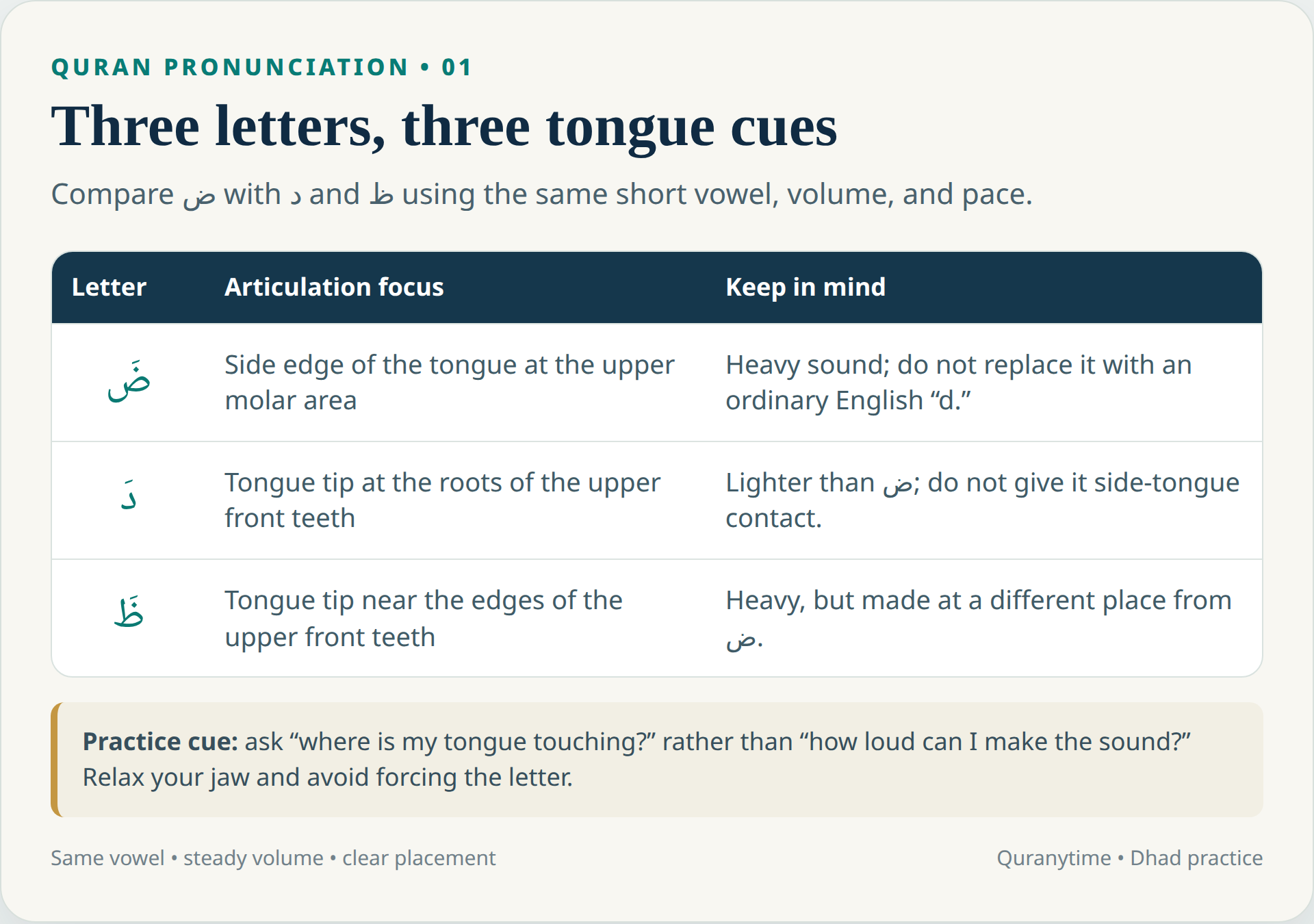
| Letter | Where to focus | Common mix-up |
|---|---|---|
| ض (Dhad/Ḍād) | Side of the tongue at the upper molar area; heavy sound | Replacing it with a plain English-style “d” |
| د (Daal/Dāl) | Tongue tip at the roots of the upper front teeth; lighter than ض | Giving it the side-tongue contact of ض |
| ظ (Dhaa/Ẓāʾ) | Tongue tip near the edges of the upper front teeth; emphatic | Confusing the front-tongue placement with ض |
For a fair comparison, say each letter with the same short vowel and similar volume: ضَ, دَ, ظَ. Pause after each one and ask: did the side of my tongue make the contact for ض, or did I move the tip forward? Do not judge by whether your English ear hears a “stronger d.” English has no exact match for every Arabic articulation, and transliteration systems differ: you may see Dhad, Daad, Ḍād, or Ḍāḍ. The Arabic symbols are the reliable guide.
Heaviness is also not simply “saying it louder.” If you need a refresher on how Tajweed describes heavy and light letters, see the site’s guide to heavy letters and their levels.
Practise Dhad inside Quran words
Once the isolated sound feels less awkward, move into words. Start slowly, preserve the vowel marks, and read the whole word rather than stopping on ض each time.
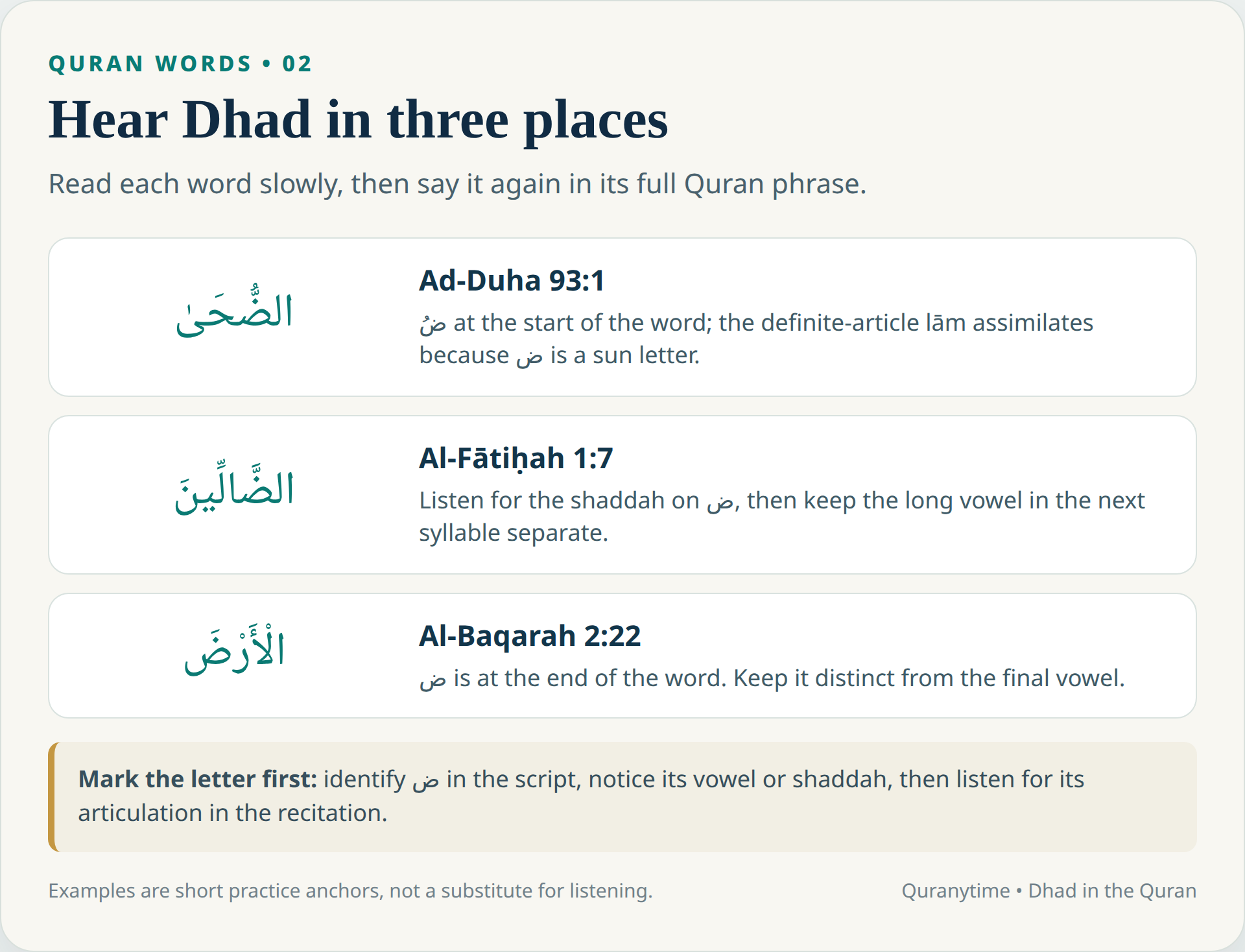
- الضُّحَىٰ — aḍ-ḍuḥā, “the morning brightness” (Surah Ad-Duha, 93:1). The letter ض begins the word after the definite article. Because ض is a sun letter, the written lām is assimilated in recitation; keep the shaddah clear without adding a separate lām sound.
- الضَّالِّينَ — aḍ-ḍāllīn, “those who are astray” (Surah Al-Fātiḥah, 1:7). Notice the shaddah on ض and keep the long vowel in the following syllable separate from the consonant itself.
- الْأَرْضَ — al-arḍa, “the earth” (Surah Al-Baqarah, 2:22). Here ض is at the end of the word. Keep it distinct from the final vowel; do not turn it into a prolonged “d” or add a trailing syllable.
These examples let you hear ض in different positions and neighbouring sounds. Use a marked mushaf, listen to a trusted recitation, then repeat a short portion at a comfortable pace. If you are building a routine, this guide to practising Tajweed between lessons can help you keep repetitions focused instead of tiring your mouth with long drills.
Common mistakes—and a simple correction
- Making ض like an ordinary d. This often happens when the tongue tip moves to the front teeth. Return to the tongue side and upper molar area; do not compensate by increasing volume.
- Making ض like ظ. Both are heavy, but their articulation points differ. For ض, think side of tongue; for ظ, the tongue tip approaches the upper front teeth.
- Pressing so hard that the sound is strained. Correct contact should be controlled, not painful. Relax the jaw and use a teacher’s sound model rather than forcing a “thick” noise.
- Adding a vowel after the letter. A short echo such as “ḍa-a” changes the syllable. Keep the consonant attached to the vowel that is actually written.
- Trusting transliteration over the Arabic script. English spellings vary and can hide the difference between ض, د, and ظ. Look at the Arabic letter, its mark, and the word around it.
Pronunciation difficulty is normal when a sound is unfamiliar. Quranytime’s guide to Quran pronunciation challenges for English speakers explains why listening and careful repetition are more helpful than trying to copy a familiar English consonant.
A short practice routine
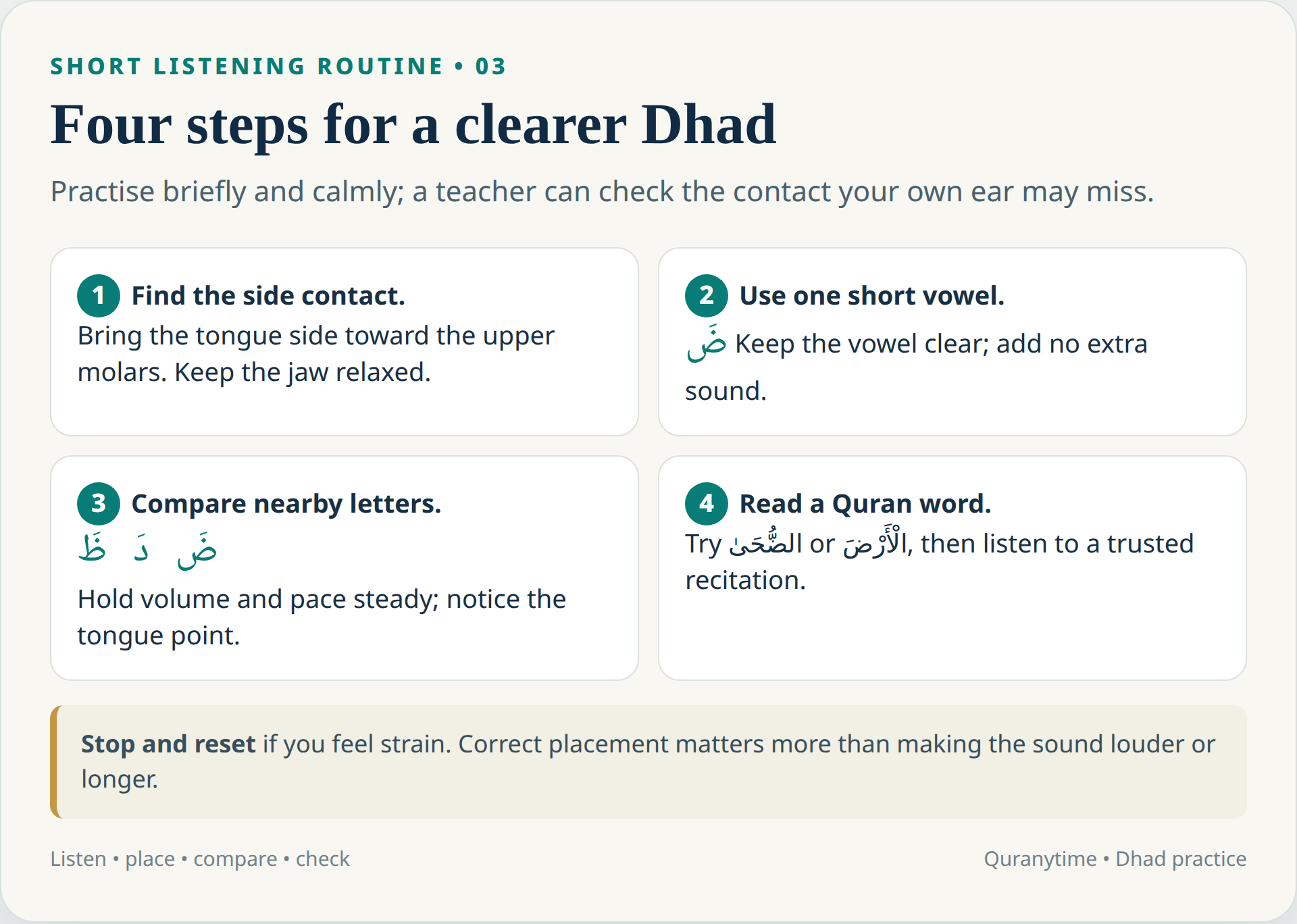
Keep the first practice brief—about five minutes is enough. First, listen to a reliable model for ض in a Quran word. Next, repeat the isolated letter with one vowel, then compare it with د and ظ using the same vowel. Move to one example word, read it in context, and finish by listening again. Stop if your jaw or tongue feels tense; accuracy improves through relaxed, attentive attempts.
For useful feedback, record a short recitation rather than an isolated “sound test” only. The guide to recording Quran recitation for teacher feedback can help you capture a passage clearly and ask a focused question about one sound. A teacher can tell you whether the contact is correct in a way a phone recording or transliteration cannot.
Frequently asked questions
Is Dhad the same as the English letter D?
No. Some learners use “d” as a rough memory aid, but ض has its own articulation and heavy quality. Do not rely on the English letter to tell you where to place the tongue.
Can I pronounce Dhad with either side of the tongue?
Many Tajweed explanations allow the left or right side. A teacher can help you find the side that produces a clear, repeatable sound without strain. The goal is not to force both sides at once.
Is Dhad the same as Dhaa (ظ)?
No. ض is Dhad/Ḍād; ظ is Dhaa/Ẓāʾ. Both are heavy, but they are made at different tongue positions. Practise them as separate letters and follow a qualified teacher’s correction.
Get feedback on your Quran pronunciation
When you can hear a difference but are unsure whether your own ض is clear, ask for correction instead of repeating the same uncertain sound for a long time. You can book a free Quran and Arabic trial class and ask the teacher to listen to a short example such as الضُّحَىٰ or الْأَرْضَ. A few careful corrections can make home practice more useful.