
A full stop, comma, or question mark can tell an Arabic reader how one idea relates to the next. It can also prevent a practical misunderstanding: is a sentence asking for a lesson time, confirming one, or listing several options? This guide treats punctuation as a tool for making modern Arabic writing clear, with short messages and editing exercises you can use immediately.
This is a guide to ordinary Modern Standard Arabic prose. Quranic stopping signs belong to a different notation system with recitation guidance; do not replace them with email punctuation or infer a tajweed rule from a comma. Likewise, a writer’s house style may allow choices that differ from the beginner models here. The aim is consistent, readable communication rather than decorating every line.
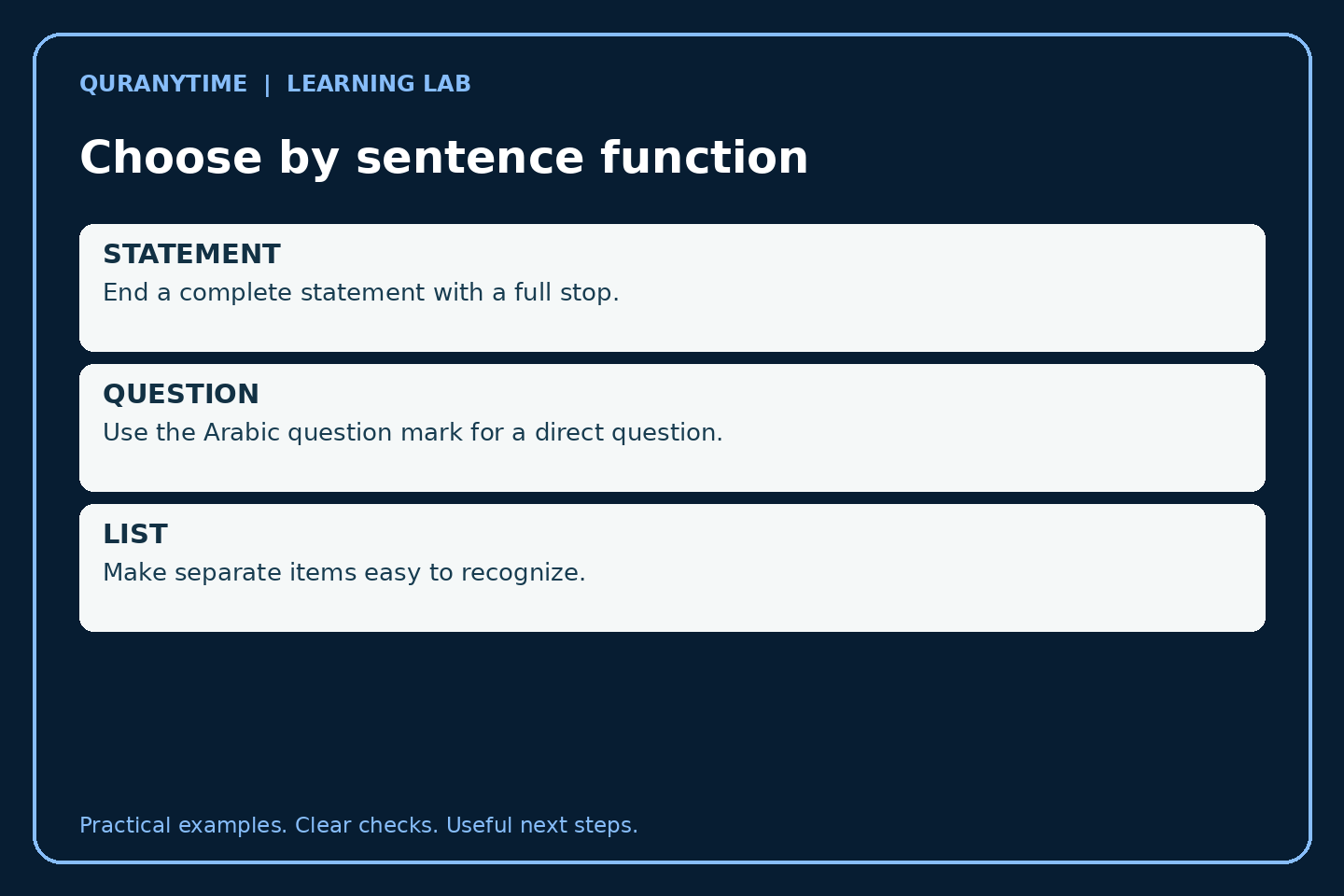
Meet the marks through their jobs
| Mark | Useful beginner job | Example |
|---|---|---|
| . | End a statement | الدرس قصير. — The lesson is short. |
| ، | Separate items or related parts | قلم، وكتاب، ودفتر — A pen, a book, and a notebook |
| ؟ | End a direct question | أين الكتاب؟ — Where is the book? |
| : | Introduce an explanation or list | المطلوب: قلم ودفتر. — Required: a pen and a notebook. |
| ؛ | Separate closely connected clauses where the relationship warrants it | Use after you can explain the connection |
| « » | Mark quoted wording in a style that uses these quotation marks | قالت: «نعم». — She said, “Yes.” |
The Arabic comma ، and question mark ؟ differ in shape from their English counterparts. A period and colon are familiar shapes, although mixed-direction text can change where they appear on screen. Learn the marks in complete short sentences rather than memorizing isolated symbols. Your reader needs to recognize the sentence’s function, not admire a collection of punctuation.
The primary professional Unbabel Arabic style guidance is a neutral reference for common modern punctuation conventions. A publication’s own style guide may be more specific. For learner work, choose one convention and apply it consistently instead of mixing several layouts in a paragraph.
Begin by finding the sentence boundary
Read this unpunctuated note: الدرس اليوم أحضر كتابك هل أنت مستعد. The three units are “The lesson is today,” “Bring your book,” and “Are you ready?” A practical edit is: الدرس اليوم. أحضر كتابك. هل أنت مستعد؟
The punctuation makes the note easy to follow, but the editor first had to identify its meanings. If you cannot tell where one thought ends, adding a comma at every pause will not solve the problem. Read each proposed sentence by itself. Does it communicate a complete statement, instruction, or question in this context?
For help distinguishing sentence patterns, use our Arabic nominal-sentence lesson and verbal-sentence lesson. You do not need advanced grammatical terminology to edit a short message, but understanding who did what makes sentence boundaries less arbitrary.
A boundary test
Place a vertical line where you think a sentence ends: أنا طالب جديد أتعلم العربية أين الصف. Then add final punctuation. A reasonable answer is أنا طالب جديد. أتعلم العربية. أين الصف؟ — I am a new student. I am learning Arabic. Where is the classroom? You could combine the first two statements with a suitable conjunction, but the final direct question still needs its own clear ending.
Use a question mark for an actual question
Compare متى الدرس؟ — When is the lesson? with الدرس يوم الاثنين. — The lesson is on Monday. The first asks for information; the second supplies it. Beginners sometimes add a question mark to a sentence merely because it contains a question word somewhere. Instead, ask whether the writer is directly asking the reader something.
Our Arabic question words guide helps you practise that distinction with short examples. Read a direct question aloud, then answer it in a complete statement. Write both. This pairs the mark with a communicative action and discourages the habit of guessing from the last word.
Rhetorical questions, quoted questions, and indirect questions introduce more choices. Leave those for a later lesson if you are still editing short everyday messages. A beginner can write accurately by choosing simpler structures. Clarity does not require every sentence to contain several layers of reported speech.
Make a comma earn its place
A comma can separate a short list: أحتاج إلى قلم، وكتاب، ودفتر. — I need a pen, a book, and a notebook. The mark helps the reader see the items. It does not mean you should insert a comma inside every noun phrase or before every conjunction.
Compare الكتاب الجديد — the new book — with الكتاب، الجديد. The second disrupts an ordinary phrase when no special context calls for that separation. If your draft contains a comma between an adjective and the noun it describes, examine it carefully. Punctuation should reflect meaning, not the amount of time you take to decode a word.
Another useful comma is after a greeting in a message: مرحبًا، followed by the body on a new line. Keep the greeting short. A series of commas connecting six unrelated requests is usually a sign that the message should become several sentences or a short list. Our Arabic conjunctions guide can help you see that a conjunction expresses a relationship a comma alone cannot explain.
Give lists a readable entrance
A colon introduces material the reader is about to receive. المطلوب: قلم ودفتر. means “Required: a pen and a notebook.” In a longer instruction sheet, put the items on separate lines. A list is useful when the reader must check or compare items; a paragraph is better when you are developing one connected idea.
Do not place a colon after an incomplete phrase simply because you want the page to look organized. Read the lead-in with the list. Does the result make sense? For example, “Bring the following:” naturally introduces items. A heading can also introduce a list without a colon, depending on the document’s style.
For a beginner exercise, write a packing note with three classroom items, then convert it into a complete sentence. Compare which version is easier to use while checking a bag. This small task demonstrates that punctuation and layout work together. Neither is a substitute for choosing precise words.
Handle quotations without inventing words
Quotation marks identify wording you are presenting as someone’s words. In the model قالت: «نعم». the quoted word is نعم — yes. The surrounding punctuation tells you where the narrator’s statement ends and the quoted material begins. Publishing conventions vary, so follow your editor’s style when one exists.
If you cannot remember the exact wording of a message, paraphrase it rather than placing a guess inside quotation marks. This matters especially when quoting teachers, religious texts, or instructions. Punctuation can make a sentence look authoritative, but it cannot make an inaccurate quotation reliable.
For sacred text, verify the wording and reference against a reliable mushaf and do not alter its orthography to match an email exercise. If your learning goal is pausing during recitation, move to our Quran stopping-rules guide with teacher support. The familiar appearance of a mark is not evidence that two systems have identical rules.
Check spacing and text direction
In ordinary Arabic prose, punctuation generally attaches to the preceding word, followed by a space when another word follows. Compare مرحبًا، كيف حالك؟ with مرحبًا ،كيف حالك ؟. The first keeps the word and its following mark together and gives the next word space. This is a useful proofreading habit even before you can explain every mark.
Mixed Arabic and English introduces bidirectional display issues. A website address, number string, or bracketed English phrase may appear unexpectedly. Test the completed display in the application the recipient will use. Do not repeatedly reverse the underlying text just because one draft view looks strange; you may corrupt a correct sequence.
Our Arabic keyboard guide helps with practical entry. In a document you control, a separate line or properly set right-to-left paragraph can make mixed content easier to inspect. In a short message, simplicity often works: avoid nesting several brackets and quotation marks around a web address.
Editing workshop: fix meaning before typography
Draft 1: أين الدفتر. الدفتر على الطاولة؟
The first sentence asks where the notebook is; the second states its location. A suitable correction is أين الدفتر؟ الدفتر على الطاولة. Explain the change in English before looking at the symbols. If you can explain it, you are learning the function rather than matching shapes.
Draft 2: أحتاج إلى: قلم كتاب دفتر.
A clearer short version is أحتاج إلى قلم، وكتاب، ودفتر. Another possibility is a complete lead-in followed by a list. The repair makes the three items visible and avoids inserting a colon in the middle of the simple prepositional phrase.
Draft 3: مرحبًا ،أنا طالب جديد هل الدرس اليوم.
A practical edit is مرحبًا، أنا طالب جديد. هل الدرس اليوم؟ You may put the greeting on a separate line. The important decisions are attaching the comma correctly, ending the self-introduction, and recognizing the last sentence as a question.
Draft 4: الدرس قصير، الكتاب جديد، أين المعلم، أنا هنا.
There are four distinct units. One clear version is الدرس قصير. الكتاب جديد. أين المعلم؟ أنا هنا. Do not keep the commas merely to preserve the original draft’s appearance. A different context might support a more connected paragraph, but it would need meaningful connections rather than punctuation alone.
Give an editor a reason, not just a correction
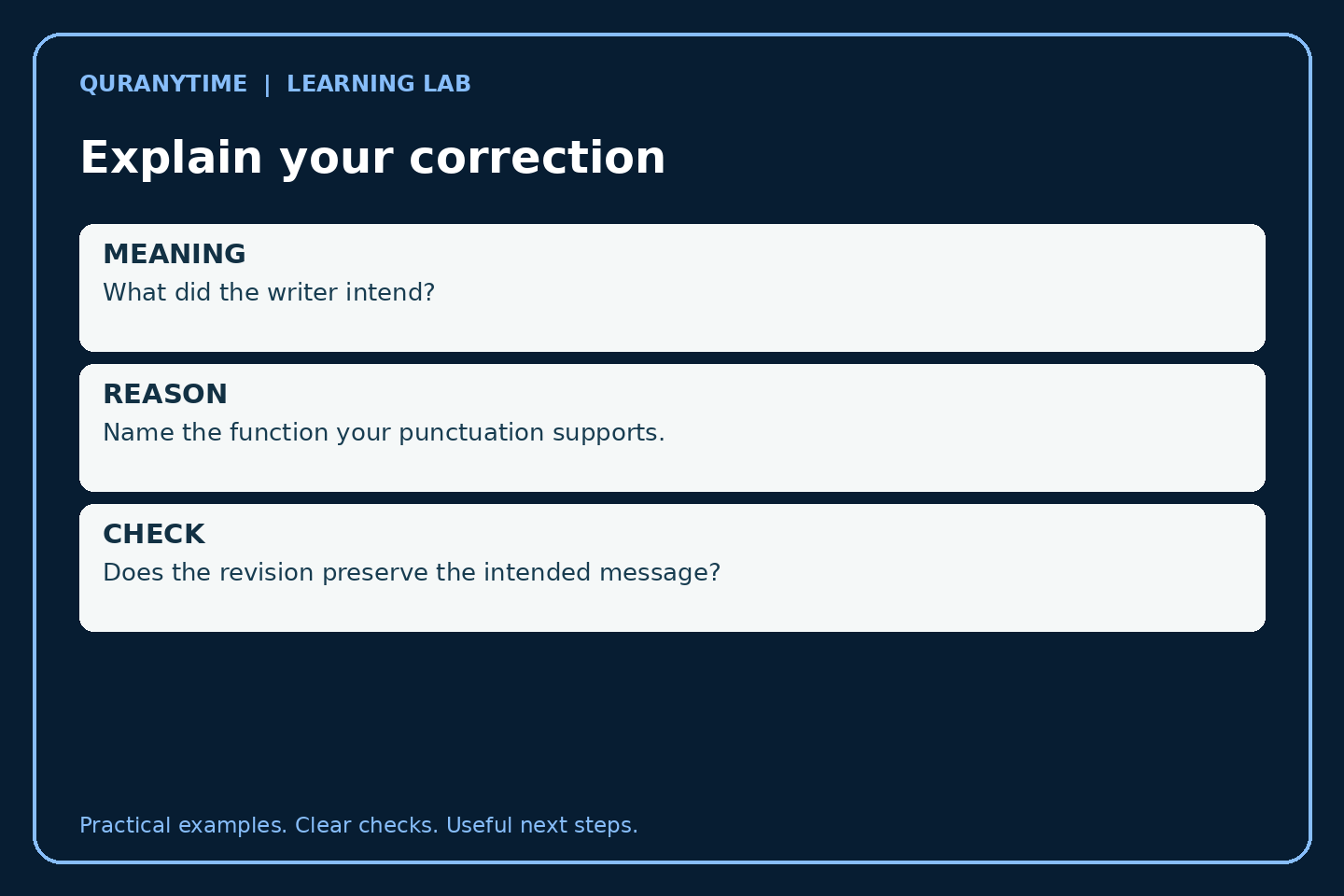
When reviewing a partner’s paragraph, write one short explanation beside each change: “This asks a direct question,” “These are three list items,” or “This begins a new complete thought.” If you cannot explain the change, mark it as a question for the teacher instead of presenting your preference as a rule.
Read the revised paragraph back to the writer and ask whether it preserves the intended meaning. An editor can accidentally make a message clearer but different. For example, replacing a question with a statement changes the communicative purpose. Good proofreading checks the writer’s intention as well as the visible marks.
Keep optional style choices separate from genuine misunderstandings. A short paragraph may admit more than one readable division into sentences. Discuss the alternatives and choose one consistent version. This helps learners understand that punctuation involves meaning and judgment, while still maintaining clear conventions for questions, spacing, and list structure.
A proofreading routine that fits one page
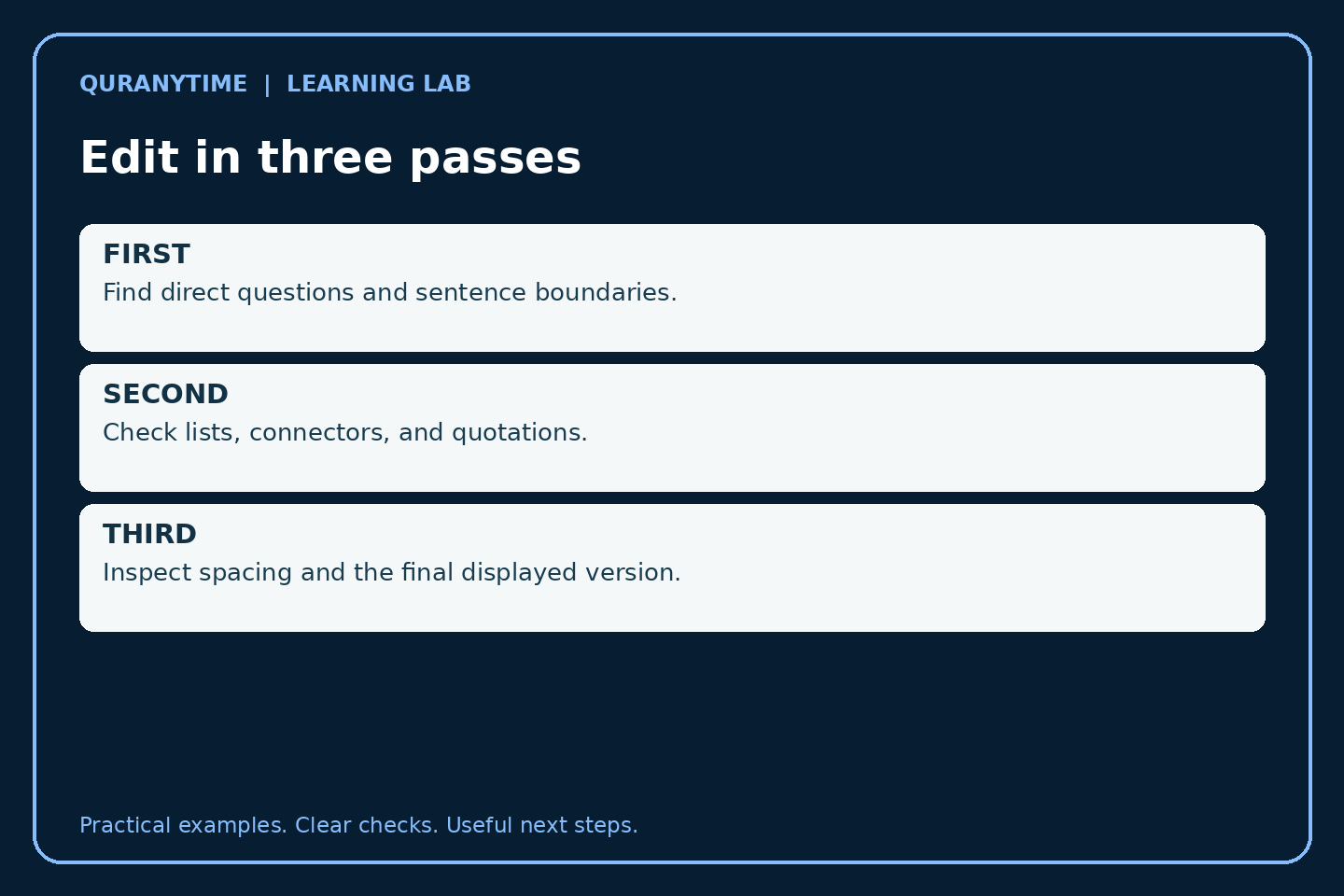
On the first pass, circle every direct question and check its ending. On the second, draw a line between complete thoughts and decide whether each needs a full stop or a meaningful connector. On the third, inspect lists, quotations, and spacing. Finally, read the displayed version after saving or sending a test.
Keep a small error record with one before-and-after pair per week. Label the reason: question, sentence boundary, list, quotation, or spacing. Do not collect twenty nearly identical examples. Once one habit improves, choose a new target. You can use our Arabic phrases collection for short material to punctuate, but first make sure you understand the meaning.
For feedback, Book a Free Trial Class and bring a short paragraph you wrote yourself. Ask the teacher to discuss where the reader needs a boundary and why. That conversation turns punctuation from a set of symbols into a practical editing skill you can carry into messages, worksheets, and everyday Arabic reading.