
A learner may recite a memorized passage confidently from its beginning, then struggle when a teacher asks for a later verse. That does not mean the earlier work was worthless. It reveals a different retrieval demand: finding a verified entry point without relying on the entire preceding chain. Random-start practice can explore that skill when it is carefully scoped and supervised.
In this guide, “random start” means choosing among teacher-approved verse beginnings within material already learned and reviewed. It does not mean starting at arbitrary words, inventing stopping rules, or jumping through unfamiliar text. A qualified teacher should determine suitable starts, stops, and restarts, especially where meaning or recitation rules require care.
Establish readiness before introducing surprise
First ask whether the passage is stable when read in the usual order. If a learner is still struggling with the basic text or recently corrected pronunciation, random cues may add confusion rather than useful information. Begin with regular teacher-approved revision and resolve known issues before adding this challenge.
Next, explain the activity. The learner should know that a cue will identify an approved start and that hesitation is information, not a moral failure. A surprise public test can create anxiety and conceal what the learner actually knows. Keep the first attempts private, brief, and low pressure.
Our Hifz revision-schedule guide supports the broader revision routine. Random-start work is a small addition to that routine, not a replacement for connected recitation, teacher listening, or appropriate review of older material. Do not spend an entire revision session jumping between cues while neglecting the passage’s continuity.
Create a verified cue set
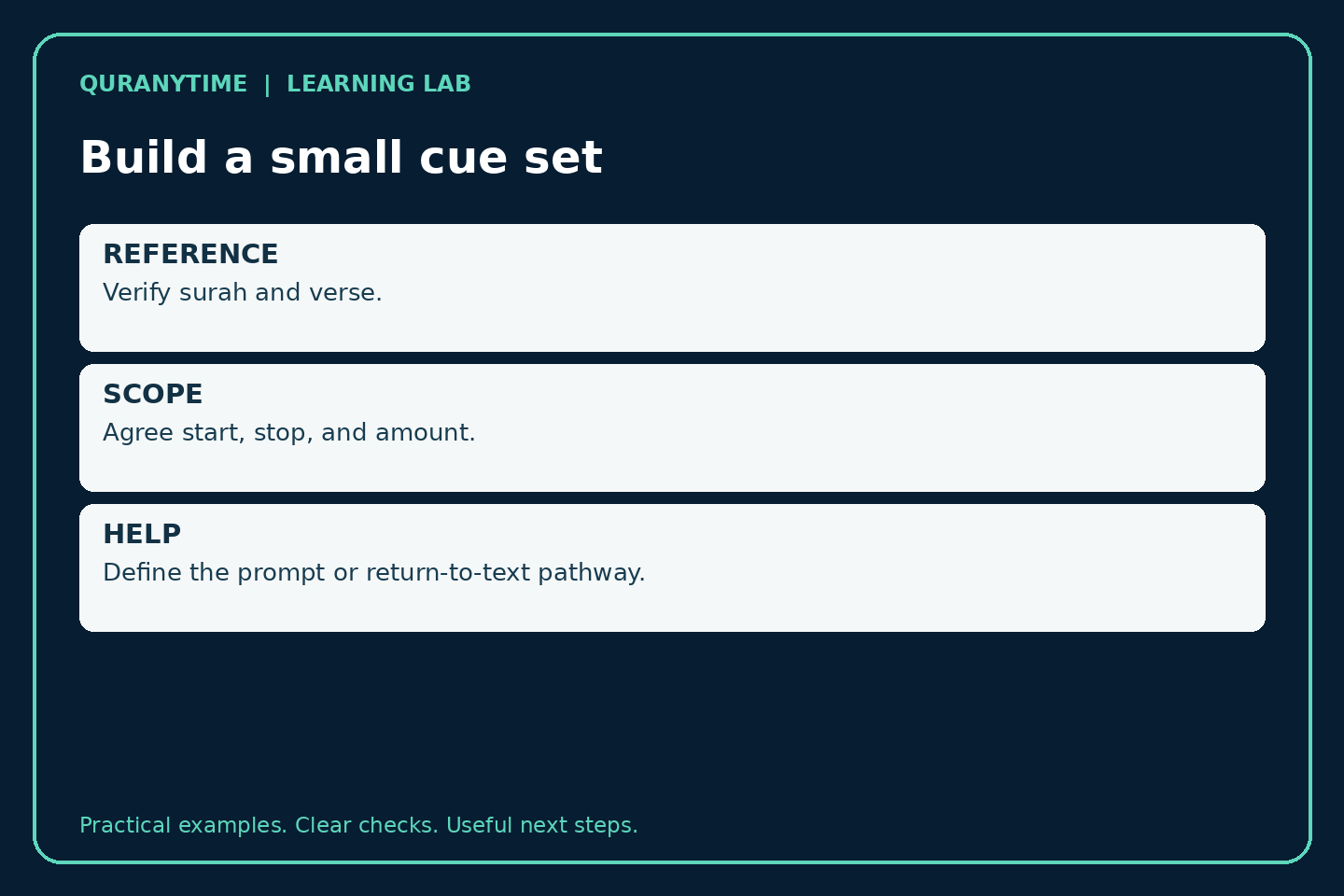
Ask the teacher to select a small number of verse beginnings in one manageable passage. Each cue card should contain the surah name, verse number, and the form of prompt the teacher wants used. Avoid copying Quranic text from memory. If a card includes Arabic wording, verify it against a reliable mushaf before using it.
You can begin with reference-only cards, such as a surah and verse number, while the learner locates the verse in the mushaf. Later, the teacher may use an approved spoken prompt for retrieval without looking. These are different versions of the activity; record which version you used so progress is not confused with a change in difficulty.
A cue should identify a legitimate, agreed beginning. It should not become a fragment that encourages a learner to start from an unsuitable mid-verse location. Our Quran stopping and restarting guide gives background, but the teacher’s passage-specific guidance is essential. Do not turn a general article into a ruling about every possible start.
Teach the cue before shuffling it
Show all approved cues in order first. Let the learner locate each one and explain where it sits in the passage. This makes the task transparent. A learner who cannot identify a verse number may have a navigation difficulty rather than a memorization difficulty.
Then practise two cues predictably: first A, then B. Only after both are understood should you shuffle them. Add a third later if appropriate. Randomness is not valuable by itself; its purpose is to vary access to known material. A huge deck of unfamiliar references mostly tests coping with uncertainty.
Our guide to Quran reading divisions can support navigation language. Keep the actual cue precise enough for the learner’s edition. Surah-and-verse references travel more reliably between layouts than page numbers alone, although a shared page can be a useful additional anchor.
Use a clear response sequence
The learner hears or reads the cue, identifies the intended start, and recites the teacher-approved amount. If uncertain, the learner says so. The teacher provides the agreed level of help: locating the reference, supplying a prompt, or returning to the mushaf. Help should be recorded as part of the attempt, not hidden to make the result look independent.
After the attempt, reconnect the selected section to its surrounding passage under teacher guidance. This guards against treating memorized verses as isolated cards. Connected recitation remains important, and random-start practice should not encourage a fragmented relationship with the text.
Keep the recitation measured. Our tartil guide provides a foundation for pace. A fast start is not automatically a good start, and a brief pause to identify the correct reference is not automatically a failure. Accuracy and appropriate recitation take priority over speed.
Score the kind of help, not the learner’s worth
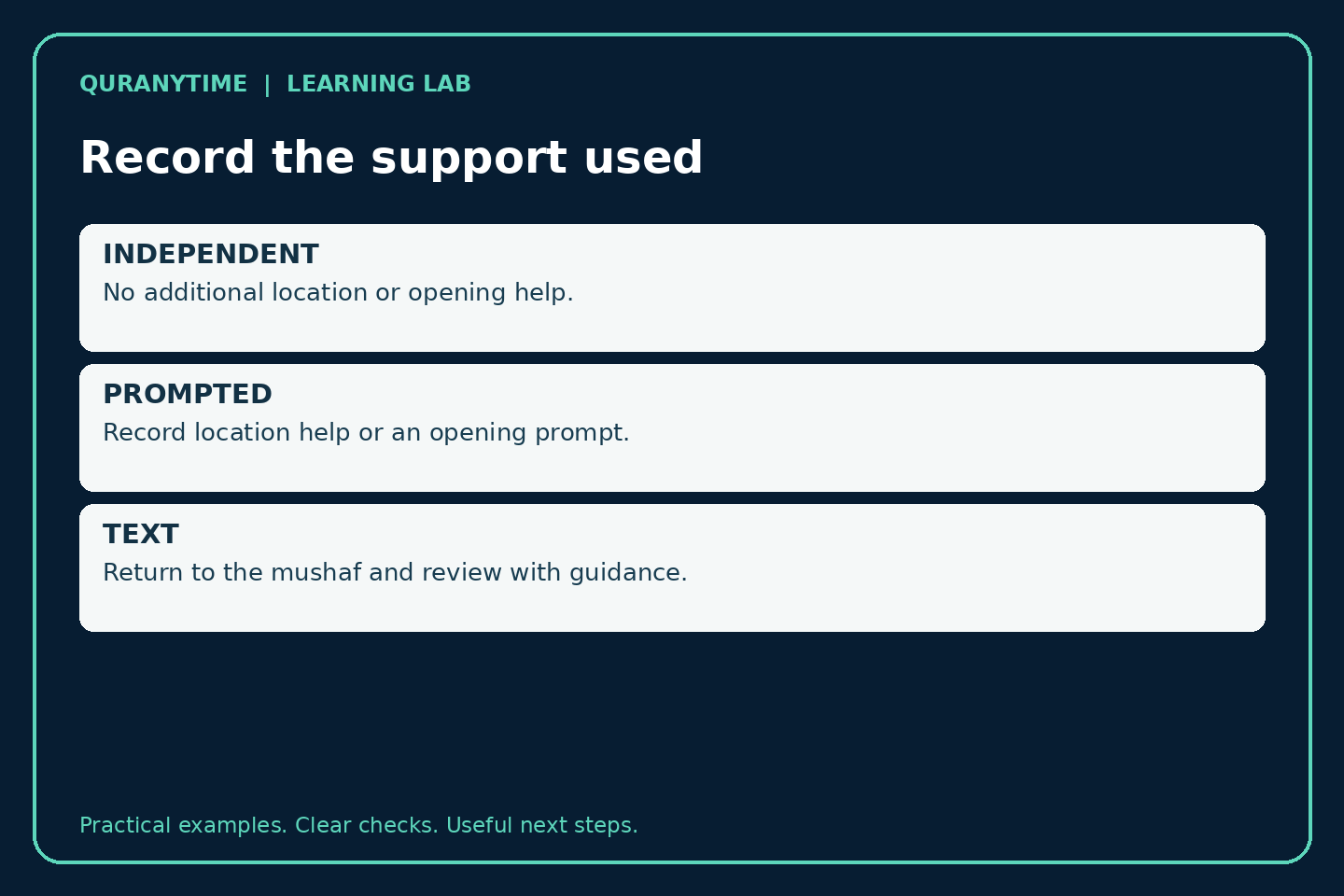
A simple practice record can use four labels: independent; location help; opening prompt; return to text. These describe what happened. They do not assign a permanent ability label to the learner. A passage may move between categories on different days, especially after a new correction or a break in practice.
Add a short note if the problem was not retrieval: unfamiliar reference notation, misheard cue, fatigue, or a recitation correction. Without that context, every hesitation may be misclassified as weak memorization. The record should help the teacher choose a next step, not produce an impressive-looking percentage.
Our Quran lesson-notes guide can support this record. Keep it compact: cue, support used, and next action. If a detailed recitation mistake log is also used, avoid duplicating the same note in several places. One clear record is easier to review.
A sample session without quoting verses
Imagine a teacher-approved passage with three suitable verse-beginning cues labeled A, B, and C. The learner identifies all three with the mushaf open. The teacher then asks for B, A, and C in a shuffled order. After each response, the learner completes the agreed amount and receives feedback.
Suppose B is independent, A needs an opening prompt, and C requires return to text. The next action is not “do everything twice as fast.” The teacher may strengthen A and C in context, clarify C’s location, and keep B in ordinary connected revision. The labels point to targeted work rather than a general punishment repetition.
Distinguish similar openings carefully
Some passages have similar wording. A cue that is too short may not uniquely identify the intended place. The teacher should decide how much verified context is needed. Do not accuse the learner of confusing passages when the prompt itself was ambiguous.
Our similar Quran verses revision guide explores that related challenge. For random-start work, keep a comparison note only when it resolves a real recurring confusion. Copy exact wording from a reliable source and have the teacher verify it. Avoid inventing mnemonic explanations about why a verse uses a particular word.
A useful comparison asks where the two verified passages differ and what reference identifies each. It does not make unsupported claims about interpretation. If meaning-based support is appropriate, use a reliable translation or tafsir under suitable guidance and distinguish the explanatory material from the Quranic text itself.
Adapt the activity for children
For a child, make the cue set small and predictable before introducing a shuffle. Let the child choose a card from the approved set. Explain that asking for help is allowed. Never use the game format to conceal a test with consequences the child did not understand.
Keep an adult responsible for the emotional tone. Avoid comparing siblings’ response times or counting hesitations aloud as if they were faults of character. A child who becomes upset may need a return to familiar connected reading rather than more surprise cues. Our children’s memorization and revision guide can help families discuss a sustainable balance.
Use a clear stopping rule for the session: a small agreed number of attempts or the first signs that attention is no longer useful. Do not keep drawing cards until the child finally produces a perfect answer. That can turn a diagnostic exercise into an exhausting search for a satisfactory ending.
Troubleshoot the result
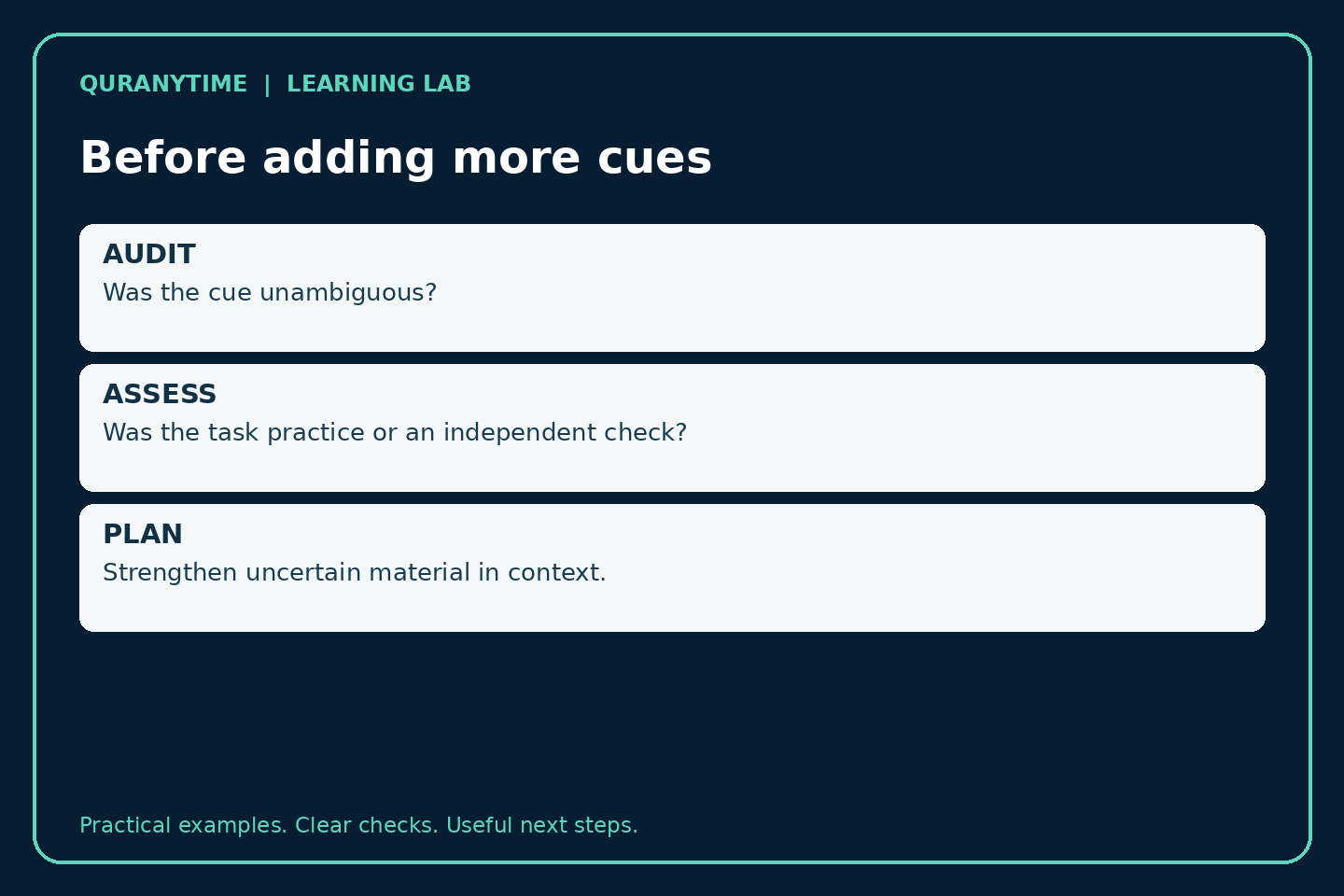
If the learner starts the wrong passage, first verify that the cue was unambiguous. If the correct start is found but continuation breaks down, return to that section in context. If every random start fails while ordinary recitation is stable, simplify the cue format and teach the navigation step explicitly.
If pronunciation errors appear that were absent in regular practice, reduce the retrieval demand and ask the teacher to reassess. The activity should not trade accurate recitation for rapid access. If a learner begins guessing aloud, pause and use the agreed help pathway rather than rewarding confident approximations.
If the learner succeeds only with yesterday’s cue order, change the order modestly and include a later recheck. Do not claim a permanent improvement from one good session. Look for repeated independent access across ordinary practice while maintaining accurate connected revision.
Audit the cue before judging the response
Before the next session, ask the helper to show exactly what each card means. Can another qualified adult identify the same starting place from the reference? Is the amount to recite clear? Is the learner expected to look at the mushaf first, or respond from memory? An unclear task can create an apparent memory problem that disappears when the instruction is made precise.
Keep a small distinction between a practice cue and an assessment cue. In practice, the teacher may model the opening and let the learner rehearse it. In assessment, the teacher may withhold that model to observe independent retrieval. Both have a place, but comparing their results as if conditions were identical is misleading. Write the condition beside the attempt.
For example, a learner succeeds after hearing the opening twice on Monday and succeeds without that support on Friday. The meaningful change is reduced support under the recorded conditions. It is not proof that the entire passage is permanently secure. Continue ordinary review and let the teacher decide whether another check is needed.
Finally, ask the learner to explain the help pathway in their own words. They should know that uncertainty leads to a verified prompt or return to text, not a guess. A responsible pause protects the accuracy of the exercise and makes the record more informative. If the learner cannot explain the procedure, reteach the procedure before adding more cues.
Decide what belongs in the next week
Review the record with the teacher. Keep stable cues in a light rotation, strengthen uncertain sections in their full context, and remove any start that needs different guidance. Add new cues only when the passage is ready. More cards are not automatically better practice.
Explain the purpose to anyone helping at home. A parent can manage the approved card set and record the support used, but should not invent new Quranic starts or pronounce on a technical dispute. A responsible “we will check with the teacher” protects accuracy and keeps the home helper’s role clear.
For a plan suited to your memorization, Book a Free Trial Class and explain what you can recite independently, which material needs revision, and whether starting away from the beginning is difficult. Ask the teacher to assess readiness and choose a few appropriate entry points. The useful outcome is a clearer path into known material, supported by careful recitation and honest records of help.