

Changing a Hifz teacher can interrupt a learner’s routine even when everyone is acting in good faith. The new teacher may not know which passages are secure, which corrections are recent, or how much revision the learner can manage alongside school or work. A clear handover turns those unknowns into questions that can be checked, instead of forcing the learner to restart blindly or continue at an unsuitable pace.
This guide is a practical transition plan for adult learners and parents. It does not assume that changing teachers is a sign of failure, and it does not promise that one document can replace a new teacher’s assessment. The purpose is to preserve useful information while allowing the new teacher to form an independent, qualified view of the learner’s recitation and revision needs.
Separate the reason for changing from the learning record
A family may change because of scheduling, language, relocation, teaching fit, or an unresolved concern. The learning record should remain factual regardless of the reason. List what was assigned, what was reviewed, and what support was used. Avoid turning the handover into a judgment about someone’s character.
If there is a safety or professional concern, address it through the appropriate management or reporting channel. Do not place sensitive allegations, private messages, or another student’s information inside a routine learning summary. Share only what the new teacher needs to support the learner, with appropriate consent and a suitable private channel.
For the learner, use calm language: “We are making sure your new teacher knows what you have worked on.” A child should not feel responsible for explaining an adult dispute. Keep the transition focused on continuity, accurate assessment, and a manageable next step.
Build a passage inventory that admits uncertainty
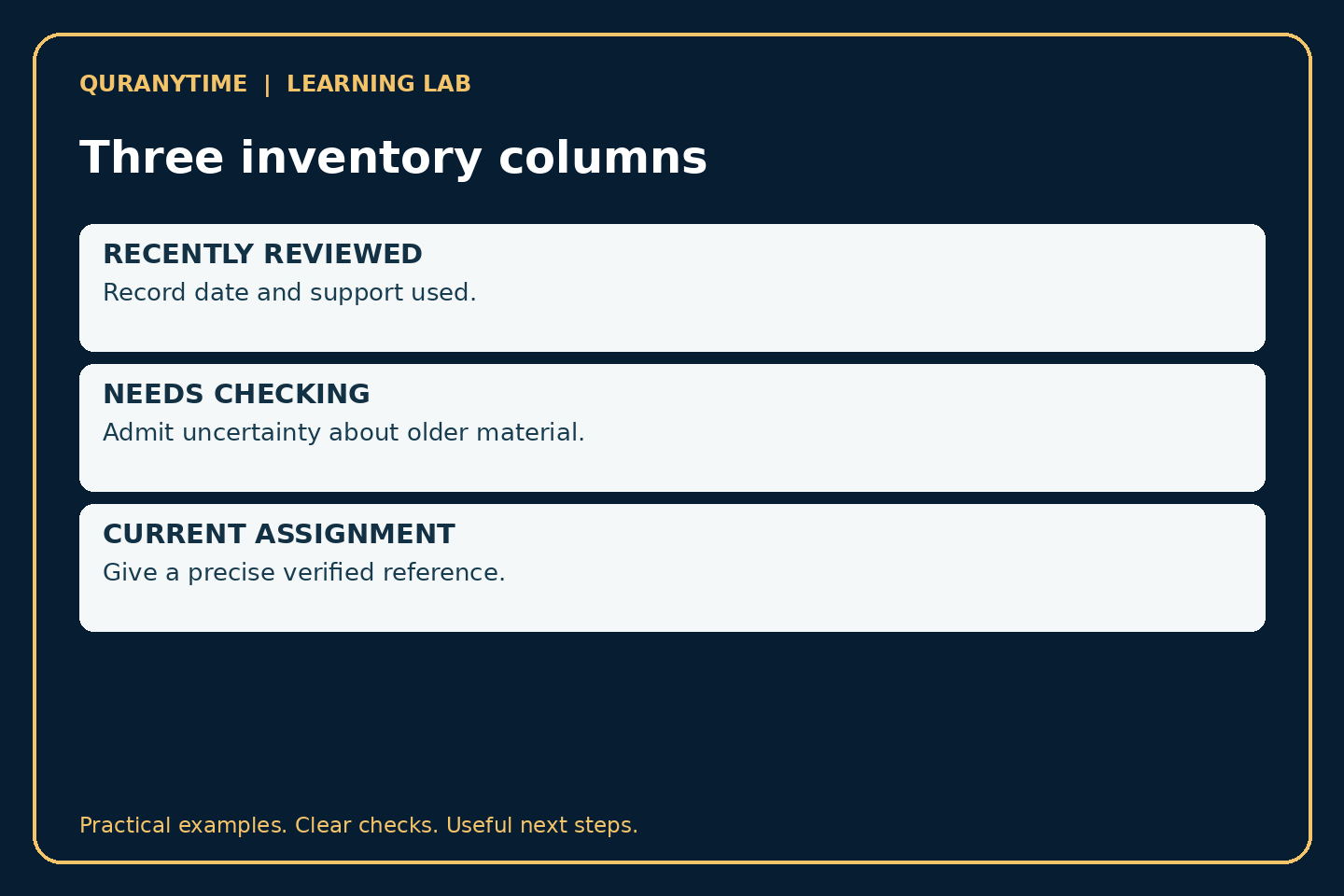
Create three columns: learned and recently reviewed; learned but needs checking; currently being learned. Use surah-and-verse references or another precise teacher-approved reference. If you record pages, name the edition or add references so the new teacher can identify the same passage.
Do not label a large section “mastered” merely because it was once recited successfully. Describe the evidence: date last heard by the teacher, whether the mushaf was used, and what kind of prompting was needed. A truthful “needs checking” is more useful than an inflated claim that makes the next lesson unnecessarily difficult.
Our Hifz revision-schedule guide can help you describe the existing routine. The new teacher may adjust that routine after listening. The handover preserves information; it does not bind the new teacher to a plan that no longer suits the learner.
A simple inventory example
Use placeholders rather than inventing a learner’s record: “Passage A — last reviewed this week, one opening prompt”; “Passage B — learned earlier, not recently checked”; “Passage C — current new assignment.” Replace the labels with verified references. This format distinguishes recency and support without pretending to calculate a precise memory score.
If the old record is incomplete, say so. The new teacher can sample and assess the relevant material. Do not reconstruct months of supposed performance from a parent’s vague recollection, and do not make a child responsible for proving every past assignment.
Transfer corrections, not a wall of red marks
Choose the few current corrections that are most relevant to the next lessons. Include the exact location and the previous teacher’s checked explanation where available. Mark anything you are unsure about as unconfirmed. A copied note that nobody understands can be more confusing than no note at all.
Our Quran recitation mistake-log guide can help organize these entries. Keep the original teacher’s wording separate from a parent’s interpretation. If an audio example is part of the correction, obtain permission to share it and use an appropriate private channel.
The new teacher should verify the issue by listening. Do not demand that a correction be accepted solely because it appears in an old notebook. Equally, do not erase a useful correction simply because a new teacher has not yet seen it. Preserve the evidence and ask for a clear explanation of the current expectation.
Record the recitation context
Ask the previous teacher, where appropriate, which riwayah and teaching conventions were being followed. Do not guess from an accent, a favorite reciter, or the cover of a book. If the information is unknown, write “to be confirmed” and ask the new teacher to clarify.
The same applies to stopping and restarting guidance. If a learner has been taught a passage-specific practice, note the reference and ask the new teacher to review it. Our Quran stopping-rules guide provides background, but a transition document should not attempt to settle every technical issue independently.
Record which mushaf or digital resource the learner uses and whether teacher and student share the same layout. This can explain page-reference confusion that might otherwise look like poor preparation. It also helps the new teacher give assignments the learner can locate reliably at home.
Describe the routine the learner actually follows
Write the real weekly pattern, including available days, approximate practice windows, and the balance between new memorization and revision. Do not submit an ideal schedule that the family has never followed. A new teacher can work with honest constraints more effectively than with a plan that collapses after two days.
For a child, include school demands and the type of adult help available. “A parent can listen for ten minutes on three evenings” is more actionable than “we will help whenever needed.” Avoid making promises on behalf of another family member without checking. For adults, work shifts and changing time zones may matter more than a fixed daily slot.
Our children’s Hifz and revision guide can support that discussion. Describe what the learner does independently and where a helper is needed. The distinction helps the new teacher assign work that fits the support actually available.
Prepare the learner for the first assessment
Explain that the new teacher may ask for familiar material, a less recent passage, and a short reading task. The exact assessment is the teacher’s decision. The learner does not need to perform a rehearsed showcase that hides the parts requiring help. Honest sampling gives a better starting point.
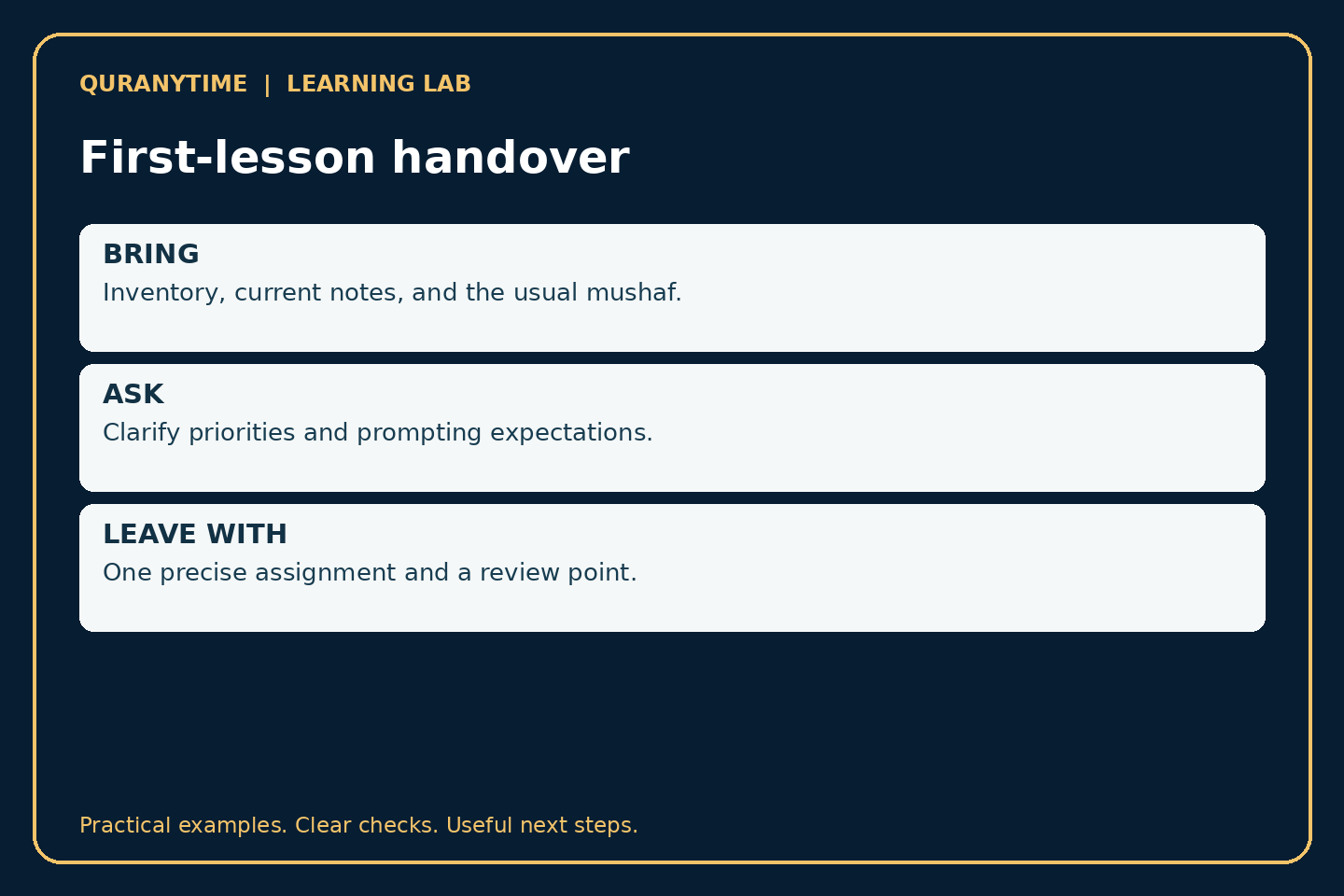
Bring the inventory, current correction notes, and the mushaf used at home. Ask the teacher how prompting will be handled and how the first week’s assignment will be recorded. Our Quran lesson-notes guide can help you leave with a precise task rather than a vague instruction to revise more.
If a child is anxious, tell the teacher beforehand in a private, respectful way. Do not discuss the child’s supposed weaknesses at length in front of them. Ask for a calm introduction and explain that the assessment is about choosing suitable work, not comparing the learner with other students.
Five questions worth asking
- Which material should we keep in connected revision during the transition?
- Which previous corrections do you want to check first?
- What is the first week’s exact assignment and expected support?
- How should we record uncertainty or missed practice?
- When will we review whether the plan is realistic?
Our guide to asking better Quran-teacher questions can help you make these questions specific. Do not try to settle the whole year in the first conversation. A clear first week and a review point are often a more practical beginning.
Use a settling-in week rather than a dramatic reset
Keep familiar revision available while the new teacher checks the learner’s level. Avoid simultaneously changing teacher, mushaf layout, practice time, recording method, and memorization target unless there is a clear reason. Too many changes make it difficult to identify what is helping or causing difficulty.
This does not mean preserving every old habit. It means changing deliberately. If the teacher reduces new material temporarily to strengthen revision, ask what success will look like and when the balance will be reviewed. A temporary adjustment should have an understandable purpose rather than feel like a punishment for changing teachers.
At home, use consistent encouragement. Our positive Quran practice guide can support a child through the transition. Notice useful behaviors such as locating the assignment, asking for help, and practising the agreed correction, rather than praising only the amount memorized.
Troubleshoot common handover problems
The new teacher’s assessment differs from the old record. Ask what was observed and which conditions differed. Was the learner prompted before? Was the passage recently revised? Were different criteria used? A discrepancy is a reason to clarify evidence, not immediately accuse either teacher or learner.
The learner says every correction has changed. Ask for two precise examples and have the teacher explain them. Some differences may be misunderstandings, while others may reflect context or teaching approach. Do not ask a parent to adjudicate technical recitation issues from memory.
There is no previous record. Start a modest new inventory and let the teacher assess representative material. Do not delay all learning until an impossible historical reconstruction is complete. Mark the starting record’s limits and improve it prospectively.
The learner misses the previous teacher. Acknowledge the relationship without making the new teacher compete with it. Keep the new routine predictable and allow time to settle. If distress persists, discuss it with the teacher and adjust the transition pace where appropriate.
A handover message you can adapt
A concise message might say: “We are sharing a short learning summary so the first lessons can begin with clear information. The passage inventory distinguishes recent review from material that needs checking. The correction notes contain only current points, and unconfirmed items are labeled. Please assess independently and let us know the first week’s priorities.” Adapt the wording to your situation and keep private details out of a general group chat.
Attach only what is necessary. A short inventory and two current questions may be more useful than months of screenshots. If recordings are shared, confirm consent and identify the passage and date. Do not forward another teacher’s private messages indiscriminately or include other students in the record.
Ask for acknowledgment of the learning information, not agreement with every previous conclusion. The new teacher needs room to listen, explain differences, and set a suitable plan. The handover succeeds when it saves avoidable confusion while preserving that professional judgment. Keep a copy of the agreed next assignment so the learner and home helper leave the transition conversation with the same understanding.
Review after the first few lessons
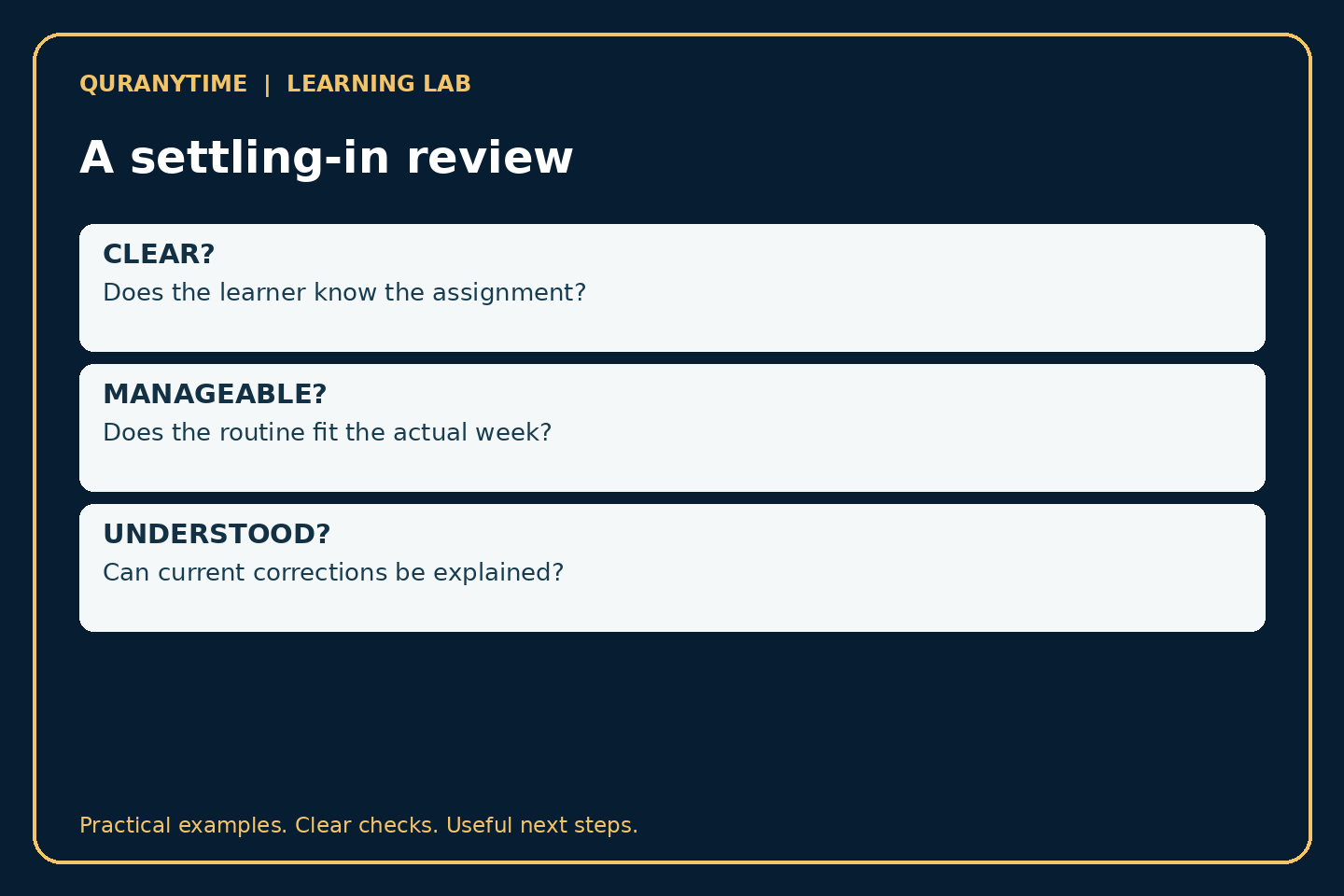
Compare the new plan with the learner’s actual week. Is the assignment clear? Is the revision amount manageable? Are corrections understood? Is the learner able to ask questions? These observations are more useful than deciding after one lesson whether the change has “worked.”
Keep a short review note: what is stable, what needs adjustment, and who will do the next action. For example, the teacher may clarify one correction, the parent may simplify the evening routine, and the learner may bring an uncertain reference. Shared responsibility prevents the entire transition burden from falling on the student.
Retain the handover summary as a living learning record. Update only material facts and current needs; do not accumulate every minor comment indefinitely. A concise, accurate record is easier for a teacher to use and more respectful of the learner’s privacy.
For help planning a transition, Book a Free Trial Class and bring the passage inventory and a few current questions. Ask for an assessment-based first step rather than a promise about how quickly memorization will advance. A successful handover preserves useful work, makes uncertainty visible, and gives the learner a clear, humane way to continue.