

You learned أَب, “father,” and then met أَبُو, أَبَا, and أَبِي. Are they three different words? Often they are forms of the same noun, displaying a grammatical case through a letter rather than an ordinary final short vowel. The five nouns, الْأَسْمَاءُ الْخَمْسَةُ, are a small group with a particularly useful pattern for formal Arabic and Quran reading.
Think of this lesson as a form-selection clinic. Each section diagnoses a different reason a familiar family word may look unexpected. The goal is to explain a form before copying it: which noun is this, which construction is it in, and which case does that construction require? The classroom sentences below are composed examples unless a Quran reference is given.
Case one: the father has not changed, but his role has
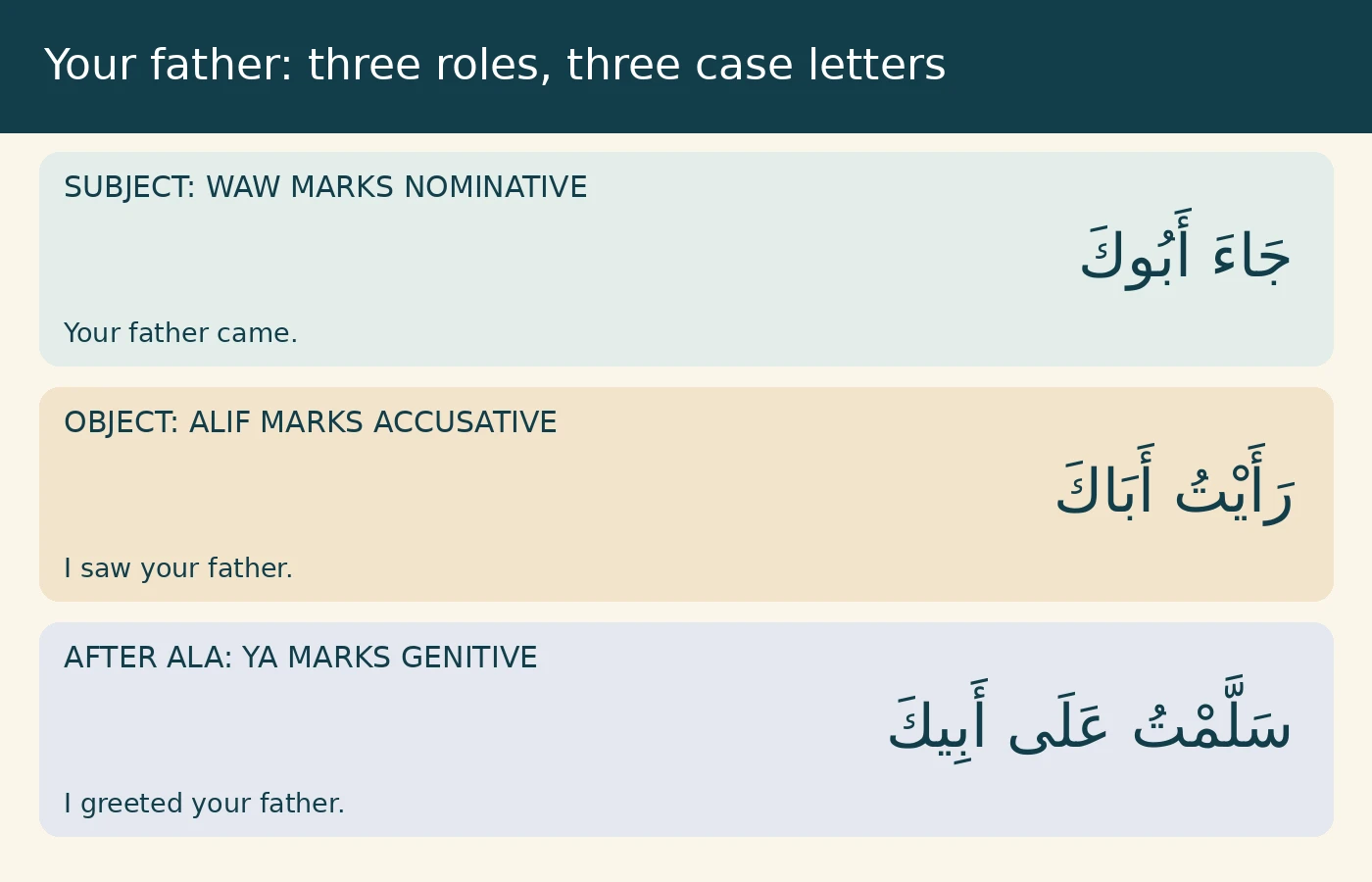
Compare جَاءَ أَبُوكَ, “Your father came”; رَأَيْتُ أَبَاكَ, “I saw your father”; and سَلَّمْتُ عَلَى أَبِيكَ, “I greeted your father.” All three refer to the same father, and all address one male listener through ـكَ. What changes is the father’s role: subject, direct object, then the noun governed by عَلَى.
In this pattern, wāw marks nominative case, alif marks accusative case, and yā marks genitive case. Say the case name and the reason before reading the form: “subject, nominative, أَبُوكَ”; “object, accusative, أَبَاكَ”; “after a preposition, genitive, أَبِيكَ.” The long vowel belongs to the case pattern here. It is not simply an optional pronunciation flourish.
The Arabic case lesson explains the larger relationship between role and marker. These nouns show why a basic chart of dammah, fathah and kasrah cannot describe every visible ending. The grammatical categories remain the familiar three; their markers differ with the noun type.
Case two: which words belong to the group?
The standard beginner list is أَب, father; أَخ, brother; حَم, a male in-law; فَم, mouth, when its mīm is removed for this pattern; and ذُو, meaning “possessor of” or “having.” They are not five arbitrary vocabulary items to attach to every family word. أُمّ, mother, does not join the group merely because it names a close relative.
With a suitable dependent, the nominative forms include أَبُوكَ, أَخُوكَ, حَمُوهَا, فُوكَ, and ذُو عِلْمٍ. Their accusative counterparts include أَبَاكَ, أَخَاكَ, حَمَاهَا, فَاكَ, and ذَا عِلْمٍ. Their genitive counterparts include أَبِيكَ, أَخِيكَ, حَمِيهَا, فِيكَ, and ذِي عِلْمٍ. Do not memorize this as fifteen unrelated words: identify a common three-way pattern and the additional conditions below.
Some of these forms are more familiar in literary, grammatical, or Quranic study than in everyday conversation. Learn what a form means in its register. The family vocabulary guide covers the broader vocabulary; this lesson isolates a small inflectional group rather than replacing ordinary family expressions.
Case three: the noun needs a dependent
The special letter pattern applies when the noun is in an appropriate idafa construction, including one completed by an attached possessive pronoun. أَبُو الطَّالِبِ means “the student’s father”; أَبُوكَ means “your father.” In each, the father noun is the construct head. The following noun or attached pronoun completes the relationship.
Now remove the dependent and compare هَذَا أَبٌ, “This is a father”; رَأَيْتُ أَبًا, “I saw a father”; and تَحَدَّثْتُ مَعَ أَبٍ, “I spoke with a father.” The ordinary indefinite forms have case vowels and tanwin. You cannot simply write أَبُو as a free-standing indefinite substitute for أَبٌ in these exercises.
A suffix may make the dependency harder to see because it is written as part of one word. Bracket أَبُو + كَ mentally without inserting an actual space in the Arabic spelling. Review idafa and its dependent when the construction is unclear. The head’s case comes from the larger sentence; being the first member of idafa does not automatically make it genitive.
Case four: “my father” is a special warning
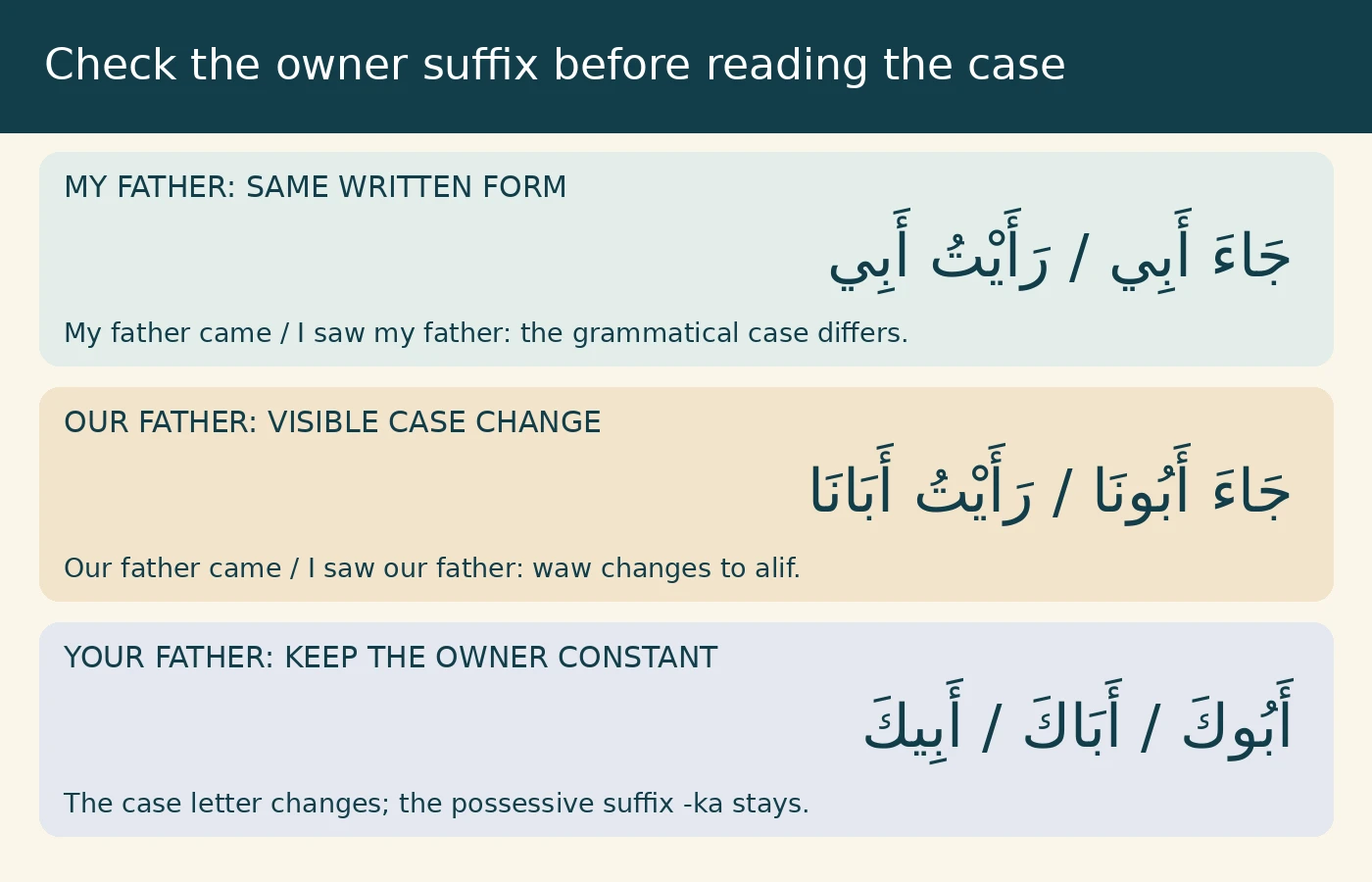
أَبِي can mean “my father,” with the first-person singular possessive suffix yā. In that construction, you do not apply the visible أَبُو / أَبَا / أَبِي alternation mechanically. The form with the speaker’s yā behaves differently: its grammatical case may be understood without the same changing written case letters.
Compare جَاءَ أَبِي, “My father came,” with رَأَيْتُ أَبِي, “I saw my father.” The father is nominative in the first and accusative in the second, although the written أَبِي stays the same. Therefore “I can see yā, so the noun must be genitive” is an unsafe rule.
Our father is different from my father in this respect. أَبُونَا, أَبَانَا, and أَبِينَا can show the special letter alternation because ـنَا is not the singular speaker’s yā. Likewise, a suffix referring to one female listener gives أَبُوكِ, أَبَاكِ, and أَبِيكِ. The suffix and case letter convey different information. The possessive suffix guide helps you separate the owner from the noun’s sentence role.
Case five: the mouth keeps or loses its mīm
When فَم retains its mīm, it does not use the special فُو / فَا / فِي letter pattern. Compare فَمُكَ, “your mouth” in a nominative position, with فُوكَ in the corresponding five-noun pattern without mīm. Both involve the noun for mouth, but they do not display case through exactly the same form.
In composed sentences, فَمُكَ نَظِيفٌ and فُوكَ نَظِيفٌ both mean “Your mouth is clean.” Do not combine the two alternatives by retaining mīm and adding a special wāw after it. The choice of noun form determines which inflectional pattern you are illustrating.
Also be careful with فِيكَ. In بِفِيكَ, the sequence can mean “with your mouth,” with بِـ as the preposition and فِي as the genitive mouth form. Elsewhere فِيكَ can simply be the preposition فِي plus ـكَ, “in you.” Identical letters can represent different grammatical structures. Read the surrounding sentence rather than identifying a word by its silhouette alone.
Case six: dhu is not the demonstrative “this”
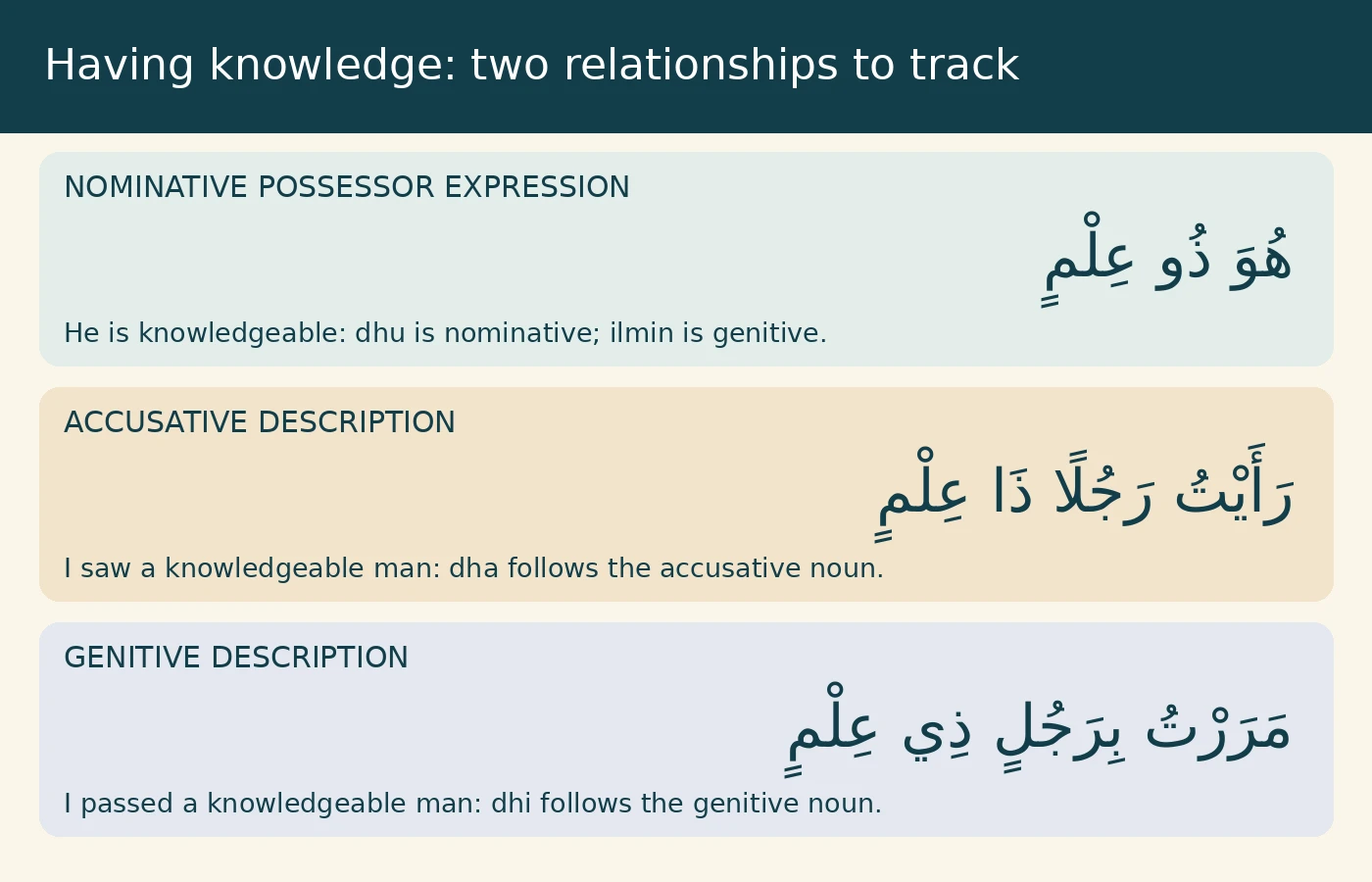
For this five-noun pattern, ذُو means “possessor of” or “having” and is followed by a suitable dependent. هُوَ ذُو عِلْمٍ means “He possesses knowledge” or “He is knowledgeable.” In رَأَيْتُ رَجُلًا ذَا عِلْمٍ, “I saw a man possessing knowledge,” ذَا follows the accusative noun it qualifies. In مَرَرْتُ بِرَجُلٍ ذِي عِلْمٍ, it follows a genitive noun.
The final عِلْمٍ stays genitive as the dependent of ذُو / ذَا / ذِي. There are two relationships to track: the case of the describing possessor expression in the larger phrase, and the genitive dependent inside it. A change in the first does not erase the second.
Do not assume that every written ذا is this accusative possessor form. Arabic also has demonstrative expressions and other contexts involving similar letters. Here the meaning “having” and the following dependent are part of the identification. If you cannot explain what is possessed, reconsider whether this is the construction you think it is.
Two tests before you apply the letter chart
The first test is lexical: is this actually one of the five nouns in the relevant meaning? A noun can resemble one of the forms without belonging to this lesson’s construction. ذُو must have the possessor meaning here, and the mouth form must meet the mīm condition. Do not start changing letters until you have identified the word and its relationship to the following expression.
The second test is structural: is the noun singular and in the required construct form, with a dependent other than the singular speaker’s yā? A familiar word does not automatically qualify in every use. When the noun is not in this environment, return to the rule appropriate to its actual form. Treat the chart as a conditional pattern, rather than a replacement for all the noun’s other inflections.
Use two separate boxes in your notes: “eligible for the pattern?” and “which case?” This keeps you from finding the correct case but choosing the wrong marker. For example, you can correctly identify أَبٌ as a nominative predicate while still making an error if you replace it with an unattached أَبُو. Eligibility and case are two decisions, and both need an explanation.
Case seven: a Quran example and its nearby contrast
In Quran 28:23, وَأَبُونَا شَيْخٌ كَبِيرٌ includes أَبُونَا, “our father.” The Quranic Arabic Corpus analysis of 28:23 identifies the father noun as nominative and ـنَا as a first-person plural possessive pronoun. The wāw in أَبُو is the nominative case marker of this noun pattern. The initial وَ is a separate connector; do not confuse the two wāws.
Quran 28:25 contains إِنَّ أَبِي يَدْعُوكَ, where أَبِي means “my father.” This is the singular speaker’s yā construction discussed above. It is not evidence that every father noun near a particle must show the same visible letter. Read the complete verses for their narrative context and check the sentence construction before applying a memorized chart.
For the statement framework in the first example, review nominal sentences. For the genitive classroom examples, the preposition lesson provides the governing relationship. You are connecting an inflectional form to a sentence, not identifying a form in isolation.
A short dialogue that tests the whole phrase
Work with a partner using a fictional family rather than anyone’s private details. One partner asks مَنْ حَضَرَ؟, “Who attended?” The answer is أَخُوكَ, “Your brother.” The questioner then says رَأَيْتُ أَخَاكَ, “I saw your brother,” and follows with تَحَدَّثْتُ مَعَ أَخِيكَ, “I spoke with your brother.” Keep the focus on the changing role, not on making a realistic family story.
After the first round, replace “your brother” with “our brother”: أَخُونَا, أَخَانَا, أَخِينَا. The owner has changed, but the three-case pattern remains. In a final round, replace it with “my brother,” أَخِي, and explain why the visible alternation no longer works in the same way. This change of suffix is the part most likely to expose a memorized rule that has not yet become a usable skill.
Record one round if that helps you compare the long vowels. Play back the whole phrase, including the governing verb or preposition. A recording of three isolated forms cannot show whether you chose them for the right reason. Ask your partner to point to the governing relationship as you listen.
Case eight: choose, explain, and repair
Complete these composed sentences with the suitable form of “your brother,” addressing one male listener: (1) حَضَرَ ____; (2) سَأَلْتُ ____; (3) كَتَبْتُ إِلَى ____. Then explain the marker, not just the translation.
Answers: حَضَرَ أَخُوكَ, “Your brother attended,” uses nominative wāw for the subject. سَأَلْتُ أَخَاكَ, “I asked your brother,” uses accusative alif for the direct object. كَتَبْتُ إِلَى أَخِيكَ, “I wrote to your brother,” uses genitive yā after إِلَى. The listener suffix ـكَ stays constant across the three.
Next repair these explanations: “Every family noun takes these letters”; “A written yā always proves genitive case”; and “The first noun of idafa is always genitive.” Each is false. Replace them with a specific condition or counterexample from the lesson. Your correction should explain why أُمّ is outside this five-word group, why أَبِي can be a subject, and why أَبُو الطَّالِبِ can be nominative.
Finally, keep the scope of the rule clear. The special pattern is taught for singular, non-diminutive nouns under the required construct conditions. A dual or plural form follows its own noun-type rules; do not force it back into this chart. The dual-noun guide explains one such change of category. Al Jazeera Learning Arabic’s five-nouns explanation is a neutral reference for the core letter markers and possessive condition.
To work through your own reading examples with feedback, Book a Free Trial Class. Bring three forms that looked like different vocabulary items. A useful outcome is being able to show which part identifies the noun, which part identifies its owner, and which letter marks its grammatical case.