

Arabic can mark exactly two people or things with a grammatical form of its own: the dual, called al-muthannā (المُثَنَّى). For learners reading the Quran, recognizing endings such as -āni and -ayni can help you see whether a phrase is about one, two, or more than two—and how the noun fits into its sentence.
This guide brings the closely related questions together: what Arabic dual nouns mean, how masculine and feminine forms change, why the ending depends on case, and how to spot the pattern in Quranic examples. The aim is grammatical recognition, not tafsīr or a substitute for listening to a qualified reciter. If you are building a wider study sequence, start with this Quranic Arabic learning roadmap.
What is the Arabic dual, or al-muthannā?
Arabic nouns can distinguish three number categories: singular for one, dual for two, and plural for more than two. English usually adds a number word—“two books”—while Arabic can mark the noun itself. A useful beginner question is therefore: “Does this form point to exactly two?” The Quranic Arabic Corpus also records singular, dual, and plural as separate number values in its morphology reference.
The dual pattern applies to nouns and adjectives. In an ordinary, fully inflected noun, the ending changes with grammatical case. The stem and context still matter: do not decide a word’s meaning from its final letters alone. For a refresher on how case works more broadly, see Quranytime’s guide to Arabic case endings in Quranic Arabic.
The basic Arabic dual endings
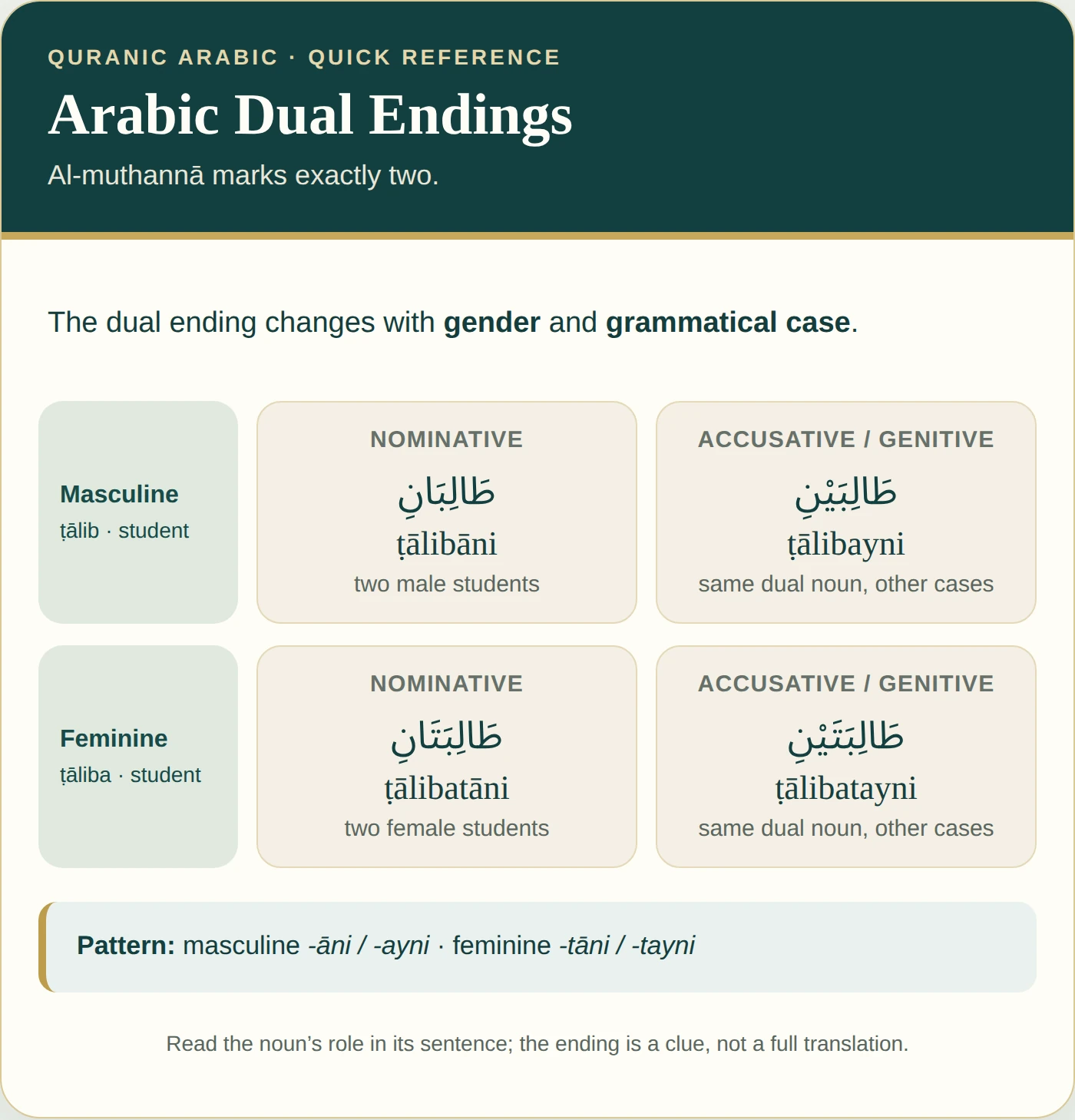
For a masculine noun such as ṭālib (طَالِب, a male student), the common nominative dual is ṭālibāni (طَالِبَانِ, two male students). In the accusative or genitive, the ending is ṭālibayni (طَالِبَيْنِ). These endings are often written in simplified lessons as ـانِ and ـيْنِ: -āni in the nominative; -ayni in the accusative and genitive.
Feminine nouns ending in tāʾ marbūṭa (ـة) usually change that marker to a regular tāʾ (ت) before the dual ending. For example, ṭāliba (طَالِبَة, a female student) becomes ṭālibatāni (طَالِبَتَانِ) in the nominative and ṭālibatayni (طَالِبَتَيْنِ) in the accusative or genitive. Notice the extra tāʾ: it belongs to the feminine noun stem, not to a separate word.
The table is a recognition aid, not a replacement for sentence analysis. A noun may also carry the definite article or a possessive suffix, and the pronunciation at a pause may differ from a fully connected reading. In Quran recitation, follow the written text and a qualified teacher’s model.
Why does the ending change?
Case is the grammatical role a noun has in its phrase or sentence. In the dual, the nominative commonly ends in -āni; the accusative and genitive commonly end in -ayni. Do not treat the two endings as two different words. They are case forms of one dual noun.
A practical clue is the word or construction before the noun. A subject or predicate may be nominative; a direct object is often accusative; a noun after a preposition such as bi- (“with,” “by,” or “to,” depending on context) is genitive. These are starting clues, not automatic translation rules. Arabic syntax, the full clause, and the intended reading all matter. If you need to review how prepositions affect a following noun, see this guide to common Arabic prepositions in Quranic reading.
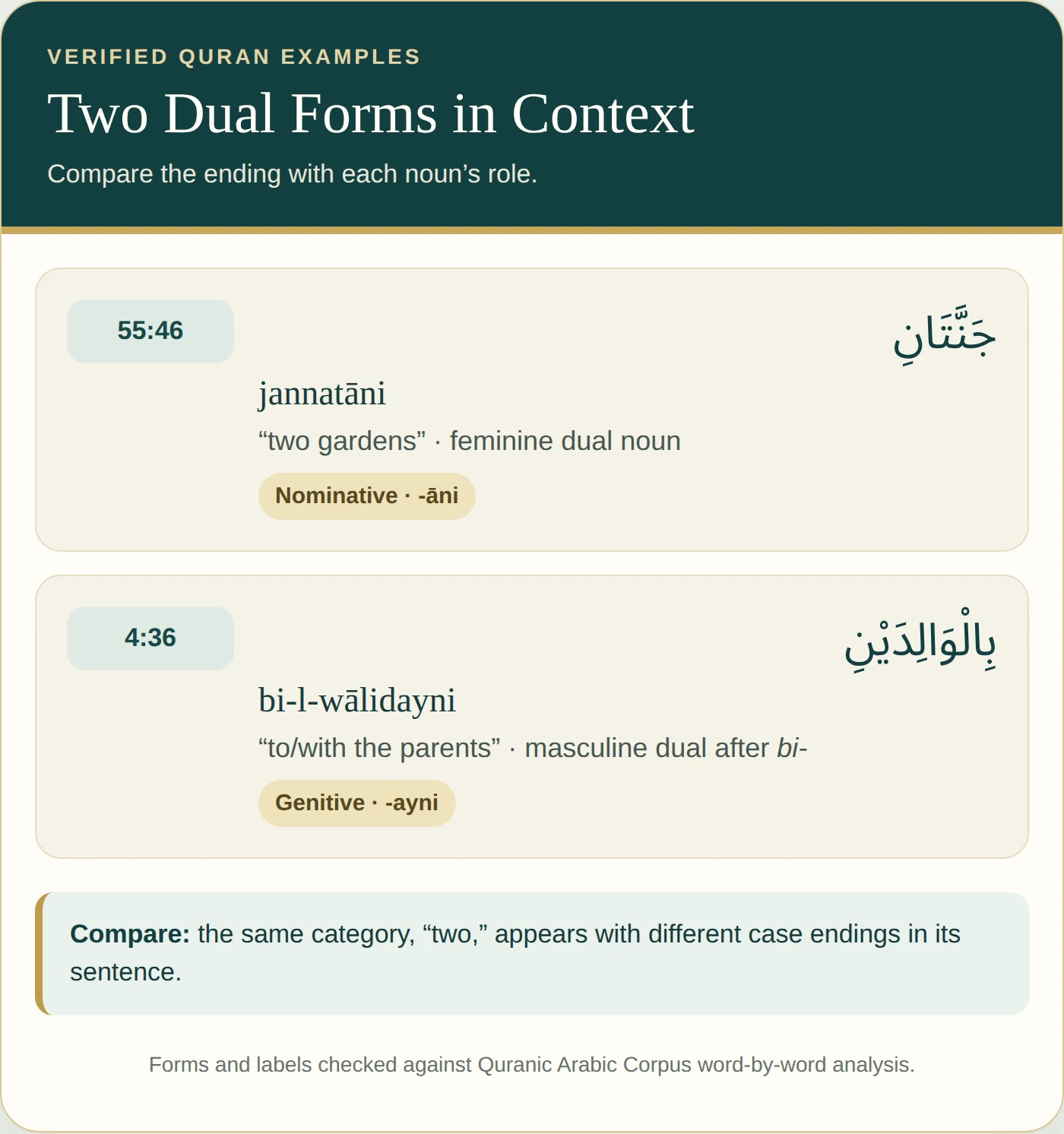
For instance, in Quran 55:46, jannatāni (جَنَّتَانِ, “two gardens”) is a feminine dual noun in the nominative. In Quran 4:36, al-wālidayni (الْوَالِدَيْنِ, “the parents”) follows the preposition bi- and is genitive. The Corpus analysis labels the two examples differently, which makes them useful for comparing -āni with -ayni rather than memorizing a spelling list.
Recognizing dual nouns in Quranic examples
Quran 2:282 contains several clear dual forms in its discussion of recording a debt. Shahīdayni (شَهِيدَيْنِ, “two witnesses”) and rajulayni (رَجُلَيْنِ, “two men”) are masculine dual nouns with the -ayni ending. The same passage includes imraʾatāni (وَامْرَأَتَانِ, “and two women”), a feminine dual noun with the nominative -atāni ending. Here the verse provides grammar examples; this article does not explain the legal rulings of the passage.
Another concise example appears in Quran 55:46: jannatāni means “two gardens.” It is helpful because the word visibly ends in -āni and the Corpus classifies it as a nominative feminine dual noun. In Quran 4:36, bi-l-wālidayni means “and to the parents”; the dual noun follows a preposition and appears with -ayni. Compare the complete phrases, not the endings in isolation.
These examples illustrate a useful method: first identify the possible dual ending, then ask what the sentence is doing with the noun. A subject, an object, and a noun after a preposition will not necessarily take the same case ending. For support with the agreement between a noun and its describing word, review Arabic adjective agreement.
Feminine duals, adjectives, and agreement
A dual adjective normally agrees with the noun it describes in number, gender, definiteness, and case. That means a learner should not stop at the noun’s ending. Look for the describing word and check whether it matches the noun. If the phrase feels complicated, start by identifying the noun, then return to the adjective after you know the noun’s role.
The feminine ending is especially easy to misread because the tāʾ marbūṭa changes shape before the dual marker. A feminine singular such as ṭāliba becomes ṭālibatāni or ṭālibatayni; do not erase the tāʾ when you identify the stem. Arabic adjectives can also carry these dual endings, so the pattern is not restricted to nouns alone.
Arabic pronouns and demonstratives are another nearby topic, but they are not simply ordinary nouns with the same ending. Quranytime’s articles on Arabic demonstrative pronouns and personal pronouns for Quranic reading explain those categories separately. This distinction helps prevent a familiar-looking final alif or yāʾ from being treated as proof that every word is a dual noun.
When the final letters are not enough
Not every word that appears to end in -ān is a dual. Proper names such as ʿUthmān or month names such as Ramaḍān contain similar letters but do not mean “two Uthm…” or “two Ramadans” in ordinary use. Check whether the word has a singular form with the same stem and whether the sentence’s meaning actually supports two items.
Possessive or construct forms can also look different from the stand-alone pattern because the nūn at the end of the dual marker is dropped before an attached possessor or in an iḍāfa construction. For example, Quran 12:100 has abawayhi (“his parents”): the dual noun is attached to the pronoun -hi (“his”), so the ending is not written as a free-standing -ayni. When a noun carries a suffix, read the entire word and identify its parts; Quranytime’s explanation of Arabic possessive iḍāfa phrases can help with noun-to-noun links.
A four-step way to spot al-muthannā
Use this short routine when a Quranic word seems to describe two:
- Find the noun stem. Separate the likely ending from the base word, including any feminine tāʾ.
- Check the number clue. Does the form plausibly mark two, or could the final letters be part of a name or another word pattern?
- Read the case context. Is the noun nominative, accusative, or genitive? Use its role and any preceding preposition as evidence.
- Check agreement and attachments. Look for a matching adjective, a possessive suffix, or a construct phrase that may alter what you see at the end.
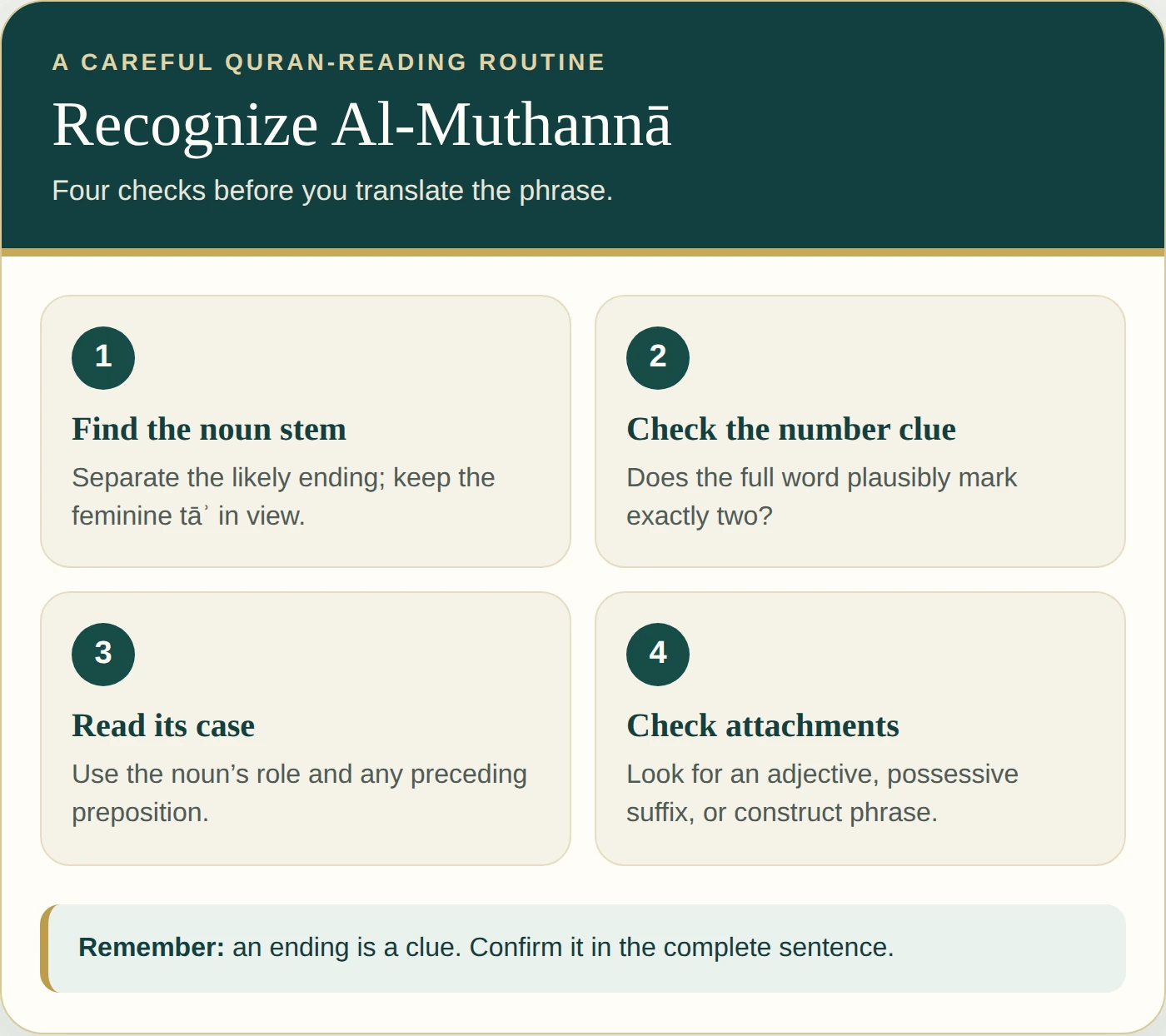
This process is deliberately cautious: an ending is a clue, not a full translation. If the word appears in a longer sentence, read the phrase as a unit before deciding whether it means “two.” For plural patterns, compare Quranytime’s guide to common Arabic broken plurals in the Quran.
Practise with one verse at a time
Choose a short passage and mark only the nouns that may be dual. Underline the stem, circle the ending, and note the role of each word before translating the phrase. Then compare your reading with a reliable word-by-word analysis and listen to the verse recited by a qualified teacher. Avoid inferring interpretation or legal meaning from a grammar label alone.
If you want a teacher to check your reading, you can book a free Quran and Arabic trial class. Bring one short verse and ask how the case ending, dual noun, and surrounding words work together. Consistent feedback can help you notice patterns without turning every ending into a guess.
Key points to remember
- Arabic uses a dual form, al-muthannā, for exactly two nouns or adjectives.
- -āni is the common nominative form; -ayni marks the accusative or genitive.
- Feminine nouns ending in tāʾ marbūṭa usually change it to tāʾ before the dual ending: -tāni or -tayni.
- Read the case, agreement, and any attached pronoun in context; similar-looking endings do not prove a word is dual by themselves.