

“A kasrah means genitive” works often enough to become a dangerous habit. Then you meet رَأَيْتُ الْمُعَلِّمَاتِ — “I saw the female teachers” — and the object ends in kasrah. The sentence is correct. الْمُعَلِّمَاتِ is accusative, and this noun type uses kasrah as its accusative marker.
Sound feminine plurals, جَمْعُ الْمُؤَنَّثِ السَّالِمِ, teach an important reading skill: separate a noun’s grammatical case from the mark that expresses it. This lesson works through one small school scene so you can follow the same group as subjects, objects and prepositional dependents. You will also see why an ending in ـات does not automatically tell you that a noun refers to women.
Keep the teachers constant while the scene changes
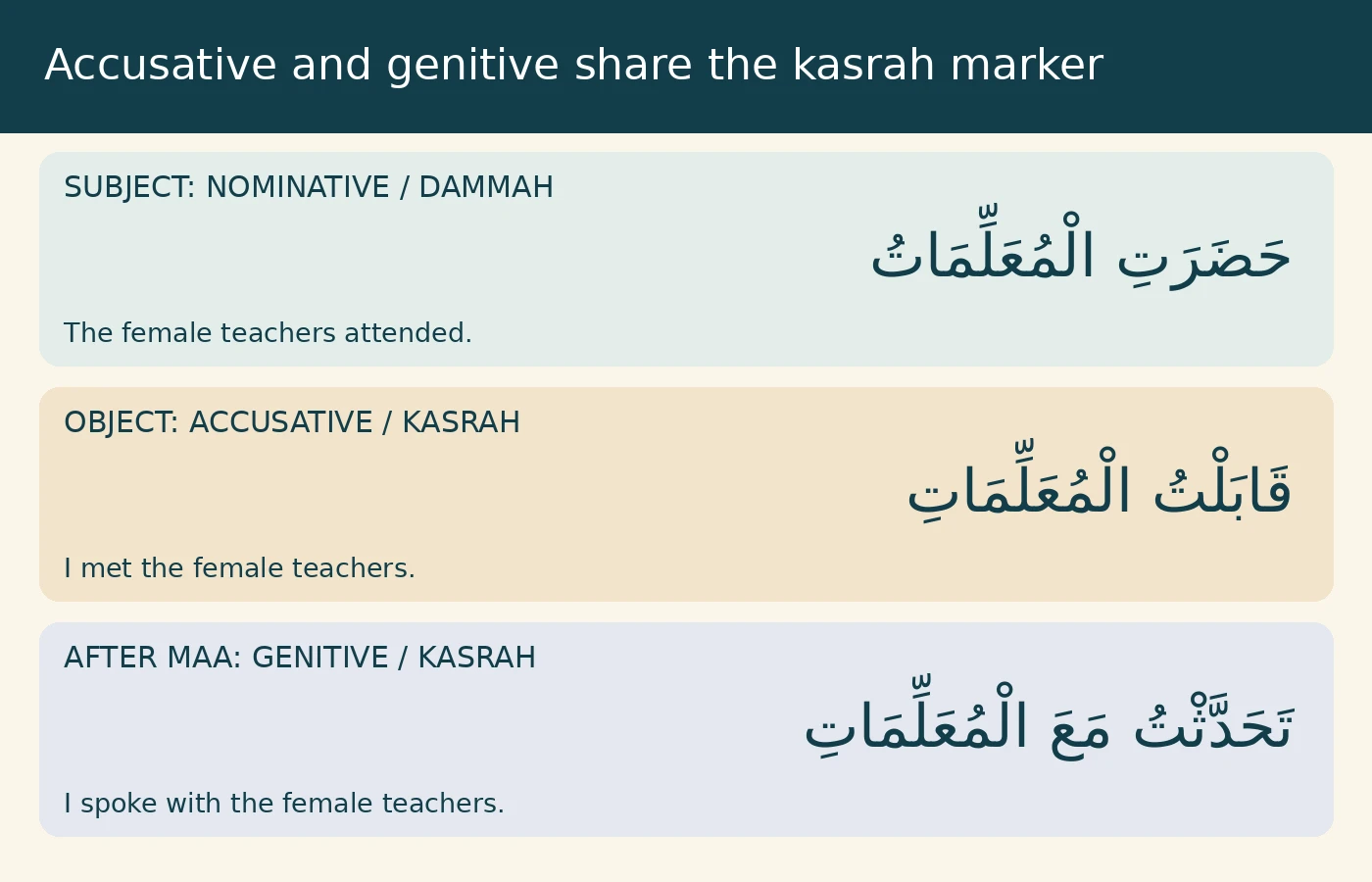
All examples in this classroom scene are composed practice, not Quran quotations. In حَضَرَتِ الْمُعَلِّمَاتُ, “The female teachers attended,” the teachers are the subject and the noun is nominative. In قَابَلْتُ الْمُعَلِّمَاتِ, “I met the female teachers,” they are the direct object and the noun is accusative. In تَحَدَّثْتُ مَعَ الْمُعَلِّمَاتِ, “I spoke with the female teachers,” the noun is genitive in the phrase after مَعَ.
The nominative has dammah, but both accusative and genitive have kasrah. Looking only at the final vowel cannot distinguish the latter two. Ask which relationship governs the noun. An object does not become genitive because you hear an -i sound, and a noun after a preposition does not become an object because it looks like one you saw earlier.
Keep two labels in your notes: “case” and “marker.” For the second sentence write “accusative; marker kasrah because sound feminine plural.” For the third write “genitive; marker kasrah.” The case-ending guide provides the wider framework. The point of this lesson is to make that distinction usable when the same visible ending supports different analyses.
Build the plural without carrying over ta marbuta
A transparent example is مُعَلِّمَةٌ → مُعَلِّمَاتٌ, female teacher → female teachers. The singular’s ta marbuta is replaced by the sound plural ending alif and open ta. Do not write a ta marbuta and then append a second ending after it. The plural form is not a singular noun with an extra word attached.
Try طَالِبَةٌ → طَالِبَاتٌ, female student → female students, and كَاتِبَةٌ → كَاتِبَاتٌ, female writer → female writers. Pronounce the long ā in the plural ending. The final ta is an ordinary written ت rather than ة. The ta marbuta pronunciation lesson helps you keep the singular ending and its pause behavior separate from the plural spelling.
These easy pairs are useful models, not a command to manufacture every Arabic plural by adding ـات. Arabic has several plural strategies, and a noun’s established plural must be learned or checked. Some words have more than one plural with differences of usage. If your dictionary gives a broken plural, do not discard it because the sound pattern feels simpler.
Why “feminine” in the name is not a complete meaning test
The pattern includes familiar references to female people, but form and meaning do not always align so neatly. مَعْلُومَات, information, and اِجْتِمَاعَات, meetings, do not denote groups of women. The broader grammatical family includes plurals formed with added alif and ta, including words whose singular does not end in ta marbuta.
For reading, recognize the morphological pattern and check the singular rather than inventing a human referent. In a classroom vocabulary task, ask separately “What is the singular?” and “Does this noun refer to people?” The answers determine different things. Plural formation concerns word structure; rational/non-rational agreement concerns how the plural relates to verbs and adjectives.
Compare the strategies with the broken-plural guide. A broken plural changes the internal pattern, while a transparent sound plural retains the stem more clearly. Neither category is simply a translation of the English distinction between regular and irregular spelling.
Add an adjective and follow both words
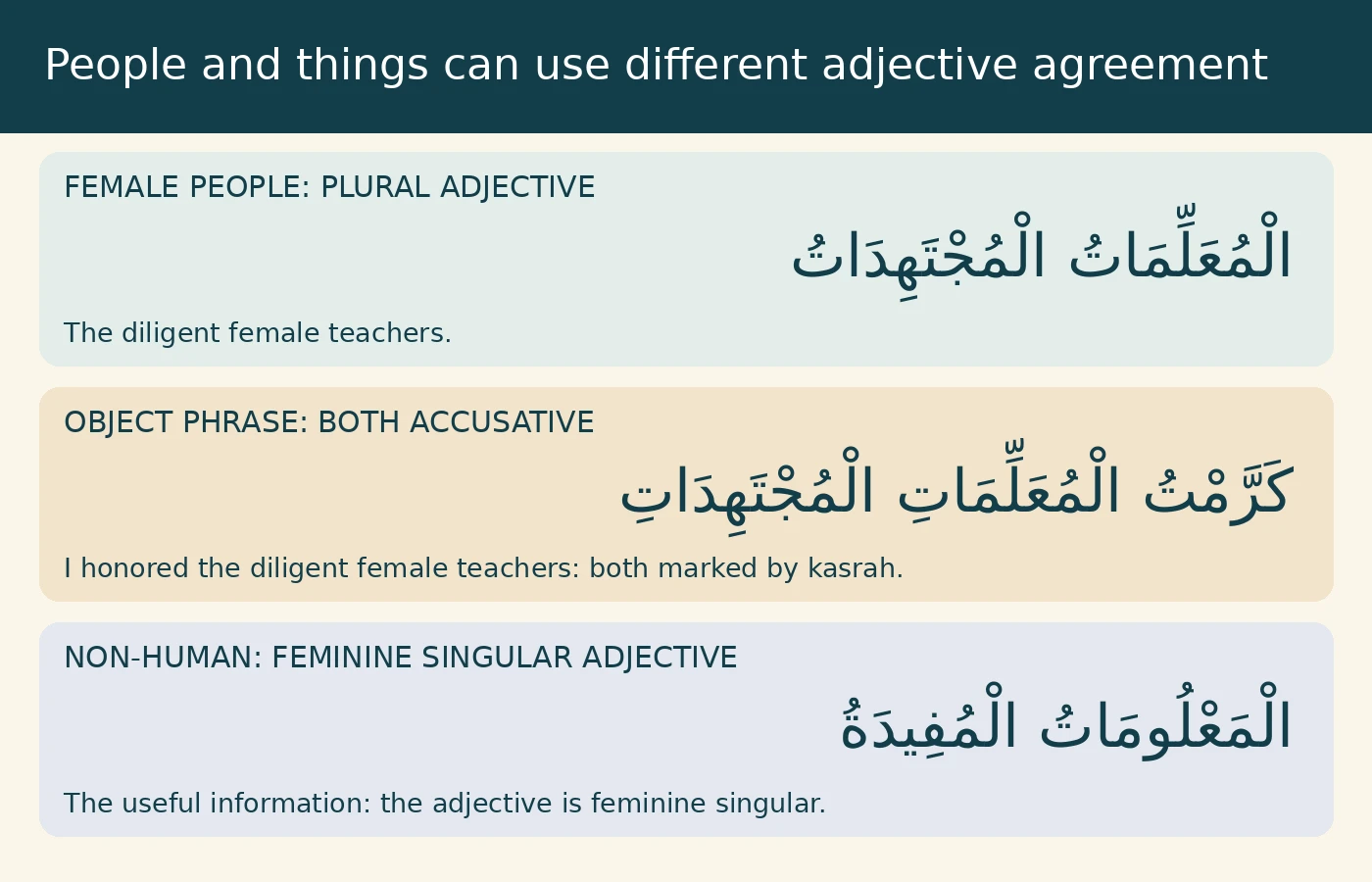
In the composed phrase الْمُعَلِّمَاتُ الْمُجْتَهِدَاتُ, “the diligent female teachers,” both noun and adjective are nominative sound feminine plurals. Now put the phrase after an object-taking verb: كَرَّمْتُ الْمُعَلِّمَاتِ الْمُجْتَهِدَاتِ, “I honored the diligent female teachers.” Both become accusative, and both show kasrah as the marker for this noun type.
The matching kasrahs support the relationship, but you still need the noun’s function to identify the case. If you memorize only that adjectives follow the noun’s ending, you may reproduce the forms while calling both genitive incorrectly. State the case and its cause before checking the adjective’s agreement.
Non-human plurals commonly take feminine singular agreement in standard beginner patterns. Thus الْمَعْلُومَاتُ الْمُفِيدَةُ means “the useful information”: الْمُفِيدَةُ is feminine singular, not a sound feminine plural adjective. The adjective agreement lesson explains this distinction. Do not make every adjective end in ـات just because its noun does.
Tanwin belongs to definiteness, not the plural ending
Compare مُعَلِّمَاتٌ, “female teachers,” with الْمُعَلِّمَاتُ, “the female teachers.” The plural’s alif and ta remain in both. Tanwin changes with the noun’s definiteness and construction. In a composed object phrase, رَأَيْتُ مُعَلِّمَاتٍ means “I saw female teachers”; رَأَيْتُ الْمُعَلِّمَاتِ means “I saw the female teachers.”
The first object has kasratayn; the definite object has a single kasrah. Neither is genitive in these sentences. This is another reason to avoid translating a mark directly into a case name without considering the word type. Review definite and indefinite nouns if tanwin and the article are still competing clues in your notes.
Now build an idafa: مُعَلِّمَاتُ الْمَدْرَسَةِ, “the school’s female teachers.” The first noun is the construct head and has no tanwin. Its case can change with the sentence, while الْمَدْرَسَةِ remains genitive as the dependent. The guide to idafa covers that relationship. Do not assume that every noun inside the phrase must have the same case.
Read one school scene as three different jobs
Read this composed mini-story: حَضَرَتِ الْمُعَلِّمَاتُ. قَابَلْتُ الْمُعَلِّمَاتِ. تَحَدَّثْتُ مَعَ الْمُعَلِّمَاتِ. “The female teachers attended. I met the female teachers. I spoke with the female teachers.” Before reading aloud, label the teachers’ role in each sentence. Then identify what the final mark expresses.
In the first sentence, the preceding feminine singular verb is consistent with the standard verb-before-explicit-plural-subject pattern. Do not turn that observation into a rule that plural subjects always take singular verbs. Word order matters. الْمُعَلِّمَاتُ حَضَرْنَ, with the plural topic placed first, has a different agreement structure.
If that difference distracts you, initially concentrate only on the noun case and ask a teacher to check the verb agreement separately. A manageable exercise should test one main decision before adding another. The verbal-sentence guide gives the broader word-order explanation. This lets you diagnose an agreement mistake without confusing it with the plural’s case marker.
Quran example: why an accusative description ends in kasrah
Quran 66:5 includes مُسْلِمَاتٍ مُؤْمِنَاتٍ among descriptions following أَزْوَاجًا. The descriptions are accusative and follow the noun they qualify, but the sound feminine plural forms use kasrah. This is a useful real-text contrast with the preceding accusative أَزْوَاجًا, which belongs to a different plural pattern.
Al Jazeera Learning Arabic’s sound feminine plural explanation uses this verse to explain the accusative marker. Read the complete verse with a reliable translation and tafsir before interpreting the passage; the short word group here illustrates an inflectional relationship. A shared case does not require all words to display the same written marker.
When listening to recitation, also distinguish connected reading from stopping. A pause may affect what you hear at the end of a word, but it does not replace the word’s syntactic analysis. Inspect the fully vocalized text and the grammatical relationship rather than deciding a case from a single paused audio clip.
A two-column correction exercise
Draw two columns titled “case required” and “marker shown.” Fill them for these composed examples: (1) جَاءَتْ طَالِبَاتٌ; (2) سَأَلْتُ طَالِبَاتٍ; (3) كَتَبْتُ إِلَى طَالِبَاتٍ. The meanings are “Female students came,” “I asked female students,” and “I wrote to female students.”
Answers: 1. Nominative subject, marked by dammah with tanwin. 2. Accusative object, marked by kasrah with tanwin. 3. Genitive after إِلَى, marked by kasrah with tanwin. In the last two, the spelling of the target noun is the same. The governing relationship supplies the distinction that the ending cannot supply alone.
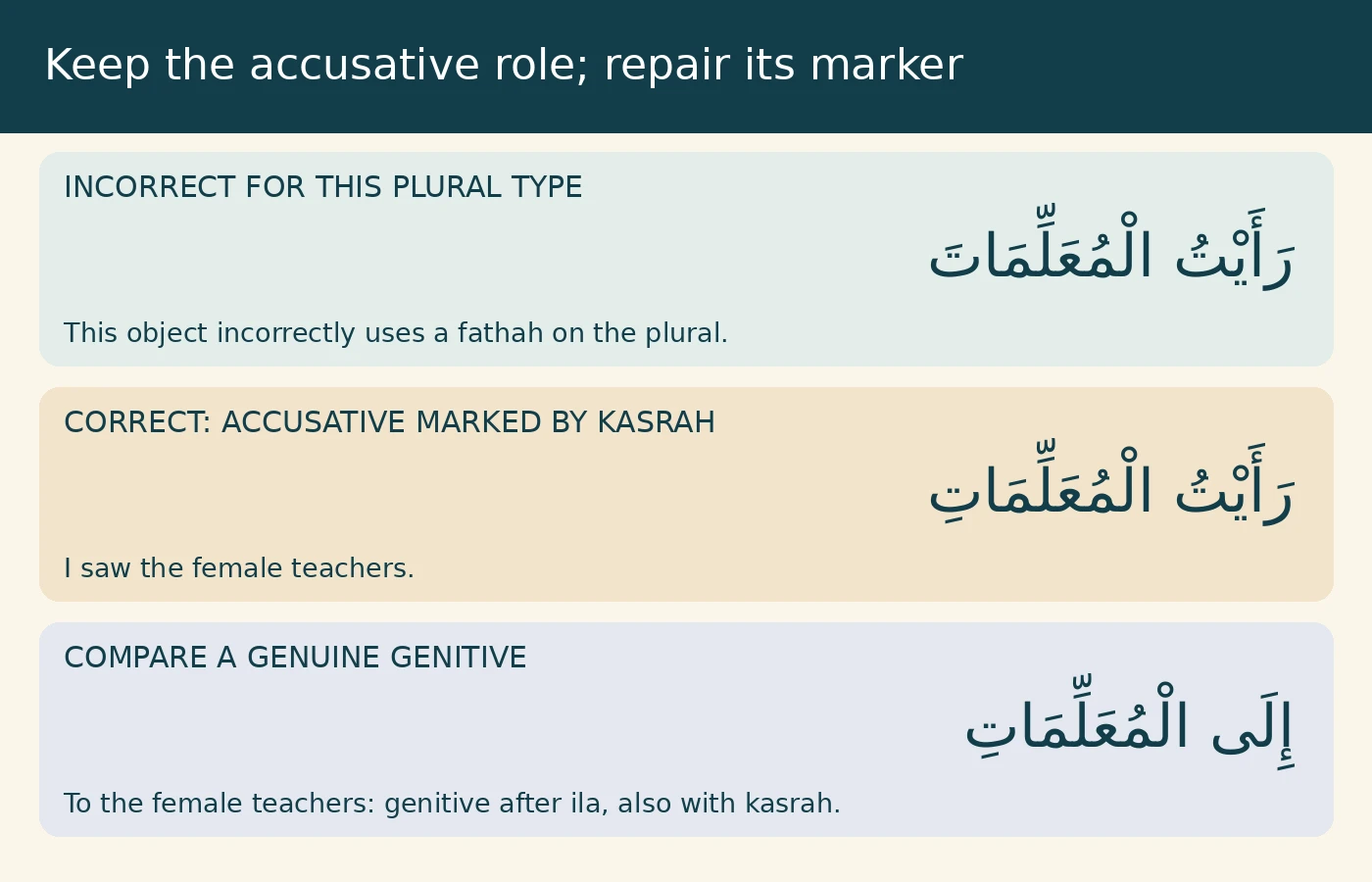
Now correct the deliberately faulty رَأَيْتُ الْمُعَلِّمَاتَ. In the intended standard sound feminine plural construction, write رَأَيْتُ الْمُعَلِّمَاتِ. Explain that the object remains accusative: you are repairing the marker, not changing the case. If your explanation is “because I added a preposition,” you have solved the wrong problem; there is no such preposition in this sentence.
Follow a longer phrase without losing the head noun
Take the composed phrase مُعَلِّمَاتُ الْمَدْرَسَةِ الْجَدِيدَةِ, “the female teachers of the new school.” Here الْجَدِيدَةِ describes the school, not the teachers. Its feminine singular form and genitive case match الْمَدْرَسَةِ. The phrase has two layers, and the final adjective belongs inside the school layer. Reading from the first plural noun straight to the last adjective would assign the wrong relationship.
Now use the whole phrase as an object: قَابَلْتُ مُعَلِّمَاتِ الْمَدْرَسَةِ الْجَدِيدَةِ. “I met the female teachers of the new school.” مُعَلِّمَاتِ becomes accusative, marked by kasrah. The school and its adjective remain genitive for reasons inside the construct phrase. All three final words now display kasrah, yet the first belongs to a different case from the other two.
This is a useful challenge because the visible pattern tempts you to write “all genitive” without reading the structure. Put brackets around الْمَدْرَسَةِ الْجَدِيدَةِ and identify what that bracketed phrase contributes. Then return to the head noun and ask what was met. The answer identifies the object: the female teachers, with a dependent phrase explaining which school they belong to.
How to annotate a mistake that keeps recurring
If you repeatedly mislabel these objects as genitive, make your correction precise. Write “I inferred case from kasrah without checking the noun type,” rather than “I forgot Arabic grammar.” The first diagnosis suggests a practical repair: identify the case required by the verb, then inspect the noun type. The second diagnosis is too broad to guide useful practice.
Keep a successful example alongside the mistaken one. Explain why the same final vowel is correct in both, although the cases differ. When you can make that comparison without looking at the answer, move on to a new noun. Repeating the original example indefinitely can hide the fact that you have memorized its translation rather than learned the grammatical decision.
Check whether the skill transfers
On a later day, use مُسْلِمَات or طَالِبَات instead of the teacher example. Write one sentence with a subject, one with an object, and one with a preposition. Then cover the target noun and state which case the remaining structure requires. Reveal it and check the noun-type marker. This order makes guessing from a familiar final sound harder.
Use a second task to test agreement: compare a phrase about female people with a phrase about information. Explain why the first can have a feminine plural adjective and the second commonly has a feminine singular adjective. Correct performance on the case task does not automatically prove that the agreement decision is secure.
For feedback on both decisions, Book a Free Trial Class. Bring one accusative sound feminine plural that you initially mistook for genitive. Explaining why the kasrah belongs there will show more understanding than merely copying the corrected spelling.