
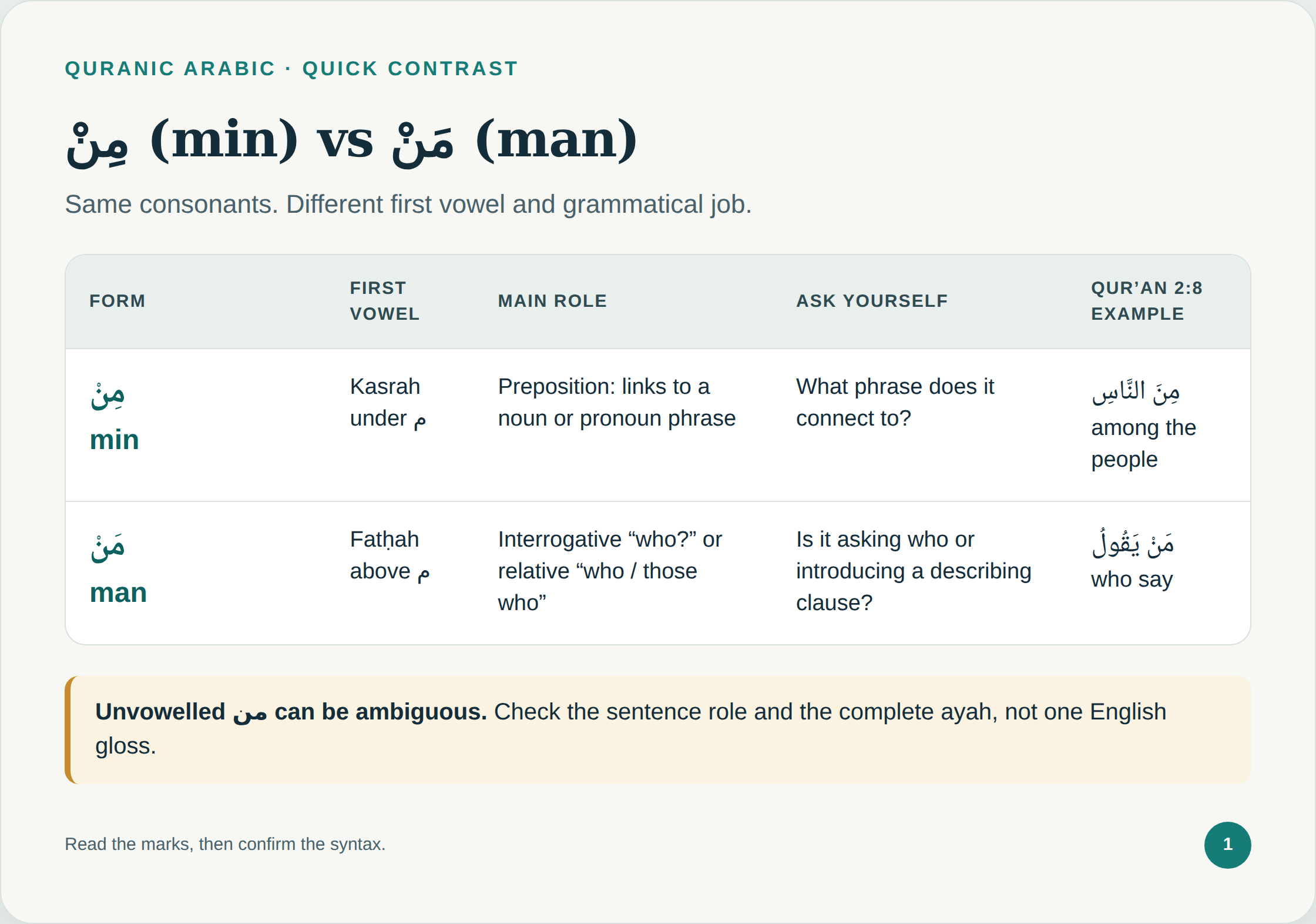
Min in Quranic Arabic can be confusing when a text is written without vowel marks: من may stand for two different words. Fully marked, مِنْ (min) begins with a kasrah, while مَنْ (man) begins with a fatḥah. The first is a preposition; the second can ask “who?” or introduce a clause meaning “who” or “those who.” To tell them apart, check the marks when they are present, then ask what grammatical job the word does in the whole verse.
This is a focused guide to the min versus man distinction, not another overview of every Arabic particle. If you need a basic refresher on prepositions, see Quranytime’s guide to Arabic prepositions and مِنْ. For the wider idea of a relative clause, the guide to relative pronouns in Quranic Arabic is a useful companion.
مِنْ and مَنْ at a glance
The consonants are the same; the first vowel and the sentence role are different. The short mark on the final ن may also be shared, so look at the first letter’s vowel rather than relying on the final letter alone.
What does مِنْ (min) do?
مِنْ is a preposition. In a basic learner’s parse, it connects to a following noun or pronoun and forms a prepositional phrase. Depending on the construction, an English translation may use “from,” “of,” “among,” or a different natural phrase. Those English words are possible context clues, not permanent dictionary labels that settle every verse.
In Qur’an 2:8, the phrase مِنَ النَّاسِ is commonly rendered “among the people” in the surrounding sentence. Here the Corpus labels the first word as a preposition and the following noun as genitive. Notice the written form مِنَ: it is still the preposition min, even though its final vowel is shown as fatḥah in this connected phrase. That final mark does not turn it into man.
You can also meet مِنْ attached to a pronoun, as in مِنْهُمْ (“of/from them,” according to context). In Qur’an 4:55, the opening فَمِنْهُمْ contains the preposition and an attached pronoun. The practical question is: does this token introduce a phrase whose following noun or pronoun is linked to it? Use that clue, then verify the complete construction rather than treating the attached pronoun as a separate occurrence of man.
What can مَنْ (man) mean?
مَنْ is not a preposition. Its function depends on its construction. In a direct question it can mean “who?” In a relative construction it can be understood as “who,” “the one who,” or, in a natural English sentence, “those who.” The words around it—not one English gloss—show which reading fits.
Qur’an 2:245 begins a question with مَن ذَا الَّذِي, approximately “Who is it that…?” The Corpus tags the first man as an interrogative noun. The question structure is the clue: the speaker is asking who. In Qur’an 2:8, by contrast, مَنْ يَقُولُ follows a phrase about people and is tagged as a relative pronoun; the clause identifies the people being described—“those who say.”
For another relative use, Qur’an 4:55 has فَمِنْهُمْ مَنْ آمَنَ بِهِ. The first part, مِنْهُمْ, is a prepositional phrase with an attached pronoun. The next word, مَنْ, introduces the group described by the following verb: “then among them are those who believed in it.” The two forms appear close together, but their jobs are not interchangeable.
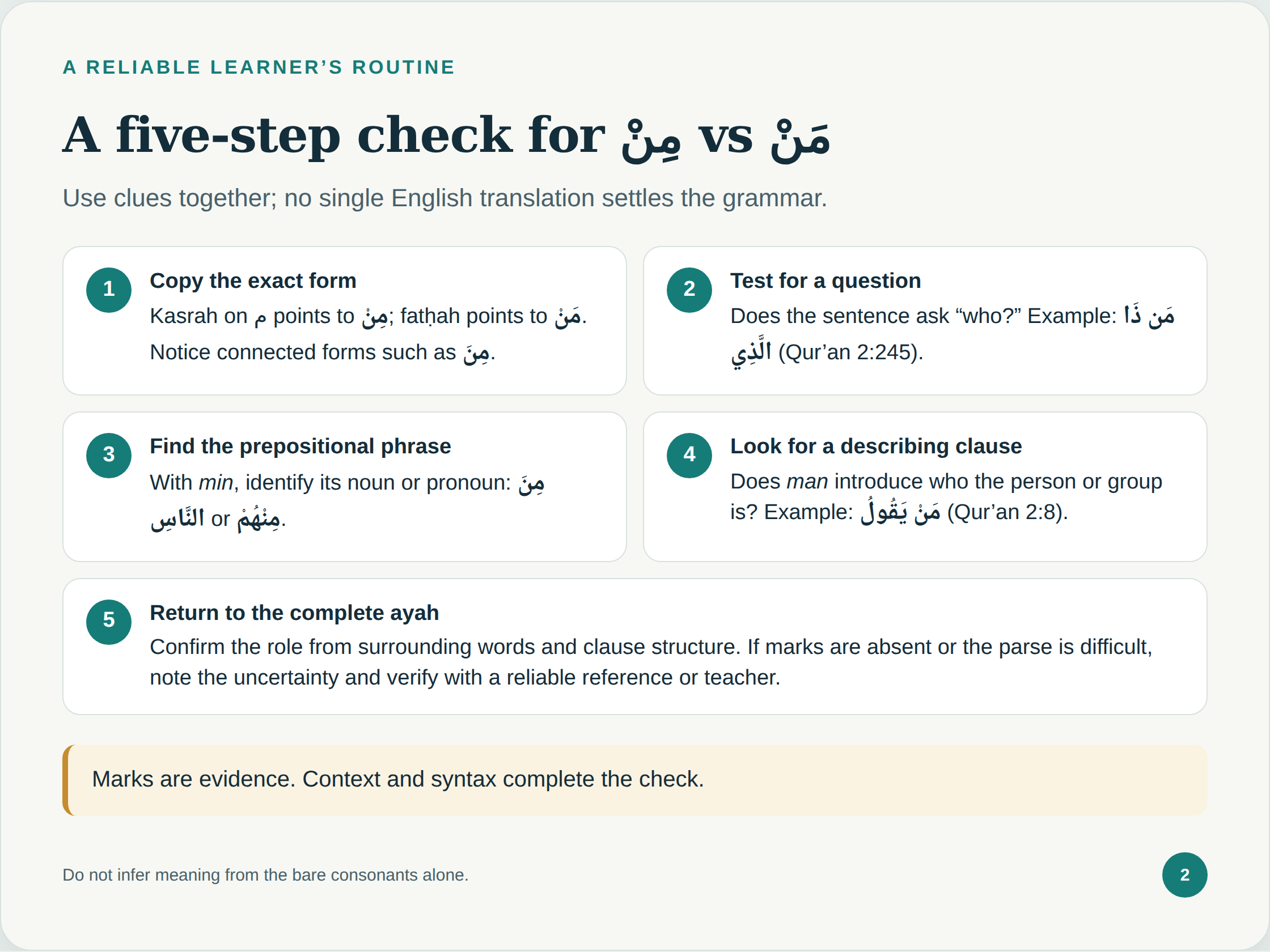
See both forms in one verse: Qur’an 2:8
Consider this short sequence: وَمِنَ النَّاسِ مَنْ يَقُولُ (Qur’an 2:8). A cautious working gloss is “And among the people are some who say…” The first min belongs with النَّاسِ, “the people”; it introduces the prepositional phrase. The later man belongs with يَقُولُ, “say”; it introduces the clause describing those people. The Corpus’s word-by-word analysis identifies the first token as a preposition and the later one as a relative pronoun.
So the same verse gives you two helpful questions: “What group does مِنَ introduce?” and “Which people does مَنْ يَقُولُ describe?” Do not translate each token in isolation and stop there. A translation helps you understand the sentence, but the Arabic role comes from the token, its neighbors, and the clause structure together.
A five-step check for مِنْ versus مَنْ
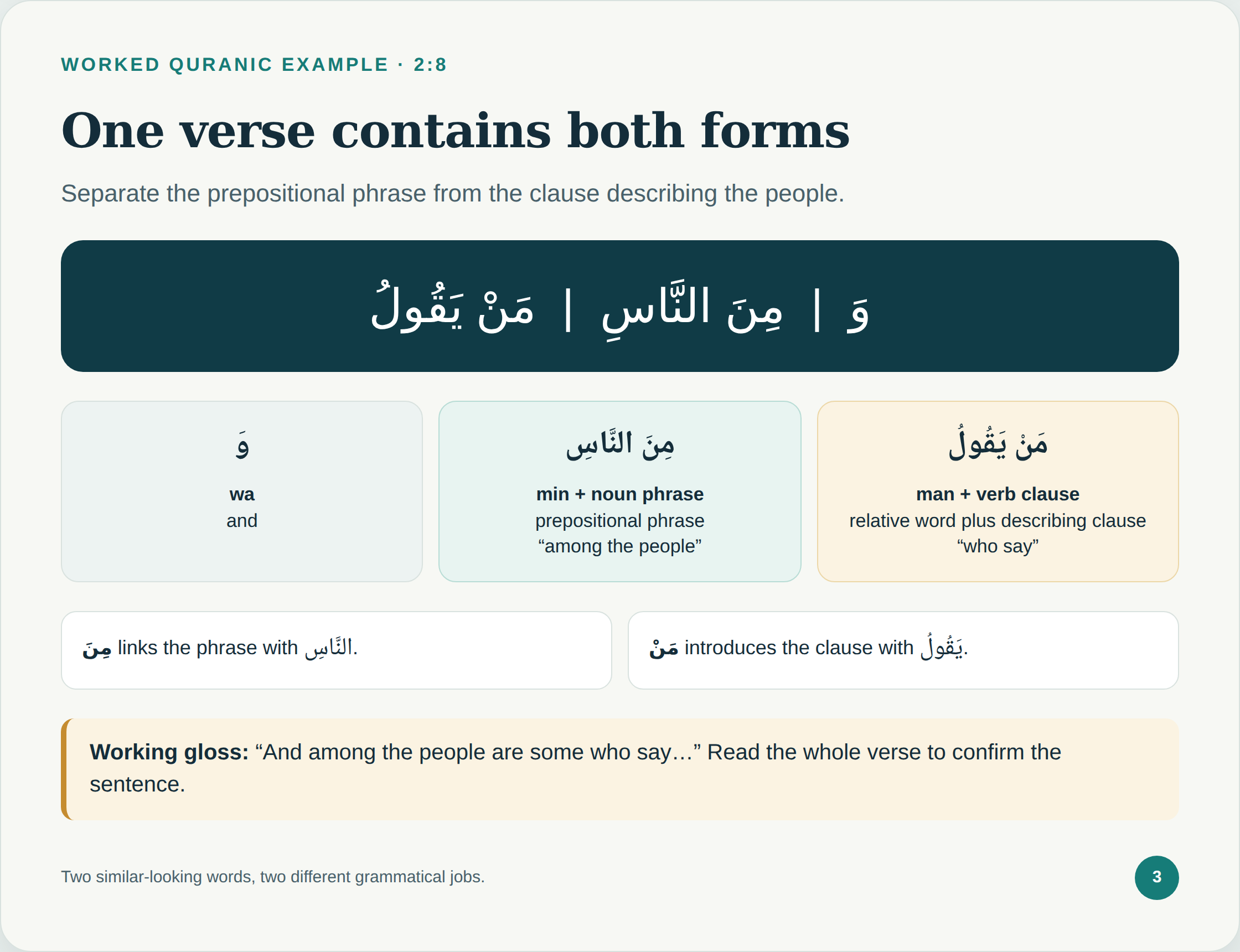
- Copy the exact form. If the text is fully vowelled, check the vowel on م: kasrah in مِنْ points to min; fatḥah in مَنْ points to man. In connected phrases, you may see مِنَ, as in 2:8; read the whole phrase rather than treating the final vowel as a new word.
- Ask whether a question is being asked. If the phrase is asking “who?”, test the interrogative reading of man, as in مَن ذَا الَّذِي in 2:245.
- Look for the phrase linked by a preposition. With min, identify the noun or pronoun it connects to. In مِنَ النَّاسِ, the following noun is part of the prepositional phrase; in مِنْهُمْ, the pronoun is attached.
- Check for a describing clause. If man is followed by a clause that tells you which person or people are meant, test the relative reading, as in مَنْ يَقُولُ in 2:8.
- Return to the complete ayah. Confirm the proposed role against the whole sentence, not a word-for-word English gloss. If the marks are missing or a construction is difficult, note the uncertainty and check a reliable grammatical reference or ask a qualified teacher.
Use a grammar tool as a check, not as tafsir
The Morphological Search in the Quranic Arabic Corpus lets readers search Quran words by part of speech, including preposition and relative pronoun, and inspect fields such as root, lemma, and stem. Its notes also explain that a lemma search depends on correct vowelization, while a stem search ignores diacritics. That makes it a useful language-learning check when two unvowelled spellings look alike.
A database label helps you inspect a word’s form and grammatical role; it does not answer every question about interpretation, context, or tafsir. Quranytime’s guide to using a Quranic Arabic corpus explains a careful lookup process. For a second method of checking a phrase in context, see how to study a Quran verse word by word without losing context.
Common mistakes to avoid
- Giving مِنْ one fixed English meaning. “From,” “of,” and “among” can all be useful in context, but none is a universal substitute for the Arabic construction.
- Calling every مَنْ a relative pronoun. It can also be interrogative. Check whether the sentence asks “who?” or uses a clause to describe someone.
- Ignoring the marks on the first letter. When the marks are present, they are useful evidence. When they are absent, the bare spelling من may not decide the question by itself.
- Using translation as the only grammar test. English word order and phrasing can hide the Arabic relationships. Quranytime’s context-first particle guide for ما offers a related example of why sentence context matters.
- Guessing from one word. Read the clause and verse. If the parse remains uncertain, record both possibilities and verify instead of forcing a confident answer. The guide to Arabic negation in Quranic reading shows the same broader lesson: similar-looking forms can have different jobs.
Listen to Qur’an 2:8 in context
This short clip displays the Arabic text of Qur’an 2:8 and includes its recitation with Urdu/Kashmiri translation or commentary. Listen for the sequence containing both forms, then use the marked phrase above to identify which token is the preposition and which introduces the describing clause. The clip is a listening prompt, not an English grammar explanation.
If you want to build the grammar foundation behind examples like this, Quranytime’s step-by-step Quranic Arabic sentence-parsing guide shows how to identify a clause and check its roles. The broader Quranic Arabic learning path can help you study related structures in sequence.
Practise with one ayah at a time
Choose one short verse. First, mark every occurrence of من. Beside each one, write a tentative label: preposition, question word, or relative word. Next, circle the phrase or clause connected to it. Only then compare your answer with a vowelled text and a trusted morphology reference. This turns the contrast into a small parsing exercise rather than a memorized translation list.
If you are still unsure, bring the exact verse and your reasoning to a teacher instead of guessing at a religious or interpretive meaning. If you would like guidance on your current reading and Arabic level, book Quranytime’s free Quran and Arabic assessment class. A brief teacher check can help you separate a spelling question from a grammar question and choose an appropriate next lesson.
The quick rule is simple: مِنْ links a phrase as a preposition; مَنْ can ask “who?” or describe “who.” When the vowel marks are missing, let the syntax and the complete ayah—not one English gloss—settle the reading.