
Grammar lessons can explain subjects, objects, particles, and case endings one at a time. The challenge is putting those clues together when you meet a complete Quranic phrase. This guide shows how to parse a Quranic Arabic sentence step by step: set a small boundary, identify the clause pattern, mark its main roles, trace the attached phrases, and verify your first-pass reading. The aim is a careful learning exercise—not a substitute for tafsir or qualified instruction.
What does it mean to parse a Quranic Arabic sentence?
Parsing, often called iʿrāb, is describing how words function and relate inside a phrase or sentence. A useful beginner parse asks: What is the main clause? Where is its verb or topic? Who or what is linked to it? Which particles, pronouns, conjunctions, or prepositions affect the relationship? Case endings and word forms provide evidence, but they do not replace reading the whole construction.
It helps to separate three tasks. Reading identifies the written and recited words. Grammar explains their structure. Tafsir and translation address meaning within a larger interpretive tradition. Grammar can support understanding, but a novice should not turn one grammatical observation into a religious ruling or a definitive interpretation of a verse.
Prepare before you analyze
Choose one short phrase from a passage you already study. Keep the surrounding verse visible, read a trusted translation for context, and write down what you are trying to identify. If letters or vowel marks slow you down, review the Arabic letter explorer and Arabic alphabet and Tajweed guide first. Those are separate skills; this lesson focuses on how words connect after you can recognize them.
Use a reliable Quran text and avoid guessing a missing ending when the mushaf does not print one. A grammar reference may show a word’s full analysis, while a recitation resource focuses on pronunciation. For a refresher on the latter, see Quranytime’s guide to Quran reading and Tajweed.
How to parse Quranic Arabic sentences: a repeatable six-step method
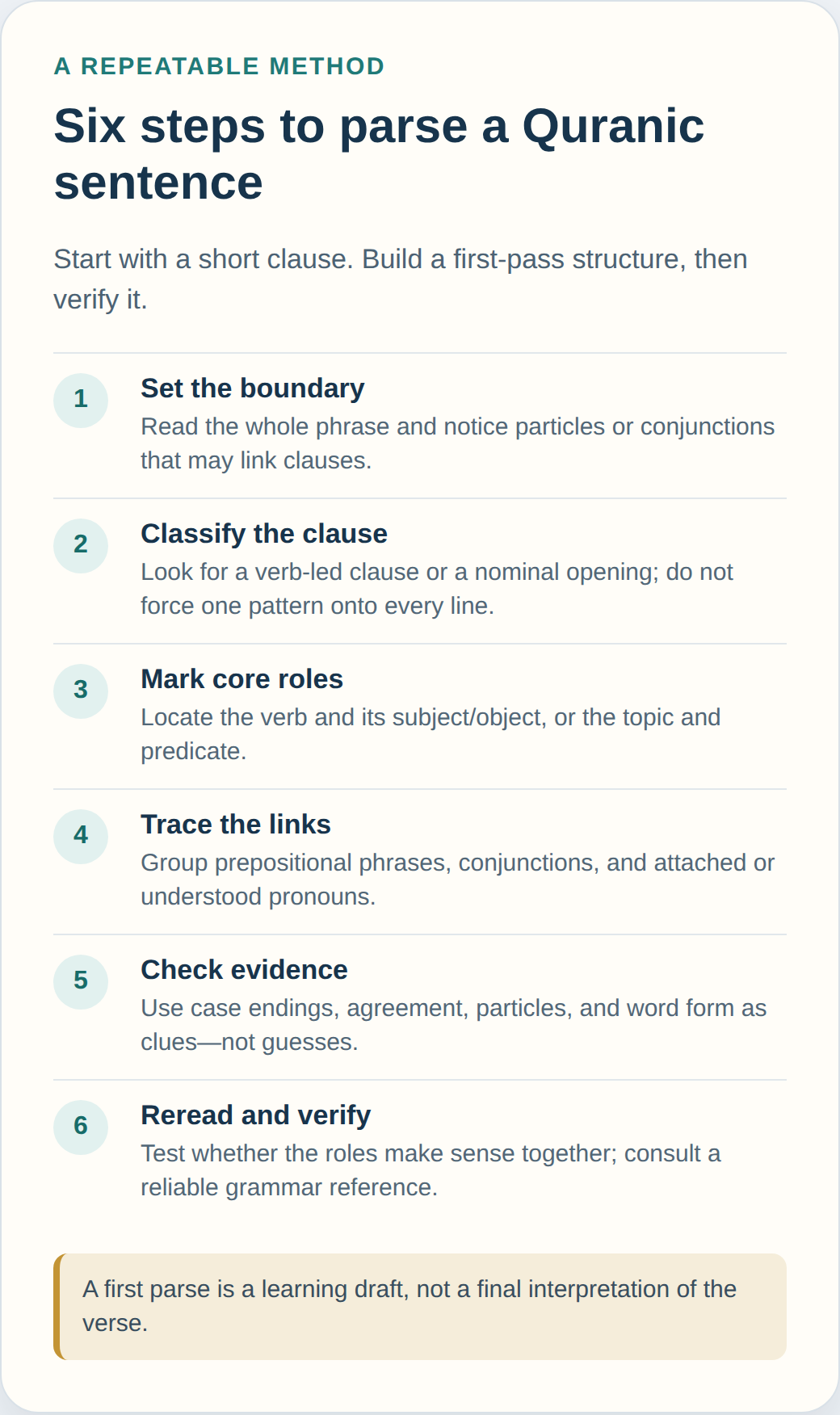
Start with the whole phrase, not a dictionary meaning for each word in isolation. Mark where one clause ends and another begins. Then decide whether the clause is verb-led or begins with a nominal topic; do not force every verse into the same pattern. Identify the main verb and its subject or object, or the topic and predicate. Next, group words joined by a preposition, conjunction, or attached pronoun. Finally, check case, agreement, and word form against a trusted grammar reference, then reread the phrase to see whether the relationships fit together.
For a quick overview of how a Quranic Arabic corpus displays word-by-word grammar and syntax, this short screen recording demonstrates the corpus interface:
Worked example: a verb-led phrase
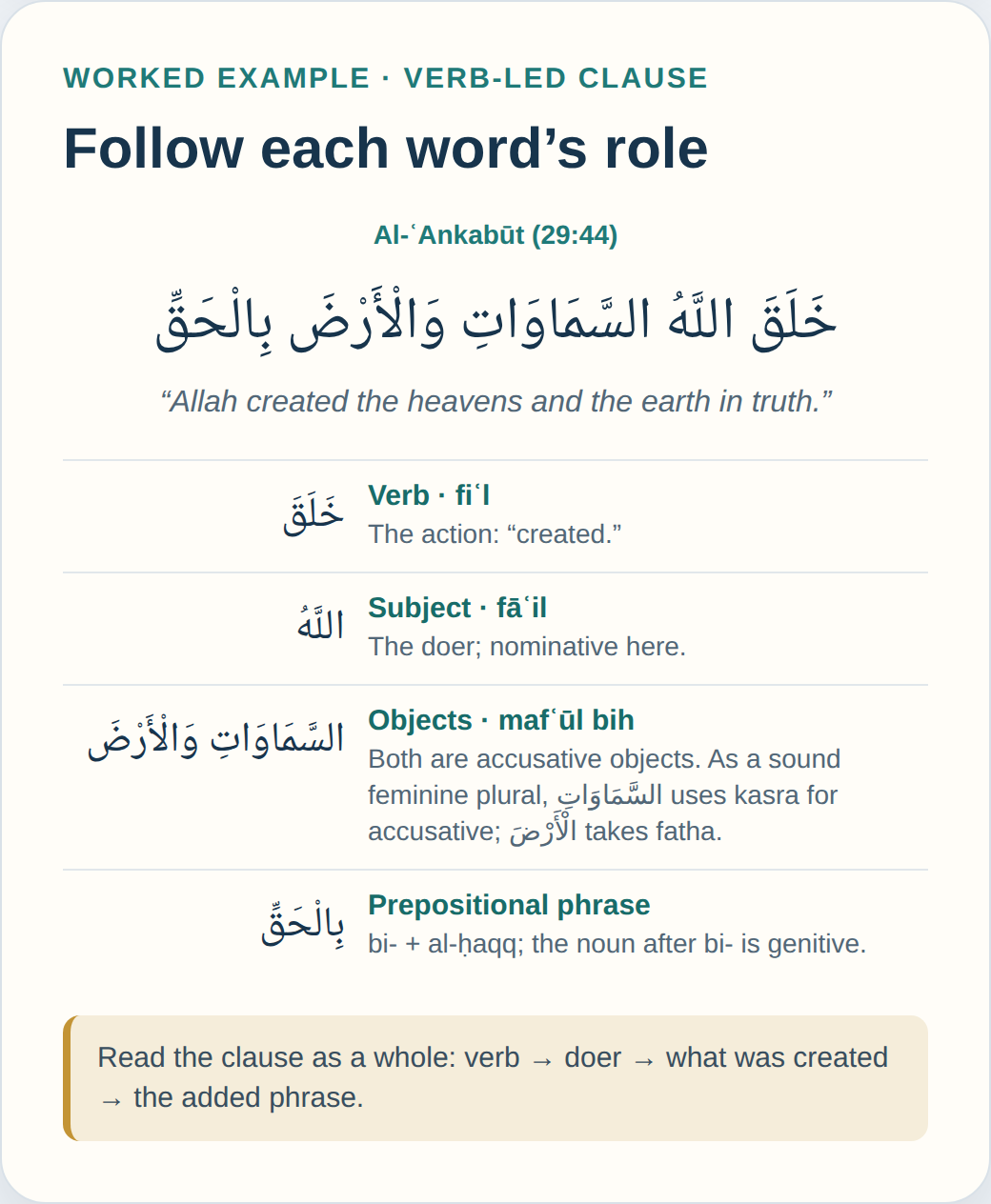
Consider the verified words from Al-ʿAnkabūt 29:44: خَلَقَ اللَّهُ السَّمَاوَاتِ وَالْأَرْضَ بِالْحَقِّ, translated here as “Allah created the heavens and the earth in truth.” Start with the verb خَلَقَ (created). Ask who performed the action: اللَّهُ (Allah) is the subject, marked nominative in the corpus analysis. Ask what was created: السَّمَاوَاتِ and the coordinated الْأَرْضَ are the objects of the verb.
This is a useful reminder that case endings are evidence, not a shortcut. The sound feminine plural السَّمَاوَاتِ is accusative here even though its ending is kasra; the coordinated noun الْأَرْضَ has fatha. The phrase بِالْحَقِّ begins with the preposition بِـ, so the following noun is genitive. The preposition phrase adds information to the clause without becoming its main verb or subject.
For a deeper review of the pieces used here, compare this example with Quranytime’s lessons on Arabic verbal sentences and word order, Quranic Arabic case endings, and Arabic prepositions in Quranic reading. Keep the verse’s context visible as you practice, especially when a short excerpt leaves a grammatical relationship provisional.
Practice a nominal opening without overclaiming
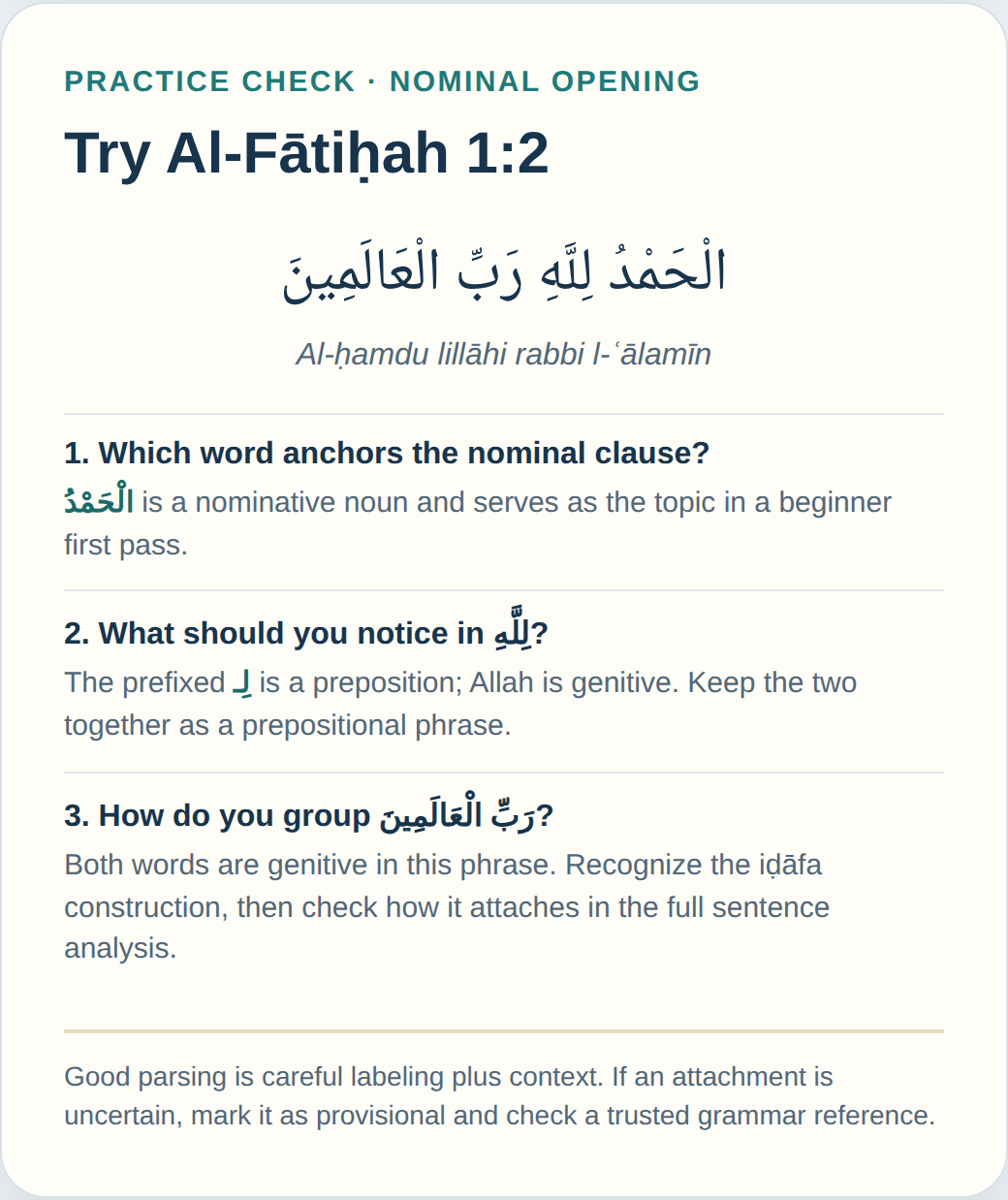
Now try Al-Fātiḥah 1:2: الْحَمْدُ لِلَّهِ رَبِّ الْعَالَمِينَ. A beginner can notice that الْحَمْدُ is a nominative noun and that لِلَّهِ contains the preposition lām followed by a genitive noun. The sequence رَبِّ الْعَالَمِينَ has genitive forms and an iḍāfa relationship. Those observations are a useful start; use a full grammar reference to check how the phrases attach in the sentence rather than assigning every word a final role from a short excerpt alone.
Compare your first pass with Quranytime’s explanations of nominal sentences in Quranic reading and conjunctions in Quranic Arabic. If an attached pronoun or a relative clause appears in another passage, review attached possessive pronouns and relative pronouns as separate grammar skills.
Common patterns to look for
In a verb-led clause, locate the verb first, then ask who performs the action and whether a direct object is present. In a nominal opening, identify the topic and look for the information attached to it; the predicate can be a phrase rather than one word. A preposition usually connects a noun or pronoun to another part of the sentence. A conjunction can join words or clauses, so check what it links. An attached pronoun may refer back to a noun, but confirm its form and antecedent instead of guessing from proximity alone.
These are starting questions, not mechanical rules. Arabic word order can vary, a subject may be understood from the verb, and a phrase can have more than one layer. For additional practice with the building blocks, review the guide to Inna and its sisters alongside the specific grammar lesson you need. The aim is to connect the lessons you already know, not to repeat each one here.
To keep notes useful, mark each claim as “identified,” “probable,” or “check again.” A prefix or ending can suggest a role, but a form can behave differently inside a construction. If a reference gives another analysis, record the exact phrase and source, then ask why; do not force a verse to match a rule you only partly remember. This builds careful reasoning and makes teacher feedback more precise.
How to practice and check your work
Spend a few minutes on one short phrase. Copy it accurately, mark the clause boundary, and write one provisional label for each word group. Then compare with a trusted grammar source. Note which clue helped—case, a prefix, agreement, or an attached pronoun—and correct your first pass if the reference differs. Over time, collect examples of a pattern rather than trying to memorize isolated labels without context.
The Quranic Arabic Corpus documentation describes its use of traditional grammatical analysis and dependency structures for Quranic verses. Use it as a linguistic reference to compare word forms and relationships, not as a substitute for tafsir or a teacher’s explanation. Its grammar documentation explains the conventions behind the annotations. When two analyses are unfamiliar, record the question and ask a qualified instructor rather than treating a search result as a final answer.
If you are learning with a teacher, bring one short phrase and show your provisional parse. Ask which evidence supports each label and where the analysis depends on surrounding context. Quranytime’s free assessment class can help you discuss your current Arabic or Quran-learning goals and decide what to study next.
Frequently asked questions
Is parsing the same as translating?
No. Translation expresses meaning in another language; parsing describes grammatical relationships. A translation can help you orient yourself, but a similar English word order does not prove the Arabic structure.
Should beginners parse a whole surah at once?
Start smaller. Choose one short phrase, identify its main clause, and verify your labels. Expand to a longer passage only when you can keep the surrounding verse and relationships in view.
What if a case ending is not written in my copy?
Do not invent a visible vowel. Consult a reliable recitation or grammar reference and mark your analysis as provisional. The written form, recitation, syntax, and interpretive context work together.
Can a grammar parse tell me the full meaning of a verse?
It can show relationships among words, but it does not by itself settle the full meaning. Read the verse in context, consult trustworthy tafsir, and ask a qualified teacher when you need religious interpretation.
Take the next step
To parse a Quranic Arabic sentence, begin with a short phrase, identify the clause pattern, mark the central roles, trace linked phrases, and verify your reasoning. Keep your first attempt modest and evidence-based. A sequence of careful, checked examples builds a stronger foundation than a confident guess about every word.