
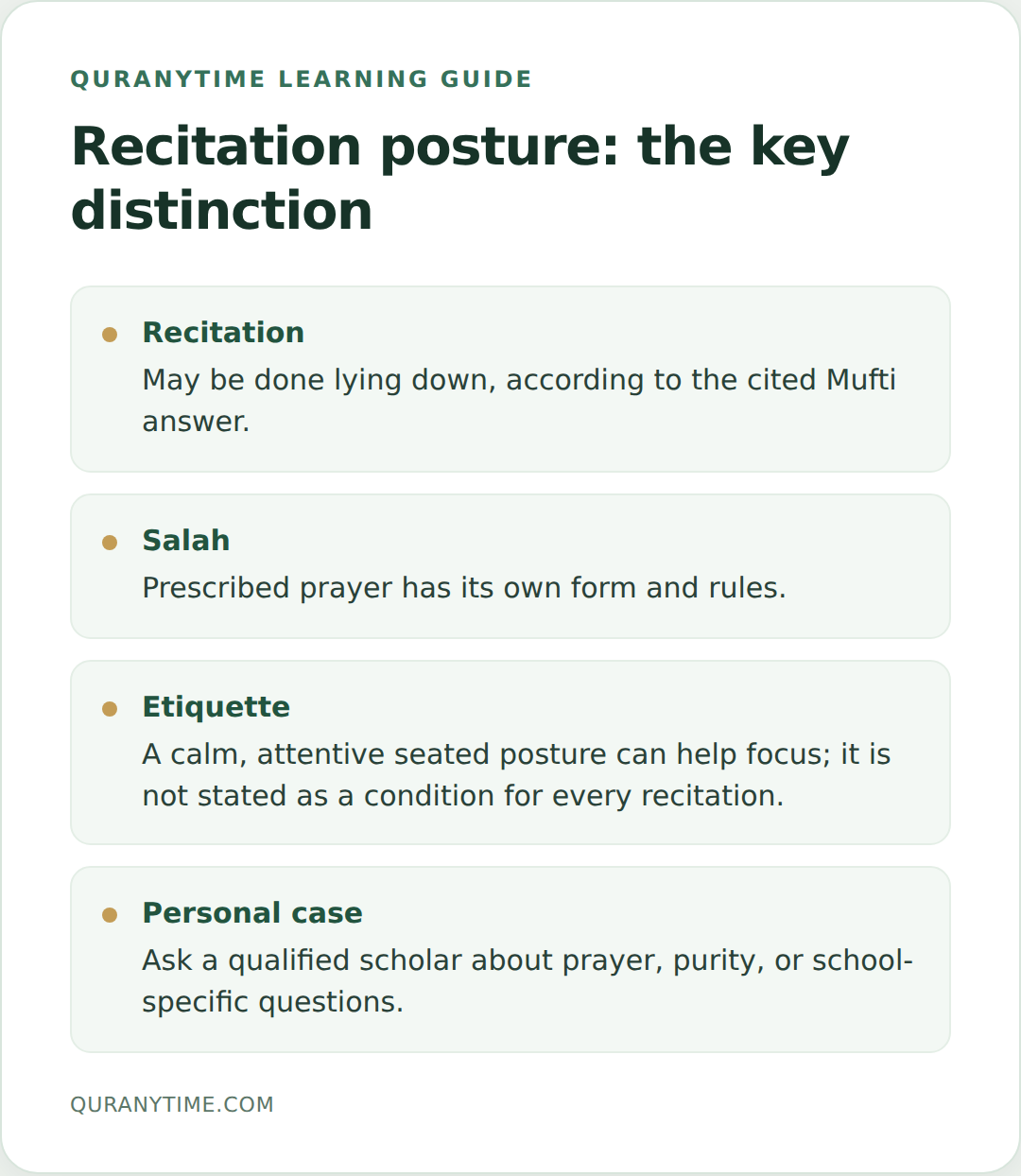
Short answer: If you are wondering, “can I recite Quran while lying down?”, a published answer from the Mufti of the Federal Territories in Malaysia says that ordinary Quran recitation while lying down is permissible. The answer treats recitation as remembrance and cites Quran 3:191, which mentions remembering Allah while standing, sitting, and on one’s sides. A comfortable posture does not turn ordinary recitation into salah: prescribed prayer has its own form and rules. When sitting helps you focus, choose it; when lying down makes recitation possible or comfortable, do not assume the posture itself makes it wrong.
This question often arises in an ordinary moment: you are tired before sleep, recovering, managing pain or limited mobility, or trying to continue a reading routine from bed. It helps to separate three matters that can get blurred together: reciting Quran, showing care and attention while doing so, and performing prescribed prayer. They are related acts of worship, but one does not replace another, and an answer about one should not automatically be applied to the others.
Can you recite Quran while lying down?
The Mufti of the Federal Territories’ Department answers this specific question by saying that reciting the Quran while lying down is permissible. Its explanation points to Quran 3:191, which describes people who remember Allah standing, sitting, and on their sides. The answer also quotes Imam al-Nawawi’s statement that reciting while standing, lying on a bed, or in other conditions is permissible and rewarded.
That is a clear answer to the basic question, but it is useful to state its scope precisely: ordinary Quran recitation while reclining or lying down. It is not a claim that posture never matters in worship, nor does it establish that all questions connected with reading have the same answer. For example, reciting from memory, looking at a phone, and handling a printed mushaf can raise distinct practical or legal questions. The source should not be stretched beyond the question it addresses.
Read the Mufti of the Federal Territories’ answer on reciting the Quran while lying down for its full reasoning and cited references. It is a useful source for this narrow question, not a substitute for asking about a different situation. If you follow a particular school or need advice tailored to your circumstances, consult a qualified scholar you trust.
Recitation is not the same as prescribed salah
One important distinction prevents confusion: reciting verses outside prayer is not the same act as performing salah. A person may read or recite from memory while lying down, while prescribed prayer follows its own form. If someone cannot stand for prayer or has a condition affecting movement, that is a separate fiqh question; this article does not issue a prayer ruling.
For example, if you are resting in bed and quietly recite a memorized surah before sleep, that is recitation. It is not a replacement for a required prayer, and the rules of salah should not be inferred from what is acceptable for recitation. Conversely, someone asking how to perform salah while seated or lying down should explain their circumstances to a qualified scholar rather than rely on an article about recitation posture.
The distinction also matters when reading from a phone or printed copy. The posture question is one issue; whether and how to handle a mushaf, and questions about wudu or other states of ritual purity, are separate discussions. Quranytime’s guide to reading Quran without wudu addresses a different question, so do not treat it as a ruling about lying down. If several questions are on your mind, naming them separately can help you find an answer that actually fits each one.
Etiquette: care without turning preference into a rule
Many people have learned to sit upright when reading Quran. A calm, attentive seated posture can be a helpful way to focus, especially during a lesson or a longer reading. The cited Mufti answer itself describes sitting properly, focusing, and being calm as a more complete manner of recitation. In that answer, this is an etiquette recommendation, not a claim that lying down makes recitation invalid or forbidden.
In practice, “respectful” need not mean one rigid posture for every person and every moment. Consider what helps you give the words attention. You might sit at a desk when studying a new passage, lean back in a chair while reviewing a familiar surah, or recline when resting. The aim of these suggestions is a considerate, workable setting, not to make comfort and reverence seem opposed.
Small choices that can support attention
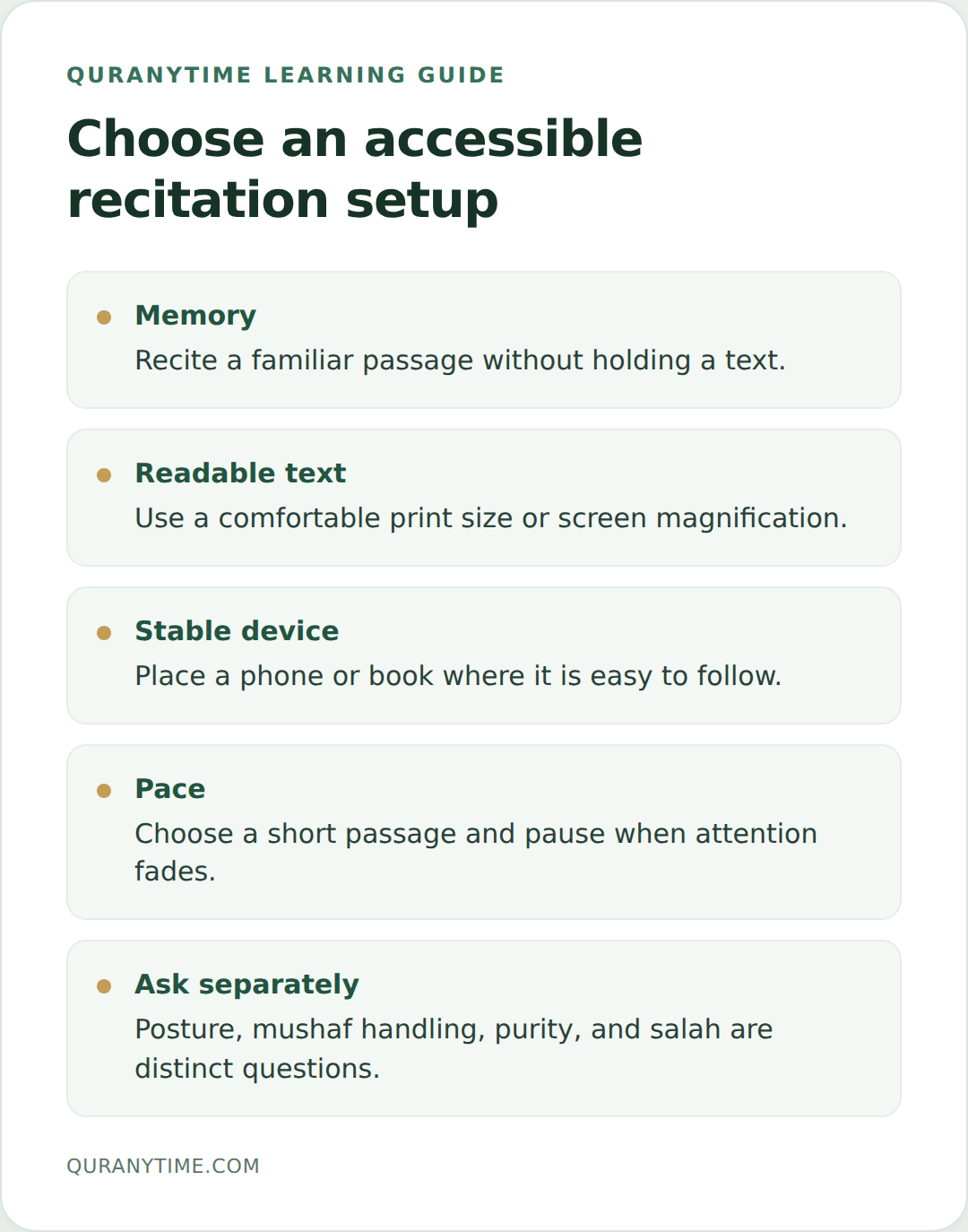
- Choose a manageable passage. A few familiar verses may suit a quiet resting moment better than beginning a long new section. You can continue another time if you want to read more.
- Use a position you can maintain comfortably. If holding a phone or book is awkward, set it on a stand or choose recitation from memory, if that suits your learning goal.
- Keep the text secure and readable. Avoid balancing a copy where it might fall, and use an accessible display or a stable surface that lets you follow without straining.
- Pause if you are drifting off. You can resume when alert; this is a practical choice, not a judgment about your intention or the value of your effort.
- Ask for guidance when the question changes. A concern about touching a mushaf, ritual purity, or salah deserves its own answer rather than an assumption based on posture alone.
These are practical suggestions for a considerate reading setup, not additional religious requirements. Different learners will find different arrangements helpful, and a setup that works in one session may not work in another.
Accessibility matters: make recitation possible for the person
Posture can be more than a preference. A person may be ill, disabled, recovering, fatigued, or unable to sit comfortably for a long time. Another person may use a bed or recliner because it is the setting where they can access their text, audio, or assistive technology. An idealized study setup is not available to everyone, and a learner’s circumstances should not be dismissed because they cannot use it.
Start with the person’s goal and what works for them. If they want to recite from memory, they may not need to hold anything. If they are following text, larger print, screen magnification, a stable tablet stand, or audio paired with text may help. These are options to consider, not solutions that will suit every person. Ask rather than assume: one learner may want a family member to position a device, while another prefers to manage it independently. Respecting that preference can make a session more usable without taking control away from the learner.
For practical ideas on formats such as magnified print, selectable digital text, audio, and teacher feedback, see Quranytime’s guide to reading and studying the Quran with low vision. Its accessible Quran study plan for seniors also discusses readable text, audio controls, and adapting a lesson setup. These are learning and access resources, not sources of religious rulings.
A teacher can help make a session workable by sharing the passage in advance, checking that the learner can see or navigate it, and agreeing how feedback will be given. A learner might prefer spoken correction, written notes, or a slower pace; it is best to ask what is useful. If you want to discuss a starting level and learning format, Quranytime offers a free Quran and Arabic trial class. Mention any access preference when arranging it, and confirm that the proposed format is suitable rather than assuming an accommodation.
Examples: applying the distinction in everyday situations
Reading before sleep
You are already in bed and want to recite a surah you know. The cited answer supports reciting while lying down. You can recite from memory, or arrange a device where the text is comfortable to see. If you become too sleepy to follow what you are saying, stop and continue another time. This is optional recitation in a resting moment, not a prescribed prayer.
Resting because sitting is uncomfortable
You want to keep a small daily reading habit while resting. Reciting from memory or using a stable, readable device may be practical. You can choose a shorter passage or take a break if that makes the session manageable. If your question is actually about how to perform salah with a limitation, ask a qualified scholar about that separate issue. Do not treat the answer about recitation as an answer to prayer posture.
Following a lesson from a recliner
You can hear a teacher or audio clearly but find that sitting upright for the entire session is tiring. Tell the teacher what position works and agree on a way to follow the text and receive corrections. A comfortable posture does not by itself show whether pronunciation is accurate, so feedback may still be useful. For learning what a measured, attentive pace can look like, see the guide to tartil and measured Quran recitation.
Using a printed mushaf while reclined
The basic permissibility of reciting while lying down does not answer every handling question about a printed copy. If you have a concern about touching or positioning a mushaf, follow the guidance of your school or ask a trusted scholar. You can avoid conflating two issues by reciting from memory while you clarify the handling question, if that works for you.
A simple way to decide what guidance you need
- Name the act. Are you reciting Quran outside prayer, reading a printed mushaf, using a phone, or performing salah?
- Name the concern. Is your question about posture, wudu, touching a copy, pronunciation, or prayer movements?
- Use a source that addresses that concern. An answer about reciting while lying down should not be stretched to unrelated questions.
- Ask about personal circumstances. If disability, illness, a particular school of law, or another specific condition matters, explain it to a qualified scholar.
This short checklist can make a question clearer and prevent a confident answer to the wrong issue. A Quran teacher may help with reading and pronunciation; a qualified scholar is the right person for personal fiqh guidance. If you are unsure which category your question belongs to, explain the actual situation and ask the adviser to distinguish the issues.
Frequently asked questions
Is it permissible to recite Quran while lying in bed?
The Mufti of the Federal Territories’ published answer says that reciting while lying down is permissible, citing Quran 3:191 and Imam al-Nawawi. This addresses recitation posture; it does not settle every other religious question.
Is sitting more respectful?
Sitting calmly and attentively can be a helpful etiquette choice, and the cited answer describes it as a more complete manner of recitation. That does not make sitting a condition for every recitation or mean that a person who lies down has done something wrong.
Does this mean I can pray lying down?
This article is about reciting Quran outside prescribed prayer, not the rules for performing salah. If you need guidance about prayer while seated or lying down, ask a qualified scholar about your circumstances.
Can I recite while lying down if I am unwell or have limited mobility?
The cited answer permits recitation while lying down. Accessibility needs are a good reason to choose a workable setup, but any separate question about prayer, purity, or a specific ruling should be asked separately.
Should I use a phone or a printed mushaf?
Choose the format that you can read or follow comfortably, while keeping separate handling and purity questions distinct. If uncertain about a printed copy or your personal circumstances, follow trusted school-specific guidance.
A balanced takeaway
Yes: the cited official Mufti answer says Quran recitation while lying down is permissible. Sitting upright and giving the text calm attention may be a helpful etiquette preference, but it should not be turned into an unsupported prohibition or a requirement for every person. Most importantly, ordinary recitation is not prescribed salah. Keep posture, etiquette, accessibility, purity, and prayer as distinct questions—and seek qualified guidance when your circumstances call for a personal answer.