

Direct answer: Moses—Mūsā in Arabic—is named 136 times in the Quran, according to the Quranic Arabic Corpus’s Musa concept entry, which links to a 136-occurrence verse list. That figure counts occurrences associated with Moses in the Arabic Quranic text; it is not a count of separate stories, chapters, or every English translation’s use of the word “Moses.”
That distinction matters. One passage can name Moses more than once, while another can refer to him by a pronoun or title without repeating his name. If you are looking for a reliable answer to “how many times is Moses mentioned in the Quran?”, 136 is the standard corpus-based answer—but it helps to know what has actually been counted.
What does the count of 136 mean?
The Quranic Arabic Corpus entry for Musa identifies him as a prophet and states that his name occurs more frequently in the Quran than that of any other prophet or messenger. Its linked verse list reports 136 occurrences. This is the strongest simple reference for the commonly cited figure because it makes the counting scope visible instead of repeating an unattributed number.
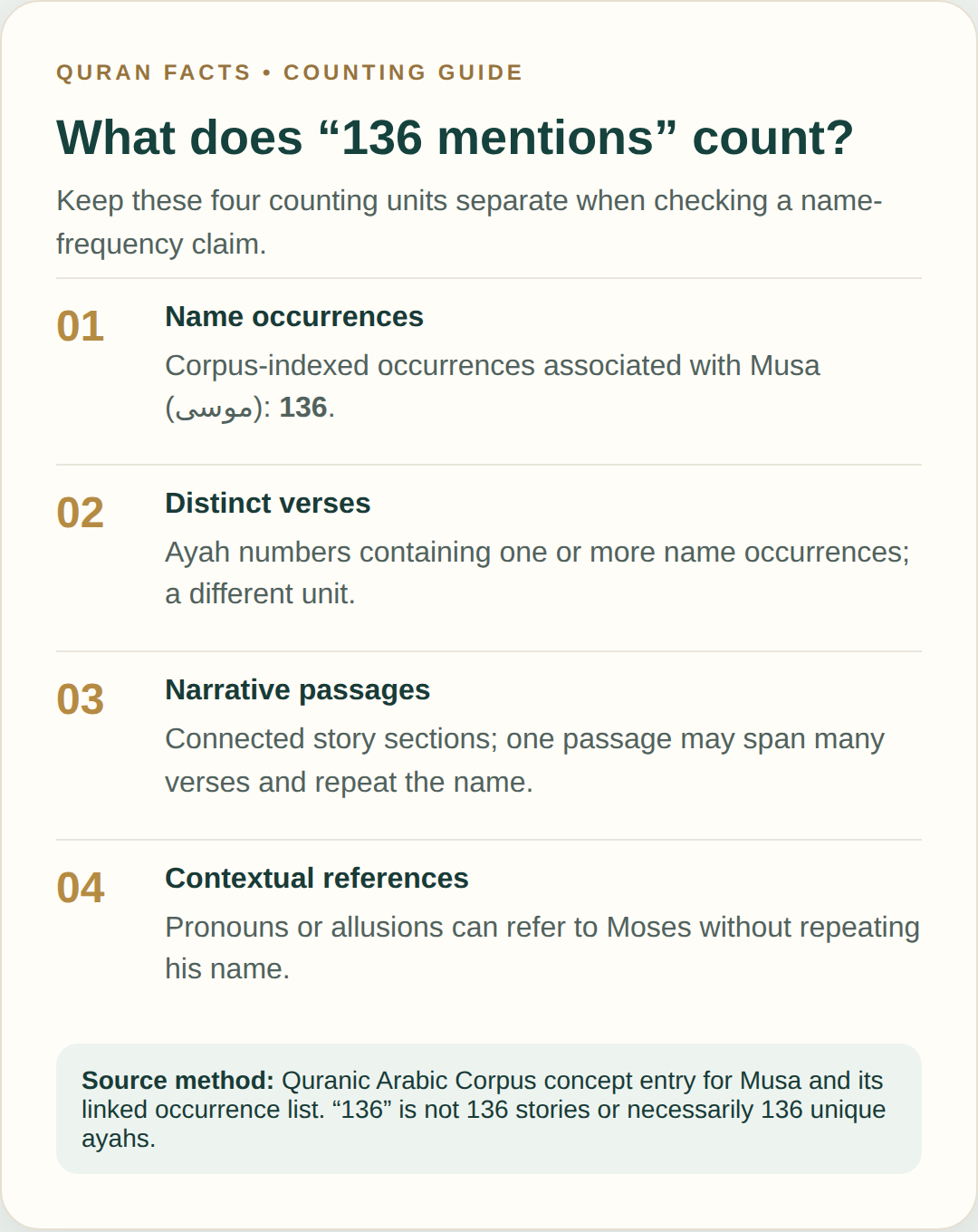
In this guide, “136” means name-occurrences associated with the Quranic concept Musa (موسى) in the Arabic text as indexed by that corpus. In everyday summaries, this is often phrased as “Moses is mentioned 136 times.” More precisely, it is a count of indexed mentions, not 136 distinct verses and not 136 independent accounts. A verse may contain a name occurrence, and a single narrative may stretch across many verses.
Nor should the number be confused with mentions of other people or words that might be translated as “Moses” in an English rendering. English translations make interpretive choices: after a person has been introduced, a translator may use “he,” “him,” “the prophet,” or another expression where Arabic uses a pronoun or description. Translation word-searches therefore do not provide a dependable count of named occurrences.
How the count is made—and why other numbers can appear
A useful count needs a rule. Here the rule is to follow the Quranic Arabic Corpus’s concept indexing for Musa and its displayed occurrence list. That is different from counting only verses containing the exact Arabic spelling as displayed in one digital edition, tallying passages where Moses is clearly the subject, or searching an English translation for “Moses.” Each method asks a slightly different question.
- Name occurrences: instances indexed to Musa in the Arabic text. This is the basis for the 136 figure.
- Verses: distinct numbered ayahs that contain at least one such occurrence. The verse total may be lower than the occurrence total if a verse names him more than once.
- Narrative passages: continuous sections telling an episode from his life. These are fewer still, and one narrative can name him repeatedly.
- Allusions and pronouns: references understood from context even when his name is absent. These require interpretation and do not belong to the straightforward name count.
Differences can also arise from the tool used. A concordance may index a named person as a concept; a morphological search may look for a particular form; a reader may count occurrences manually in a chosen text. Before comparing two totals, check whether both are counting the same unit—name tokens, verses, or passages—and whether both include the same forms.
For a transparent answer, use the corpus figure and explain its scope. Do not imply that 136 means Moses appears in 136 different surahs, or that it measures the number of lessons contained in his story. Those are separate questions.
Where Moses’ name appears: follow the episodes, not just the tally
The number becomes more meaningful when you notice how broadly the Quran returns to Moses’ story. Rather than telling his life in one uninterrupted biography, the Quran revisits episodes in different settings and for different purposes. A passage may focus on revelation, courage, deliverance, accountability, or the response of a community. Counting provides a starting point; reading the surrounding verses gives the mention its meaning.
For a brief Islamic account of Moses, Islam Question & Answer describes him as receiving revelation and being sent to call the Children of Israel to worship Allah alone. That is a concise description of his prophetic mission, not an alternative method for counting his name in the Quran.
1. His infancy and his mother’s trust
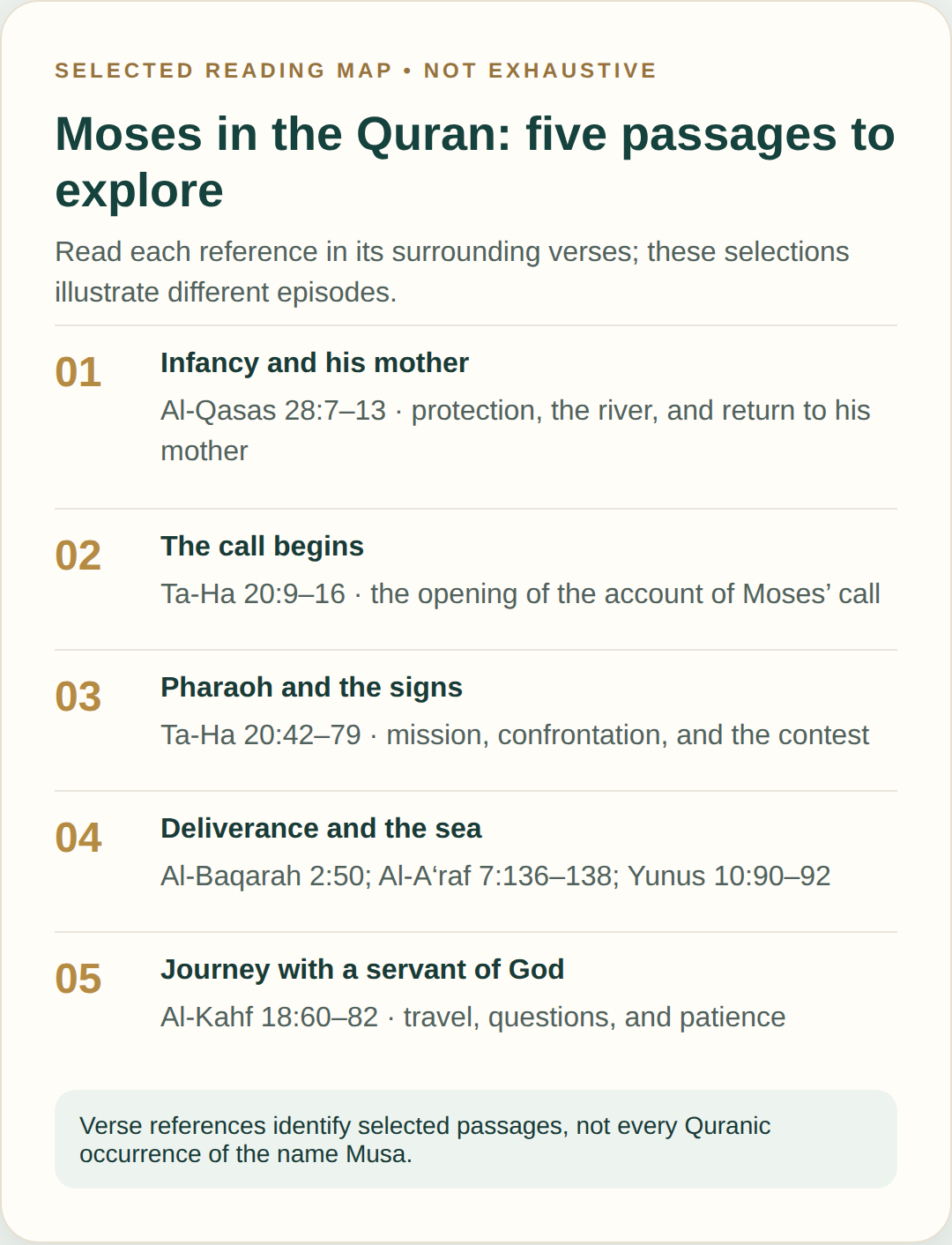
In Al-Qasas 28:7, the text describes inspiration to Moses’ mother: nurse him, and when she fears for him, place him in the river without fear or grief; the verse also promises his return and future mission. The Quran.com passage displays the surrounding verses, where the account continues through his rescue and reunion with his mother (28:8–13). This is a compact example of how one named reference sits inside a much larger narrative unit.
2. The call and the mission
Surah Ta-Ha opens its account with the question, “Has the story of Moses reached you?” (20:9), then develops the scene of the fire and the call in the following verses. That framing invites the reader into a story rather than offering a bare biographical fact. The same narrative can be approached through other passages, so a name-count alone cannot tell you how many times the Quran recounts a particular episode.
3. The confrontation with Pharaoh and the signs
Moses’ mission before Pharaoh is recalled in several places, including Al-A‘raf 7:103 onward and Ta-Ha 20:42–79. These passages describe the call to Pharaoh, the signs, and the contest before the gathered people. The Quran revisits the confrontation with distinct emphases; readers should check the complete local passage rather than lifting a single phrase out of context.
4. The Exodus and the crossing
The deliverance of the Children of Israel and the crossing of the sea appear in multiple passages, including Al-Baqarah 2:50, Al-A‘raf 7:136–138, and Yunus 10:90–92. Not every verse in these connected sections repeats the name “Moses.” This is one reason an account of the whole story cannot be reduced to a name search.
5. The encounter with the servant of God
Al-Kahf 18:60–82 tells of Moses travelling with his young companion and meeting a servant of God. The account focuses on patience, questions, and the limits of what a person can understand at first glance. As with other extended narratives, the name may appear in the passage while many of its verses develop the exchange and events around it.
These references are examples, not an exhaustive concordance. Use a searchable Quran or a corpus verse list when you need every occurrence, and read each result with enough surrounding text to understand whether it belongs to a dialogue, a narrative transition, or a reminder directed to a later audience.
Is Moses the most frequently named prophet in the Quran?
Yes, according to the Quranic Arabic Corpus’s concept entry, Musa’s name occurs more frequently than that of any other prophet or messenger. The same entry links to the 136-occurrence list. This statement is about the frequency of the name in the corpus’s Quranic indexing; it does not rank prophets by importance, virtue, or spiritual status.
It is also worth keeping “most mentioned” separate from other popular comparisons. A claim about who appears in the most verses, who has the longest continuous narrative, or which prophet is discussed in the greatest number of surahs would need its own definition and method. The 136 figure answers a narrower, more verifiable question: how many occurrences are indexed to the name Musa?
A practical way to verify the count yourself
- Open the corpus’s Musa entry and note the stated concept and linked occurrence list.
- Use a Quran text to inspect individual references in Arabic and translation. Check the verse number, not just a search-result snippet.
- Decide whether your task needs occurrences, unique ayahs, or whole narrative passages; label the number accordingly.
- For interpretation, read the surrounding context and consult a reliable tafsir rather than inferring a lesson from the tally alone.
Quranytime readers who want to explore references carefully may find our guides to using a Quran surah index, checking a Quran verse quote, and reading the layout of a mushaf page useful. For deeper study, see how to choose a beginner-friendly tafsir or our word-by-word Quran study guide.
Reading a name search without losing the passage
A concordance is a map, not a substitute for reading. When you open a result, first notice who is speaking and whether the passage has shifted from one audience or scene to another. Then read at least the verses before and after the hit. A name may occur in a question, a direct address, a reminder, or a transition that only becomes clear in its paragraph of revelation.
It also helps to separate three kinds of work. A search tool answers a retrieval question: where does a term occur? A translation helps a reader understand one rendering of the passage. Tafsir and close study explore meaning, context, and scholarly explanation. These tools support one another, but one should not be made to do the work of the others. A corpus count can establish an occurrence total; on its own it cannot settle every interpretive question about why a passage is placed where it is or what lesson a reader should draw.
If compiling your own list, keep a small audit trail: record the exact corpus or edition, search term, date accessed, and whether you counted repeated occurrences in a verse separately. That makes the result reproducible and prevents a later reader from mistaking a verse total for a token total. For a casual reader, there is no need to manually recount all 136 entries—the important habit is to report the source and describe what its number measures.
Frequently asked questions
How many times is Moses mentioned in the Quran?
The commonly cited corpus-based count is 136 occurrences associated with Musa (Moses), as listed by the Quranic Arabic Corpus. The count refers to indexed name occurrences, not a count of distinct stories or necessarily unique verses.
Is Musa the Arabic name for Moses?
Yes. Musa (موسى) is the Arabic name used in the Quran for Moses. The corpus transliterates it as mūsā and gives “Moses” as its English translation.
Does Moses appear in every surah that tells his story?
Not necessarily in every verse of a passage. A narrative can continue through pronouns, dialogue, or descriptions after the name has already appeared. Check a passage as a whole rather than expecting the name in each ayah.
Does 136 mean 136 different verses?
No. The corpus labels this as 136 occurrences. Occurrences and distinct verse numbers are different counting units, so avoid describing the number as 136 separate verses unless you have separately counted unique ayahs.
Does being the most frequently mentioned prophet mean Moses is the most important?
No such conclusion follows from a frequency count. Frequency describes how often a name occurs in a defined text; it is not a measure of rank, merit, or importance.
In short
Moses is named 136 times in the Quran according to the Quranic Arabic Corpus’s Musa entry. The best way to use that answer is to state the method alongside the number: these are corpus-indexed name occurrences, not 136 unique stories, surahs, or necessarily ayahs. From there, follow the references into their full passages—the Quran’s retellings of Moses’ life gain their meaning from context, not from the tally alone.
Sources: Quranic Arabic Corpus: Musa; Corpus occurrence list for Musa; Quran.com, Al-Qasas 28:7 (with context); Quran.com, Ta-Ha 20:9–16; Quran.com, Al-Kahf 18:60–82.