
Quick answer: The four sacred months are Dhu al-Qaʿdah, Dhu al-Hijjah, Muharram, and Rajab. Three come consecutively—Dhu al-Qaʿdah, Dhu al-Hijjah, and Muharram—while Rajab falls between Jumada al-Thaniyah and Shaʿban. The Qur’an states that there are twelve months and that four are sacred (Qur’an 9:36); the Prophet’s explanation recorded in Sahih al-Bukhari names them.
That simple answer distinguishes this subject from merely learning month vocabulary. A calendar list helps you say a date; this guide explains the sacred-month reference, where each month sits in the Hijri year, and how to read the relevant verses carefully. It does not try to issue legal rulings about particular acts.
The four sacred months at a glance
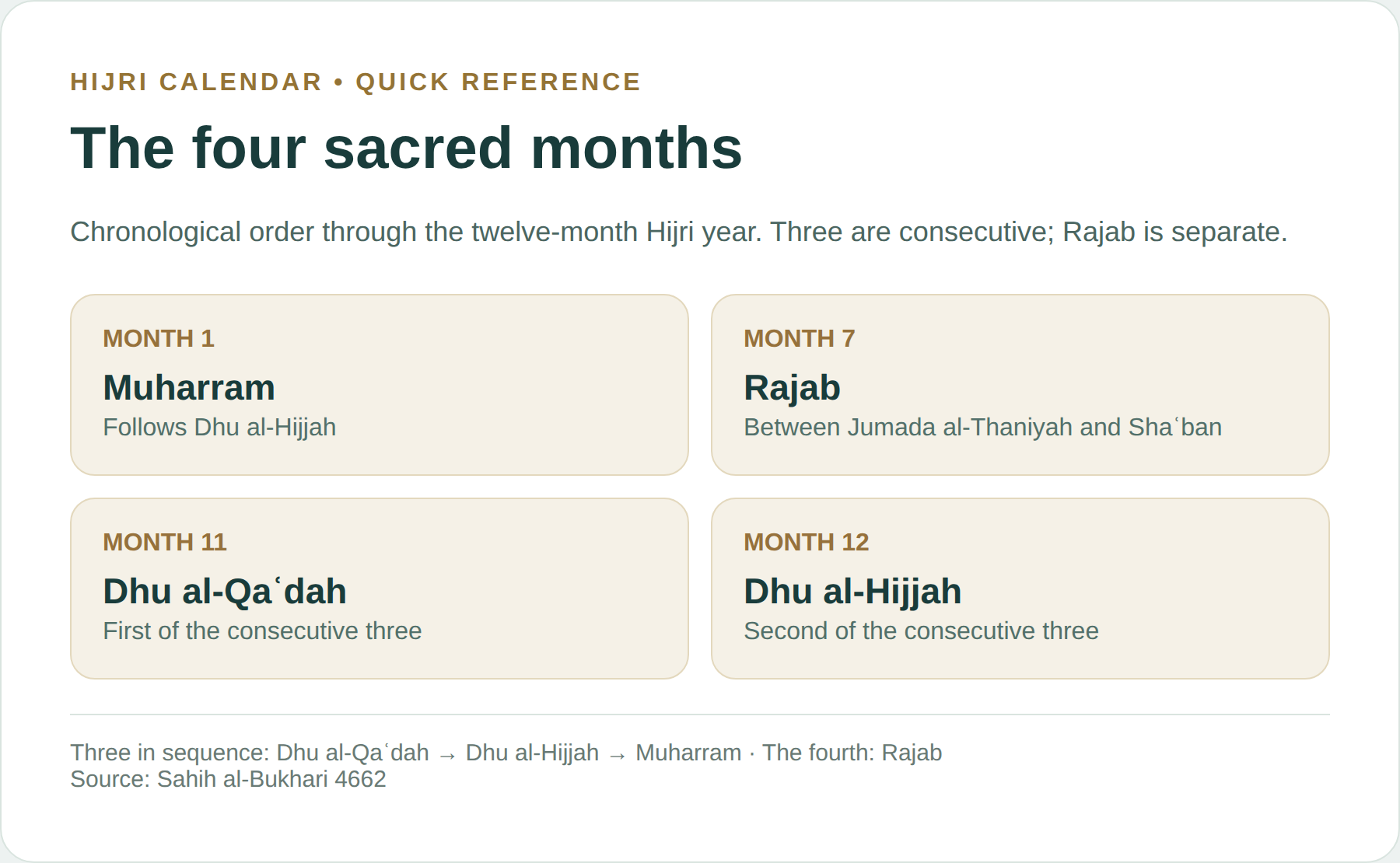
In order around the Hijri calendar year, they are:
- Muharram — month 1
- Rajab — month 7
- Dhu al-Qaʿdah — month 11
- Dhu al-Hijjah — month 12
The order above is chronological, not the order in which the hadith lists them. In the narration, the three consecutive months come first, followed by Rajab. This arrangement is useful to remember: three together at the end and beginning of the year, and one on its own midway through.
Spelling differs across English transliterations because Arabic sounds do not map one-to-one onto English letters. You may see Dhu’l-Qaʿdah, Dhul-Qa’dah, or Dhu al-Qiʿdah, for example. These forms refer to the same month. “Rajab Mudar” is the wording in the hadith, which identifies the Rajab situated between Jumada and Shaʿban; it is not an additional month.
What Qur’an 9:36 says
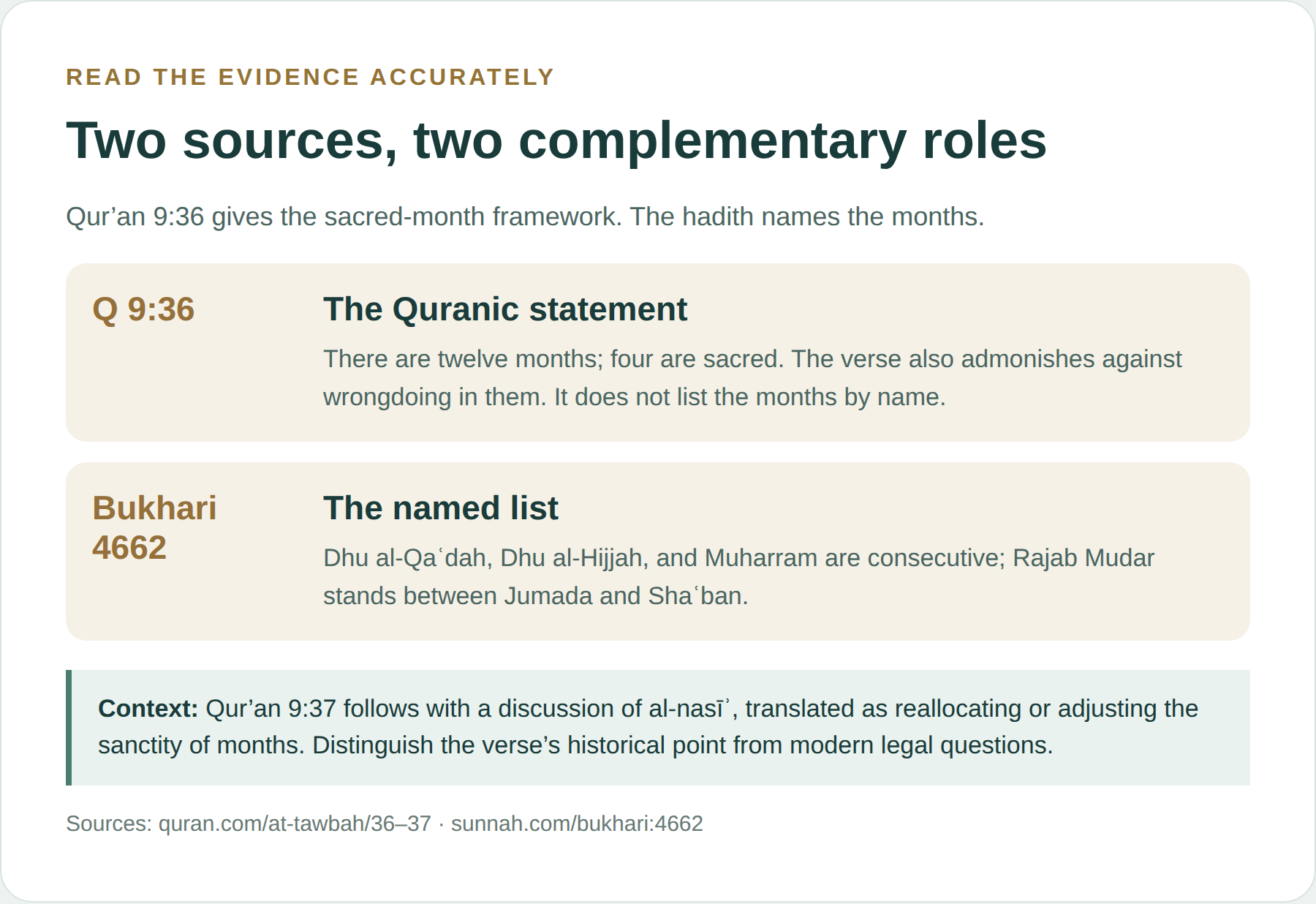
Surah At-Tawbah 9:36 says that the number of months with Allah is twelve, and that four of them are sacred. In the same verse, the instruction “do not wrong yourselves during them” appears. The verse itself establishes the count and sacred status; it does not name the four months individually. That distinction matters when citing evidence: the Quranic passage gives the framework, while the Prophetic narration supplies the names.
Quran.com’s translation of At-Tawbah 9:36 renders the verse’s opening as: “Indeed, the number of months ordained by Allah is twelve … of which four are sacred.” The ellipsis here omits intervening wording, not a claim about the verse’s meaning. Read the full translation and Arabic in context at the source rather than relying on a clipped quotation.
For a close reading, notice the structure: first the verse states the count of months; next it identifies four as sacred; then it turns to a moral admonition. The names are not in that verse. A reader who sees only the phrase “four are sacred” may naturally ask which four—and that is where the hadith explanation is essential.
The hadith that names them
In Sahih al-Bukhari 4662, Abu Bakrah narrates that the Prophet described a year of twelve months, four sacred. He named three consecutively: Dhu al-Qaʿdah, Dhu al-Hijjah, and al-Muharram; then he named Rajab Mudar, “which stands between Jumad (ath-thani) and Shaʿban.” This report is the direct source for the names and arrangement given above. Islam Question & Answer explains the same distinction in “The Month of Rajab,” under “What are the Sacred months?”: Qur’an 9:36 mentions four sacred months without naming them, and the Sunnah gives their names. A directly relevant Islam Question & Answer response about why Rajab is separate likewise identifies all four months, while treating suggested reasons for their arrangement as explanations offered by some scholars.
Because month names are sometimes unfamiliar in English, it helps to unpack the sequence without altering it. Dhu al-Qaʿdah is month 11, followed immediately by Dhu al-Hijjah, month 12; Muharram, month 1, comes next. Rajab is month 7, between Jumada al-Thaniyah and Shaʿban. That placement—not a Gregorian date—is how the narration identifies Rajab.
The hadith also connects its statement to Qur’an 9:36, as the Bukhari chapter heading does. That offers a clean citation path: quote or summarize the Quranic principle, then cite Bukhari for the list. The two sources complement each other rather than competing.
How the months fit the Hijri calendar
The Hijri calendar has twelve lunar months. The names of the months stay in sequence, but the calendar is not fixed to the solar year; its months move through the seasons over time. For that reason, the sacred months are not four fixed Gregorian months such as January or April. A Gregorian calendar may show their current dates for a particular year, but those dates shift from year to year.
This is also why knowing Arabic month vocabulary and understanding sacred months are different learning tasks. If your goal is to say “the appointment is on the 10th,” a vocabulary guide such as Days and Months in Arabic is useful. If your question is why four months have a special designation in Islamic sources, the relevant starting point is Qur’an 9:36 and its Prophetic explanation.
A quick orientation trick is to locate the three consecutive names around the year boundary: Dhu al-Qaʿdah (11), Dhu al-Hijjah (12), then Muharram (1). Rajab (7) is the separate one, placed between Jumada al-Thaniyah (6) and Shaʿban (8). This sequence is a memory aid, not a substitute for a reliable Hijri calendar when you need a date.
Why does Qur’an 9:37 follow this passage?
The next verse, At-Tawbah 9:37, discusses al-nasīʾ, a practice described in the translation as reallocating or adjusting the sanctity of months. The passage says that the adjustment was used to make lawful in one year what was treated as sacred in another, while keeping the number of months considered sacred. Read alongside 9:36, it emphasizes that the sacred calendar is not simply a flexible label people can move at will.
Keep the scope precise: verse 9:37 criticizes the practice of postponing or shifting the sacred status of months, so that a prohibited month could be treated as permissible in one year and the number of sacred months maintained. It is not a modern calendar-conversion table, and it does not name the four months again. Quran.com’s rendering of At-Tawbah 9:37 and its notes help readers follow the immediate context. For more on reading a passage in its setting, see Quranytime’s guide to reasons for revelation and context; use contextual material as an aid, while checking the verse and its tafsir directly.
Using the references accurately
When answering this question, separate three kinds of information. The count and sacred status come from Qur’an 9:36. The individual names and their sequence come from the Prophetic report in Sahih al-Bukhari 4662, also recorded in other hadith collections. A reference explaining how those texts relate—such as Islam Question & Answer’s discussion of the sacred months—helps readers check the answer, but it does not replace the primary text. Keeping those roles clear prevents the common mistake of attributing the names themselves to the wording of 9:36.
It is also useful to distinguish a month’s position from a date within that month. The list tells you that Muharram is first, Rajab seventh, Dhu al-Qaʿdah eleventh, and Dhu al-Hijjah twelfth. It does not, by itself, tell you the corresponding Gregorian date for a particular year, nor whether a local calendar begins a month on a particular evening. Those practical date questions depend on the Hijri calendar being used and its method of determining month beginnings. The hadith’s placement of Rajab between Jumada and Shaʿban is a stable sequence clue, not a prediction of a solar-calendar date.
For readers comparing translations, small differences in spelling and translation are normal. “Dhul-Qa‘da” and “Dhu al-Qaʿdah,” for example, are variant renderings of one name. The hadith’s own sequence is a useful safeguard: the consecutive trio is Dhu al-Qaʿdah, Dhu al-Hijjah, and Muharram; Rajab Mudar follows as the fourth. If a summary gives a different group, return to the source wording and verify before repeating it.
What can be said without overclaiming?
The sources support several straightforward statements: there are twelve months; four are sacred; the names are Muharram, Rajab, Dhu al-Qaʿdah, and Dhu al-Hijjah; and three of the four occur consecutively. Qur’an 9:36 also admonishes against wrongdoing in them. These points are enough to answer the basic historical and textual question.
They do not, by themselves, settle every detailed legal question people may ask about fasting, travel, conflict, vows, or the relative merit of specific deeds in a particular month. Those are questions of Islamic rulings and may require a precise answer with scholarly qualifications. This explainer intentionally does not turn a short overview into a fatwa or state a universal legal consequence. If you are studying a ruling, consult a qualified scholar and a directly relevant answer that states its scope.
Similarly, be careful with popular claims that circulate about special worship on a particular night or day. The basic identification of the months does not verify every devotional report associated with them. Check the actual Quranic passage or hadith source for the specific claim, and distinguish established text from later summaries, cultural customs, or unsourced social posts.
A simple way to remember the list
Use two groups instead of one long list: the three in sequence—Dhu al-Qaʿdah, Dhu al-Hijjah, Muharram—and the one between Jumada and Shaʿban—Rajab. Then attach their positions in the calendar: 11, 12, 1, and 7. Saying them out loud in the hadith’s order can also help: three consecutive, followed by Rajab Mudar.
For students reading Arabic, compare a transliteration with the Arabic text in the cited hadith. Transliteration is an aid, not a standardized spelling system. You can also review how Qur’an references are formatted in Quranytime’s practical guide to reading a Quran page and locating ayah numbers. Learning to navigate references makes it easier to verify a short quote against its surrounding verses. Quranytime’s checklist on verifying a Quran verse quote is a practical next step when you encounter a quotation without a surah or ayah reference. For a broader introduction to how commentary works, see how to choose tafsir books for beginners; a translation and a tafsir answer related but not identical questions.
Frequently asked questions
Which are the four sacred months in Islam?
Muharram, Rajab, Dhu al-Qaʿdah, and Dhu al-Hijjah. Bukhari 4662 names three consecutive months—Dhu al-Qaʿdah, Dhu al-Hijjah, and Muharram—then Rajab Mudar.
Does the Quran name all four months in one verse?
No. Qur’an 9:36 says that four months are sacred but does not list their names. The names and sequence are given in the Prophetic narration recorded in Sahih al-Bukhari 4662.
Why is Rajab called Rajab Mudar?
That is the identifier used in the hadith, which locates it between Jumada al-Thaniyah and Shaʿban. The phrase distinguishes the intended Rajab by its position in the calendar; it does not indicate a fifth sacred month.
Are the sacred months the same Gregorian months every year?
No. They are months in the Hijri lunar calendar. Their corresponding Gregorian dates shift over time, so use a reliable calendar for a specific year rather than assuming a fixed solar-month match.
Does this article explain what is legally permitted in each month?
No. It identifies the months and summarizes the cited Quranic context. It does not issue rulings about conduct. For a specific legal question, seek a qualified scholar and a precise, directly relevant answer.
Reading the month names with care
English spellings are useful search terms, but a small difference in transliteration does not necessarily indicate a different month. For instance, the Arabic letter often represented by ʿayn in Dhu al-Qaʿdah is not pronounced like an ordinary English “c,” and transliteration systems handle it differently. When a name appears in a source with a different spelling, compare its position and surrounding wording before assuming the source means another month.
The hadith supplies a helpful positional check: it says Rajab Mudar is between Jumada and Shaʿban, and it groups Dhu al-Qaʿdah, Dhu al-Hijjah, and Muharram as successive months. Those clues can resolve unfamiliar forms. A useful note-taking method is to record both the spelling you encountered and its month number, then keep the source citation beside it. That way, a classroom handout, a calendar, and an English translation can be compared without forcing every source into one spelling convention.
When you share the information, avoid compressing the evidence into a claim that “the Quran lists four named months.” A more accurate sentence is: “Qur’an 9:36 states that four months are sacred; Sahih al-Bukhari 4662 names them.” That wording is only slightly longer, but it tells readers which source supports each part and makes verification easier.
In summary
The four sacred months are Muharram, Rajab, Dhu al-Qaʿdah, and Dhu al-Hijjah. Qur’an 9:36 establishes that four of the twelve months are sacred; Sahih al-Bukhari 4662 names them and explains their order. Three are consecutive—Dhu al-Qaʿdah, Dhu al-Hijjah, Muharram—and Rajab is the separate month between Jumada al-Thaniyah and Shaʿban. Read 9:36–37 together for the immediate Quranic context, and keep historical description distinct from detailed legal rulings.