

Learning the days and months in Arabic is most useful when you can put them together in a real date. This guide gives you a clear Modern Standard Arabic starting point: the seven weekdays, common Gregorian month names, the twelve Hijri months, and simple ways to ask and answer “What is the date?” Regional names and spoken pronunciation vary, so treat the transliterations as reading aids rather than a single accent everyone uses.
One important distinction comes first: a civil appointment is usually scheduled by a Gregorian date, while Islamic occasions are described by the Hijri calendar. A month name alone does not tell you which calendar someone means. Say “Gregorian” or “Hijri” when the context could be unclear, and use a month name instead of digits when a written date might be misread.
Days of the week in Arabic
Here are the weekday names in a common Modern Standard Arabic form. The order below starts with Sunday because that is a familiar teaching sequence in many Arabic lessons; it is a vocabulary list, not a rule that every calendar or country starts its week on Sunday.
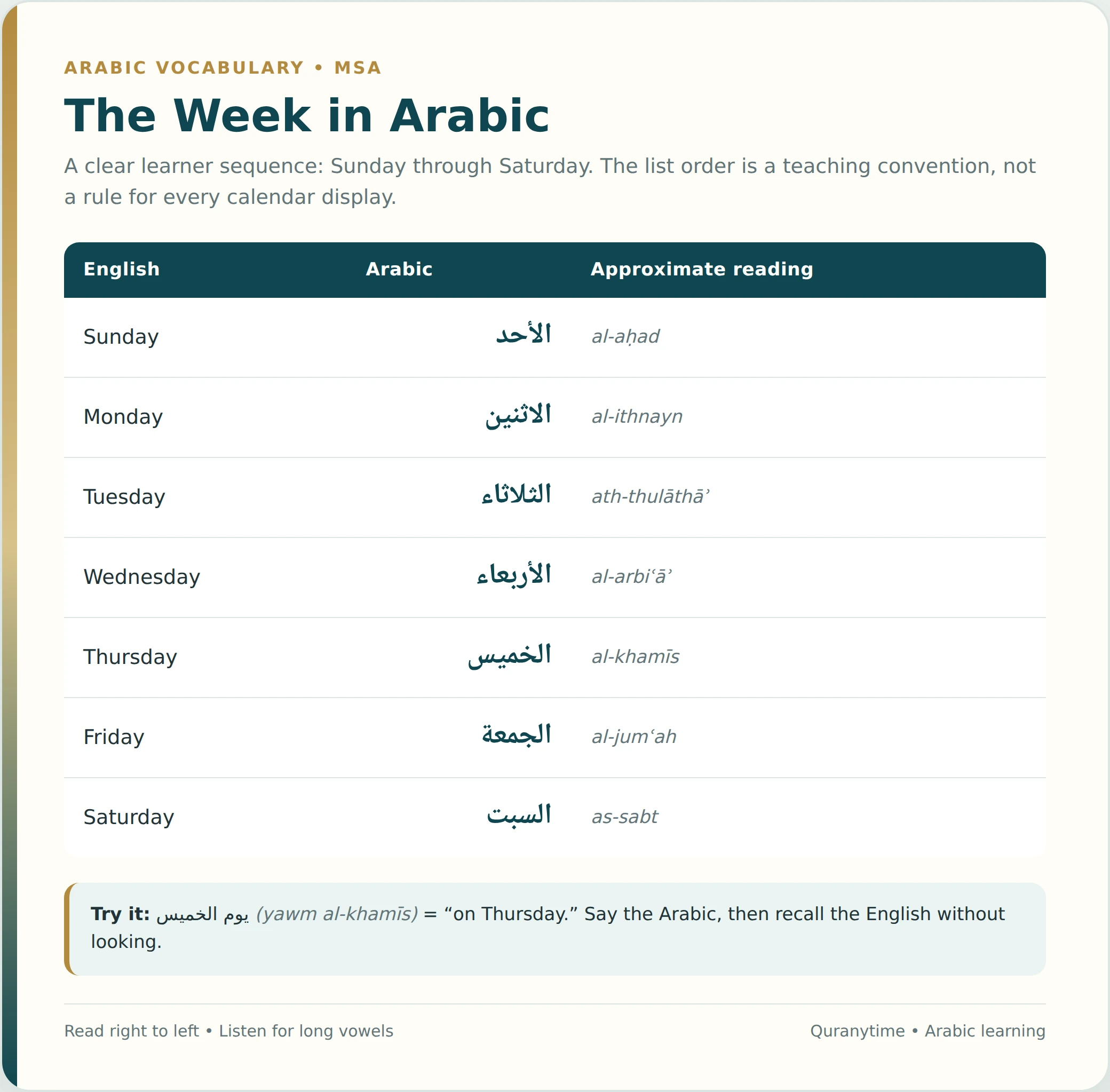
Read the Arabic from right to left. The transliteration is deliberately simple: it helps you sound out a new word, but it cannot fully capture sounds such as ع (ʿayn), ح (ḥāʾ), or emphatic consonants. Listen and repeat, then use the Arabic spelling to recognize the word when it appears in a calendar.
Several weekday names reflect Arabic number words: الأحد is connected with “one,” الثلاثاء with “three,” and الأربعاء with “four.” This pattern can help with recall, but Friday and Saturday have their own familiar forms. Calendar apps may display Monday first or Sunday first; that layout does not change the Arabic names.
Common Gregorian month names in Arabic
For everyday civil dates, learners will often meet these widely used Arabic spellings of the Gregorian months. Long vowels and local pronunciation differ. The table gives a useful reading approximation, not a promise that every Arabic-speaking country pronounces each name identically.
| Month | Arabic | Approximate reading |
|---|---|---|
| January | يناير | yanāyir |
| February | فبراير | fibrāyir |
| March | مارس | māris |
| April | أبريل | abrīl |
| May | مايو | māyū |
| June | يونيو | yūniyū |
| July | يوليو | yūliyū |
| August | أغسطس | aghusṭus |
| September | سبتمبر | sibtambir |
| October | أكتوبر | uktūbar |
| November | نوفمبر | nūfambir |
| December | ديسمبر | dīsambir |
These are common written forms, but they are not the only regional names. In parts of the Levant, you may hear forms such as كانون الثاني for January, شباط for February, and آذار for March; names such as نيسان, أيار, and حزيران are also used in that regional set. In other places, speakers commonly use forms closer to the international month names. If you are learning for travel or a local conversation, ask which form your teacher or community uses and keep that choice consistent.
When a calendar date matters, clarity beats guessing. If someone says “in March,” you can confirm the calendar and month form: هل تقصد شهر مارس؟ (“Do you mean the month of March?”). A clear spoken month name is often more helpful than relying on an unfamiliar abbreviation.
The twelve Hijri months
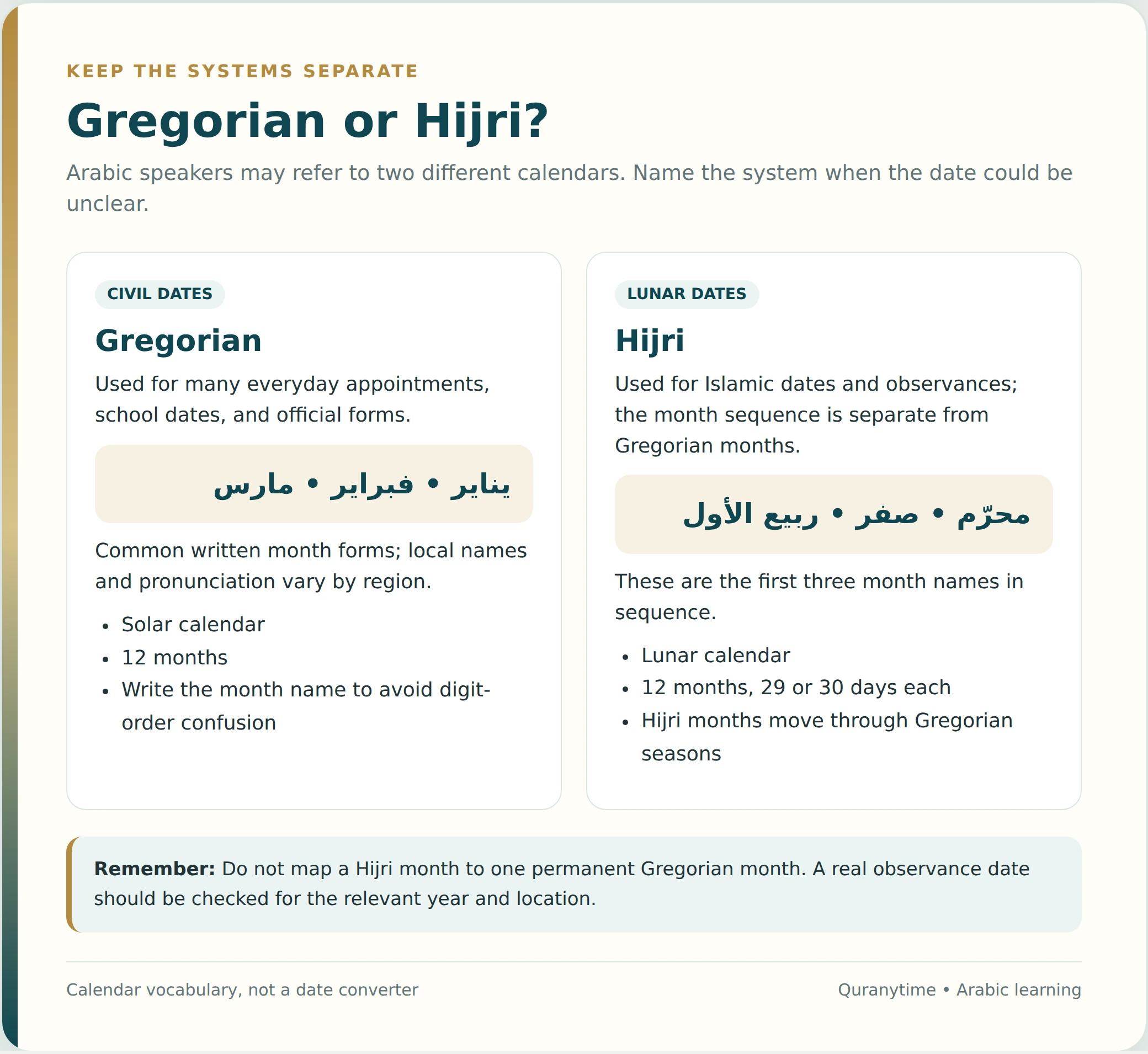
The Hijri calendar has its own sequence of months. Learn the names as a separate list rather than matching each one to a fixed Gregorian month. Their position in the solar year changes over time, so Ramadan, for example, does not stay in the same Gregorian season.
| Order | Hijri month | Arabic spelling |
|---|---|---|
| 1 | Muḥarram | محرّم |
| 2 | Ṣafar | صفر |
| 3 | Rabīʿ al-awwal | ربيع الأول |
| 4 | Rabīʿ al-ākhir (also called al-thānī) | ربيع الآخر |
| 5 | Jumādā al-ūlā | جمادى الأولى |
| 6 | Jumādā al-ākhirah | جمادى الآخرة |
| 7 | Rajab | رجب |
| 8 | Shaʿbān | شعبان |
| 9 | Ramaḍān | رمضان |
| 10 | Shawwāl | شوّال |
| 11 | Dhū al-Qaʿdah | ذو القعدة |
| 12 | Dhū al-Ḥijjah | ذو الحجة |
The Hijri year is lunar and shorter than the Gregorian solar year. Months are 29 or 30 days, and the start of an observance may vary with local calendar practice or crescent-sighting decisions. Timeanddate’s explanation of the Islamic calendar describes the lunar structure and why a new month may begin on different dates in different locations. For the cultural and religious occasions associated with some months, see Quranytime’s guide to important days in the Muslim year.
Do not turn a Hijri-to-Gregorian conversion into a permanent fact. A date on a printed calendar or website should be checked for the relevant year and location. If your goal is language practice, say the Hijri month name and identify the calendar; if you are making a real travel, school, or appointment plan, confirm the date with the organizer.
How to ask and say the date in Arabic
Use these short questions to start a conversation:
- ما تاريخ اليوم؟ (mā tārīkh al-yawm?) — What is today’s date?
- في أي يومٍ سيكون موعد الدرس؟ (fī ayyi yawmin sayakūnu mawʿid al-dars?) — What day will the lesson appointment be?
- متى يبدأ شهر رمضان؟ (matā yabdaʾ shahr Ramaḍān?) — When does the month of Ramadan begin?
A practical spoken frame is اليوم هو … (“Today is …”) or الموعد يوم … (“The appointment is on …”). To name a calendar date, a useful MSA model is the ordinal day, then من (min, “of”), then the month: اليوم الخامس من مايو (“the fifth of May”). Add the weekday before it when needed: يوم الاثنين، الخامس من مايو (“Monday, the fifth of May”). These are learner models; endings and pronunciation can change with the full sentence.
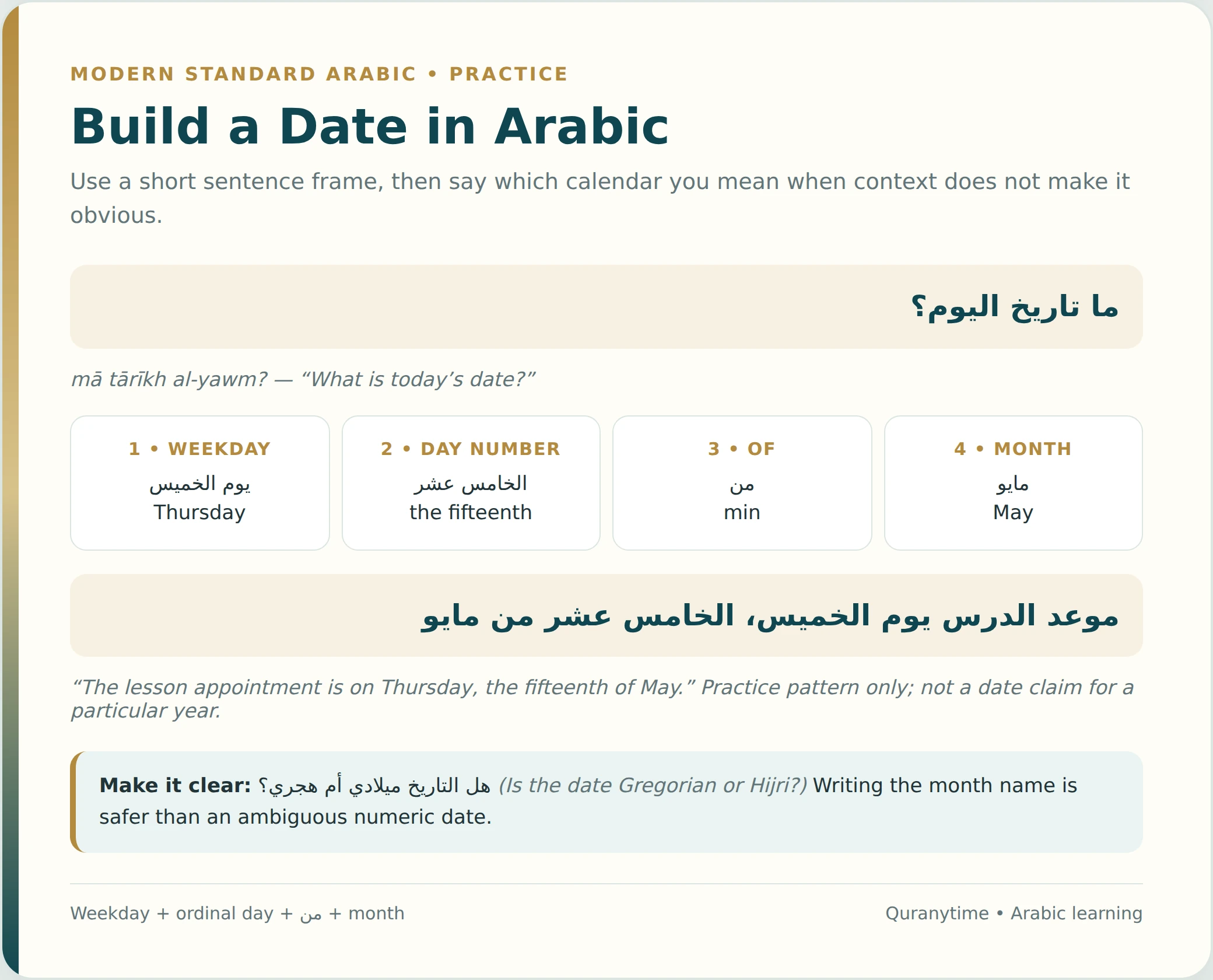
For example, موعد الدرس يوم الخميس، الخامس عشر من مايو means “The lesson appointment is on Thursday, the fifteenth of May.” Treat it as a sentence pattern, not as a claim about a particular year’s calendar. If you include a year, say سنة or عام before it and use the number forms you have studied. Quranytime’s Arabic numbers guide can help you review number words before reading a full date aloud.
In written messages, a numeric date such as 5/6/2026 can be ambiguous: some readers may interpret it as the fifth of June and others as May sixth. Writing the month name avoids much of that confusion. If the form asks for digits only, follow its date order and check whether the year comes last.
Make the date part of a real plan
Dates are easier to remember when connected to something you actually need to say. Ask أي يوم؟ (“Which day?”) using the Arabic question words you already know. Add a weekday to a class plan, a month to a birthday, or a Hijri month to a religious occasion. For the appointment’s clock time, connect the date to Quranytime’s guide to telling time in Arabic.
Practise this three-line exchange aloud:
- Ask: ما تاريخ الموعد؟ — What is the appointment date?
- Answer with a weekday and month: يوم الثلاثاء، العاشر من يونيو — Tuesday, the tenth of June.
- Confirm the calendar if needed: هل التاريخ ميلادي أم هجري؟ — Is the date Gregorian or Hijri?
Next, cover the English column in the card above and recall the Arabic. Then reverse the exercise: read the Arabic aloud, write a transliteration from memory, and check the spelling. A short review on several different days usually works better than trying to memorize all the lists in one sitting.
Quick review and common questions
Are Arabic weekdays numbered?
Several weekday names preserve a clear relationship to Arabic number words, but learners should memorize each full name as vocabulary. Do not assume the weekday order in a calendar app tells you the first day used by every school, workplace, or country.
Are Gregorian month names the same everywhere?
No. The Arabic spellings in the Gregorian table are common forms, while some regions use a different set of month names. Label the variety you are learning and notice what local speakers use; do not mix two systems in one list without saying so.
Can I use a Gregorian month to identify a Hijri date?
Not by itself. The Hijri year is shorter, so its months move through the Gregorian year. For a real religious observance, check the calendar used by the relevant community and location instead of relying on a memorized month-to-month match.
Build confidence by practising one list at a time: weekdays first, then the Gregorian months you use most, then the Hijri sequence. If you would like guided help reading Arabic and using it in conversation, you can book a free Quran and Arabic trial class. A teacher can help you hear the sounds, read the spellings, and practise a complete date in context.
Turn the list into a date you can use
Choose a real but non-sensitive example, such as a class, a planned reading session, or a trip. First write the weekday in Arabic, then add the day number and month name. Read the result aloud once while looking at the text and again without looking. Check that you have not mixed a Hijri month with a Gregorian date, and include the year if another person needs to put the event into a calendar.
To make the sentence conversational, surround the date with a greeting or a simple question from Quranytime’s beginner Arabic phrases guide. A small personal example is easier to remember than a long list of isolated translations. Over several days, replace one element at a time: keep the sentence frame, change the weekday, then change the month. This gives you repeated practice with the same grammar while gradually learning more vocabulary.