
Quick answer: A parent looking for a dua for a sick child in Arabic can use this well-known supplication. It is reported from ʿA’ishah that the Prophet ﷺ used these words when visiting an ailing member of his family. The narration concerns an ill family member generally, rather than a formula reserved specifically for children.
اللَّهُمَّ رَبَّ النَّاسِ، أَذْهِبِ الْبَأْسَ، وَاشْفِ، أَنْتَ الشَّافِي، لَا شِفَاءَ إِلَّا شِفَاؤُكَ، شِفَاءً لَا يُغَادِرُ سَقَمًا
Transliteration: Allāhumma Rabban-nās, adhhib il-ba’sa, washfi, Antash-Shāfī, lā shifā’a illā shifā’uka, shifā’an lā yughādiru saqaman. Meaning: “O Allah, Lord of mankind, remove the affliction and cure [the sick person]. You are the Healer. There is no cure except Your cure, a cure that leaves no illness behind.” The Arabic and transliteration above follow Riyad as-Salihin 902.
The dua for a sick child in Arabic
The supplication is often shared by people looking for a dua for a sick child in Arabic. Here it is presented in the wording found in Riyad as-Salihin 902:
اللَّهُمَّ رَبَّ النَّاسِ، أَذْهِبِ الْبَأْسَ، وَاشْفِ، أَنْتَ الشَّافِي، لَا شِفَاءَ إِلَّا شِفَاؤُكَ، شِفَاءً لَا يُغَادِرُ سَقَمًا
Transliteration: Allāhumma Rabban-nās, adhhib il-ba’sa, washfi, Antash-Shāfī, lā shifā’a illā shifā’uka, shifā’an lā yughādiru saqaman.
Meaning: “O Allah, Lord of mankind, remove the affliction and cure [the sick person]. You are the Healer. There is no cure except Your cure, a cure that leaves no illness behind.” English translations vary slightly; this rendering follows the sense of the translation provided with the hadith.
Transliteration is a reading aid, not a single universally standardized spelling. The Arabic sounds do not map perfectly onto Latin letters, and published transliterations may differ in punctuation or vowel notation. If you are learning to pronounce the words, listen to a knowledgeable Arabic reader or seek a qualified teacher. Quranytime’s Arabic reading guide and guide to learning Quranic Arabic offer separate starting points for reading practice.
What the hadith says
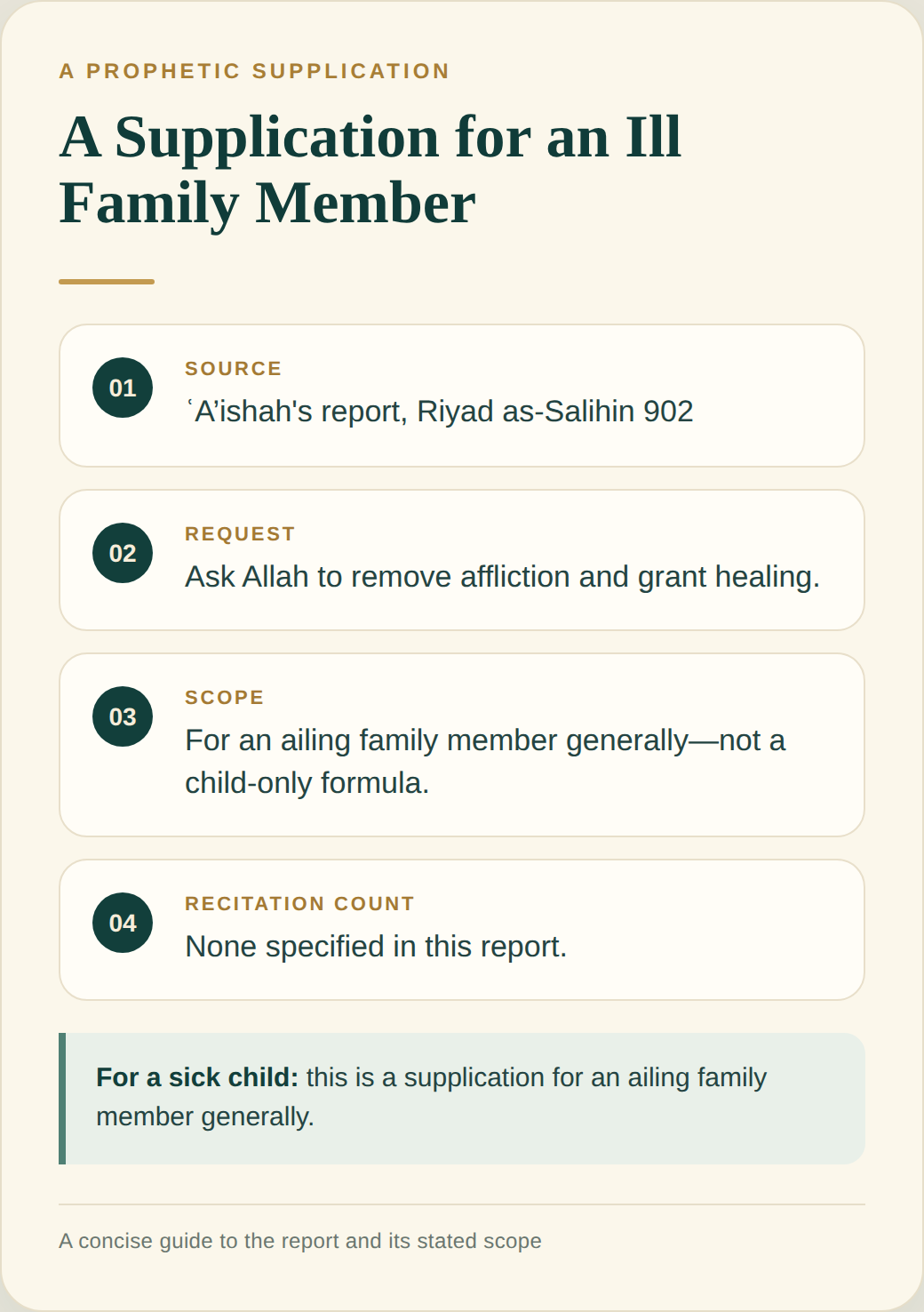
In Riyad as-Salihin 902, ʿA’ishah (may Allah be pleased with her) reports that when the Prophet ﷺ visited an ailing member of his family, he would touch the sick person with his right hand and supplicate with these words. The collection identifies the report as narrated by al-Bukhari and Muslim. This is the primary wording quoted in this article.
Islam Question & Answer also addresses a parent’s question in its answer “Du’a for Sick Child”. That answer cites a related version of the supplication attributed to ʿA’ishah, transliterated there as “Adhhib il-bas, Rabbi l-nas washfi anta al-Shafi la shifa a illa shifa uka shifa an la yughadir saqaman.” Its order differs from the wording in Riyad as-Salihin 902: in the hadith text, “Rabban-nās” comes before “adhhib al-ba’sa,” and “washfi” is followed by “Antash-Shāfī.” The Arabic quoted here follows the primary hadith page, not a claim of verbatim reproduction of IslamQA’s transliteration.
IslamQA’s answer discusses more than one reported supplication and other practices in response to its question. Its answer is useful as a specific discussion of supplication for a sick child; it should not be conflated with the exact wording of the hadith text quoted above. Neither this article nor its references establish that this prayer is exclusive to children. The report itself describes an ailing family member.
That scope matters: a parent may use these words while praying for a child, but the narration does not call them a child-only formula. Riyad as-Salihin 902 gives no special repetition count. This article therefore does not add a required number, ritual, or promise of a particular result. For a religious ruling about a specific practice or circumstance, consult a trusted qualified scholar and share the exact wording and context.
How a parent may make this supplication
You can read the Arabic from the page if you have not memorized it. Take a moment to understand the request: asking Allah to remove affliction and grant healing. It is fine to approach the words calmly; the purpose of this guide is not to test a parent’s Arabic or to suggest that perfect pronunciation is a condition for seeking help from Allah.
Outside formal prayer, a parent may also ask Allah in their own language for their child’s comfort and recovery. IslamQA’s answer on supplication in other languages permits personal supplications outside prayer, using permissible words. It discusses different scholarly views about supplication in a non-Arabic language within formal prayer; this bedside guide does not settle that separate question. A personal request is not presented here as a prescribed translation of the hadith.
Keep the moment gentle. A child may be tired, frightened, or uninterested in listening. You can recite quietly or make dua privately; do not pressure the child to repeat words or suggest that getting better depends on their pronunciation, participation, or level of understanding. For a baby or young child, the caregiver can make the supplication without expecting the child to comprehend it.
The hadith mentions touching the ill family member with the right hand. It does not mean a caregiver should override a child’s comfort, hygiene or infection-control precautions, or medical advice. Do not force touch if it is unwelcome or unsuitable. The supplication can be made without touching the child.
Can I ask Allah for my child in my own words?
Many caregivers naturally want to address their child’s particular needs—asking Allah for ease, relief, strength, or healing. The cited hadith supplies one narrated supplication; it does not say that it is the only expression a parent may use. IslamQA’s language answer allows permissible personal supplication outside formal prayer; questions about what may be said during salah involve separate scholarly discussion. If you are unsure about a religious detail, ask a qualified scholar rather than relying on a short online article.
The Quran describes itself as healing and mercy for believers (Quran 17:82), and records Prophet Ibrahim saying, “And when I am ill, it is He who cures me” (Quran 26:80). These verses can be read in their context as reminders of Allah’s mercy and healing. They should not be turned into a guarantee of a specific medical outcome or timeframe, nor used to discourage clinical care.
Is there a required number of repetitions?
Riyad as-Salihin 902 does not state a number of times to repeat this supplication. For that reason, this guide does not prescribe a count. A number attached to a social post or graphic should not automatically be treated as an instruction from this report. If you encounter a specific claim and want to know its evidence or religious status, check the source with a knowledgeable scholar.
The report describes a supplication in the setting of visiting an ill family member. It does not require a parent to create a special ceremony around the words. A caregiver may pray while visiting, sitting nearby, or attending to the child in another way, without claiming that a particular time, gesture, or count is established by this narration.
Should dua replace medical care?
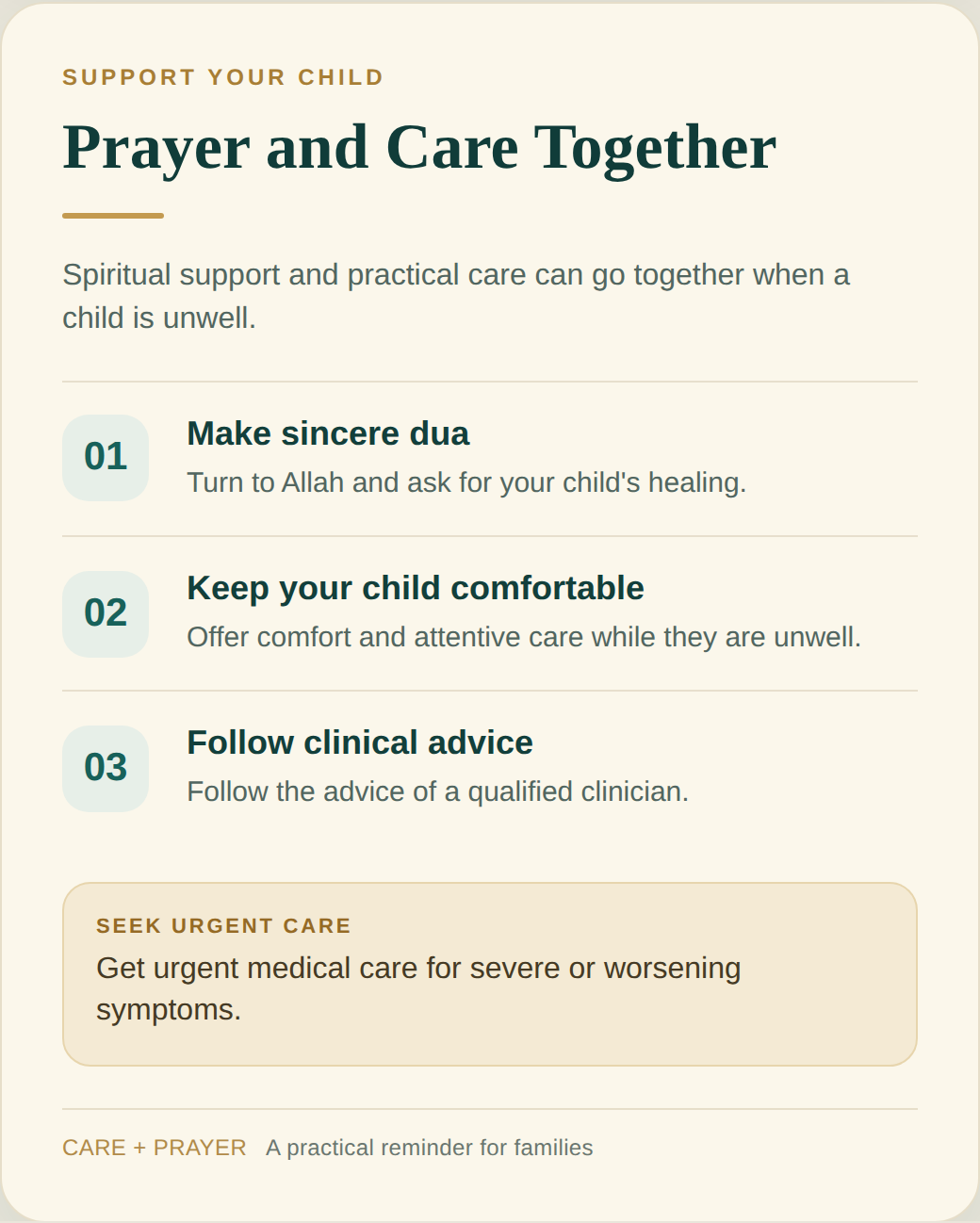
No. A supplication is a request to Allah, not a diagnosis or treatment plan. The hadith gives words used when someone is ill; it does not tell a caregiver to stop treatment, delay an assessment, or decide independently whether symptoms are serious. Follow advice from a qualified healthcare professional and seek care appropriate to the child’s age and condition. If symptoms are severe, rapidly worsening, or otherwise alarming, contact local emergency services or obtain urgent medical help.
If you are uncertain whether a symptom needs prompt attention, contact a healthcare professional for advice rather than waiting to see whether a spiritual practice changes it. A caregiver can make dua while arranging medical help, following the clinician’s recommendations, and offering ordinary comfort. What care is appropriate depends on the child; this article cannot assess that from a distance.
Helping a child feel safe
If an older child asks what you are saying, you might explain simply that you are asking Allah to help them. Avoid placing responsibility for recovery on the child or implying that illness reflects a failure to pray correctly. Let the child rest if that is what they need. A parent’s calm presence and attention to the child’s comfort matter alongside religious support.
When a child is well enough to return to learning, make room for rest and a gradual return to routine. These ideas for Quran practice without pressure address learning habits, not medical treatment. Families considering lessons can also explore Quran classes for children when the time is right; neither resource is a requirement attached to this supplication.
If you are communicating about symptoms in Arabic, this guide to Arabic health vocabulary may help you prepare useful words. It is a language resource, not a diagnostic tool. In an urgent situation, contact a healthcare professional or emergency service promptly rather than waiting to translate every detail yourself.
How to check a shared supplication
Images and messages often circulate without enough context to tell one narration from another. Before sharing a version, look for the source name and reference number, compare its Arabic wording with the cited text, and check whether a claim about the situation or number of repetitions actually appears there. A small difference in translation may reflect the translator’s choices; a different word order may reflect a related wording. Neither is a reason to rewrite the source casually.
Keep a link to the report alongside any text you save. If a card claims the words are exclusive to children or guarantees recovery, check that claim rather than passing it on as part of the hadith. For this particular report, the setting is an ill family member, and the report does not state a repetition count. A reliable reference helps another parent see what was narrated and what is a practical explanation added for readers.
If reading Arabic is still new to you, you can revisit the words slowly with a teacher when you have time. During an anxious moment, the translated meaning can help you understand the request without turning spelling or speed into another burden. Quranytime’s reading classes provide a way to practise Arabic reading, though they are not the source of this hadith or a substitute for religious guidance.
Quick reference
- Arabic: اللَّهُمَّ رَبَّ النَّاسِ، أَذْهِبِ الْبَأْسَ، وَاشْفِ، أَنْتَ الشَّافِي، لَا شِفَاءَ إِلَّا شِفَاؤُكَ، شِفَاءً لَا يُغَادِرُ سَقَمًا
- Transliteration: Allāhumma Rabban-nās, adhhib il-ba’sa, washfi, Antash-Shāfī, lā shifā’a illā shifā’uka, shifā’an lā yughādiru saqaman.
- Source: ʿA’ishah’s report, Riyad as-Salihin 902; identified there as narrated by al-Bukhari and Muslim.
- Related answer: Islam Question & Answer, “Du’a for Sick Child”, which cites a related version with slightly different word order.
- Scope: The hadith concerns an ailing family member generally, not a child-only formula.
- Count and care: No repetition count is stated in this report; dua does not replace appropriate medical care.
In summary
If you are looking for a dua for a sick child in Arabic, you may use the supplication reported in Riyad as-Salihin 902, understanding that its reported setting is an ill family member generally. Its Arabic is shown with transliteration and meaning, and IslamQA’s answer to a parent’s question is identified as citing a related wording rather than the exact same order of words. Do not add an unsupported count or promise of a guaranteed outcome. Make sincere dua in a way that is gentle for the child, and seek appropriate medical advice and urgent care when needed.
Sources: Riyad as-Salihin 902; Islam Question & Answer, “Du’a for Sick Child” (answer 75399); Islam Question & Answer, supplication in other languages (answer 262254); Quran 17:82; Quran 26:80.