
The dua before entering the bathroom is a short request for Allah’s protection. The well-known wording is reported in Sahih al-Bukhari 142. It is said before entering, not after crossing into the bathroom. Below are the Arabic, a readable transliteration, the meaning, and the context of the narration—without adding words or practices that are not established by the cited evidence.
The dua before entering the bathroom
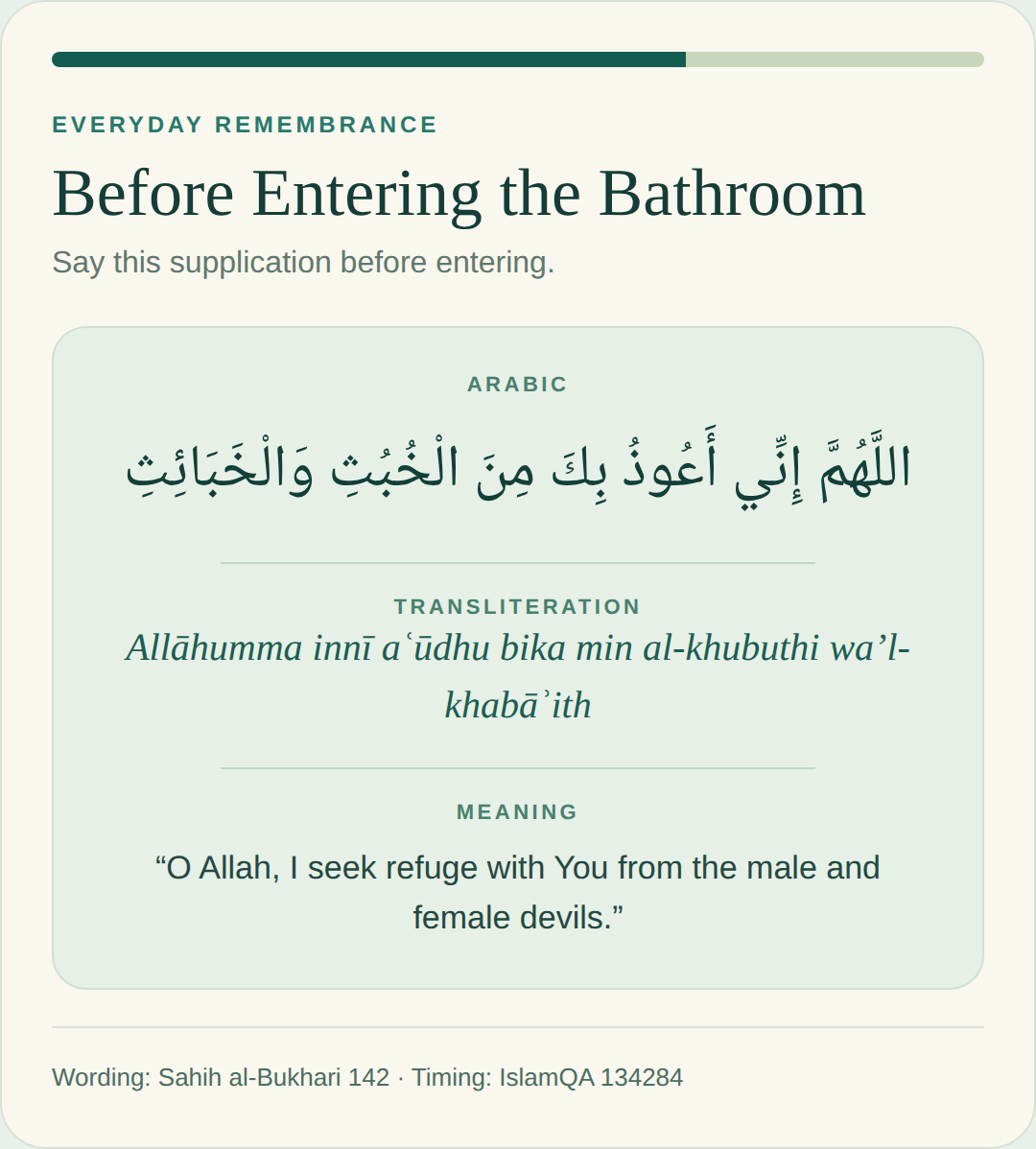
اللَّهُمَّ إِنِّي أَعُوذُ بِكَ مِنَ الْخُبُثِ وَالْخَبَائِثِ
Transliteration: Allāhumma innī aʿūdhu bika min al-khubuthi wal-khabāʾith.
Meaning: “O Allah, I seek refuge with You from the male and female devils.”
English renderings of the final words vary. Sahih al-Bukhari’s translation at the link above renders them as “all offensive and wicked things (evil deeds and evil spirits).” IslamQA’s explanation gives “the male and female devils.” Both renderings reflect the Arabic phrase, whose wording is brief and whose English translation is not a separate prescribed formula. The Arabic text is the reference point.
What is the source of the wording?
Anas ibn Malik reported that whenever the Prophet Muhammad ﷺ went to answer the call of nature, he used to say: Allahumma innī aʿūdhu bika min al-khubuthi wal-khabāʾith. The report appears in Sahih al-Bukhari, Book of Ablutions, in the chapter “What to say while going to the lavatory.” Its reference is Sahih al-Bukhari 142.
The hadith page also preserves related differences in the report’s phrasing: one accompanying narration says “when he came to the lavatory,” another says “when he entered,” and another says “when he intended to enter.” Those details matter when explaining timing. The direct entry narration supports saying the dua as one is about to go in. IslamQA’s answer on timing notes that “wants to enter” indicates before entry rather than after it.
A second report, from Zayd ibn Arqam and recorded by Abu Dawud, is quoted in IslamQA’s answer on when to say the dhikr. Its wording is commonly given as Aʿūdhu Billāhi min al-khubthi wal-khabāʾith (“I seek refuge with Allah from the male and female devils”). It is a related version, but it is not identical to Bukhari’s phrase: Bukhari begins Allāhumma innī aʿūdhu bika (“O Allah, indeed I seek refuge with You”). To quote accurately, do not combine the openings and call the resulting text one exact narration.
When should it be said?
Say the supplication before entering the bathroom. That is the clearest practical answer to the common question “before or after?” IslamQA answer 134284 explicitly says the recommended dhikr should be recited before entering and not after. Its discussion points to narrations using language of intending or wanting to enter, and notes that verbal remembrance is avoided once inside the place used for relieving oneself.
In an ordinary home bathroom, a simple approach is to say it just before crossing the threshold. If you remember only after you have entered, do not turn that into a reason to recite it inside. The cited answer’s guidance is to say it before entry, not after entry; it does not require you to leave and re-enter, repeat a phrase, or carry out a correction ritual. This article does not add such steps.
The word “bathroom” can refer to a room that includes a toilet, sink, bath, or shower. IslamQA answer 83393 addresses the question of whether the dua is limited to someone intending to use the toilet. It says the recommendation applies when entering the bathroom generally, including for other ordinary bathroom purposes. That answer frames this as a scholarly explanation of why the protection is sought in such places. It should not be stretched into a claim that every modern room layout has a distinct, universally agreed ruling.
If you are reading this alongside a separate question about ablution, keep the subjects distinct: the bathroom-entry supplication is not a step of the rules about what breaks wudu, nor is it a condition of making wudu. The phrase is a reported remembrance at the point of entry.
Questions about Quran recitation during a state without ablution are also separate from this entry supplication; see this guide to reading Quran without wudu for that distinct topic.
What does the dua mean?
Allāhumma is a way of calling upon Allah, often translated “O Allah.” Innī means “indeed, I” or simply “I” in a smooth English rendering. Aʿūdhu bika means “I seek refuge with You.” The final words name what protection is sought from; translations describe them as male and female devils, or use broader expressions such as wicked or offensive things.
Seeking refuge is asking Allah for protection. The hadith gives the words; it does not require a reader to construct a detailed explanation of unseen matters or claim a particular visible effect will follow every recitation. IslamQA answer 83393 describes the wisdom given by scholars: seeking Allah’s protection from devils associated with places where impurities are present and private parts may be uncovered. That is an explanation cited by the answer, not extra wording in the hadith itself.
Keep the distinction clear: the supplication is a short act of turning to Allah, while statements about unseen beings or the precise reason for every detail are explanations. The cited sources support the general rationale just described. They do not invite us to add dramatic claims, fear-inducing imagery, or guarantees that a particular harm will otherwise occur.
How to pronounce and remember it
Read the phrase slowly in small parts: Allāhumma | innī | aʿūdhu bika | min al-khubuthi | wal-khabāʾith. The transliteration uses marks that may be unfamiliar. The letter ʿ represents the Arabic letter ʿayn; kh represents the sound خ; and the line over a vowel, as in ā or ī, indicates a long vowel in this spelling system. Roman letters cannot reproduce Arabic sounds perfectly, so listen to a qualified Arabic reader if you can.
Pronunciation spellings differ between books and websites. You may see khubthi or khubuthi, and khabaʾith or khaba’ith. Such differences often reflect how the Arabic is represented in English letters; they do not necessarily mean the person is reciting another supplication. Use the Arabic text and a reliable teacher or reciter rather than treating one romanization as sacred punctuation.
To learn it, connect each phrase to its meaning rather than memorizing a string of unfamiliar sounds. Say it at a natural, quiet volume before entering. There is no special melody, number of repetitions, or performance to add to the hadith. A manageable daily routine can support learning Arabic, but a personal Quran reading schedule is a separate learning tool, not a prescribed part of this dua.
What is said after leaving?
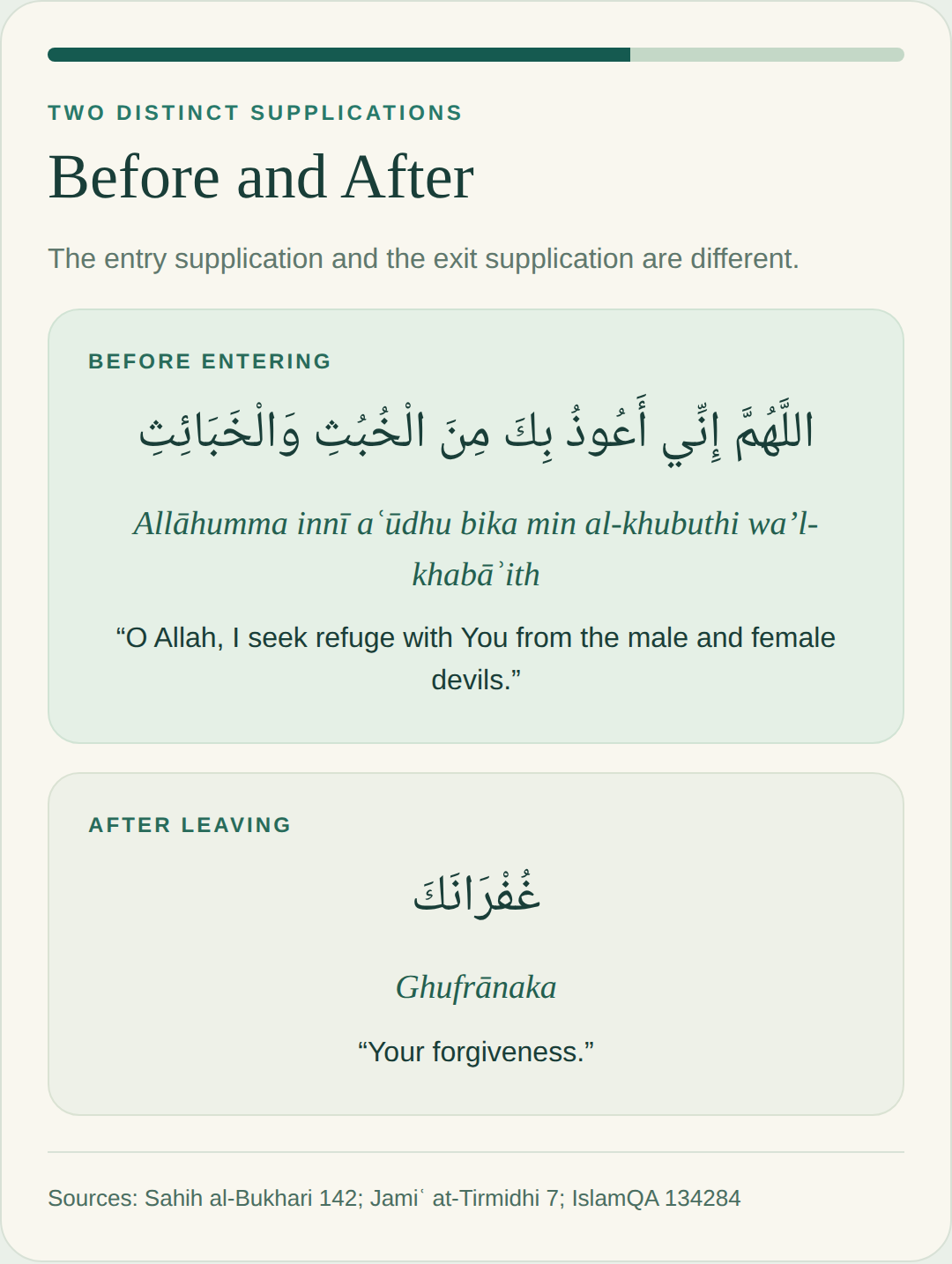
A separate report describes what the Prophet ﷺ said on leaving: غُفْرَانَكَ (Ghufrānaka), meaning “Your forgiveness.” Aisha narrated this in Jamiʿ at-Tirmidhi 7. The entry dua is a request for protection before entering; this short request for forgiveness comes after leaving. They are different narrations and should be taught as distinct phrases.
What the sources do—and do not—say
For accuracy, it helps to separate the narrated words from other advice sometimes attached to bathroom etiquette articles or social-media graphics.
- The dua itself: Bukhari 142 reports the Prophet ﷺ saying, “O Allah, I seek refuge with You from al-khubuth and al-khaba’ith,” in connection with answering the call of nature.
- The timing: IslamQA answer 134284 explains that it is said before entering, based on the wording of intending to enter and the avoidance of dhikr in the place of relieving oneself.
- The broader bathroom question: IslamQA answer 83393 says the recommendation is not limited to entering only for relieving oneself, and gives the rationale of seeking Allah’s protection.
- Other etiquette: Rules or recommendations about which foot to use, leaving phrases, or additional conduct are separate issues. They are not contained in the Bukhari wording quoted here. This article does not use this hadith as proof for those details.
Some versions and educational materials add “Bismillah” or other phrases. IslamQA answer 134284 discusses longer wordings quoted by jurists and other reports. Those should be identified by their own sources and not silently inserted into the concise wording of Sahih al-Bukhari 142. If you follow a teacher who teaches an additional established form, ask for the exact source and keep the versions distinct.
Likewise, this article does not label the dua obligatory or claim that failing to say it invalidates anything. IslamQA describes it as recommended (mustahabb). Avoid turning a recommendation into a condition of using the bathroom, purification, or worship unless a reliable source specifically addresses that separate ruling.
Why wording and context matter
Short supplications are often copied into phone notes, classroom handouts, or signs by a bathroom door. A useful habit when sharing one is to preserve the Arabic and include a source reference. Transliteration helps a learner pronounce a text, but it cannot settle which Arabic wording was transmitted. Likewise, a smooth English translation communicates the meaning but is not itself the original wording.
Here, the simplest precise reference is Bukhari 142. It records Anas’s report and gives the Arabic text. IslamQA answers 134284 and 83393 then discuss when to say the words and how scholars explain the recommendation. Those sources have different roles: a hadith collection preserves the report, while a scholarly answer explains its application. Keeping those roles visible makes it easier to see which parts are narrated and which parts are explanation.
This distinction is especially useful when an article or graphic prints a longer version. The fact that an additional phrase appears in a book or a teacher’s instruction does not make it part of every narration. One can acknowledge another reported wording without blending it into the Bukhari quotation. If a reader wants to follow a particular school or teacher, the respectful next step is to ask for the source and follow qualified guidance—not to declare every other Muslim’s wording wrong based on a brief online summary.
Nor should translations be used to make claims stronger than the source. The hadith reports a seeking of refuge; the scholarly answers explain the recommendation and its setting. They do not provide a timetable, a special count, or a promise that a person will observe a particular outcome. Staying close to the report is both clear for beginners and fair to the religious evidence.
Common questions
Is the dua said before entering or after entering?
Before entering. IslamQA answer 134284 expressly says to recite the dhikr before entry, not once inside. The wording tied to intending or wanting to enter supports that timing.
What is the exact Arabic dua?
The Bukhari wording is: اللَّهُمَّ إِنِّي أَعُوذُ بِكَ مِنَ الْخُبُثِ وَالْخَبَائِثِ. Its transliteration is Allāhumma innī aʿūdhu bika min al-khubuthi wal-khabāʾith. English translations differ slightly, so use the Arabic and hadith reference when exact wording matters.
What if I am entering the bathroom to wash or shower?
IslamQA answer 83393 says the recommendation applies when entering the bathroom generally, not only when one intends to relieve oneself. It explains this as seeking protection in such places. For a specific setting or circumstance, ask a knowledgeable scholar rather than assuming a detailed ruling from the short hadith alone.
Can I say the dua aloud?
The cited sources establish the words and their timing, not a required volume. Say it in an ordinary, quiet voice before you enter; there is no need to announce it. The key distinction in the cited guidance is before entry rather than after.
Do I need to repeat it if I forgot?
The sources cited here do not prescribe a repeat count or a ritual for forgetting. The practical guidance is simply to say it before entering when you remember. Do not invent a repeated action or treat an ordinary lapse as a crisis.
Is “Bismillah” part of the Bukhari wording?
No. The quoted text in Sahih al-Bukhari 142 starts Allāhumma innī aʿūdhu bika. Other forms may include additional words and should be cited separately. Keep a source’s exact text intact when teaching or sharing it.
A simple takeaway
Before entering a bathroom, say: Allāhumma innī aʿūdhu bika min al-khubuthi wal-khabāʾith—“O Allah, I seek refuge with You from the male and female devils.” The wording is reported in Sahih al-Bukhari 142. The timing is before entry, as explained in IslamQA answer 134284. IslamQA answer 83393 discusses the rationale and the wider bathroom context. That is enough to answer the basic question accurately; additional customs should be checked on their own evidence.
For other short supplications, see Quranytime’s guides to the dua for entering the masjid, a dua for a sick child in Arabic, and the Arabic words used in salah. Each supplication has its own wording and source context, so learn them separately rather than transferring phrases or rulings from one setting to another.
Sources
- Sahih al-Bukhari 142, Book of Ablutions, chapter on what to say while going to the lavatory.
- Jamiʿ at-Tirmidhi 7, the separate supplication on leaving the toilet.
- IslamQA answer 134284, “The dhikr for entering the bathroom should be said before entering it, not after.”
- IslamQA answer 83393, “Du’a for Entering Toilet: Why?”