

Arabic Collocations: Learn Natural Word Partnerships in Context
You can know many Arabic words and still hesitate when combining them. Fluent language is not built from isolated vocabulary alone: speakers repeatedly choose familiar word partnerships, such as a particular verb with a noun or a verb with a preposition. These patterns are called collocations. Learning Arabic collocations can help you recognize natural phrasing and retrieve useful language when you read, speak, or write.
This guide shows how to notice collocations, distinguish them from idioms and free combinations, and study them without treating each phrase as an absolute rule. The examples are practical Modern Standard Arabic (MSA) illustrations, not Quran quotations. A dialect phrase or a translation choice should not automatically be labeled MSA or Quranic Arabic.
What is an Arabic collocation?
A collocation is a combination of words that speakers commonly choose together in context. The words remain understandable, but their pairing is more conventional than a random combination. English learners say “make a decision,” not usually “do a decision.” A common Arabic equivalent is اتَّخَذَ قَرَارًا (ittakhadha qarāran, “made a decision”). Arabic has its own customary partners; it does not simply copy English.
Collocations sit between isolated words and full sentences. If you memorize a verb meaning “take” and a noun meaning “decision” separately, you may not predict their usual Arabic pairing. If you store ittakhadha qarāran together, you can recognize and retrieve the phrase as a useful unit. A broad Arabic phrase list with script and meanings can be a starting point; a collocation notebook focuses more narrowly on recurring word partnerships.
Collocations, free combinations, and idioms
A free combination is created for a particular moment and can often be changed without changing the basic pattern. “Open the wooden box” could describe many different boxes. A collocation is a pairing speakers tend to prefer, such as “heavy rain” or the Arabic phrase مَطَرٌ غَزِيرٌ (maṭarun ghazīrun). Another adjective might be grammatically possible but less expected in that context.
An idiom is a fixed expression whose overall meaning is not fully predictable from its individual words. The boundary between collocations and idioms is not always sharp. For learners, the useful question is whether the words are a conventional pairing, a figurative expression, or simply a phrase made for the moment. Mark what you know in your notes instead of calling every familiar phrase an idiom.
Collocations do not replace grammar. A phrase can help you remember which preposition often follows a verb, but you still need agreement, case, word order, and context. A focused Arabic prepositions guide explains the grammar, while phrase examples show how a particular preposition is used with a word.
Four useful patterns to notice
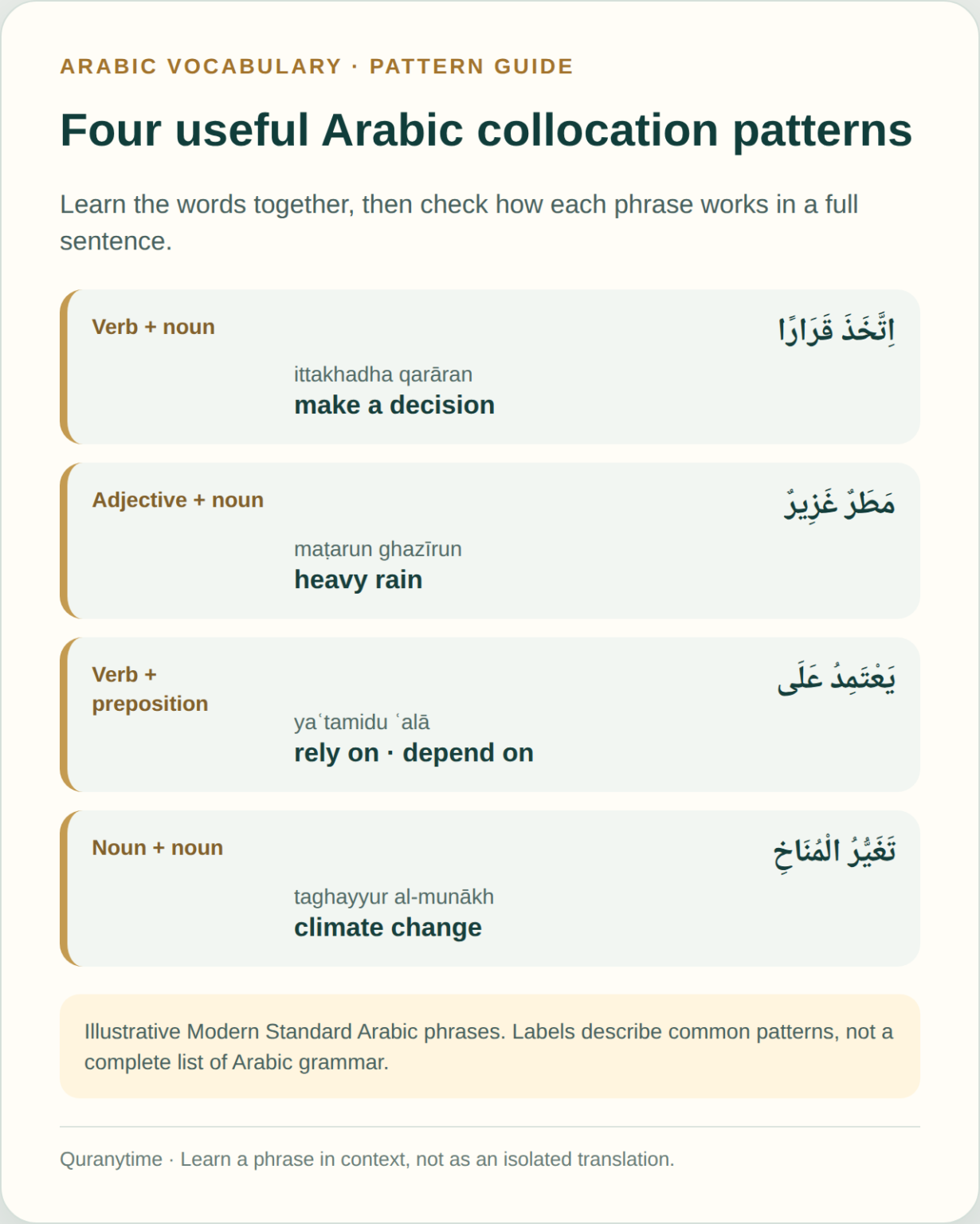
These examples illustrate common shapes, not every combination Arabic permits:
- Verb + noun: طَرَحَ سُؤَالًا (ṭaraḥa suʾālan) means “posed a question” or, naturally, “asked a question.” Learn the verb with its noun.
- Adjective + noun: مَطَرٌ غَزِيرٌ (maṭarun ghazīrun) means “heavy rain.” The adjective agrees with the noun in the relevant grammatical features, so meet the phrase in a sentence as well.
- Verb + preposition: يَعْتَمِدُ عَلَى (yaʿtamidu ʿalā) means “depends on” or “relies on.” Record the preposition because English may use a different one.
- Noun + noun: تَغَيُّرُ الْمُنَاخِ (taghayyur al-munākh) means “climate change.” Here the nouns form an iḍāfa construction, a possessive or specifying relationship.
These are examples, not a frequency ranking. Some forms change with the sentence. For Quranic Arabic, check the verse and grammar before drawing conclusions from a phrase alone. A guide to Arabic roots and patterns can help you recognize word families, but a shared root does not mean two words have the same collocations.
Why word-for-word translation can mislead
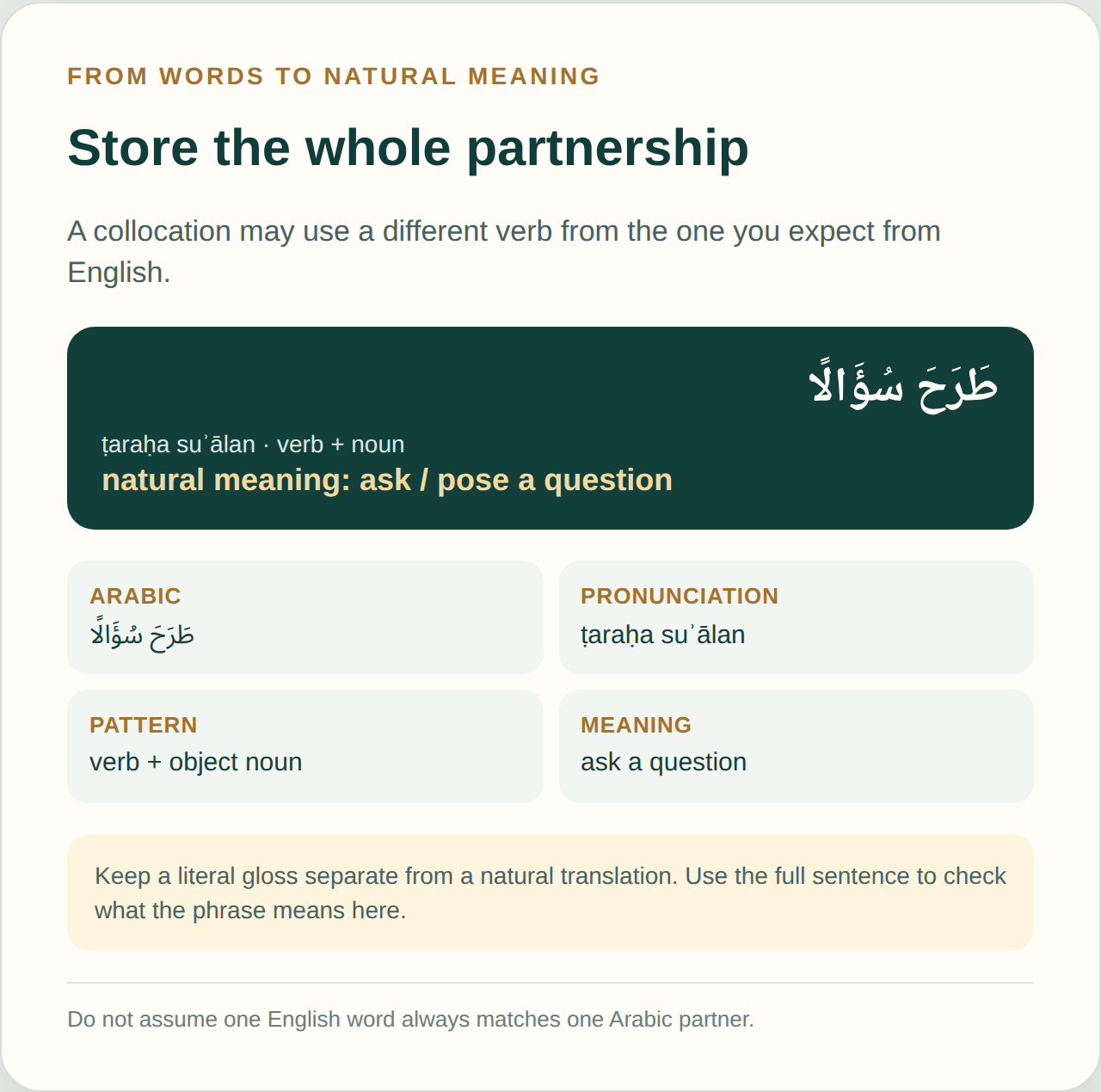
Collocations reveal that English and Arabic do not always package meaning in the same way. Someone who knows “ask a question” may look for one Arabic verb that matches “ask.” But Arabic can use ṭaraḥa suʾālan, whose literal image is closer to “put forward a question.” Its natural meaning is “ask” or “pose a question.” Translating each word separately can produce an unnatural English phrase too.
Literal meanings can still help you remember how a phrase is built. Keep a literal gloss separate from the natural translation, and do not let English wording decide the meaning of an Arabic passage by itself. That matters especially in Quranic vocabulary, where syntax and the full ayah are important. Using a Quranic Arabic corpus is one way to inspect a word alongside grammatical information and context.
A 2023 quasi-experimental study compared collocation-based vocabulary instruction with a grammar-and-vocabulary approach among 70 undergraduate Arabic-as-a-foreign-language learners. The authors reported a statistically significant post-test difference favoring the collocation group. Because the study involved one university and a specific sample, it supports trying phrase-based learning but does not prove that one method works identically for everyone. Read the study on collocations in Arabic vocabulary learning for its method and limitations.
How to build a useful collocation note
Make a note that helps you use the phrase, not merely recognize it. Record the Arabic spelling, a pronunciation aid, the pattern, a natural translation, and one short example or situation. Add a label such as formal MSA, everyday dialect, or Quranic text only when you have checked it. A phrase should not be called “Quranic” simply because it sounds formal.
For يَعْتَمِدُ عَلَى, a useful note might say: “verb + عَلَى; depends on / relies on; formal MSA; يَعْتَمِدُ النَّجَاحُ عَلَى الْمُثَابَرَةِ — ‘Success depends on persistence.’” This is a model sentence, not a quotation. If you note a Quranic phrase, preserve its reference and verify the wording instead of shortening it in a way that changes its grammar.
Connect listening and reading. A phrase heard in a lesson may become easier to remember when you find it in a passage; a phrase noticed while reading may be easier to retrieve after saying it aloud. Try a short Arabic listening routine alongside Arabic reading-comprehension practice to notice examples in context.
A simple practice cycle
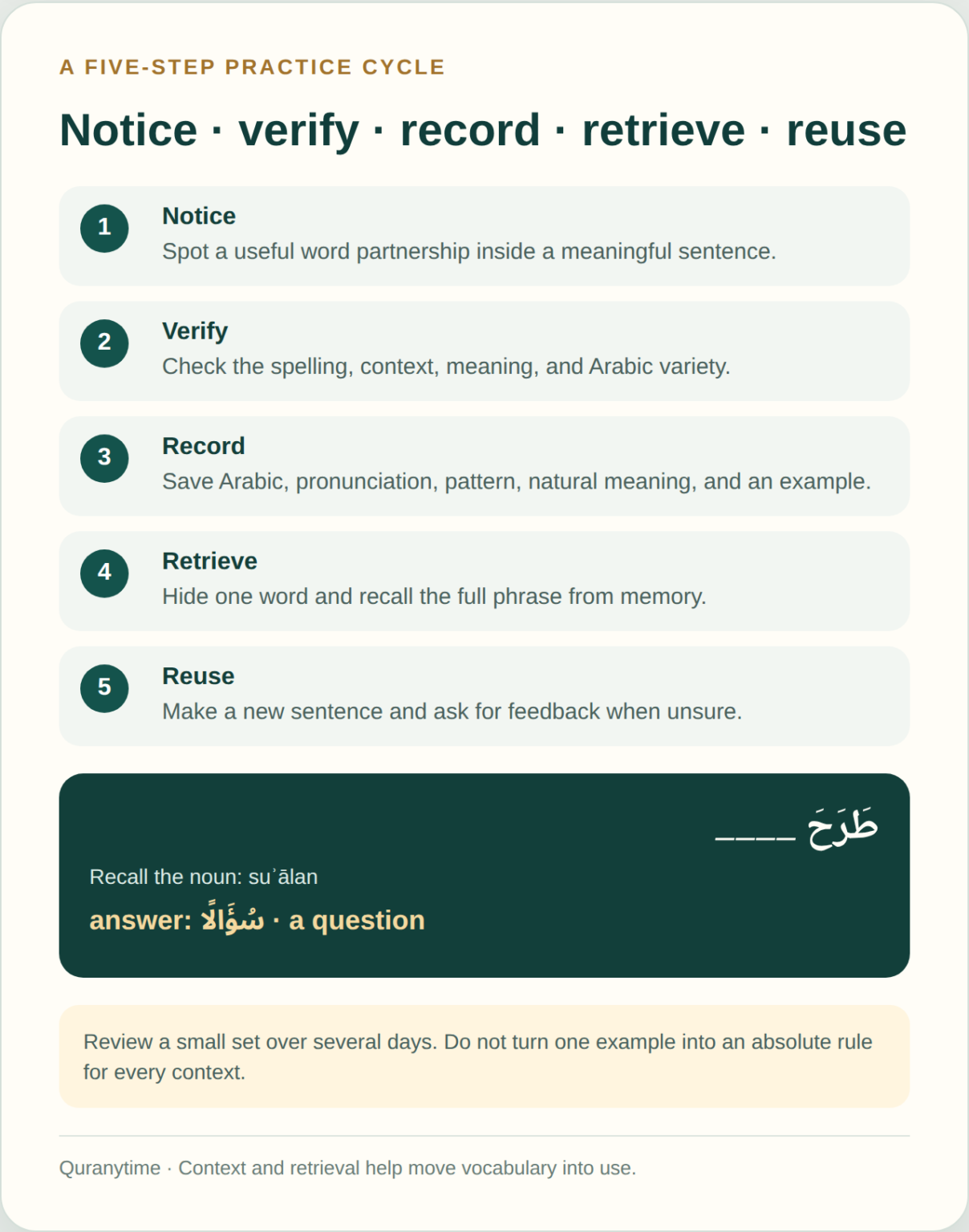
- Notice: When a verb, adjective, or preposition appears beside a noun, ask whether the pairing is familiar or repeated. Focus on useful combinations, not every pair of adjacent words.
- Verify: Check the whole sentence and, when possible, a reliable dictionary or reference. Confirm spelling, meaning, and variety. One isolated translation is not enough to establish that a phrase is standard.
- Record: Save the phrase with an example, natural meaning, and grammar note. A structured Quranic Arabic vocabulary notebook offers a useful model for keeping words in context; adapt it to your learning goal.
- Retrieve: Hide one word and recall the phrase. For ṭaraḥa ___, can you remember suʾālan? Retrieval tells you more than rereading a list and recognizing familiar words.
- Reuse: Make a simple sentence or use the phrase in a short exchange. Guided Arabic conversation practice can help move examples into turn-taking.
Keep your set manageable. Five phrases you can recognize and use accurately are more useful than a long list you cannot recall. Review after a day, a few days later, and again the following week. If a phrase slips, add a clearer example or contrast it with a phrase using a different verb. If it comes easily, retrieve it from a new prompt rather than adding more notes.
Use collocations carefully in Quranic Arabic
Repeated word partnerships can help you notice how Quranic vocabulary behaves in a sentence. They cannot replace grammar, tafsir, or careful reading of the whole ayah. A word may pair with different partners in different contexts, and a phrase in translation may not correspond to one fixed Arabic chunk. Keep a learning example separate from a verse quotation and preserve the source when discussing Quranic wording.
For this goal, study collocations as one layer: recognize the word, look at its form, observe nearby words, then check the sentence as a whole. A vocabulary notebook can help you collect examples without turning them into rigid one-to-one translation rules.
Workshop: choose the missing partner
Work through the following tasks without looking back at the examples. Say the whole expression, then write it in Arabic. The point is to retrieve a partnership rather than guess a word from an English translation. All sentences in this workshop are newly written MSA practice examples.
Round one: match meaning with a phrase
Choose from اتَّخَذَ قَرَارًا, طَرَحَ سُؤَالًا, مَطَرٌ غَزِيرٌ, and يَعْتَمِدُ عَلَى. Which expression would you use for each situation?
- A student raises a question during a lesson.
- You describe rain that is falling heavily.
- You explain that an outcome relies on a particular condition.
- A learner finally makes a decision about a study timetable.
Answers: 1. طَرَحَ سُؤَالًا — posed a question. 2. مَطَرٌ غَزِيرٌ — heavy rain. 3. يَعْتَمِدُ عَلَى — depends on. 4. اتَّخَذَ قَرَارًا — made a decision. If you recalled the noun but not the verb, underline the verb in your correction. If you recalled the meaning but not the preposition, practise the two-word unit together before adding an object.
Round two: complete and explain
Fill the gaps: طَرَحَ الطَّالِبُ ____ (“The student posed a question”); يَعْتَمِدُ النَّجَاحُ ____ الْمُثَابَرَةِ (“Success depends on persistence”); هَذَا مَطَرٌ ____ (“This is heavy rain”). The answers are سُؤَالًا, عَلَى, and غَزِيرٌ. Notice that the first gap tests the verb’s usual noun partner, the second its preposition, and the third an adjective. These are three different learning problems, so do not file every error under “vocabulary.”
Now explain your choice in English. “I selected عَلَى because the expression I learned is يَعْتَمِدُ عَلَى” is a useful answer. “English says on” is insufficient: another Arabic verb may require a different construction even when its English translation uses on. Read the sentence again to check that the selected phrase expresses the intended meaning.
Round three: change one thing without breaking the frame
Begin with طَرَحَ الطَّالِبُ سُؤَالًا. Change only the person: طَرَحَ الْمُعَلِّمُ سُؤَالًا means “The teacher posed a question.” The central partnership remains طَرَحَ سُؤَالًا. Next, change the time: يَطْرَحُ الطَّالِبُ سُؤَالًا means “The student poses/is posing a question.” Here the verb form changes, while its noun partner remains useful. Finally, add a description: طَرَحَ الطَّالِبُ سُؤَالًا مُهِمًّا means “The student posed an important question.” The adjective follows the object and agrees with it.
Do not change subject, tense, noun, and adjective simultaneously on your first attempt. One controlled change makes the source of an error easier to identify. After each version, ask two questions: is the word partnership suitable, and is the surrounding sentence grammatical? A collocation can be correct even when the verb ending needs correction, and the reverse is possible too.
Repair the precise problem, not your whole vocabulary system
If you understand a phrase while reading but cannot produce it, use a situation prompt rather than copying it again. Write “a student asks a question,” cover the Arabic, and retrieve the expression. Check immediately afterwards. If you consistently choose the wrong preposition, keep the verb and preposition visible together on the front of a card for a few practice turns, then hide the preposition only.
If every phrase sounds plausible, collect two or three complete examples from a reference or teacher before inventing more sentences. Frequency and acceptability are not identical: an unusual phrase can still be meaningful, and a frequent expression may belong to a particular register. Ask a teacher “Would you use this in a formal email, ordinary conversation, or neither?” rather than requesting a blanket correct/incorrect judgment without context.
If pronunciation distracts you from retrieval, separate the tasks. First identify the written partners and meaning. Then listen to an accurate model and practise the sound. Transliteration can support the first encounters, but keep the Arabic beside it so that your memory does not become dependent on a personal English spelling.
A seven-day test of useful phrase learning
On day one, choose four expressions for a real purpose, such as discussing your next Arabic lesson. On day two, retrieve their missing partners and correct the results. On day three, change one detail in each model sentence. On day four, read or listen for a fresh occurrence; do not force a match if none appears. On day five, ask and answer a short question using two expressions. On day six, get feedback on any uncertain combinations. On day seven, return to the original situation prompts without the notes.
Record what the final test reveals: understood only, recalled with a cue, or used independently in a suitable sentence. This is a personal practice record, not a proficiency certificate. Keep the difficult expressions for another week, replace an unhelpful prompt, and add new phrases only when they serve something you actually want to say.
Practise phrases in conversation
A phrase card can teach you what to notice; conversation tests whether you can retrieve the phrase at the right moment. Start with a collocation for describing your study, asking a question, or explaining a decision. If you are unsure which expressions fit your goal, Quranytime’s Book a Free Trial Class is a way to discuss a learning plan and practise with a teacher. Bring a few phrases and ask which ones fit your target variety and context.
Arabic collocations connect vocabulary with use. Learn the words together, check them in context, separate literal glosses from natural meanings, and label MSA, dialect, or Quranic examples carefully. With retrieval and feedback, phrases become easier to understand and use without relying on word-for-word translation.