
When you read a Quranic sentence that begins with a small word such as in, idhā, or law, it can be tempting to translate each one simply as “if.” That shortcut often hides the sentence’s shape. Arabic conditional sentences usually connect two parts: a condition, called shart, and what follows from it, called the answer or response, jawāb al-shart. Learning to see that relationship helps you read meaningfully without pretending that one English word can capture every Arabic use.
How Arabic conditional sentences connect two ideas
A condition presents a situation, event, or supposition. The response states what happens, should happen, or is presented as following from that situation. In a simple English example, “If you study, you improve,” “if you study” is the condition and “you improve” is the response. In Quranic Arabic, the two parts may be short or extended. A clause can contain a verb and its subject, an object, or attached pronouns. It may also be part of a larger sentence, so do not stop at the first word that looks familiar.
Start by asking two questions: “Where is the proposed situation?” and “What statement is connected to it?” Then check the particle, the verb forms, and the surrounding verse. A translation can help, but the Arabic order and endings often reveal the connection more clearly. A quick review of Arabic verb conjugation for Quranic reading can be useful when a verb’s person or number makes a clause boundary hard to see.
إنْ: opening a condition without asserting its realization
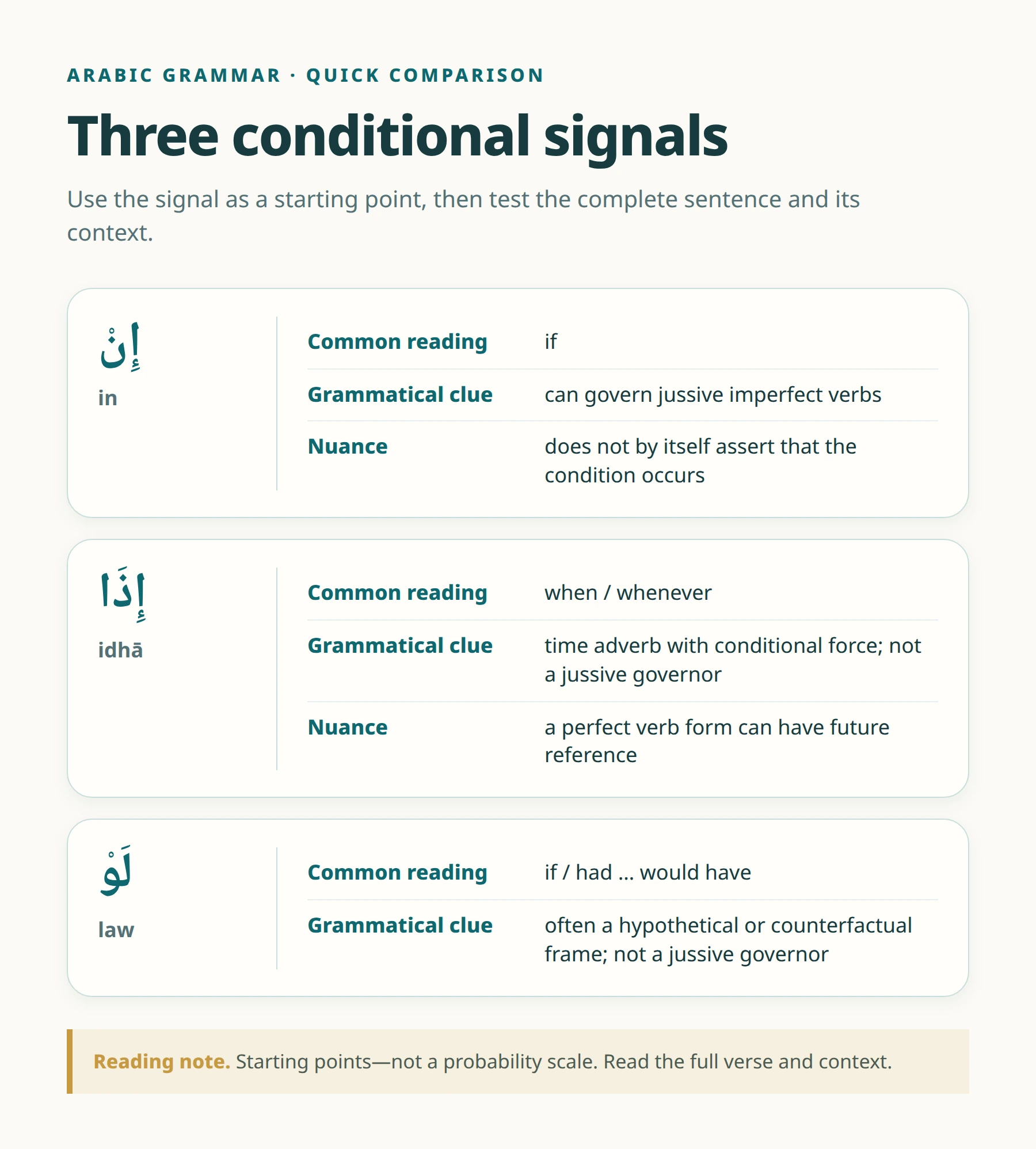
إِنْ (in) is a conditional particle often translated “if.” It introduces a condition without, by itself, asserting that the event has happened or will happen. That is a useful grammatical observation, not a universal rule about theological probability. The full verse, context, and tafsir remain important.
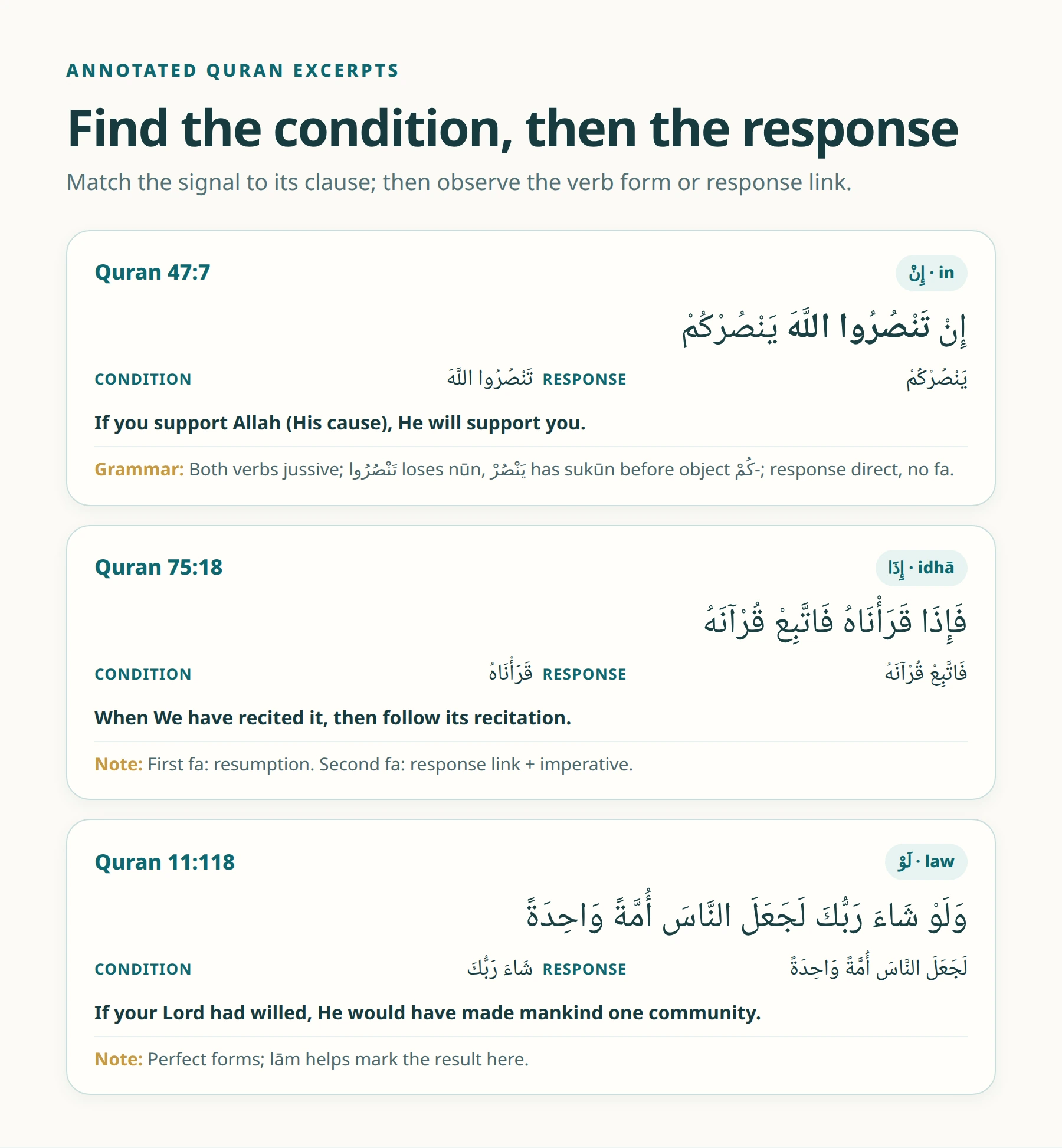
Consider the excerpt from Quran 47:7:
إِنْ تَنْصُرُوا اللَّهَ يَنْصُرْكُمْ
Read structurally: in introduces the condition, tanṣurū Allāha is “you support Allah” (that is, support His cause), and yanṣurkum is the response, “He will support you.” The second-person plural subject is built into tanṣurū; the ending shows a form whose final nūn has been deleted in the jussive. In yanṣurkum, the subject is third-person masculine singular and -kum is the attached object pronoun “you.” The Quranic Arabic Corpus analysis of 47:7 identifies the particle and the jussive mood classifications.
With in, an imperfect verb in the condition or response can show jussive marking. Depending on the verb, notice a final sukūn or deletion of a nūn. First notice the relationship, then use the ending as supporting evidence. Here, the response begins directly without a prefixed fa.
إذا: “when” or “whenever” in an unfolding situation
إِذَا (idhā) is commonly rendered “when,” “whenever,” or sometimes “if.” It often points to an event or time at which something occurs, frequently with a future-oriented sense even when the Arabic verb has a perfect-looking form. Many grammarians analyze idhā primarily as a time adverb with conditional force, rather than placing it in exactly the same word class as in. That distinction matters: do not expect every conditional marker to behave identically.
Quran 75:18 offers a compact example:
فَإِذَا قَرَأْنَاهُ فَاتَّبِعْ قُرْآنَهُ
A natural structural gloss is “So when We have recited it, then follow its recitation.” The first fa is a resumption in the flow of the passage. Idhā qaraʾnāhu supplies the time-condition, and the second fa links the response, the imperative fattabiʿ. This example shows why punctuation-like assumptions can mislead: the two fas do not automatically have identical jobs, and an imperative response is introduced here with fa.
Do not turn this into a rigid formula. Idhā is not a jussive governor, and its verb is not automatically “past” in English simply because the form resembles a perfect. Read the event as a whole.
لو: a hypothetical or counterfactual frame
لَوْ (law) frequently introduces a hypothetical or counterfactual condition. English often uses “if,” but “if only,” “had,” or “would have” may communicate the relationship more naturally. First note what is being supposed, then consider how to express the result. The context determines whether the sentence is imagined, contrary to fact, or simply framed as a supposition.
In the excerpt from Quran 11:118, observe the two linked clauses:
وَلَوْ شَاءَ رَبُّكَ لَجَعَلَ النَّاسَ أُمَّةً وَاحِدَةً
The structure is law shāʾa rabbuka, “if your Lord had willed,” followed by la-jaʿala al-nāsa ummatan wāḥidah, “He would have made mankind one community.” Both verbs are perfect forms in Arabic morphology, yet the English sense is a hypothetical past condition and result. The lām attached to jaʿala helps mark the result in this construction; it is not a reason to label every lām in the Quran an instruction. Nor should law be treated as a jussive governor merely because it introduces a condition.
Why English “if” and “when” are not word-for-word keys
English and Arabic organize time, possibility, and discourse differently. English may use present forms after “if” for a future possibility, while Arabic may use an imperfect or a perfect-looking form according to the construction. English “when” can suggest a firmly expected event, but Arabic idhā still requires attention to context. English “if” can also cover hypothetical meanings that Arabic expresses with law. Translation choices are therefore clues, not a substitute for identifying the Arabic particle and the two clauses.
Keep grammar separate from interpretation. A particle shows how a clause is framed; it does not by itself settle why a verse uses that frame. Recitation, syntax, context, and tafsir work together. For another particle-focused comparison, see Arabic negation in Quranic reading.
Finding the response: fa, direct continuation, and boundaries
Once you spot a conditional particle, scan forward for the statement that completes the thought. Sometimes the response follows directly, as in Quran 47:7. Sometimes a prefixed fa makes the link especially visible, as in the imperative response in Quran 75:18. These examples are enough to establish a practical reading habit, but not a blanket rule that fa is always required or always optional. Do not label every fa as a simple conjunction; its role depends on its location and the syntax.
Clause boundaries can also be obscured by attached pronouns, subjects placed after verbs, or a phrase that belongs to the condition rather than the response. A short pause while reading aloud can help, but a pause is not itself proof of grammar. Compare the Arabic with a reliable translation, then return to the words and ask what each pronoun refers to. Familiarity with Quranic Arabic conjunctions can sharpen this step without reducing every connector to one English equivalent.
A practical five-step reading routine
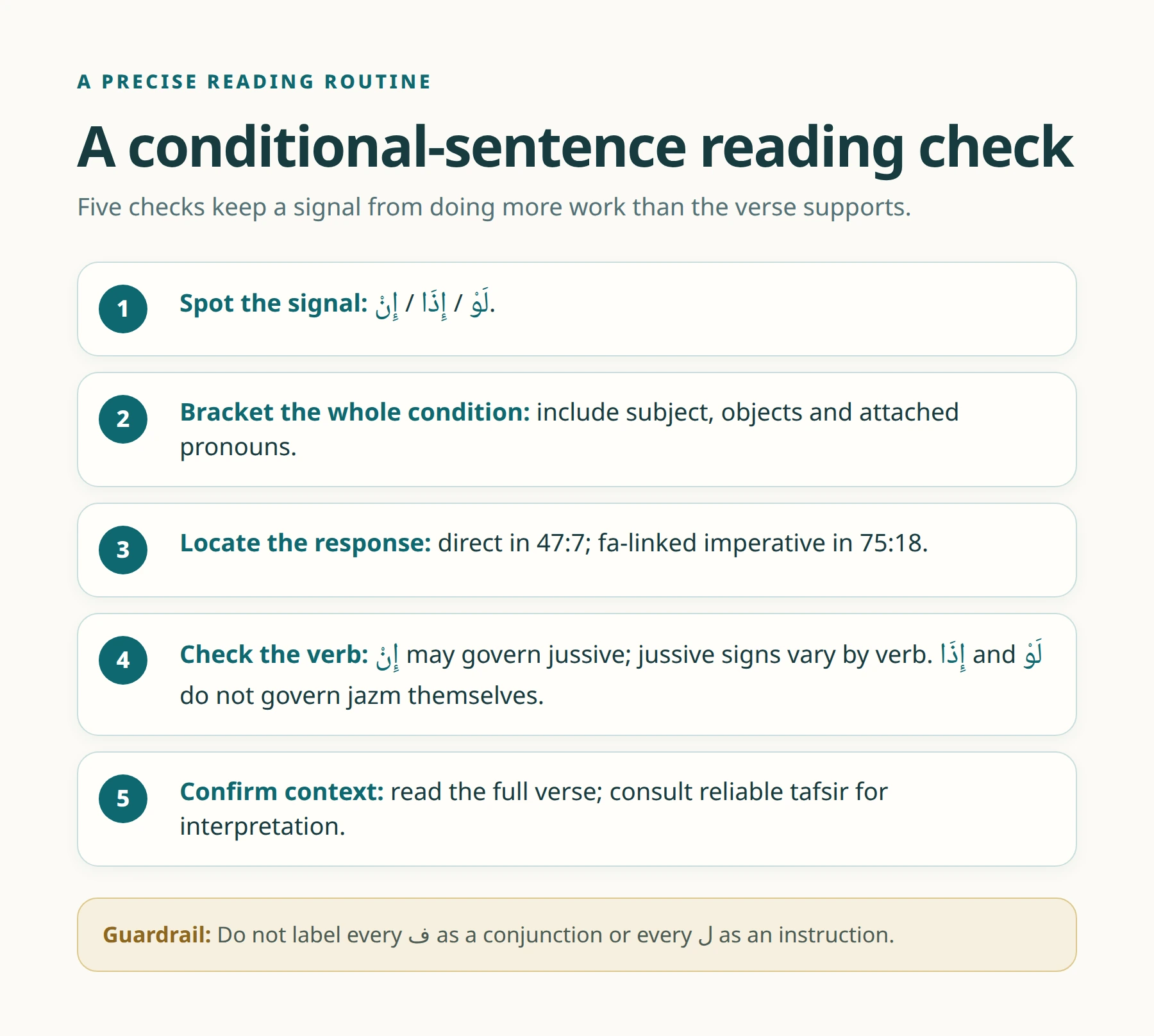
- Circle the signal. Look for إِنْ, إِذَا, or لَوْ, while remembering that context can introduce other conditional structures.
- Bracket the condition. Mark the words that describe the proposed situation, including its subject and objects.
- Locate the response. Look for a direct continuation or a response introduced with fa; do not assume the first verb after the particle is the whole clause.
- Inspect the verb gently. With in, look for possible jussive clues such as sukūn or deleted nūn. With idhā and law, do not force the same analysis.
- Read the full verse. Test your paraphrase against the surrounding words and, when interpretation matters, consult tafsir rather than relying on a particle alone.
Write a two-line gloss—“condition: … / response: …”—then reread without the labels. If roots and patterns slow your verb recognition, an introduction to Quranic Arabic roots and patterns may help.
Bonus lesson and next steps
The supporting slide-only lesson, “Bonus Quranic Arabic Lesson 36: Conditional Sentences (If/Then),” is a beginner overview. It can reinforce the basic vocabulary and sequence, but it complements rather than replaces verse-by-verse reading, grammatical checking, and context-sensitive tafsir. Use it as a short review after trying the routine above.
If you are unsure whether verb forms or clause boundaries are slowing you down, you can book a free trial class to identify a suitable starting point. For related sentence structure, you can also revisit Arabic nominal sentences in Quranic reading and compare how a verbal condition differs from a nominal statement.
Frequently asked questions
Does in always mean an uncertain event?
No. It introduces a condition without asserting realization on its own. Avoid turning that observation into a universal claim about probability or belief.
Does every conditional response begin with fa?
No. Quran 47:7 gives a direct response, while Quran 75:18 shows an imperative response linked with fa. Syntax and context decide the analysis.
Are all three particles jussive?
No. In can govern jussive imperfect verbs. Idhā and law are not jussive governors in themselves, so examine their constructions rather than applying one ending rule to all three.
What is the safest first translation?
Make a structural gloss first—“condition / response”—and then choose “if,” “when,” or “had” in light of the entire verse. That method keeps the Arabic visible while allowing natural English.