
When you read an Arabic imperfect verb in the Quran, its ending can tell you more than its English translation does. A verb may be in the default indicative mood, the subjunctive mood, or the jussive mood. The practical skill is not memorising three labels; it is recognising the governor before the verb, then checking which ending that verb type permits.
This guide treats Arabic jussive and subjunctive moods as a Quran-reading decision. It is about imperfect verbs, not a general noun-case lesson. Use it to distinguish marfūʿ (indicative), manṣūb (subjunctive), and majzūm (jussive) while keeping pronunciation, context, and teacher feedback in view.
Arabic jussive and subjunctive moods at a glance
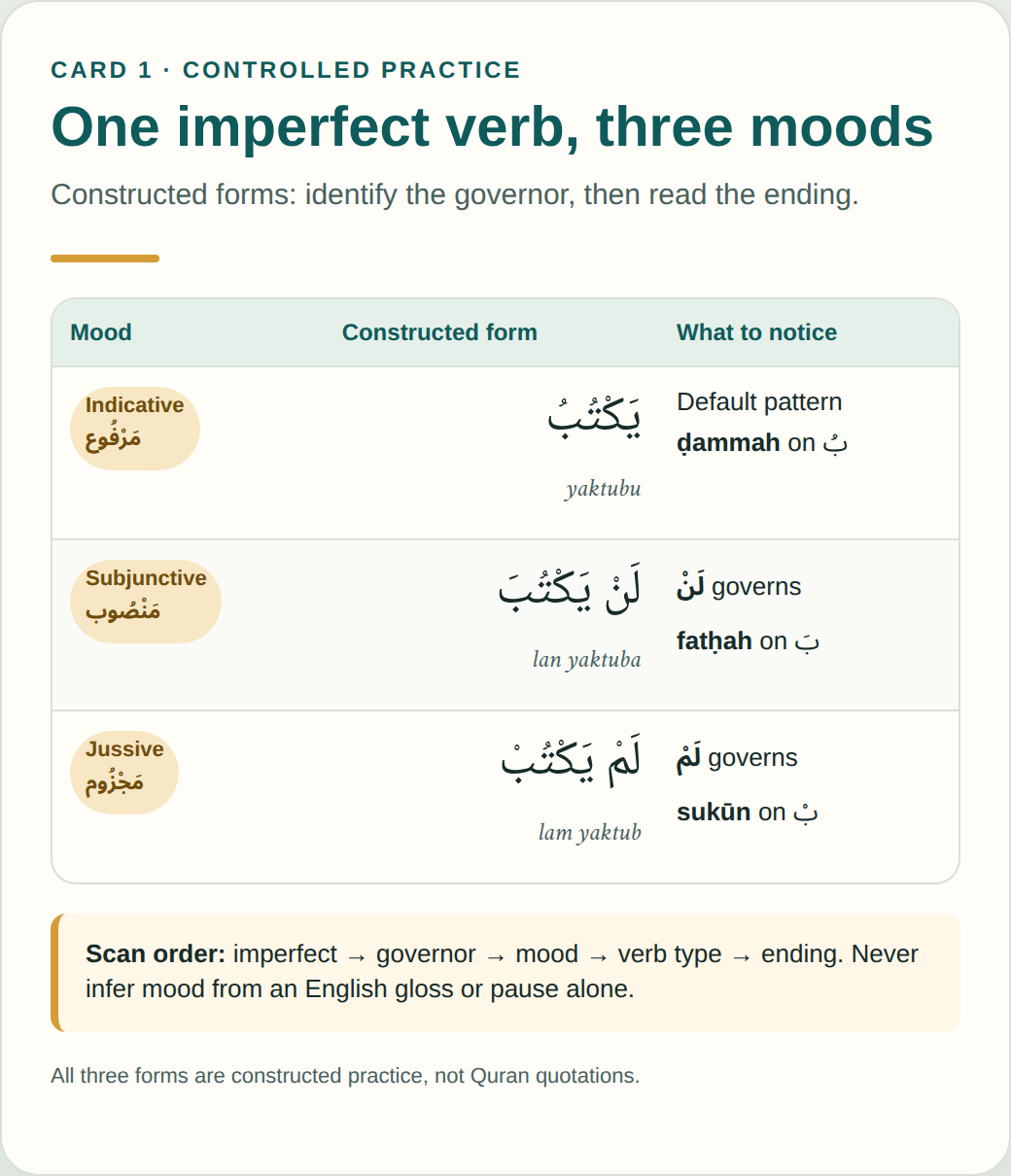
An ungoverned imperfect is normally indicative: يَكْتُبُ yaktubu, “he writes” or “he is writing.” A preceding particle can govern that same imperfect and change its mood. The subjunctive is called manṣūb; the jussive is called majzūm. These are grammatical descriptions of a verb’s position, not three English tenses.
For the core decision, ask in order: What is the imperfect verb? What word governs it? Which mood does that governor select? What ending does this verb form show? Only then translate. The Quranic Arabic Corpus overview of the subjunctive and jussive moods explains the terminology and the governing-particle system.
Indicative: the default pattern
In the controlled form يَكْتُبُ, the final ḍammah marks the ordinary indicative pattern for a sound singular masculine form. Do not assume that every imperfect you meet will visibly end in a ḍammah: five verbs, feminine-plural forms, and weak-final verbs behave differently. “Default” means no relevant governor has changed the mood, not that every ending looks identical.
Subjunctive: after lan, an, and related governors
لَنْ lan governs a following imperfect in the subjunctive: لَنْ يَكْتُبَ, “he will not write,” in our constructed practice. The final ḍammah becomes fatḥah in this sound singular example. The particle أَنْ an also commonly makes an imperfect subjunctive, often in a phrase such as “to write.” Purpose and causal constructions can require more context; do not label a form from a familiar English translation alone.
Subjunctive does not mean “negative.” Lan is negative and subjunctive, but an can be non-negative. Similarly, a purpose lām may lead to a subjunctive imperfect, while a different lām has a different grammatical job. Identify the governor first.
Jussive: after lam, prohibitive lā, and condition
لَمْ lam governs a jussive imperfect, commonly giving a past-oriented negative meaning in English: لَمْ يَكْتُبْ, “he did not write,” in the constructed set. The final ḍammah is replaced by sukūn here. A prohibitive لَا can also govern a jussive, but not every lā is prohibitive or jussive. Negative/declarative lā may simply negate without selecting this mood.
Conditional إِنْ in can govern the imperfect in both the condition clause and its response. Yet conditional sentences have their own boundaries and exceptions, so use the fuller explanation in this Quranic Arabic conditional-sentence guide rather than treating every “if” translation as identical.
How the ending changes by verb type
Once the governor is known, classify the verb form. For a regular sound singular form, the quick pattern is indicative ḍammah, subjunctive fatḥah, and jussive sukūn. This is a useful starting model, not a universal chart.
In the five verbs, the indicative ending includes a final nūn, while both subjunctive and jussive forms drop that nūn. The “five” refers to five inflected form patterns, not merely five dictionary verbs. Because both moods can remove the nūn, the governor disambiguates them. A reader who sees nūn deletion must still ask whether lan, an, lam, a prohibitive lā, or a conditional trigger caused it.
Compare these constructed plural forms: يَكْتُبُونَ, لَنْ يَكْتُبُوا, and لَمْ يَكْتُبُوا. The first retains its indicative nūn. The second and third share the same written verb ending, but their governors select different moods. Cover the particles, notice what the ending cannot tell you alone, then uncover them to complete the analysis.
Do not confuse this with يَنْصُرْكُمْ in the phrase below. The verb stem’s final rāʾ carries sukūn; this is jussive sukūn, not nūn deletion. Its nūn belongs to the root ن ص ر, not a removable five-verb ending.
Feminine-plural forms retain their nūn. The constructed form يَكْتُبْنَ stays written the same after لَمْ or لَنْ; the verb is still in the relevant mood position, but its feminine-plural form is built and invariable for this purpose. Keep the final nūn: do not apply the five-verb rule to it.
Weak-final verbs need a separate check. In the constructed example يَدْعُو → لَمْ يَدْعُ, the final wāw is removed and the remaining final ḍammah is retained in writing. This does not mean every weak or geminate verb follows one identical recipe. If the form is unfamiliar, consult a teacher and the surrounding construction. The earlier beginner’s Arabic verb-conjugation guide is useful for the person, number, and gender layer that comes before mood.
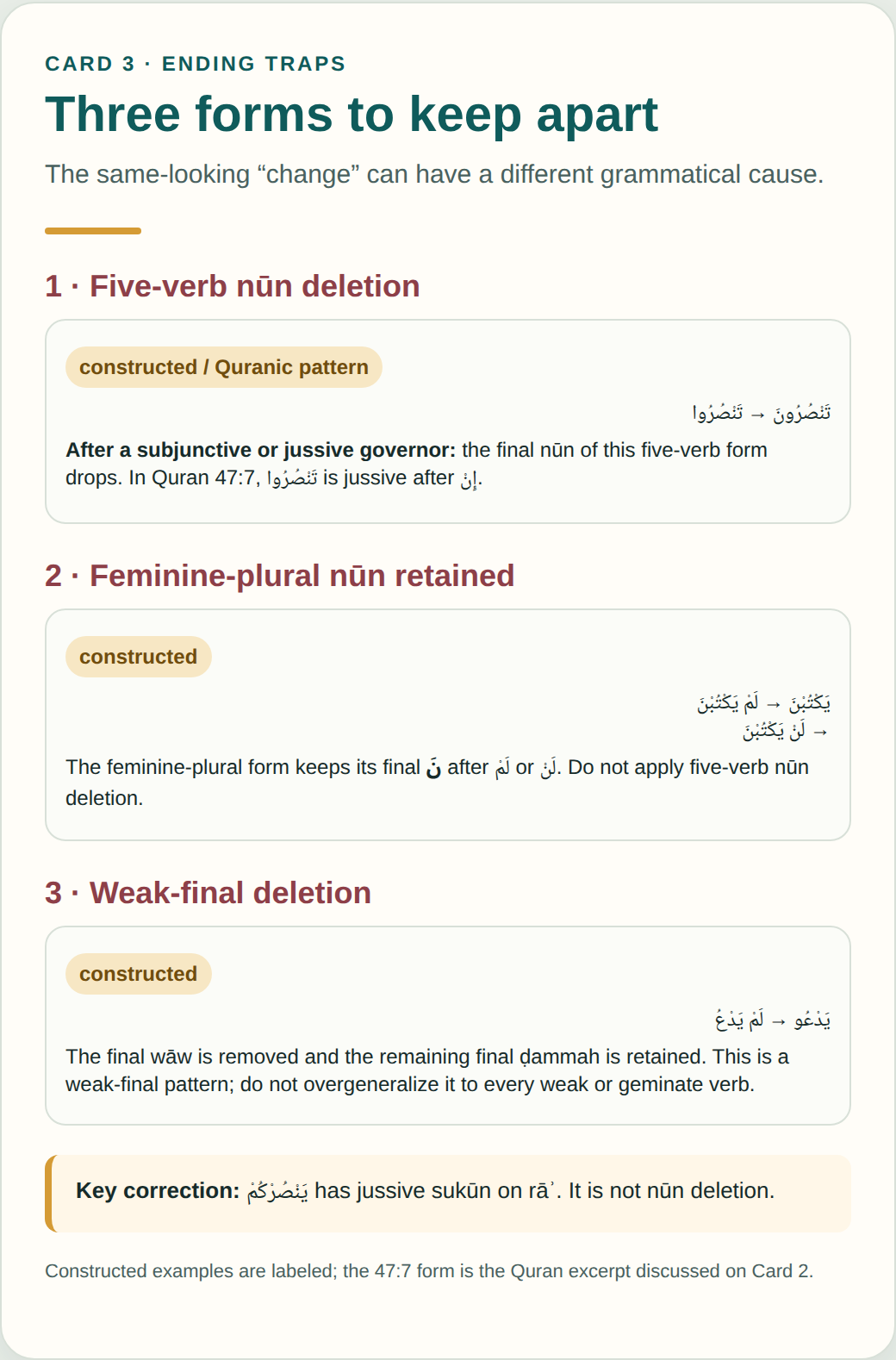
A useful habit is to say the verb type aloud before naming its sign: “five verb,” “feminine plural,” or “weak final.” That small pause prevents a memorised ending rule from being applied to the wrong form.
Three Quranic walkthroughs
1. لَمْ يَلِدْ — jussive sukūn
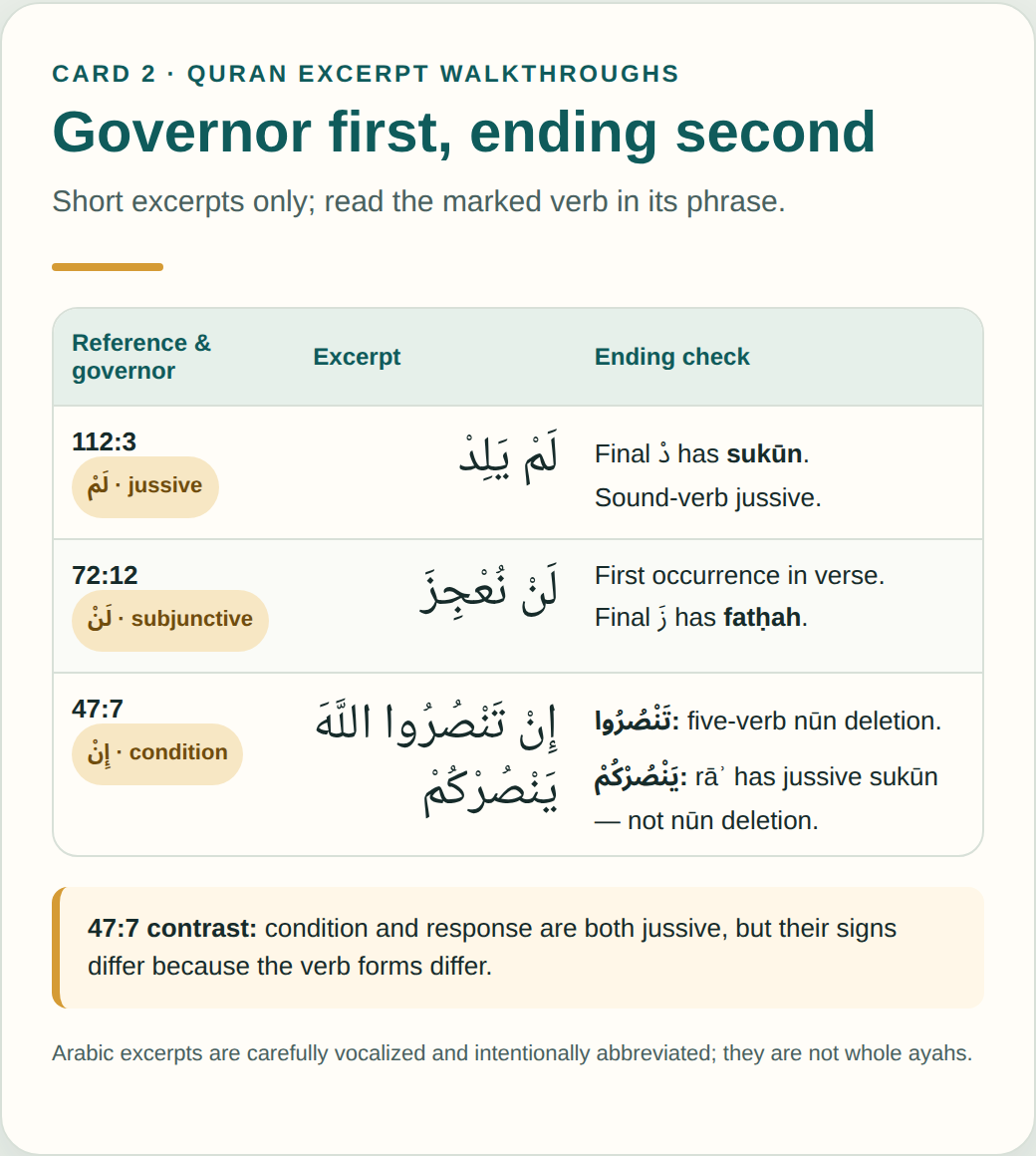
In the excerpt from Quran 112:3, لَمْ is the governor and يَلِدْ is the imperfect verb. The final dāl has sukūn: this is the jussive sign on a sound final consonant, even though the verb’s root begins with a weak letter. The short excerpt is enough to practise the scan; do not infer the mood merely from the English “did not.”
2. لَنْ نُعْجِزَ — subjunctive fatḥah
In Quran 72:12, the first occurrence in the verse is لَنْ نُعْجِزَ. Here لَنْ governs نُعْجِزَ, so the verb is subjunctive. Its final zāy has fatḥah. The phrase illustrates why the mood is not simply “the negative form”: the particle’s grammatical effect and the verb’s final sign are separate observations.
3. إِنْ تَنْصُرُوا اللَّهَ يَنْصُرْكُمْ — two jussive verbs, two signs
In Quran 47:7, إِنْ introduces the condition تَنْصُرُوا اللَّهَ, and the response is يَنْصُرْكُمْ. Both imperfects are jussive, but they show different signs. تَنْصُرُوا is a five-verb form and drops its final nūn in the jussive. يَنْصُرْكُمْ is not a five-verb nūn-deletion case: its rāʾ bears sukūn. This contrast is the central correction to remember.
A repeatable reading routine
First, circle the imperfect verb. Second, look before it in Arabic reading order and scan the larger phrase for a governor such as lam, lan, an, a prohibitive lā, or in. Third, name the mood: indicative, majzūm or manṣūb. Fourth, identify the verb type: sound-final, five-verb, feminine plural, or weak-final. Fifth, check the ending and then read the phrase aloud. This routine keeps you from using pause pronunciation or an English gloss as proof.
For related study, compare this method with the article on Arabic negation in Quranic reading, which treats lā, lam, and lan as a family of particles. Review Quranic Arabic conjunctions when a wāw or fa connects verbs, but do not assume a conjunction itself automatically supplies the mood. Likewise, Arabic case endings can clarify the difference between noun case and verb mood; manṣūb and majzūm here describe imperfect verbs, not a lesson that every noun must be analysed the same way.
Pronouns and attached objects can make a phrase look busier without changing the governor. The Arabic pronouns chart can help you separate the verb ending from a following object pronoun such as كُمْ.
Self-check
Classify the bold verb in each constructed item: (1) هُوَ يَفْهَمُ; (2) لَنْ يَفْهَمَ; (3) لَمْ يَفْهَمْ; (4) إِنْ تَفْهَمُوا. Answer key: (1) indicative, no governor; (2) subjunctive after lan; (3) jussive after lam; (4) jussive five-verb form after conditional in, with nūn deletion.
One listening exercise
The text-led lesson below demonstrates jussive patterns. Use it to practise recognising governors and endings, then return to the full Quranic phrase.
Play the lesson once without looking at an English translation. Pause playback after each imperfect verb and write three things: the governor, the mood, and the ending sign or form change. Replay the phrase and distinguish connected reading from a paused demonstration, where a final vowel may not be audible. Then check the Arabic script. If your first answer and the script disagree, trust neither guess nor pause alone; ask an experienced teacher about the construction.
Advanced Quranic Arabic includes governed phrases whose interpretation depends on syntax, ellipsis, or recitation context. The routine here is a safe first pass, not a substitute for a full grammar course. If you want guided practice, you can book a free Quran and Arabic trial class and bring one short passage to read with a teacher.