
If you want to learn Arabic in 2027, start by deciding what you want to do with the language. A plan for everyday conversation is different from a plan for reading formal news, studying Quranic Arabic, or writing for work. Once you choose a main goal, build a repeatable routine that includes listening, speaking, reading, writing, and review in a proportion that fits your needs.
This guide offers a practical path for beginners and returning learners. It does not promise fluency in a year. Arabic progress depends on your starting point, practice time, language variety, feedback, and the kind of Arabic you want to use. Treat 2027 as a year to build clear habits and useful skills, then measure progress by the tasks you can actually complete.
Choose the Arabic you want to use
“Arabic” is not a single study plan. Learners may focus on Modern Standard Arabic (MSA), a regional spoken variety, Quranic or Classical Arabic, or a combination. These paths overlap, but they have different goals and learning materials. Choosing a primary track helps you avoid collecting resources that do not prepare you for the situations you care about.
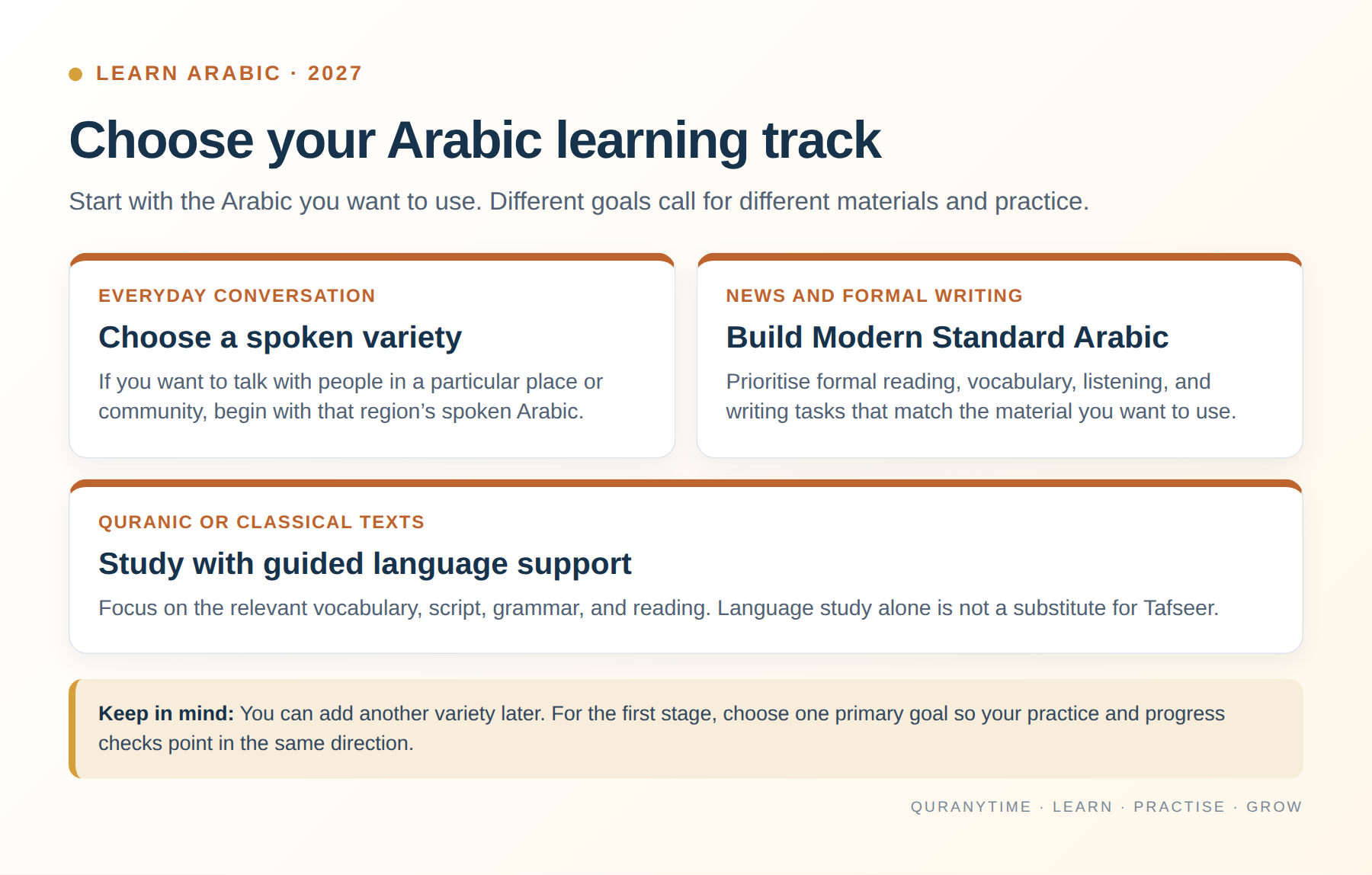
For conversations in a particular place, choose the spoken variety used by the people you hope to talk with. Prioritise listening, useful phrases, pronunciation, and short exchanges. Spoken Arabic differs across regions, so ask teachers or conversation partners about the variety they use rather than assuming every speaker uses the same expressions.
For formal reading or media, MSA may be a useful foundation. Choose materials that match the type of text you want to read—news, articles, announcements, or contemporary books—and include listening and writing if those are part of your goal.
For Quranic or Classical texts, the focus may include reading foundations, recurring vocabulary, grammar, and guided work with selected passages. Language study can support understanding, but knowing a word or a grammar rule does not by itself settle every question about a verse. For a closer comparison of text-focused tracks, see Quranytime’s guide to Quranic Arabic and Modern Standard Arabic.
You do not need to choose every future goal now. Pick one main track for your first stage and note a secondary interest for later. If you are unsure whether to focus on conversation, formal reading, or Quranic Arabic, discuss your goal during the free Quran and Arabic assessment.
Set a goal you can check
“Become fluent” is too broad to guide this week’s practice. Replace it with a task. For example: introduce yourself and ask a few questions in the variety you are learning; read a short, level-appropriate text and explain its main point; or follow a brief audio clip and identify its key phrases.
The Council of Europe’s CEFR level descriptions use “can-do” descriptors across six proficiency levels, from A1 to C2. These descriptors can help you write a clearer goal, but they are not a promise that every Arabic course or dialect maps neatly to a single level. Use them as one orientation tool, alongside a teacher’s feedback and your own practical tasks.
Write down your goal in one sentence. Then choose one weekly action that resembles it. If your goal is conversation, schedule a short speaking practice. If your goal is reading, read a manageable text in Arabic script. If your goal is understanding Quranic language, work with the relevant vocabulary and grammar in context with appropriate guidance. The closer your practice is to the task you want to do, the easier it is to see whether your routine is helping.
Build a four-skill routine
A balanced Arabic plan gives each relevant skill a place. A learner who wants to speak needs listening and spoken practice, not only grammar notes. A learner who wants to read needs repeated contact with Arabic script, vocabulary, and sentence patterns. You can begin with short sessions and add time once the habit feels realistic.
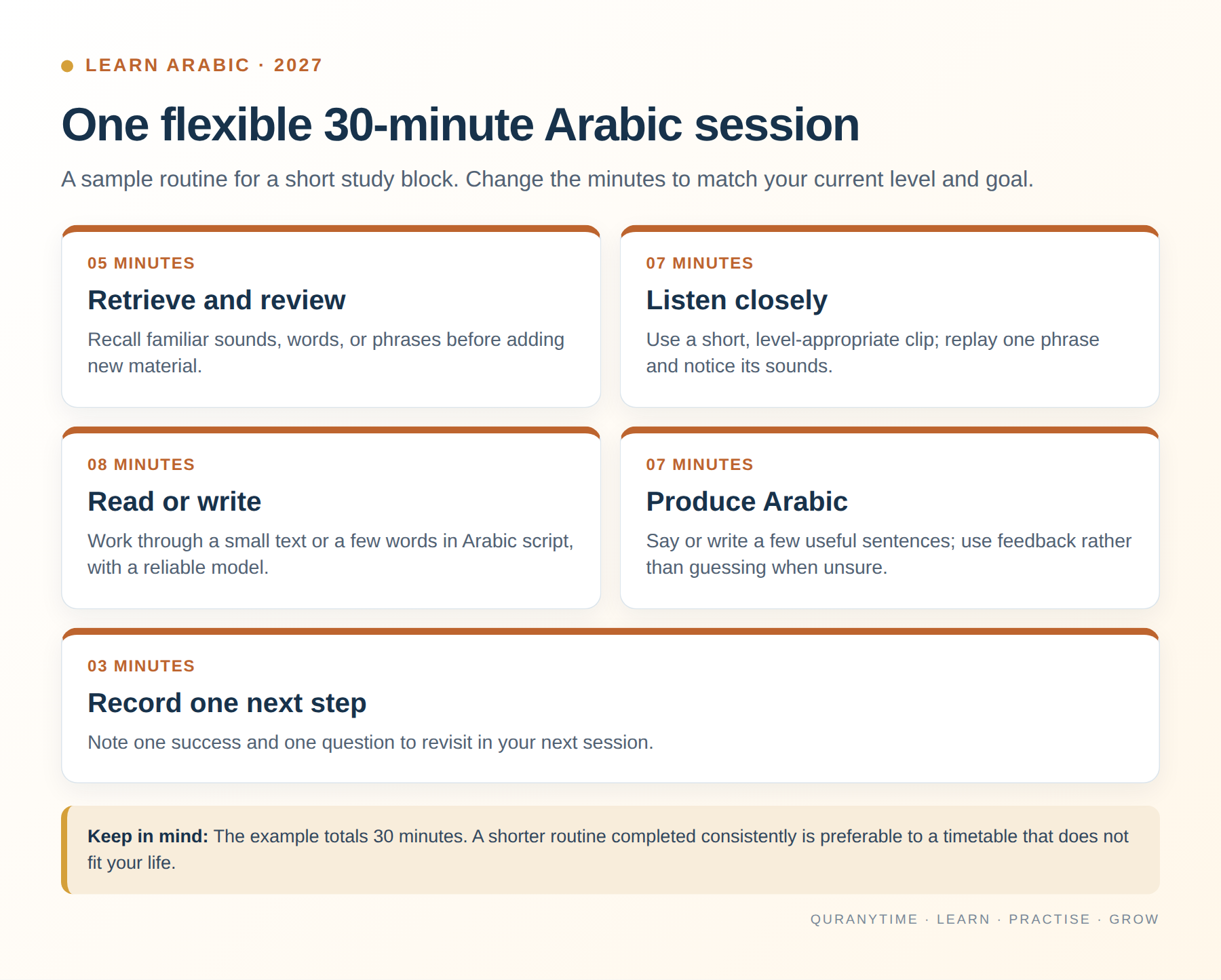
Here is one possible 30-minute study session: five minutes to recall familiar sounds or words; seven minutes of focused listening; eight minutes of reading or writing; seven minutes of speaking or producing Arabic; and three minutes to record one success and one question. This is an example, not a required formula. If you are learning the alphabet, you may spend more time on script and pronunciation. If you already read comfortably, you may shift minutes toward listening and output.
Reading: build comfort with the script
If Arabic script is new, learn how letters look in connected words, how short vowels are represented in your materials, and how sounds differ. Avoid treating letter names as the whole reading skill. Practise simple words and short, accurately modelled phrases so you can connect what you see with what you hear.
Quranytime’s Arabic alphabet guide walks through the letters, while its article on how long it can take to learn the Arabic alphabet can help set expectations. Time varies: recognising letters is only one part of reading with confidence. Use familiar materials consistently, and ask for help when a sound or connection is unclear.
Listening: use short, understandable material
Choose audio that is close to your level and goal. Listen once for the general idea, then replay a short section to notice a phrase, sound, or word. If the audio is much too difficult, repeated listening may feel like noise rather than useful practice. A transcript or teacher explanation can help, but try listening before reading the full text so you practise hearing Arabic as well as decoding it visually.
Keep the same source long enough to recognise its voice and style. For a conversation goal, seek recordings in the variety you are studying. For formal reading, use clear MSA audio that matches your materials. For Quranic or Classical Arabic, rely on suitable recitation and guided study rather than treating a general conversation clip as a model for Quranic pronunciation.
Speaking: make a small output task part of the week
Speaking can feel uncomfortable when you are still learning, but waiting until you “know enough” can delay practice indefinitely. Start with phrases you can check: introduce yourself, describe a routine, ask a simple question, or retell one idea from a short lesson. Record yourself if you do not yet have a partner, then compare your attempt with a reliable model or teacher feedback.
Do not let transliteration become the only way you read. It can be a temporary bridge for some learners, but Arabic script should stay part of your practice if reading matters to your goal. Ask a teacher to correct one or two priorities at a time instead of trying to fix every sound in a single conversation.
Writing: turn words into usable sentences
Writing a few lines can reveal gaps that passive review hides. Copy a useful phrase, change one word to make a new sentence, or write a short summary using grammar you have studied. Check the result with a teacher or dependable reference. For reading and writing, Quranytime’s Arabic reading guide can provide structured practice with foundational script and sounds.
Use 2027 as a sequence of learning stages
A yearlong plan can give you a useful review rhythm without promising a fixed level by December. Each quarter should build on what you can already do, and you can repeat a stage if it needs more time.
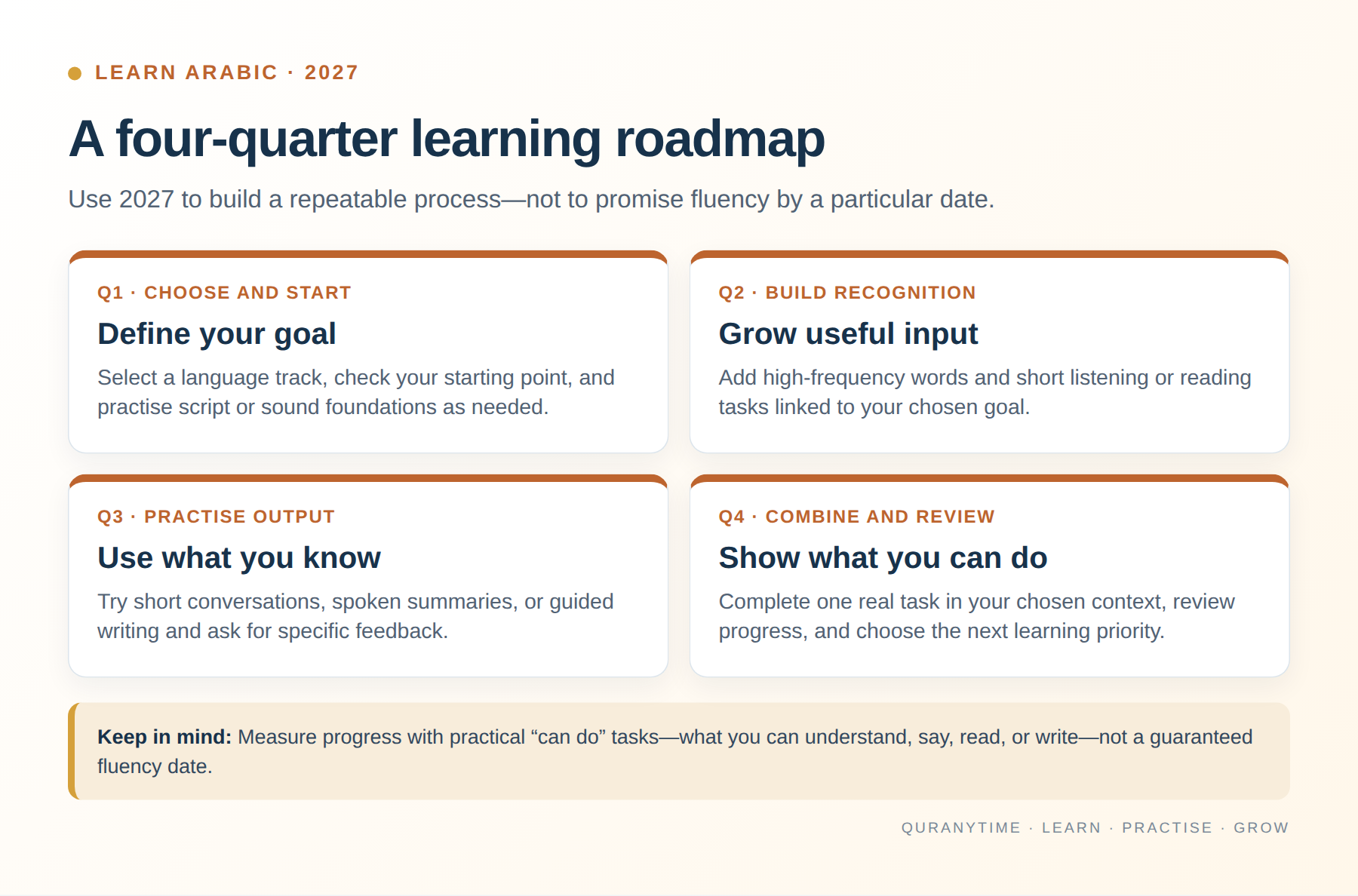
Quarter 1: choose a track and establish the foundation. Write a specific goal, identify your starting point, and choose materials for the variety or text type you plan to study. Beginners may need to prioritise script, pronunciation, and basic reading; returning learners may need a short review of familiar material before adding new grammar or vocabulary.
Quarter 2: build recognition. Add useful vocabulary and short listening or reading. Review familiar items, and note phrases or questions worth revisiting.
Quarter 3: practise output. Add weekly speaking or writing, such as a short exchange or paragraph summary. Quranic Arabic learners should study selected passages with guidance.
Quarter 4: combine skills and review. Complete a practical task in your chosen track, compare it with your starting point, and choose the next priority.
Keep vocabulary and grammar connected to meaning
New words are easier to use when you meet them in phrases and situations, not only on a list. Record a word with a model sentence or a short audio reference. Review it by trying to recall its meaning or use before checking your notes. Grouping words by topic or pattern can help, but a shared root or translation does not guarantee that related forms mean exactly the same thing in every context.
Grammar is useful when it explains examples you have already seen. Learn a manageable point—such as a common pronoun, sentence pattern, or verb form—then notice it in a short text. Avoid spending every session memorising terminology without reading, listening, or producing Arabic. If your aim is language connected to Quran study, Quranytime’s Quranic Arabic learning path describes guided vocabulary, grammar, and reading support; that track is distinct from a complete spoken-dialect course.
How often should you study?
Choose a weekly rhythm you can protect. A few short sessions may be more realistic than a long daily block; use extra time for lighter listening or phrase review.
Each week, note what you completed and what feels easier. Monthly, adjust one thing: move a missed session, choose easier listening, or add a short speaking task with feedback.
To compare structured options, see Quranytime’s online Arabic classes. Ask which variety the course teaches, what practice it includes, and how progress is checked; look beyond claims of fast fluency.
Common mistakes that slow down a study routine
Switching tracks too often. Keep one main goal long enough to notice progress; add other varieties later.
Collecting resources without finishing lessons. Choose a small set of materials and use them consistently before adding more.
Studying grammar without hearing Arabic. Add short, level-appropriate audio so you notice how words sound and connect.
Practising only comfortable skills. Keep your strengths, but add manageable work in the skill that serves your goal.
Expecting a universal fluency date. Timelines vary; track practical tasks and ask a teacher to help interpret progress.
Frequently asked questions
Can I learn Arabic in 2027 as a complete beginner?
Yes. Start with a clear goal and materials that match it. You may need to build script and pronunciation foundations before longer reading or speaking tasks. A teacher can help you choose a suitable starting point.
Should I learn MSA or a dialect first?
Choose based on where and how you want to use Arabic. MSA can support formal reading and writing; a regional spoken variety may be more directly useful for everyday conversation in that community. Quranic or Classical Arabic has its own study aims. You can add another track later.
How many minutes a day should I study Arabic?
There is no single daily number that suits everyone. Begin with a realistic weekly routine and include active practice, listening, review, and feedback as relevant. Consistency and fit matter more than copying an ambitious schedule.
Can an online teacher help me make progress?
A teacher can correct reading or pronunciation, explain grammar, guide conversation practice, and help choose next steps. Ask how the lessons will match your goal and what you should practise between sessions.
Your next step
To learn Arabic in 2027, choose one main goal, decide which Arabic track fits it, and schedule a small weekly routine that touches the skills you need. Review progress using real tasks—what you can understand, say, read, and write—then adjust the plan without expecting a guaranteed level by a fixed date. If you want help identifying a starting point, bring your current experience and goal to an assessment conversation.