
A receipt is a small reading puzzle: the Arabic labels may be unfamiliar, the digits may look different, and several amounts compete for your attention. Yet you do not need to translate every line to understand what you bought and how the total was calculated. This workshop teaches a repeatable way to read an Arabic shopping receipt using a fictional example, an arithmetic check, and short exercises with answers.
The language here is Modern Standard Arabic, the variety commonly used for printed labels. Real receipts vary by country, retailer and software. Prices, tax treatment and return conditions in the examples are invented for language practice; they describe no actual shop or policy. Keep your own personal details out of classroom photographs of receipts.
Start with the question you need to answer
Before reading, decide what you are looking for. “How much did I pay?” calls for the final amount. “Was I charged for two notebooks?” calls for an item line and its quantity. “How much change should I receive?” calls for the amount paid and the change. Different questions require different parts of the page.
This is a better starting point than reading mechanically from the top. A logo, branch address and transaction code may occupy the first third of a receipt without helping you check the purchase. Scan for an anchor word, read the associated number, and then check enough surrounding text to identify what that number represents.
If the digit shapes themselves slow you down, review Arabic numbers 1–100 separately. During this task, keep the language goal narrow: locate, interpret and verify an amount. You can practise saying longer prices after you understand the written information.
Your first receipt vocabulary map
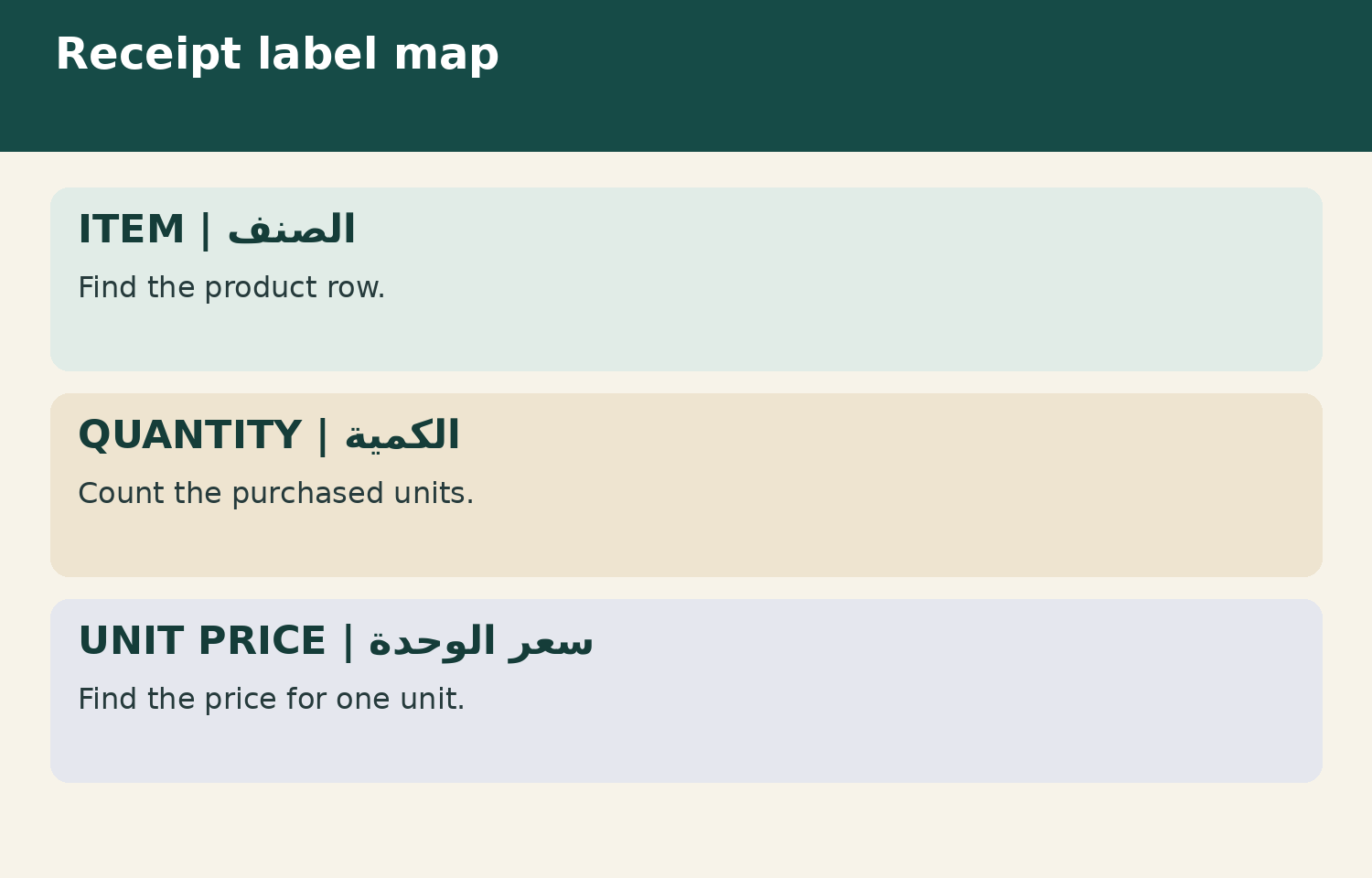
These labels are useful starting points, although a shop may use a synonym or abbreviation:
| Arabic label | Meaning in this task | What to look beside it |
|---|---|---|
| إيصال | receipt | the document heading |
| الصنف | item | a product name or code |
| الكمية | quantity | how many units were bought |
| سعر الوحدة | unit price | the price of one unit |
| المجموع الفرعي | subtotal | an amount before later adjustments |
| الخصم | discount | an amount removed or a stated percentage |
| الإجمالي | total | the overall amount, with context checked |
| المدفوع | amount paid | money received from the customer |
| الباقي | change or remaining amount | the surrounding payment labels |
Notice the last entry. A dictionary meaning alone does not settle every label. الباقي can describe what remains; on a cash-payment receipt, it may label the change. Read it alongside المدفوع and الإجمالي before deciding. This habit of using neighboring words is more reliable than memorizing one English translation as universally correct.
The noun الكمية means quantity. Do not confuse it with the item’s name or its price merely because the number sits close to both. Table headings, repeated spacing and line alignment provide evidence. If a printed receipt is narrow and wraps across lines, follow one complete item entry before moving to the next.
Read a fictional receipt from labels to calculations
Imagine a small stationery purchase. This teaching example deliberately uses a clean table rather than copying a real retailer’s receipt.
| الصنف — item | الكمية — quantity | سعر الوحدة — unit price | المجموع — line total |
|---|---|---|---|
| دفتر — notebook | 2 | 25.00 | 50.00 |
| قلم — pen | 3 | 8.00 | 24.00 |
| ممحاة — eraser | 1 | 6.00 | 6.00 |
المجموع الفرعي: 80.00
الخصم: 5.00
الإجمالي: 75.00
المدفوع: 100.00
الباقي: 25.00
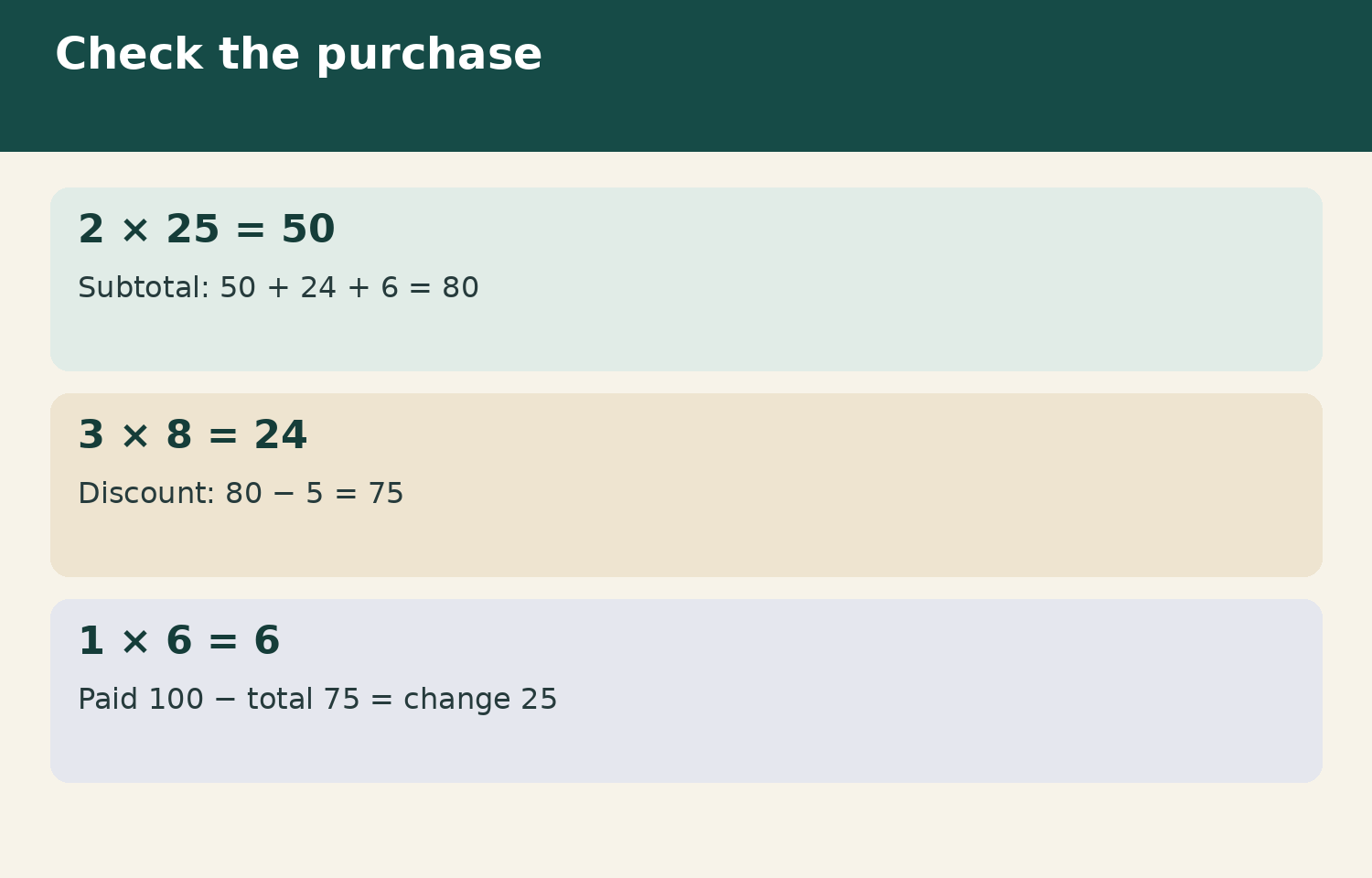
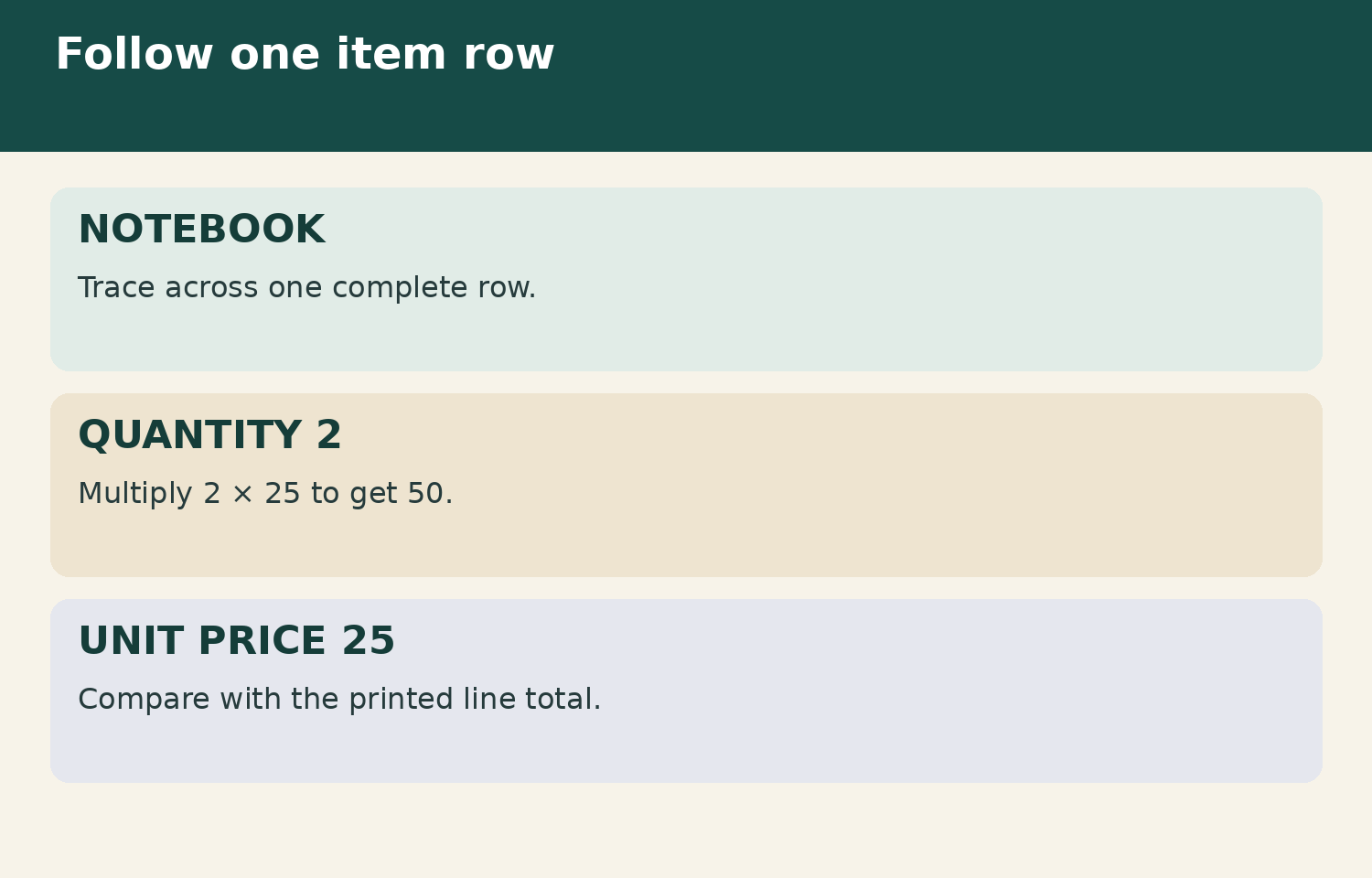
First find دفتر and trace across that row. The quantity is two and the unit price is 25.00. Two multiplied by 25.00 gives the line total, 50.00. Now read the pen line: three multiplied by 8.00 gives 24.00. The eraser contributes 6.00. Together, the three line totals give 80.00.
The discount is a fixed amount of 5.00 in this example, so the payable total becomes 75.00. The customer gives 100.00 and receives 25.00 in change. No currency is specified: the numbers are invented units, and this is not an example of any country’s tax rules. Saying that explicitly prevents a language exercise from appearing to give financial or legal information.
Read the result back in a short sentence: الإجمالي خمسة وسبعون — “The total is seventy-five.” For early practice, it is acceptable to point to the printed amount while saying الإجمالي. Add complete number expressions gradually rather than letting a difficult price phrase hide the fact that you understood the receipt correctly.
Keep numbers in the right order
Arabic text runs from right to left, but the digits within a written number retain their numerical order. The sequence ٢٥ represents twenty-five; do not reverse it into fifty-two because the surrounding words are Arabic. Both 25 and ٢٥ may appear in Arabic-language documents.
A useful conversion strip is 0–9 beside ٠–٩. Read ١٢ as twelve and ٢١ as twenty-one, then compare the first and last digit deliberately. Do not practise by rotating or mirroring the receipt: that changes the shapes rather than teaching the reading convention.
Decimal marks and grouping conventions can vary. The training receipt uses a decimal point and two decimal places consistently. If an unfamiliar real document uses a different separator, inspect repeated prices and the currency context before interpreting it. Do not assume that every dot or comma has the same function in every country.
For a neutral explanation of why Arabic words and numbers can behave differently on a screen, see the Unicode Consortium’s bidirectional-text FAQ. A display problem can occasionally make mixed Arabic and English confusing; compare the original document before treating copied text as proof of an error.
The three checks that catch common misreadings
Check quantity before questioning the price
A line showing 24.00 may be correct if three items cost 8.00 each. Learners sometimes compare the line total with a shelf price for one item and think they have found a discrepancy. Locate الكمية and سعر الوحدة first. The arithmetic should connect all three figures.
Separate the discount from the amount paid
In our example, 5.00 is removed from the subtotal, while 100.00 is handed over. These are different roles. Draw a small minus sign beside the discount during private practice and an incoming arrow beside the amount paid. Remove your marks for the next attempt and see whether the Arabic labels now carry the distinction.
Ask what “total” includes on this document
Some receipts show several intermediate totals. Read adjacent labels and the order of the calculation rather than assuming the largest bold number must answer your question. This exercise contains one fixed discount and no additional charges. A real receipt may contain more components; if you do not understand a label, ask the shop rather than inventing its meaning.
Ask a clear question at the counter
A useful question names the uncertain part. ما معنى هذه الكلمة؟ means “What does this word mean?” It works well when you can point to a label. كم سعر هذا الدفتر؟ means “How much is this notebook?” It asks about an item’s price, whereas هل هذا هو الإجمالي؟ means “Is this the total?” and checks the overall amount.
For a quantity check, say هل هذه الكمية صحيحة؟ — “Is this quantity correct?” You can point to the row and show the actual items. Avoid memorizing a long complaint for a situation you may simply have misread. A neutral question gives the other person enough information to explain.
Use the Arabic question-words guide to distinguish كم, asking “how much/how many,” from ما, asking “what.” Practise each with a visible purpose: one question about the price, one about a word and one confirmation of the total. The purpose should change even if the sentence remains short.
If the answer is too fast, ask من فضلك، أعد ببطء — “Please repeat slowly,” addressing a man. A teacher can model the corresponding form for a woman and the everyday local wording you are likely to hear. Our useful Arabic expressions provide a starting set; do not expect every cashier to answer in textbook MSA.
Exercise: become the receipt checker
Cover the worked explanation and answer these questions from the fictional receipt:
- Which Arabic label identifies the quantity?
- What is the total for the three pens?
- What amount is removed from the subtotal?
- Does 100.00 represent the cost of the purchase?
- How much change is shown?
- If the notebook quantity changed to one, with all other item quantities unchanged, what would the subtotal be before the discount?
Answers: 1. الكمية. 2. 24.00. 3. 5.00. 4. No; it is the amount paid. The purchase total is 75.00. 5. 25.00. 6. 55.00, because 25 + 24 + 6 = 55. Apply the discount only if the revised hypothetical purchase is still meant to receive it; the question asks for the subtotal.
For a second round, replace one product with a food item from food and drinks in Arabic. Keep the same calculation structure. This transfers the reading method to another setting without turning the exercise into a new vocabulary list.
Make a miniature receipt of your own
Write three item rows using invented products and prices. Choose quantities that you can calculate confidently. Give the sheet to a partner and ask them to identify one quantity, one unit price and the final amount. They should explain how they found each answer, not simply announce a number.
Then swap roles. Your partner changes one quantity, and you recalculate the affected line. This tests whether you understand the relationship between labels and values. If you only memorized that “75 is the answer,” the changed receipt exposes the problem immediately.
Typing the labels is also useful. Our Arabic keyboard practice guide helps you enter the words yourself. Put each amount in its own table cell where possible, so mixed-direction text remains readable. Read the finished document visually; a correctly typed number can still sit under the wrong heading.
Turn mistakes into a focused next lesson
Record the type of error, not just a score. “I read the digits backwards” needs digit-order practice. “I understood the item but used the wrong column” needs row tracing. “I found الإجمالي but could not ask about it” needs a short spoken exchange. These are different learning needs and should lead to different exercises.
If the receipt contains a date, use Arabic days, months and dates as a separate reading task after checking the purchase. If you want to write a polite follow-up message, the Arabic email workshop develops that skill. Keeping the tasks separate lets you see what improved.
For personal feedback, Book a Free Trial Class. Bring an invented receipt and explain which part you can read independently. A tutor can check your Arabic labels, help you say the relevant amounts and build a short counter dialogue around the exact point where you get stuck.
A final transfer test: read without the English column
For a more realistic second attempt, copy the teaching receipt and hide every English translation. Keep the Arabic headings, item names and amounts visible. Ask a partner to choose the question after you have hidden the translations, so you cannot prepare only one familiar answer. They might ask for the quantity of pens, the price of one notebook or the amount paid.
Give your answer by naming the relevant label and pointing to the value. Then explain one calculation in English if your spoken Arabic is still limited. This separates document comprehension from your ability to describe multiplication in another language. You can understand a receipt before you can explain every arithmetic step fluently in Arabic.
Finally, change the amount paid from 100.00 to 80.00 while leaving the purchase total at 75.00. The new change is 5.00. The discount remains 5.00 too, but the two identical figures have different functions. Ask yourself which Arabic label distinguishes them. Recognizing that relationship is a stronger sign of understanding than simply spotting a familiar number on the page.