Arabic colors are practical beginner vocabulary and a quick lesson in agreement. Many familiar colors have a masculine form such as أَحْمَر (aḥmar, red) and a feminine partner such as حَمْرَاء (ḥamrāʾ). Quranic color words also appear with different endings and grammatical roles, so the verse form is not always the everyday dictionary form.
This guide introduces core color names, pronunciation, simple adjective agreement, and verified Quran examples. Use the chart for vocabulary, then read each Quranic example in its phrase rather than treating every form as one pattern.
Arabic colors at a glance
Learn the six core colors as masculine–feminine pairs. Many follow أَفْعَل / فَعْلَاء (afʿal / faʿlāʾ), while common shades such as gray or pink often use endings like ـِيّ and ـِيَّة. These are useful patterns, not a rule for every dialect or shade.
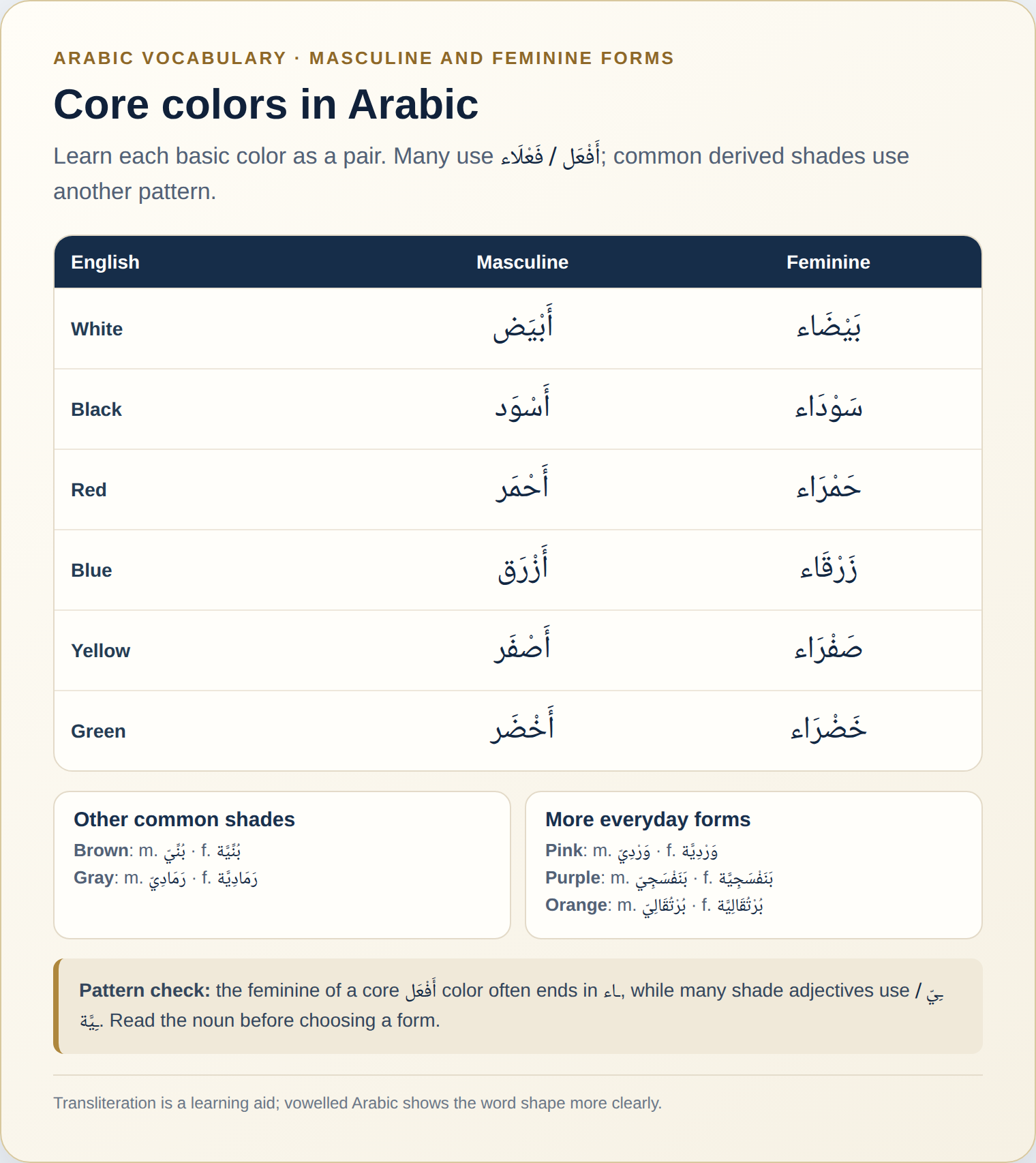
Short vowels make the word shape easier to see, but everyday Arabic is often written without them. If you are new to the script, start with Quranytime’s Arabic alphabet guide, then review its guide to Arabic vowel marks to understand fatḥa, kasra, ḍamma, sukūn, and tanwīn.
How Arabic color forms work
For many basic colors, the masculine form follows أَفْعَل (afʿal) and the feminine follows فَعْلَاء (faʿlāʾ). For example, white is أَبْيَض / بَيْضَاء (abyaḍ / bayḍāʾ) and black is أَسْوَد / سَوْدَاء (aswad / sawdāʾ). The feminine shape is built into the word; it is not simply made by adding the familiar tāʾ marbūṭah.
Other common shades use endings such as ـِيّ for masculine and ـِيَّة for feminine: رَمَادِيّ / رَمَادِيَّة (ramādiyy / ramādiyya, gray) and وَرْدِيّ / وَرْدِيَّة (wardiyy / wardiyya, pink). Learn each pair together and avoid forcing every color into the afʿal/faʿlāʾ pattern.
Match the adjective to its Arabic noun
In a simple phrase, a color adjective agrees with the Arabic noun it describes. قَلَمٌ أَحْمَرُ (qalamun aḥmaru) means “a red pen”; سَيَّارَةٌ حَمْرَاءُ (sayyāratun ḥamrāʾu) means “a red car.” The English translation does not determine the Arabic noun’s gender.
With a definite noun, both words commonly take the definite article: الْقَلَمُ الْأَحْمَرُ (“the red pen”) and السَّيَّارَةُ الْحَمْرَاءُ (“the red car”). Endings can also change with a word’s grammatical position. Quranytime’s guide to Arabic adjective agreement explains how gender, number, definiteness, and case fit together.
For practice, learn the color with a noun—“red pen,” “green book,” or “yellow flower”—instead of memorizing an isolated translation. Non-human plurals often take feminine singular agreement in standard Arabic, so check the whole phrase when a form seems unexpected.
Color words in Quranic context
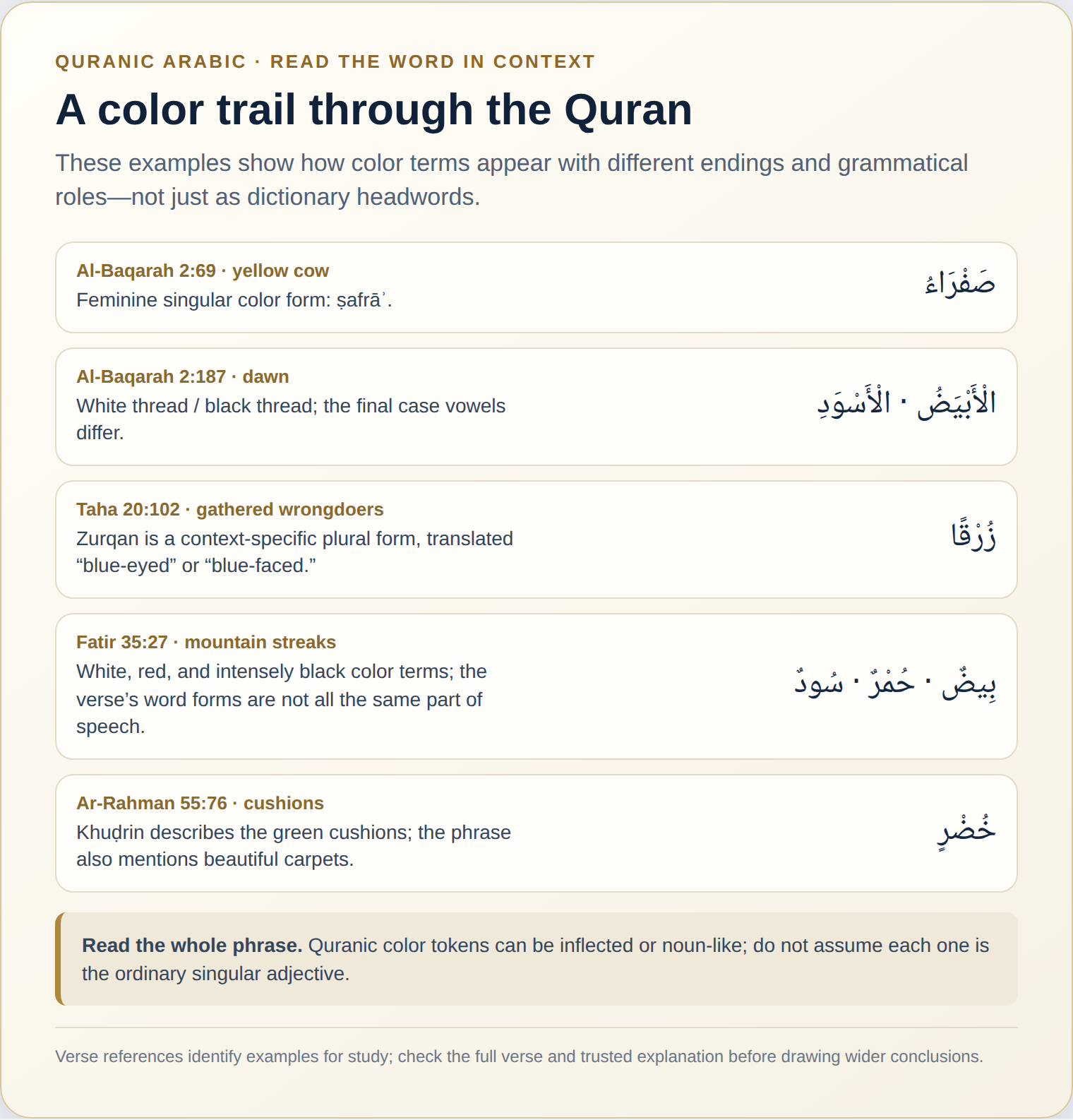
In the Quran, a color may appear with an article, case ending, plural form, or noun-like use. These examples show why it helps to compare a verse token with its dictionary form and read the words around it.
Yellow in Al-Baqarah 2:69
The description includes بَقَرَةٌ صَفْرَاءُ فَاقِعٌ لَوْنُهَا, “a bright yellow cow.” صَفْرَاءُ (ṣafrāʾu) is feminine singular and describes بَقَرَة (baqarah, cow). In the same phrase, فَاقِعٌ (fāqiʿun, vivid) is masculine because it describes لَوْن (lawn, color), a masculine noun. One verse gives a clear example of agreement following the Arabic noun.
White and black in Al-Baqarah 2:187
The phrase الْخَيْطُ الْأَبْيَضُ مِنَ الْخَيْطِ الْأَسْوَدِ مِنَ الْفَجْرِ distinguishes the white thread from the black thread of dawn. Both color words describe masculine singular الْخَيْط (al-khayṭ, thread). The forms الْأَبْيَضُ (al-abyaḍu) and الْأَسْوَدِ (al-aswadi) have different final case vowels because of their roles in the phrase—not because they mean different colors.
Blue, green, and other contextual forms
In Taha 20:102, زُرْقًا (zurqan) occurs in a description of wrongdoers gathered on the Day the Trumpet is blown. Translations render it “blue-eyed” or “blue-faced,” and the Quranic Arabic Corpus analyzes this token as an indefinite plural noun in the accusative. It is not the usual singular dictionary form for “blue.”
Fatir 35:27 mentions color among mountain streaks, including forms meaning white, red, and black. The Quranic Arabic Corpus analysis of Fatir 35:27 classifies the verse’s color terms according to their individual context; they are not all the same part of speech. In Ar-Rahman 55:76, خُضْرٍ (khuḍrin, green) describes cushions, followed by a mention of beautiful carpets.
Before drawing a wider conclusion from a verse, check its full wording and a trusted translation or explanation. This article uses examples to support Arabic reading; it is not a substitute for tafsir.
A quick checklist for recognizing color forms
When you meet a color-looking word, use this order: phrase first, pattern second, translation last.
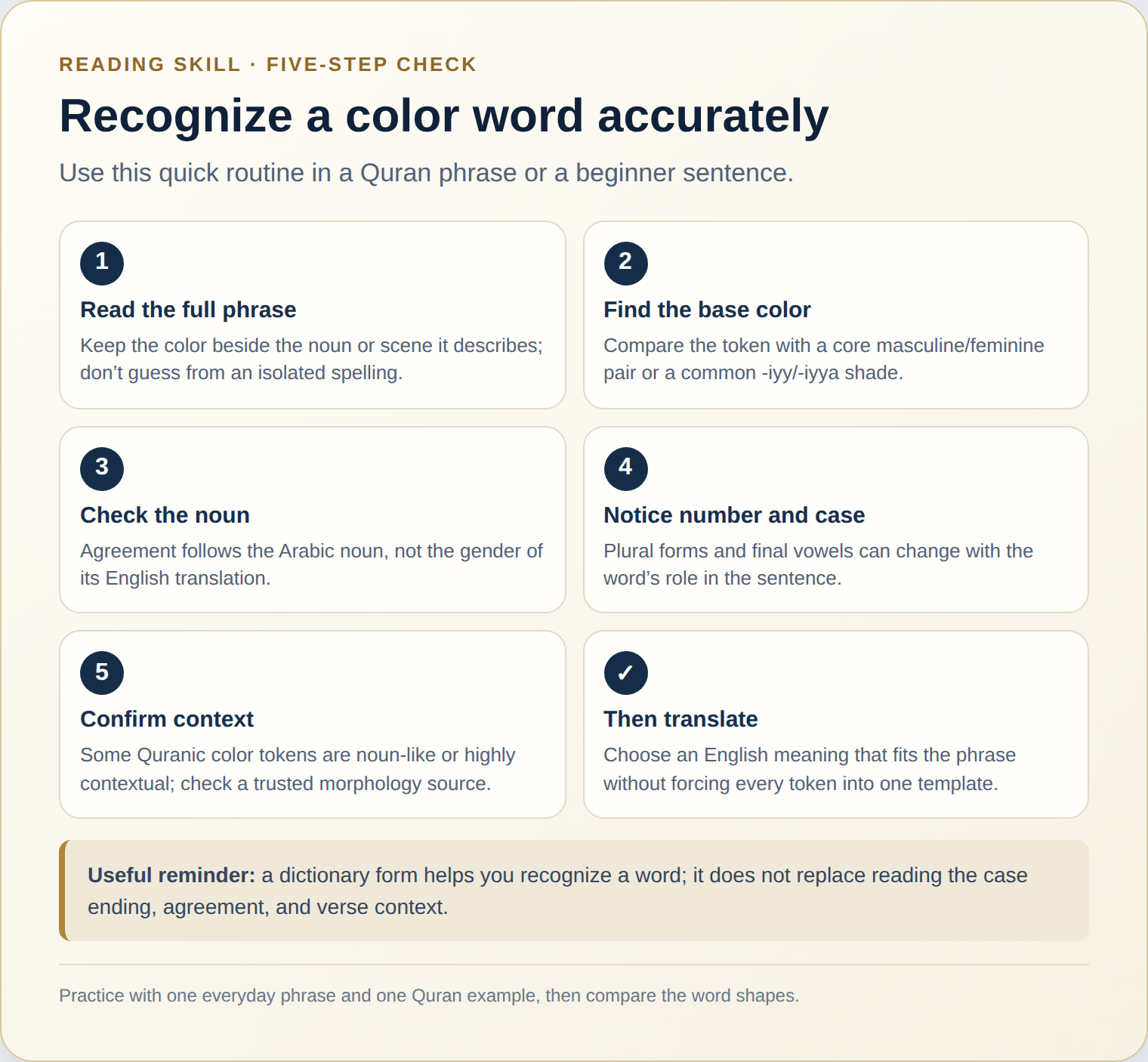
- Read the whole phrase. Do not guess from an isolated spelling.
- Find the noun or scene. Identify what the color describes.
- Compare the form. Is it a core afʿal/faʿlāʾ pair, an -iyy shade, or an inflected form?
- Notice number and case. Plural forms and final vowels can change with the word’s role.
- Confirm the context. Use a trusted morphology reference when the verse form is unusual.
For words without short vowels, Quranytime’s guide to reading Arabic without vowel marks explains how context supports recognition. Its Quran dictionary guide shows how to check a root and meaning instead of guessing.
Practise colors and pronunciation
Try a five-minute routine: read three masculine–feminine pairs aloud, cover the English column and recall the meanings, then make two short phrases using objects around you. Finish by copying one Quran example exactly as it appears, including its ending. Quranytime’s beginner vocabulary study plan offers a simple review routine, and its Arabic phrases guide provides short sentence models for using words.
For pronunciation, listen for sounds that English spelling can hide: ṣ in ṣafrāʾ, ḍ in abyaḍ, and ḥ in aḥmar. Read each Arabic word slowly, listen to a reliable model, and repeat it in a phrase. Transliteration can help at first, but it cannot replace the Arabic sound. These spellings represent standard Arabic; spoken dialects may use different everyday words or pronunciations, so label your notes by register. Notice the long ā and final hamza in ṣafrāʾ. When writing, copy the Arabic form rather than relying on Roman letters alone.
Watch this separate lesson for a visual review of Arabic color names and their written forms:
Common mistakes to avoid
- Learning only one form: keep the masculine and feminine pair together.
- Using one pattern for every shade: distinguish afʿal/faʿlāʾ colors from -iyy/-iyya adjectives.
- Ignoring the noun: agreement follows the Arabic noun, not the English word.
- Flattening Quranic forms into a list: زُرْقًا in Taha 20:102 is contextual and plural.
- Confusing color words with Tajweed color codes: printed recitation marks are a separate learning aid.
Frequently asked questions
How do you say “color” in Arabic?
The common singular is لَوْن (lawn); the plural is أَلْوَان (alwān). The plural appears in Fatir 35:27 in a phrase about things of different colors.
Do Arabic colors have masculine and feminine forms?
Many core colors do, often with the afʿal/faʿlāʾ pattern. Other shades may use a different pattern. The noun and sentence determine which form fits.
Is every Quranic color word an adjective?
No. A word’s grammatical role depends on the actual token and phrase. Check a reliable morphology source rather than assigning a part of speech from an English gloss alone.
If you would like a teacher to check your Arabic reading and pronunciation, you can Book a Free Trial Class. Bring one color phrase or Quran example and ask how its form fits the surrounding words.
The takeaway
Start with the six core pairs, then add common shades. Match the color to its Arabic noun, notice case and number, and read Quranic examples in context. This turns a color list into useful vocabulary and Quran-reading practice.
A hidden-object color game that tests agreement
Knowing that أَحْمَر means “red” is different from selecting the form that describes a particular Arabic noun. This game uses a few ordinary classroom objects to turn the vocabulary chart into a meaningful choice. It uses MSA teaching phrases and does not add new Quran quotations.
Prepare six cards: a red pen, a blue pen, a green book, a yellow book, a red bag and a blue bag. Draw simple objects or write their English labels if drawing is difficult. Color perception is not the assessment: label the cards with color names as well so learners who cannot reliably distinguish the shades can participate.
Give a clue with enough information
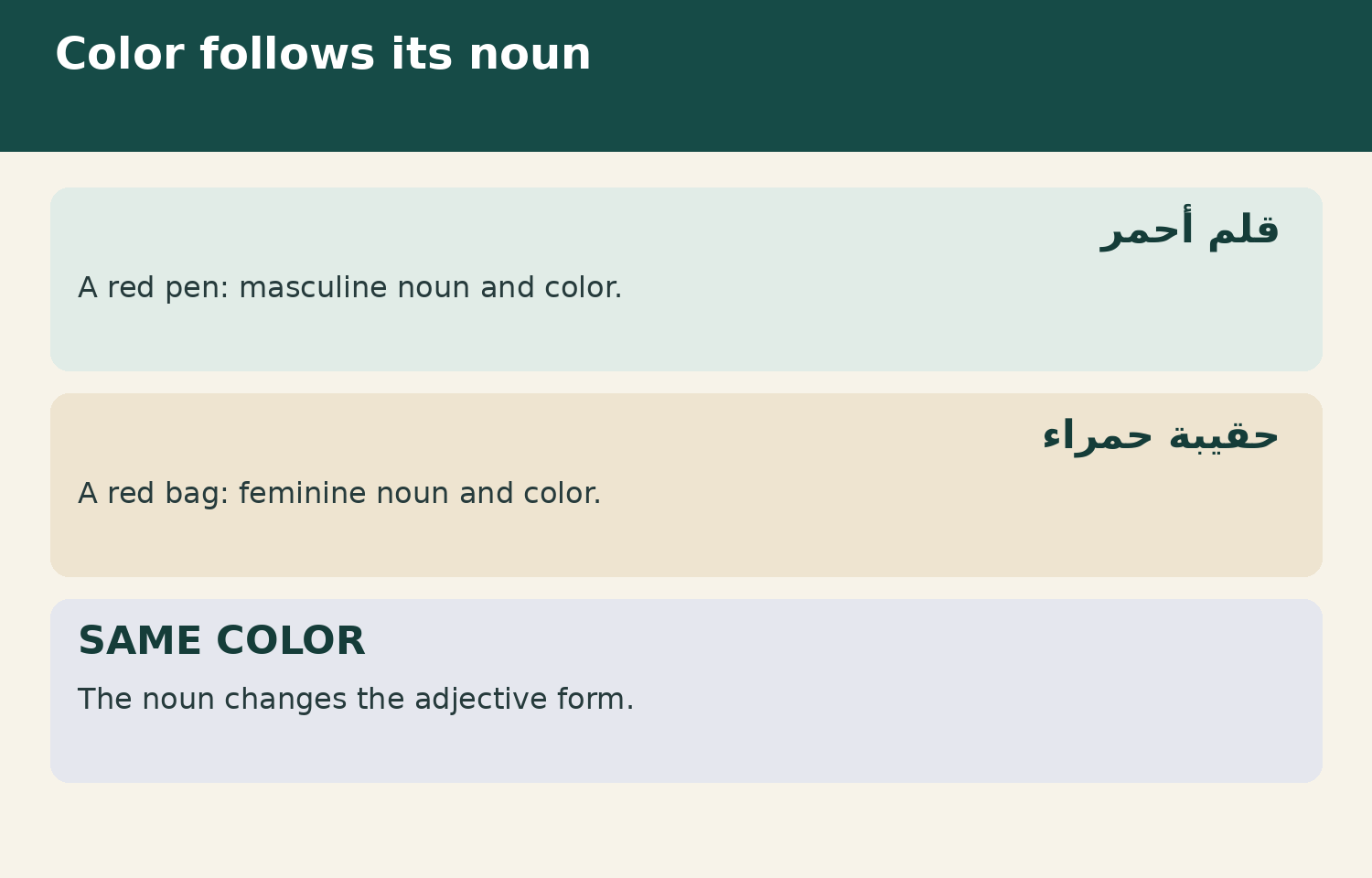
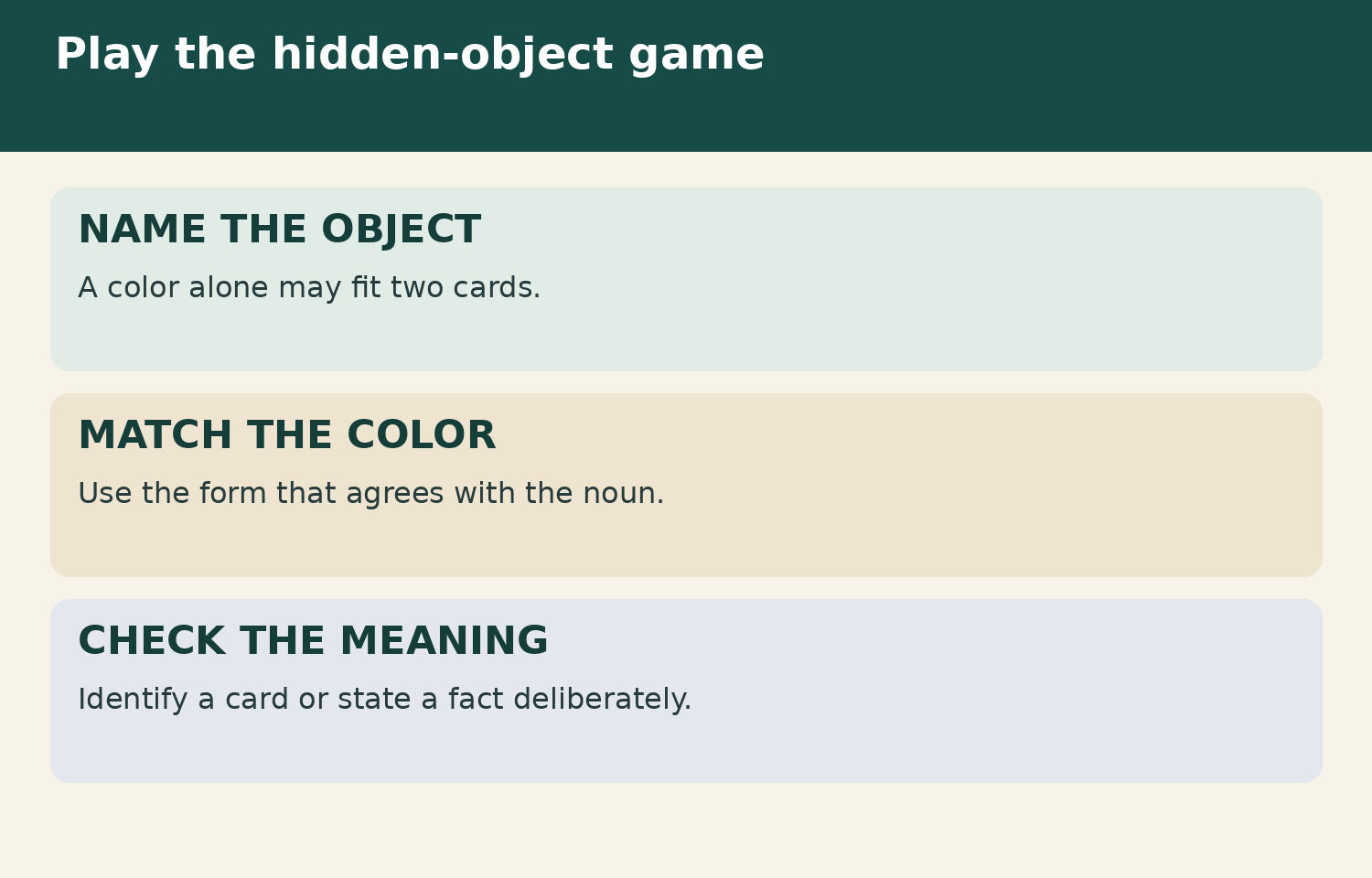
One player secretly selects a card. The other asks ما هذا؟ — “What is this?” The answer might be قلم أحمر, “a red pen,” or حقيبة حمراء, “a red bag.” The object noun and color together identify the card. Saying أحمر alone does not distinguish the red pen from the red bag.
The contrast reveals agreement. قلم is masculine, so “red” is أحمر. حقيبة is feminine, so “red” is حمراء. Do not add ة to أحمر to invent the feminine form. This color belongs to the paired pattern already introduced in the chart.
Change the noun while holding the color constant
Place the red pen beside the red bag. Say قلم أحمر and حقيبة حمراء. The visible color stays the same; the Arabic adjective changes because its noun changes. Repeat with blue: قلم أزرق and حقيبة زرقاء. Keep these as noun phrases first, without trying to teach every case ending at the same time.
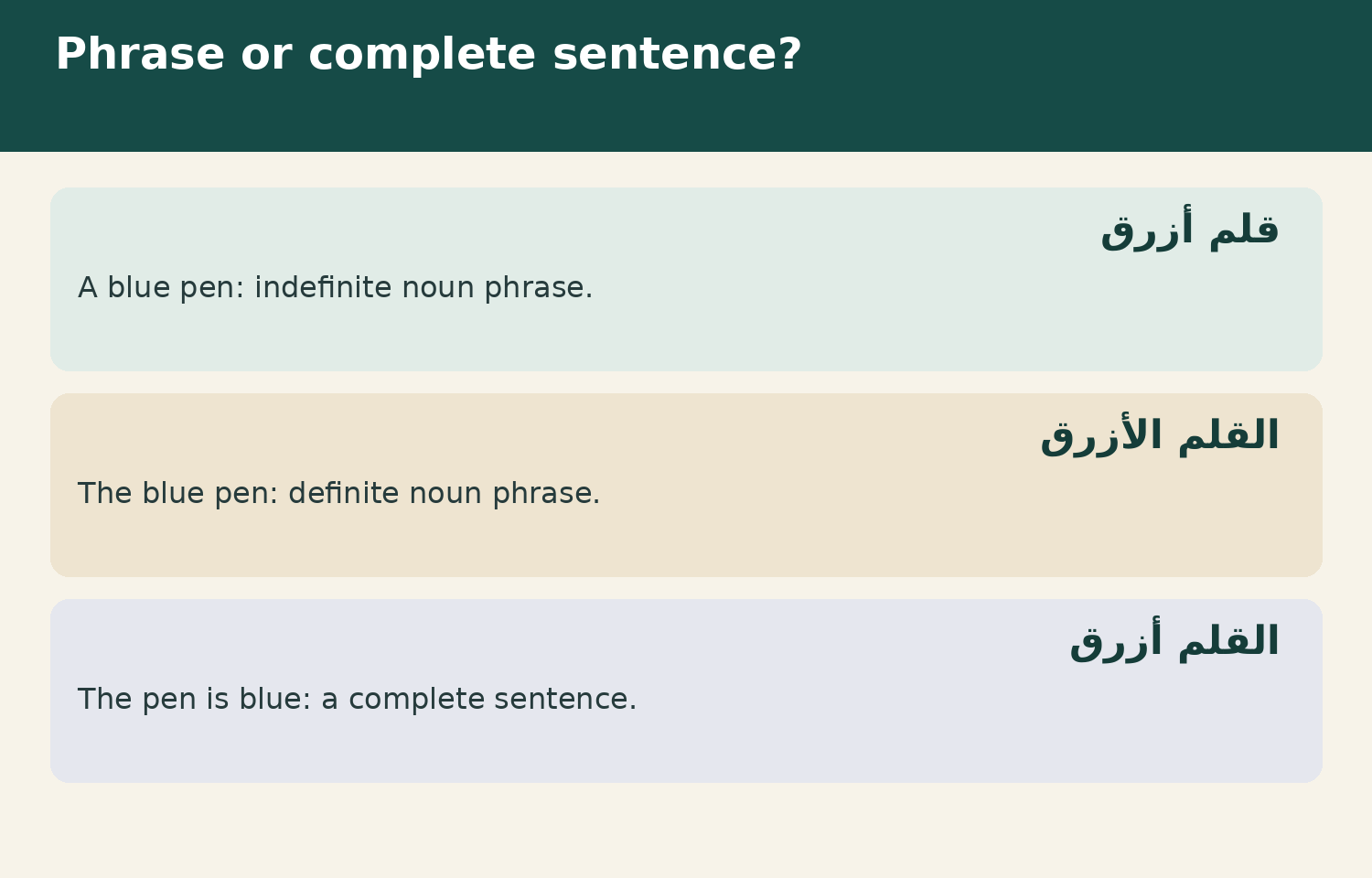
Next put the two pens together and ask the learner to identify the blue one. A possible response is القلم الأزرق, “the blue pen.” Notice that both noun and adjective now have الـ. Compare قلم أزرق, “a blue pen,” with القلم الأزرق, “the blue pen.” The task adds definiteness only after the gender contrast is secure.
Find the mistake and explain the repair
- حقيبة أحمر
- قلم زرقاء
- القلم أزرق, used by a learner who intended the noun phrase “the blue pen”
For 1, use حقيبة حمراء because the feminine noun needs the matching feminine color form. For 2, use قلم أزرق because قلم is masculine. For 3, distinguish two meanings: القلم أزرق can be a complete sentence, “The pen is blue.” The intended noun phrase “the blue pen” is القلم الأزرق. A missing article is not merely decoration; it can change the grammatical relationship.
This last contrast is worth acting out. Hold up a pen and make a statement about it: القلم أزرق. Then ask a partner which pen to hand you and identify it: القلم الأزرق. Keep the scene simple so the difference between describing a fact and identifying an object remains audible.
Extend the activity without overloading it
Introduce one new color pair only after the learner can explain the existing contrasts. Do not add plural objects, case changes, a new shade and a new sentence pattern in the same round. If you want to practise non-human plurals, set that up as a separate agreement lesson rather than assuming the singular cards show the whole system.
For independent review, write two phrases and one complete sentence beneath a small object drawing. Circle the noun, underline the color and check whether the article appears on one word or both. A partner should be able to identify which line means “the blue pen” and which means “the pen is blue” without seeing the English answer.
The success criterion is an explanation, not a memorized list: the learner can name the noun’s gender, select its color partner and distinguish the identifying phrase from the sentence. That gives a teacher a precise next step when one of the choices is still uncertain.