

Learning how to tell time in Arabic turns number knowledge into something you can use every day: asking when a class begins, understanding a schedule, or saying what time you will meet. This guide uses clear Modern Standard Arabic (MSA) forms. Spoken Arabic differs by region, so treat the dialect notes as reminders to check local usage, not as one universal spoken pattern.
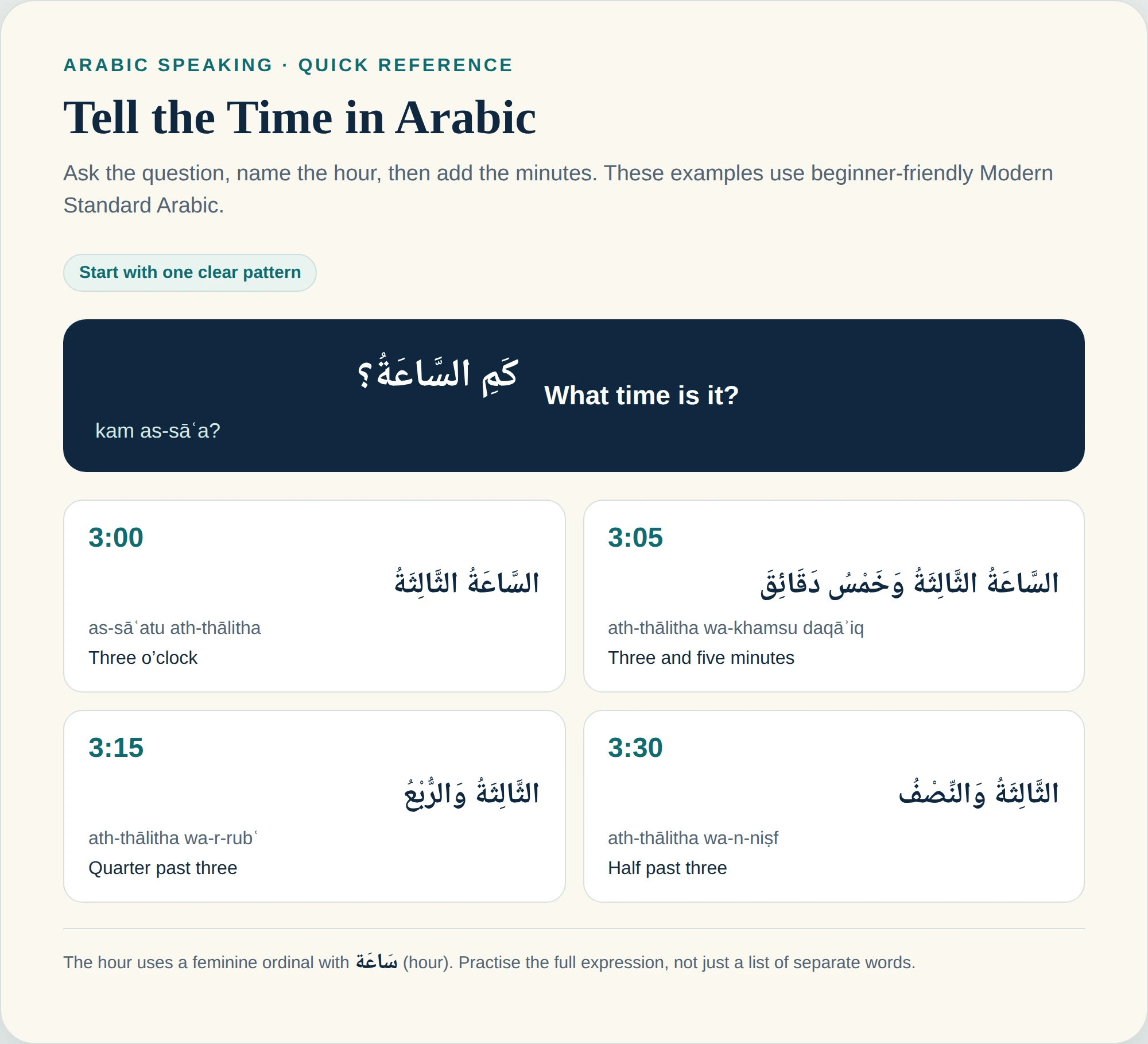
The main question is كَمِ السَّاعَةُ؟ (kam as-sāʿa?), “What time is it?” If you already know some numbers, the next step is to learn the feminine ordinal forms used with “hour,” then add minutes with a small set of repeatable patterns. You can review number pronunciation in Quranytime’s Arabic numbers guide and the question form in its beginner chart of Arabic question words.
Start with the hour
In Arabic, the word سَاعَة (sāʿa, “hour” or “clock”) is feminine. For a whole-hour time, MSA commonly uses a feminine ordinal: السَّاعَةُ الثَّالِثَةُ (as-sāʿatu ath-thālitha), “three o’clock.” In a beginner’s spoken practice, you can focus on the recognizable phrase and leave detailed case endings for later.
Learn the hour names as a sequence rather than memorizing them as isolated vocabulary: الواحدة (al-wāḥida), الثانية (ath-thāniya), الثالثة (ath-thālitha), الرابعة (ar-rābiʿa), الخامسة (al-khāmisa), السادسة (as-sādisa), السابعة (as-sābiʿa), الثامنة (ath-thāmina), التاسعة (at-tāsiʿa), and العاشرة (al-ʿāshira). The later hours follow the same pattern with الحادية عشرة and الثانية عشرة. Transliteration is only a temporary reading aid; keep looking at the Arabic script and listen to a clear model.
Say minutes after the hour
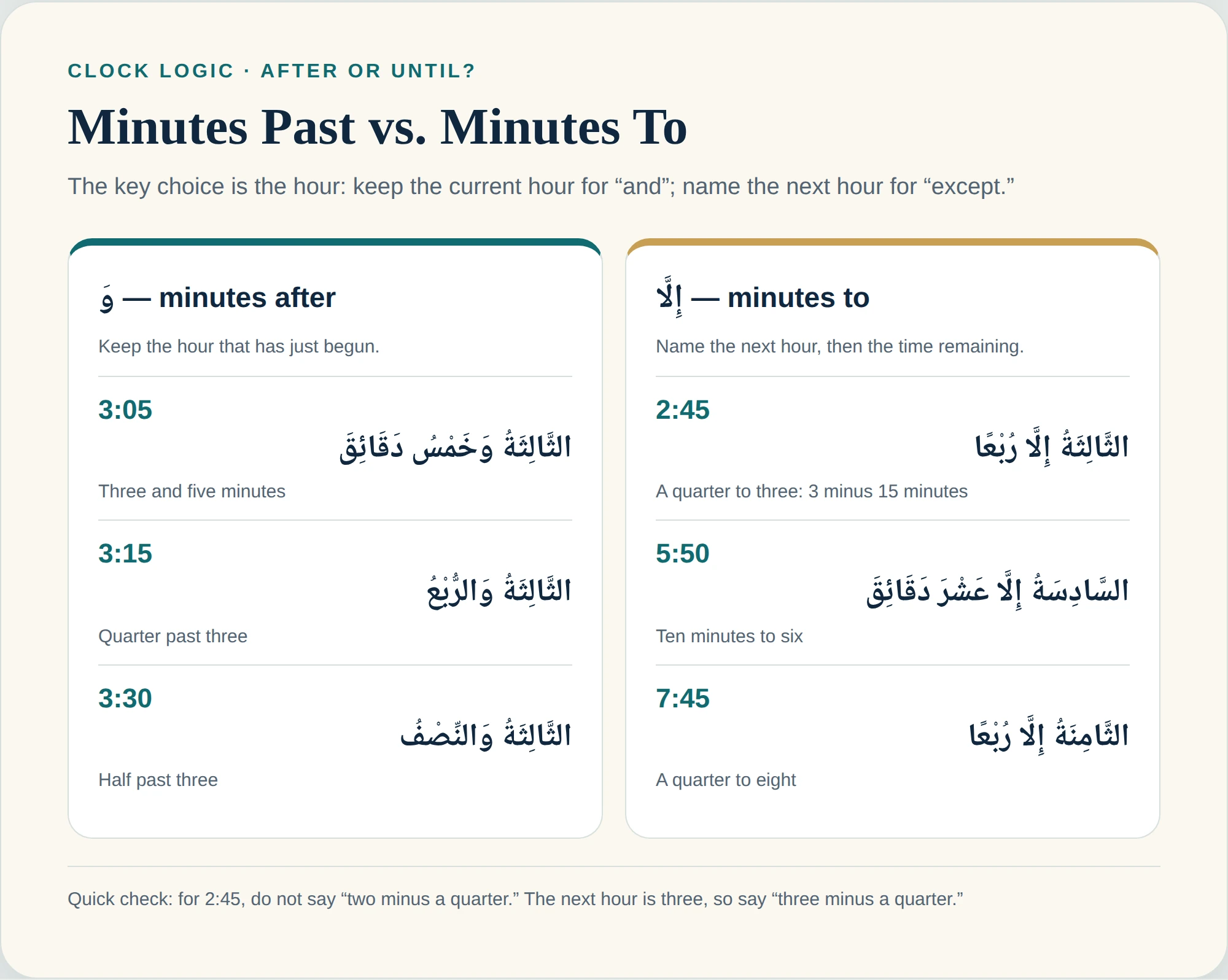
For minutes after the hour, say the hour, add وَ (wa, “and”), then give the minutes. For example, 3:05 can be expressed as السَّاعَةُ الثَّالِثَةُ وَخَمْسُ دَقَائِقَ (as-sāʿatu ath-thālitha wa-khamsu daqāʾiq), “three o’clock and five minutes.” A clock face helps you see why the minute phrase comes after the hour.
Two useful landmarks are “quarter” and “half.” At 3:15, say الثَّالِثَةُ وَالرُّبْعُ (ath-thālitha wa-r-rubʿ), “three and a quarter.” At 3:30, say الثَّالِثَةُ وَالنِّصْفُ (ath-thālitha wa-n-niṣf), “three and a half.” These are compact MSA learning patterns; the exact wording you hear in daily conversation can vary by dialect.
Notice the word wa does not mean that you should translate each Arabic word mechanically. Learn the whole time expression, then practise it with a new hour. For support with hearing and repeating Arabic, use Quranytime’s simple beginner listening routine. It can help you slow down, listen for one feature, and repeat without trying to fix everything at once.
Say minutes before the next hour
When the clock is closer to the next hour, MSA can use إِلَّا (illā, “except” or “minus”) with the upcoming hour. Think of the time as “the next hour, minus the remaining minutes.” At 2:45, for example, the next hour is three, so the phrase is الثَّالِثَةُ إِلَّا الرُّبْعَ (ath-thālitha illā r-rubʿ), “a quarter to three.” At 5:50, the next hour is six: السَّادِسَةُ إِلَّا عَشْرَ دَقَائِقَ (as-sādisa illā ʿashra daqāʾiq), “ten minutes to six.”
The most common beginner error is naming the hour that has nearly ended. For 2:45, do not start with “the second hour” in the minus pattern; move to the next hour, three, then subtract fifteen minutes. Look at the clock, say the upcoming hour, and only then add illā and the remaining time.
For a concise university-level sequence on asking and telling the time, see Michigan State University’s open textbook lesson. Use it as a learning reference, and keep your own practice focused on a few clear examples rather than trying to memorize every possible clock time in one sitting.
Add morning, evening, and daily context
When a number alone could be unclear, add a time-of-day word. صَبَاحًا (ṣabāḥan) means “in the morning,” and مَسَاءً (masāʾan) means “in the evening.” لَيْلًا (laylan) is “at night.” For example, you might say “at seven in the morning” or “at seven in the evening” after the hour expression. In written timetables, you may also see a 24-hour clock; read the context before deciding whether a speaker is using a formal schedule or a conversational phrase.
MSA is useful for a clear first lesson, but people often tell the time differently in Egyptian Arabic and other spoken varieties. The question may change, and the hour or minute phrasing may be shorter. Do not combine an MSA hour with a dialect minute pattern until you have heard that combination from a reliable speaker. If your goal is conversation in a particular country, ask for that dialect’s common form and practise it consistently. Quranytime’s beginner Arabic expressions can help you build a base of everyday language, while the broader Arabic study routine guide offers ideas for revisiting speaking, listening, and reading skills over time.
Practise with a four-step clock check
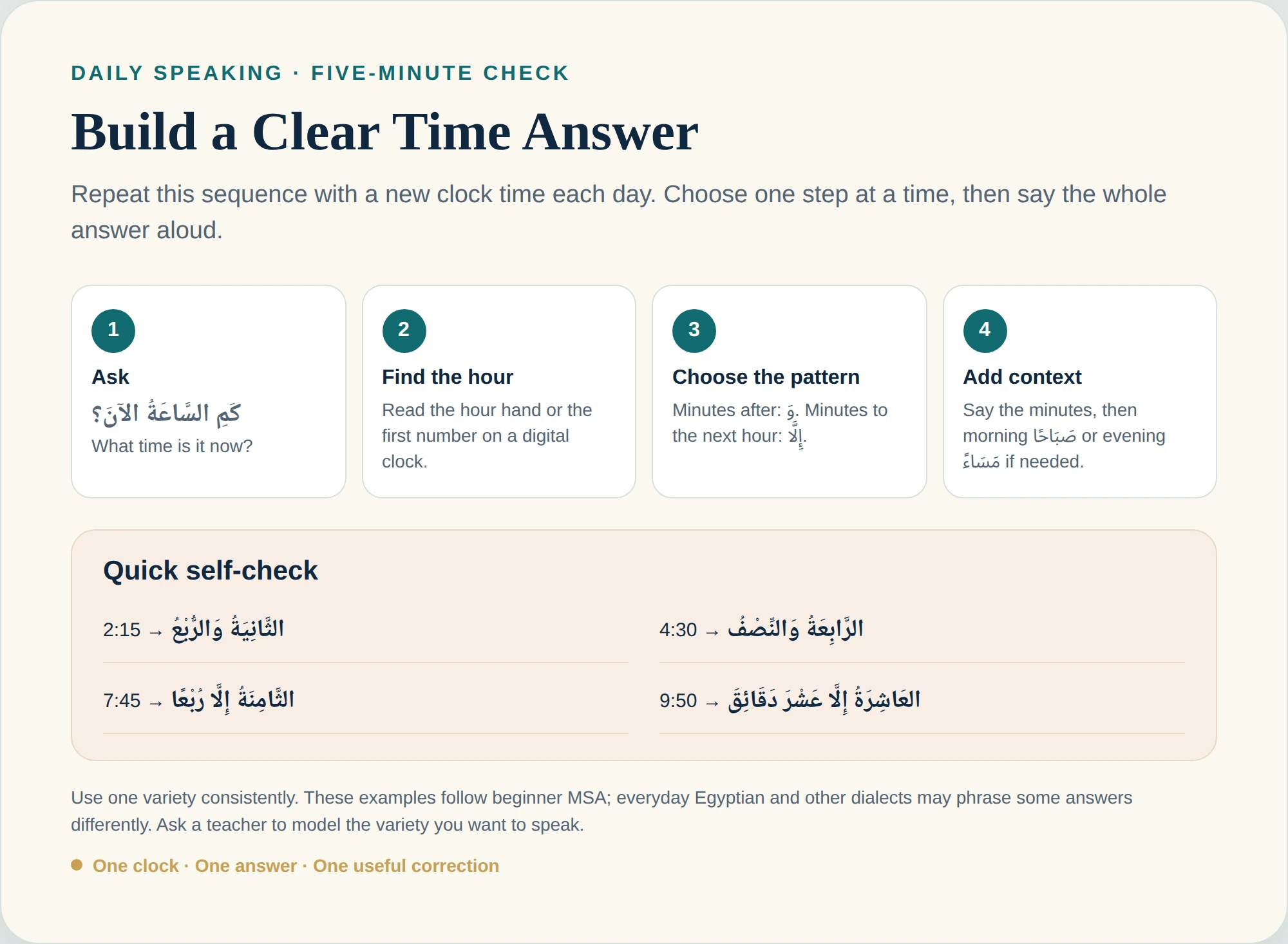
When you look at an analogue or digital clock, follow the same order each time. First, identify the current hour. Second, decide whether the minutes are after that hour or close enough to the next one to use the “minus” pattern. Third, choose the minutes phrase: a number of minutes, quarter, or half. Fourth, add morning, evening, or night if the context needs it. This prevents a common mix-up: using the next hour for an “after” expression, or using the current hour for an “except” expression.
Try these examples aloud, then cover the answer and check yourself:
- 2:15: الثانية والربع — a quarter past two.
- 4:30: الرابعة والنصف — half past four.
- 7:45: الثامنة إلا ربعًا — a quarter to eight.
- 9:50: العاشرة إلا عشر دقائق — ten minutes to ten.
Put the time in a short exchange
Practise the question with a simple answer before adding extra conversation. Ask كَمِ السَّاعَةُ الآنَ؟ (kam as-sāʿa al-ān?), “What time is it now?” A reply could be السَّاعَةُ الرَّابِعَةُ وَالنِّصْفُ (as-sāʿatu ar-rābiʿa wa-n-niṣf), “It is half past four.” You can then add a useful sentence about your plan, such as “The lesson begins at five.” Keep the first exchange short enough that you can say it without reading every word.
To practise independently, write the time in digits, cover the English meaning, and ask the question aloud. Give yourself a moment to choose the hour before answering. If you hesitate, name the step that caused it: the ordinal hour, the after-or-until choice, the minute phrase, or the time-of-day word. Then repeat only that part and try the full answer once more.
Use a short daily routine
A five-minute routine is enough to practise the patterns without turning time-telling into a long worksheet. For one minute, listen to a model question and answer. For the next minute, read three whole-hour examples. Then spend two minutes on minutes after and before the hour, switching between “and” and “except.” Use the final minute to say one real plan aloud, such as when a lesson starts or when you will call someone. If you want to extend the routine, write the time in digits, say it in Arabic, and check whether your hour changes in an illā phrase.
Keep a small correction note: write the time, your first attempt, and one thing to check. It may be the hour word, the direction of the minutes, or the pronunciation of ʿayn in sāʿa. Do not judge your whole Arabic from one sound. Work on one point, listen again, and ask a teacher if the same uncertainty keeps returning. If you want guided feedback on your current level, book a free Quran and Arabic trial class and practise useful Quran and Arabic goals with a teacher.
For your next session, choose four clock times from your day. Ask kam as-sāʿa?, answer with the hour and minutes, then say whether it is morning or evening. Check the clock logic before you check the pronunciation. Once the pattern feels familiar, use the same question in a short conversation instead of memorizing another isolated list of phrases.
Frequently asked questions
Is there one Arabic way to tell time? No. This guide uses MSA for a consistent starting point. Everyday Egyptian and other dialects may differ, so label the variety you are learning.
When should I use إلا? Use it in the “minutes to” pattern, naming the next hour first. For 7:45, the next hour is eight, so the phrase is “eight minus a quarter.”
Do I need to learn all twelve hour names first? Learn them gradually. Start with one through six, practise the minutes pattern, then add the remaining hour names. Repeatedly changing the hour in a familiar sentence is often more useful than reciting the whole list once.
Can I use English transliteration instead of Arabic script? Use transliteration only as temporary support. The Arabic script helps you connect the phrase to the letters and vowel marks, and listening helps you hear sounds that English spelling cannot show consistently.