
A student entered the room. The teacher was writing. Did those events happen one after another, or was the teacher already writing when the student entered? Arabic can package the second situation as a haal clause: a clause describing the circumstances in which the main event occurred.
This lesson focuses on clauses, not another list of one-word manner expressions. You will learn to keep a main event and its accompanying state together, identify whose state is described, and avoid translating every wāw as a simple “and.” The time, place and manner lesson introduces the broader family. Here the practical task is to read an entire mini-scene without losing its internal structure.
Scene one: enter while something is already happening
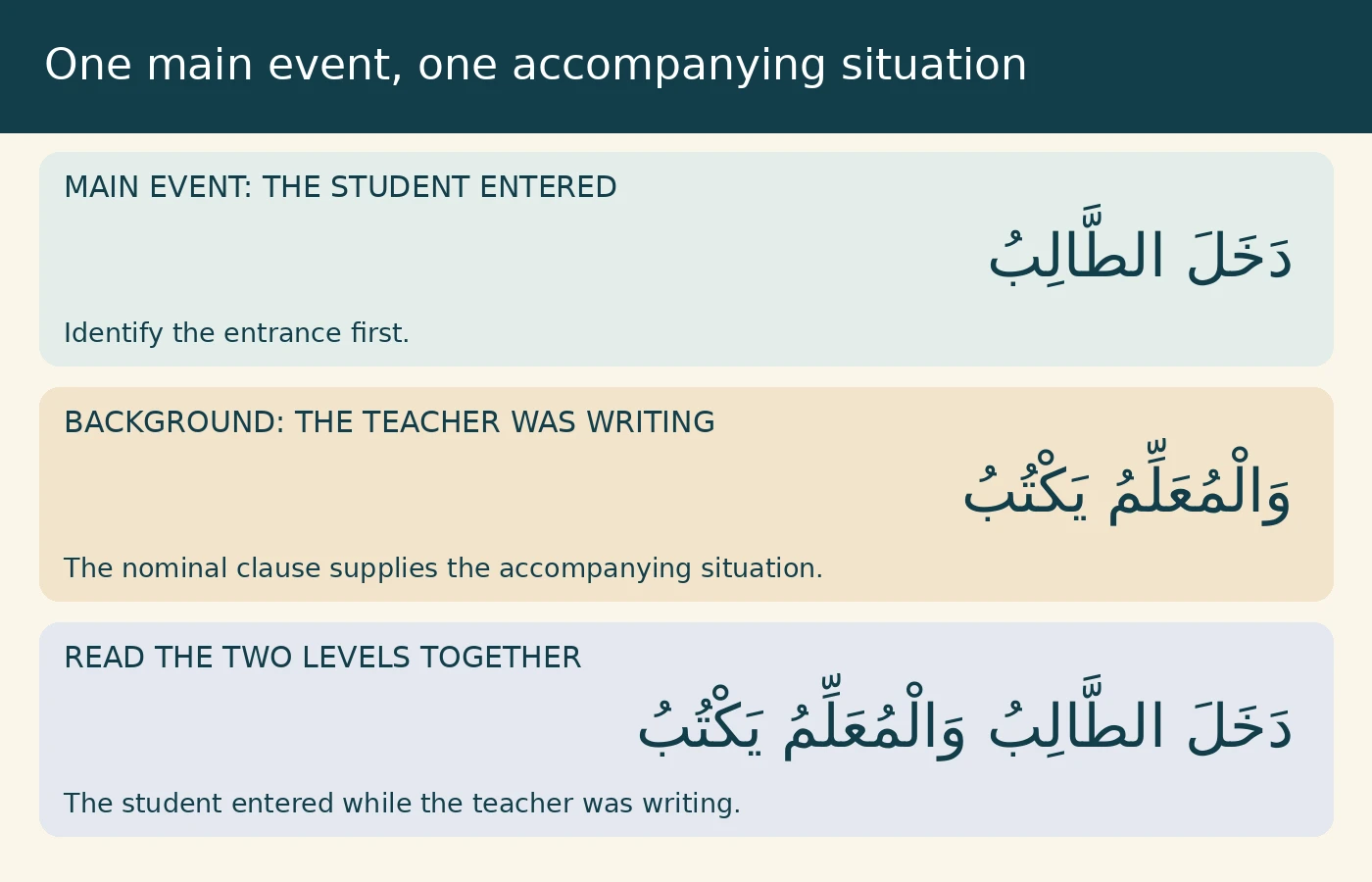
Read the composed example دَخَلَ الطَّالِبُ وَالْمُعَلِّمُ يَكْتُبُ — “The student entered while the teacher was writing.” The main event is the student’s entrance. The following nominal clause, الْمُعَلِّمُ يَكْتُبُ, supplies the accompanying situation. The wāw introduces that circumstantial relationship in this intended reading.
Do not assume that the second event began after the first. The sentence places the writing in the background of the entrance. English naturally uses “was writing,” but the Arabic embedded verb is an imperfect form within its clause. Translation chooses a tense expression appropriate to the whole scene; it does not turn every imperfect verb into the same English tense mechanically.
Draw a doorway for the entrance and a horizontal line for the writing already in progress. Place the entrance point somewhere along that line. This is a teaching model of the intended sentence meaning, not a universal tense diagram for every haal construction. It helps you resist turning an accompanying situation into the next step of a story.
Inside the clause, ordinary grammar still works
In الْمُعَلِّمُ يَكْتُبُ, the teacher noun is nominative as the topic of the embedded nominal sentence. The predicate is the verbal clause يَكْتُبُ. The whole expression can function as a circumstantial clause in the larger sentence without making every word inside it accusative.
This is a common source of confusion. A learner hears that haal is associated with an accusative position, then tries to give the embedded topic a fathah. But a clause’s position in a larger structure is different from the individual cases and moods inside it. State the two levels separately: “The whole clause supplies the circumstance; inside it, the topic is nominative.”
The nominal-sentence guide explains the topic/predicate framework. The case lesson helps with word-level endings. Together they let you analyze an embedded statement without flattening it into a row of identical case labels.
Scene two: the participant’s own state
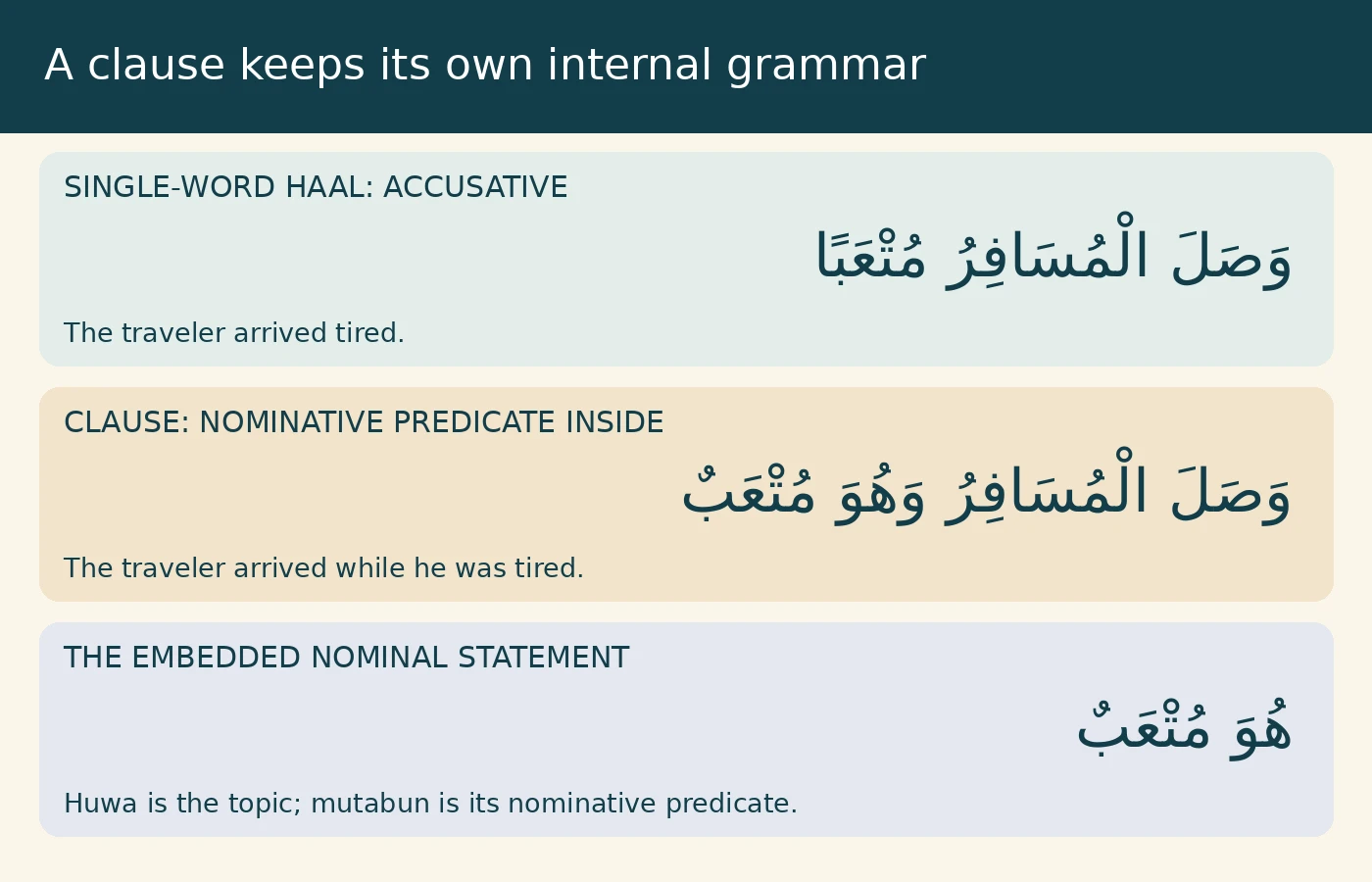
Now read وَصَلَ الْمُسَافِرُ وَهُوَ مُتْعَبٌ — “The traveler arrived while he was tired.” This composed example describes the arriving traveler’s state. هُوَ refers back to الْمُسَافِرُ, and مُتْعَبٌ is the nominative predicate inside the nominal clause.
Compare وَصَلَ الْمُسَافِرُ مُتْعَبًا, “The traveler arrived tired.” The one-word state expression is accusative. The clause version instead has its own subject/predicate organization. The two can communicate closely related circumstances, but their internal analyses differ. Do not copy the one-word ending into the predicate of the clause.
Identify the referent before translating the pronoun. If a paragraph contains two male participants, “he” may need more contextual attention. The pronoun guide provides the forms, but forms alone cannot resolve every antecedent. Ask whose arrival or state the scene actually describes and whether the surrounding sentences support that reading.
Scene three: an action clause without a visible wāw
A haal clause does not always begin with wāw. In the composed example جَلَسَ الطَّالِبُ يَقْرَأُ كِتَابًا, “The student sat reading a book,” the verbal clause يَقْرَأُ كِتَابًا presents the student’s accompanying activity. Its understood subject points back to the student.
Read it as two levels again: the sitting is the main event; reading a book describes what the student is doing in that scene. Inside the reading clause, كِتَابًا is the direct object of يَقْرَأُ. The entire clause supplies a circumstance, but the book has its own object relationship within it.
The verbal-sentence lesson explains how to identify a verb’s participants. Use it to keep the embedded object attached to the embedded verb. If you attach every noun to the first verb in the sentence, the story will stop making sense.
Wāw is a clue to investigate, not an automatic label
Arabic wāw has several uses. It can coordinate words or clauses, and it can introduce a circumstantial clause. Seeing the same letter does not prove the same relationship. قَرَأَ خَالِدٌ وَكَتَبَ سَعِيدٌ, “Khalid read and Said wrote,” coordinates two events in this composed example. It does not, by spelling alone, state that one is the accompanying state of the other.
The earlier classroom example is read circumstantially because the second clause presents the situation surrounding the entrance. The conjunction lesson covers ordinary coordination. Compare both possible relationships and ask which one the syntax and context support. Do not use an English “while” translation as your only proof after you have already guessed it.
It is also unwise to treat every circumstantial clause as a precise stopwatch claim that two actions have identical duration. The clause gives a circumstance or state relevant to the main event. Context, aspect and the particular construction determine how that relationship is understood.
Do not confuse “the student who reads” with “the student reading”
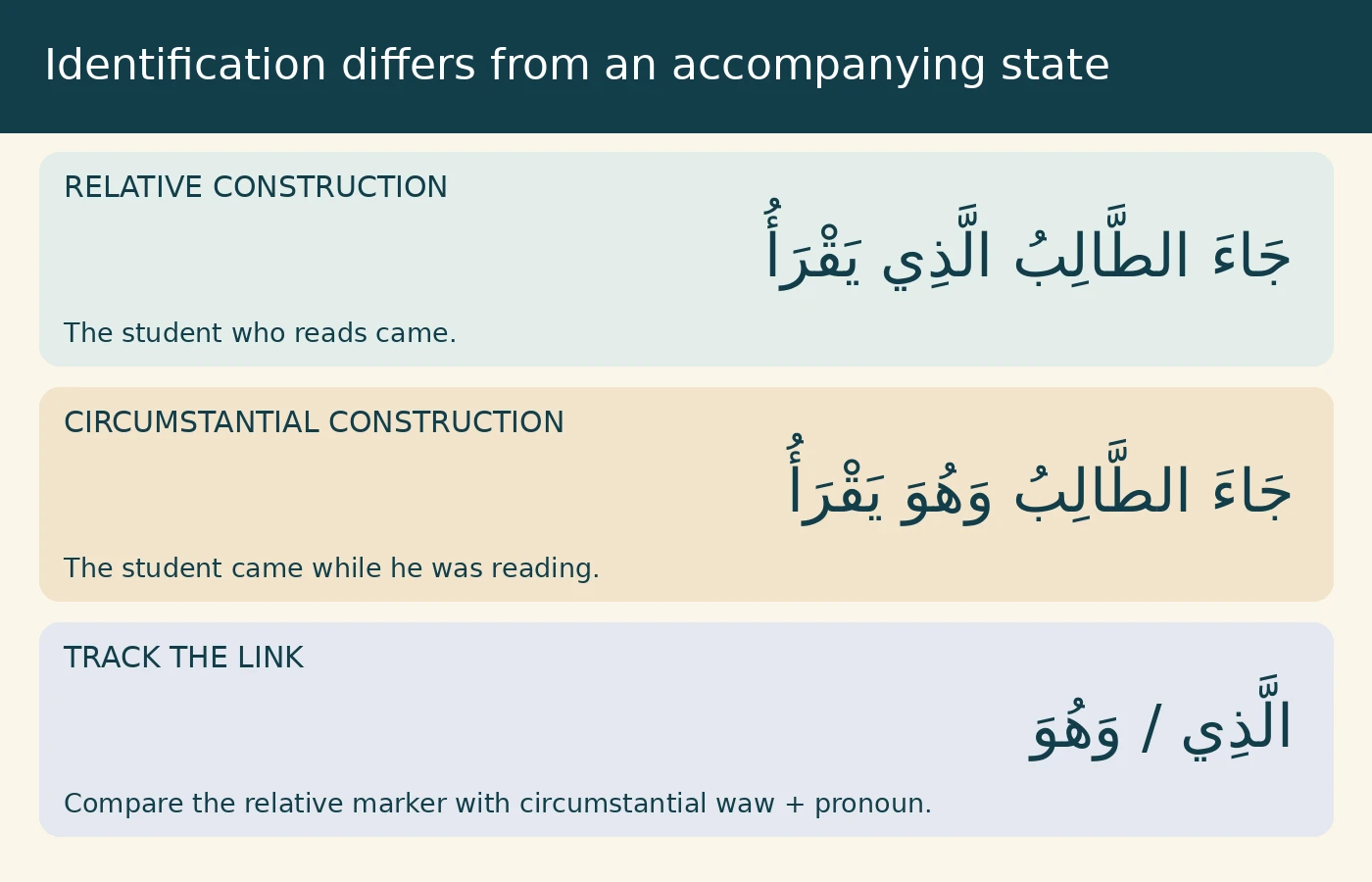
A relative clause helps identify or describe a noun through a relative construction. A circumstantial clause describes the state or situation associated with an event. Compare the composed جَاءَ الطَّالِبُ الَّذِي يَقْرَأُ, “The student who reads came,” with جَاءَ الطَّالِبُ وَهُوَ يَقْرَأُ, “The student came while he was reading.”
In the first, الَّذِي introduces the relative clause attached to the student. In the second, وَهُوَ introduces a nominal clause giving his accompanying state. The underlying people and verbs may be similar, but the information is organized differently. The relative-pronoun lesson supplies that separate construction.
Do not turn this comparison into a rigid claim that every clause after a definite noun has one fixed label. Arabic permits more complex constructions and contextual analyses. In these controlled examples, the explicit relative marker and circumstantial structure make the contrast clear enough for practice.
A Quran example where the inner predicate stays nominative
Quran 12:14 contains وَنَحْنُ عُصْبَةٌ within the brothers’ speech. The phrase means, in its context, “while we are a group.” The Corpus analysis tags the initial wāw as circumstantial and identifies نَحْنُ as a first-person plural pronoun. عُصْبَةٌ is nominative within the clause.
See the Corpus analysis covering 12:13–14. The nominative predicate is exactly the kind of two-level analysis practised above: an embedded nominal statement can supply the circumstance without changing its predicate into an accusative one-word haal.
Read the whole exchange, not only this short phrase, when studying Surah Yusuf. The speech’s argument and narrative context matter. This grammar note explains the clause relationship and the visible ending; it does not supply a full tafsir or a judgment about the speakers from one isolated construction.
Reassemble a scene from three strips
Make three paper strips: دَخَلَ الطَّالِبُ; وَالْمُعَلِّمُ يَكْتُبُ; and كِتَابًا. First attach the second strip to the first. Translate the main event and its background. Then place كِتَابًا after يَكْتُبُ to mean that the teacher was writing a book. The added noun belongs to the embedded writing clause, not directly to the student’s entrance.
Ask your partner which word governs the final noun and which clause describes the circumstance. Require two answers rather than one overall translation. A learner may translate the story correctly while still attaching the object to the wrong verb in an analysis. The strip activity makes that mistake visible.
Next replace the teacher clause with وَهُوَ مُبْتَسِمٌ, “while he was smiling,” intending the pronoun to refer to the student. Explain what changed: the background no longer names a separate teacher but describes the entering student’s own state. If the intended referent is unclear in a longer passage, rewrite the practice story or supply enough context to clarify it.
Three deliberately incorrect explanations
First: “Every wāw means the second action happened next.” Incorrect; coordination does not by itself guarantee a sequence, and a circumstantial wāw presents an accompanying situation. Second: “Every noun inside a haal clause is accusative.” Incorrect; internal subjects, predicates and objects retain their own grammatical relationships. Third: “A clause without wāw cannot supply a circumstance.” Incorrect; the reading activity in جَلَسَ الطَّالِبُ يَقْرَأُ كِتَابًا illustrates a verbal clause used circumstantially.
Correcting these explanations should change how you annotate. Draw a boundary around the full circumstantial clause. Inside that boundary, identify its own subject and predicate or verb and object. Then draw one connection from the whole clause to the main scene. This is more informative than highlighting every word after a wāw in the same color.
Translate the scene twice, then compare the information
Translate the classroom entrance example first with “while” and then as two independent English sentences joined by “and.” Ask what a reader would confidently understand from each version. The version with “while” explicitly presents the writing as an accompanying situation. The version with “and” may leave the connection less explicit. The task is not to find a magical English word that always matches wāw; it is to preserve the relationship established in this particular Arabic sentence.
Now write a three-sentence English story in which the teacher starts writing only after the student’s entrance. Notice that this is a different event arrangement. To express a clear sequence in Arabic, you would need wording that actually establishes that sequence rather than quietly reading it into the original circumstantial sentence. Ask your teacher to check the revised Arabic if you are still learning the connectors.
Finally, change the activity to a state: the student entered while the room was quiet. You now need a nominal statement for the accompanying situation rather than a writing action. A possible composed phrase is دَخَلَ الطَّالِبُ وَالْغُرْفَةُ هَادِئَةٌ. Identify الْغُرْفَةُ as the embedded topic and هَادِئَةٌ as its predicate. Both are nominative inside the clause.
Use a recording to find clause boundaries
Read one composed example aloud without rushing through the connecting wāw and pronoun. Listen for the difference between the first event’s participants and the embedded clause’s own organization. A pause in a teacher’s demonstration can help you hear the structure, but a pause by itself is not a grammatical proof. Return to the written words and explain the dependencies.
For Quran study, work from an accurate recitation and a reliable vocalized text. Do not invent stopping points merely to make a grammar exercise easier. Mark clause boundaries in your study notes while keeping your recitation practice under appropriate teacher guidance. The aim is to recognize a relationship already present in the text, rather than changing the reading to fit a diagram.
A neutral reference and a useful lesson question
Al Jazeera Learning Arabic’s grammar note on haal explicitly illustrates both verbal and nominal clauses used for circumstance. The examples in this workshop build an original classroom scene around that distinction. They are designed for analysis and editing, so check their complete constructions rather than treating every phrase as an everyday conversational formula.
For guided practice, Book a Free Trial Class and bring a sentence with two actions. Explain which action is the main event, which supplies a state, and what evidence connects them. A strong question is “Does this clause identify the participant, coordinate another event, or describe the situation?” That question gives your teacher a specific reading decision to help you resolve.