

To memorize the Arabic alphabet, learn a few related letter shapes, connect each shape to a clear sound model, and test yourself without looking. Revisit those letters across several days and meet them inside words. Reciting the alphabet in order is useful, but genuine recognition means identifying a letter when it appears unexpectedly, in a different position or beside a similar shape.
This guide gives you a flexible practice system rather than a promise that everyone can master the script in a fixed number of hours. The aim is dependable recall: you can name a letter, notice its dots, recognize its connected form and begin to read a vowelled example. The worksheets help you find which part of that process needs more practice.
Decide what memorizing actually means
There are several different tasks hidden inside the phrase learn the alphabet. You may be able to sing the names in sequence while struggling to recognize one isolated letter. You may recognize the shape while producing the wrong sound. You may read a printed letter correctly but fail to identify the same letter in a connected word.
Separate those tasks before judging progress. Ask whether you can identify the body and dots, recall the name, repeat an appropriate sound model, and recognize an initial or final form. A weakness in one task does not mean you have forgotten everything. It simply gives you a specific target for the next short session.
Keep the full Arabic alphabet reference nearby for checking after an attempt. Looking at the reference is useful feedback; looking at it throughout every attempt makes it harder to tell what you can retrieve independently.
Learn shape families before random lists
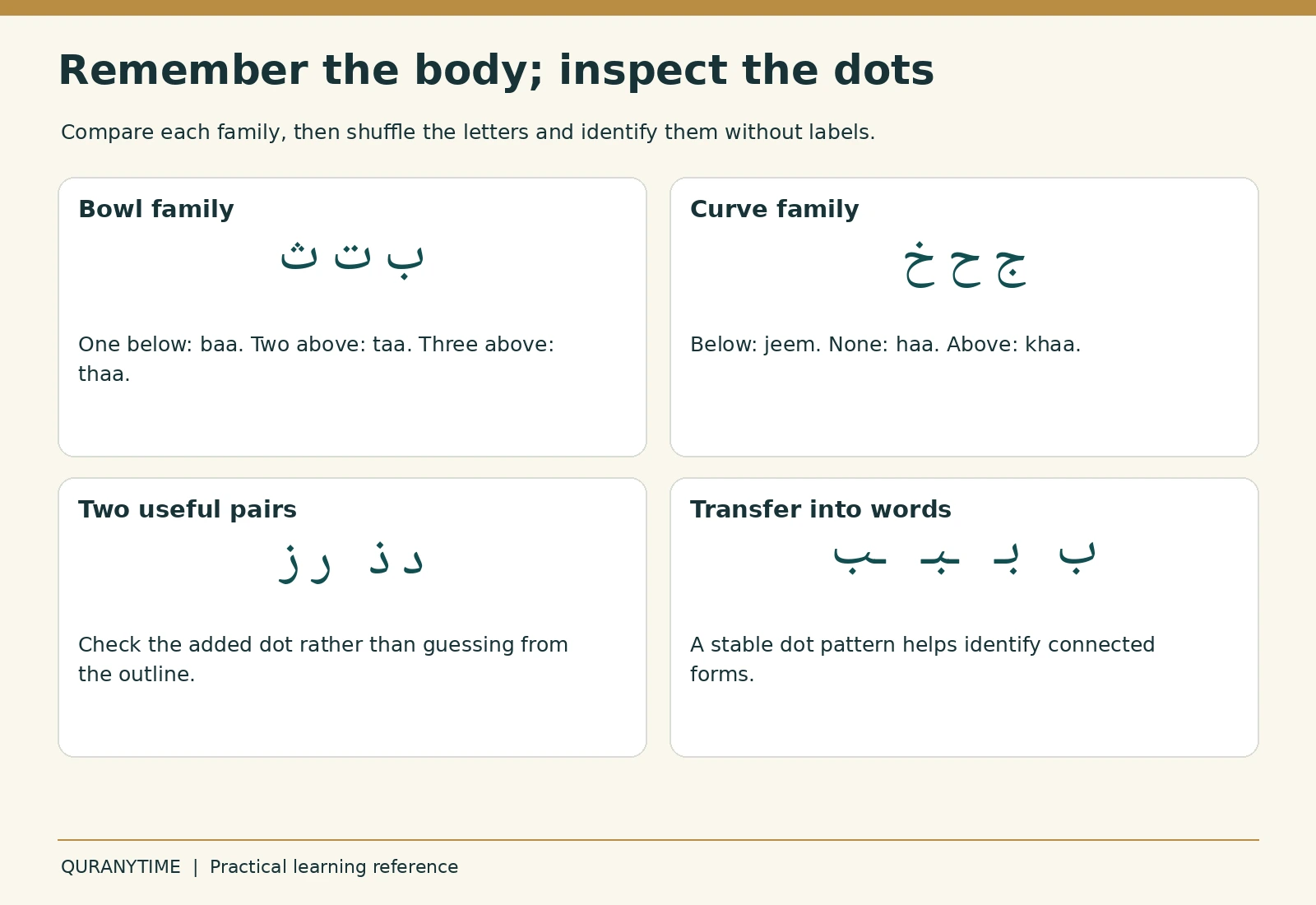
Several letters share a recognizable body. Compare ب ت ث and notice one dot below, two above and three above. Compare ج ح خ and notice a dot below, no dot and a dot above. The family connection reduces the amount of unfamiliar visual material, but it also creates a risk of mixing the members. That is why comparison must be followed by testing.
Other useful pairs include د ذ, ر ز, س ش, ص ض, ط ظ and ع غ. Do not assume that every related letter has the same sound or exactly the same behaviour in every handwriting style. The visual grouping is a memory aid, not a substitute for listening and checking examples.
Start with two or three members of one family. Place them in a different order each time. Say the identifying feature before the name: one dot below, baa. Then gradually remove that verbal support as recognition becomes easier. The goal is accurate identification, not permanent dependence on a long mnemonic.
Connect the shape with sound from the beginning
A letter name and a letter sound are related but not identical. Saying baa names ب, while reading بَ produces a consonant with a short vowel. A learner who only memorizes names may try to read words by stringing full names together. Introduce a small number of vowelled syllables once the underlying letters are recognizable.
Use one clear pronunciation model appropriate to your goal. Everyday Arabic varieties differ, while Quran reading requires attention to the recitation model being learned. English sound hints can introduce a distinction, but they cannot fully represent letters such as ع or ح. Repeat after a teacher or reliable recording and ask for targeted correction.
The Arabic Reading Guide with audio can support listening and recognition practice. First listen, then repeat without talking over the model. If two sounds seem identical, compare a short pair slowly instead of increasing the volume or speed.
Use retrieval rather than endless rereading
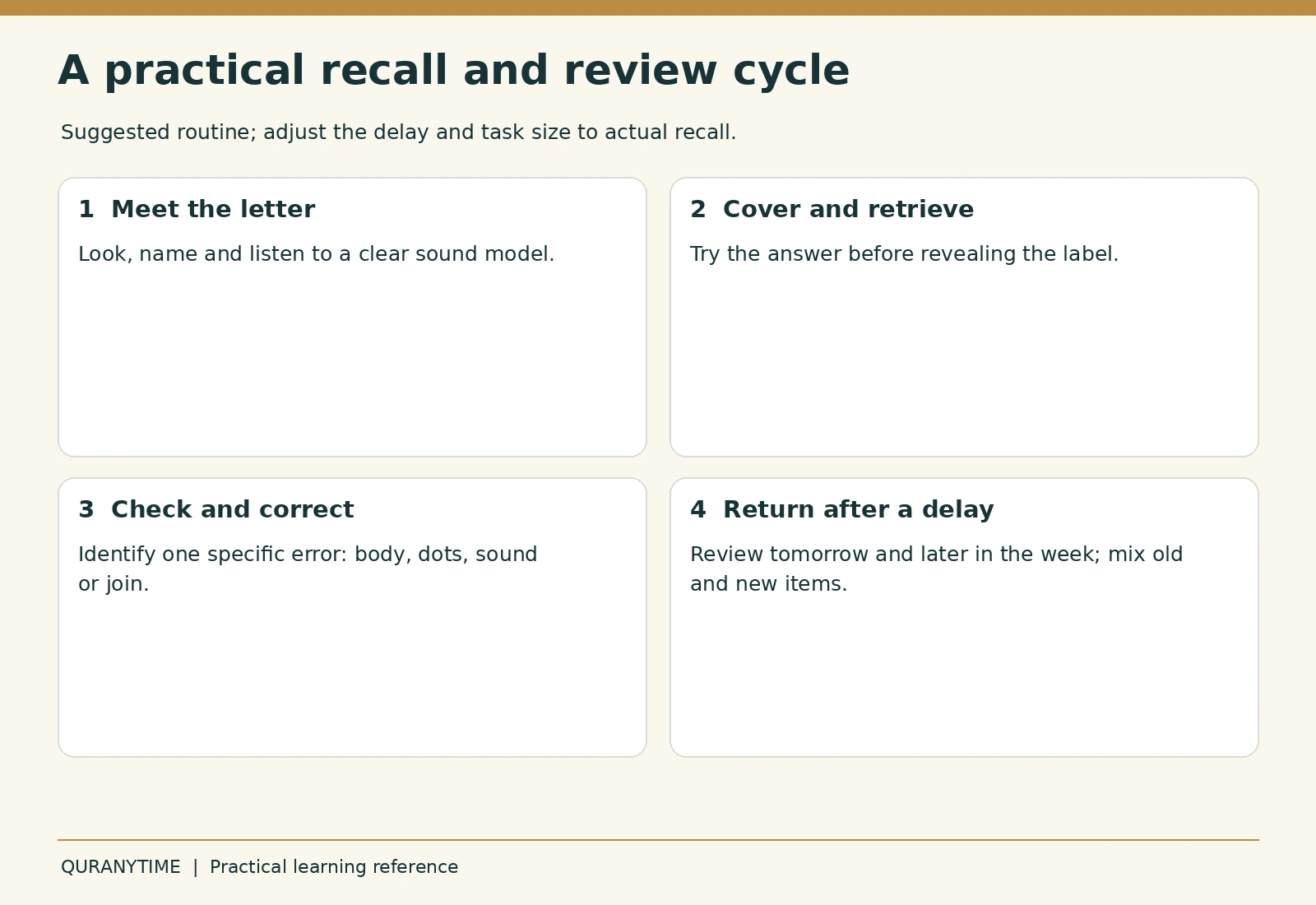
Retrieval means trying to bring an answer to mind before seeing it. For alphabet learning, look briefly at a card, cover its label and name the letter. For a stronger test, hear a letter name and point to the matching shape among several choices. Later, write the letter from memory and check its dots.
Rereading a chart can feel smooth because the answer remains visible. That feeling does not always predict whether you will remember the letter tomorrow. A short unsuccessful attempt followed by a clear correction is informative: it shows the exact confusion that needs attention. Do not turn the activity into a high-pressure exam, especially with children.
The Learning Scientists describe retrieval and spaced practice as useful study strategies. Applying them here means a brief attempt, immediate correction and another encounter after a delay. The particular alphabet routines in this article are teaching suggestions, not a published trial demonstrating that one schedule works best for every learner.
Space the reviews across days
Instead of completing all practice on one evening, revisit the material tomorrow and later in the week. A starting pattern might be an initial lesson, a review the following day, another a few days later and a later check after a week. Adjust the intervals according to actual recall rather than treating the dates as a rigid rule.
Letters recalled confidently after a delay can receive less attention. Letters confused repeatedly should reappear sooner and in clearer comparisons. If you miss several sessions, restart with a short mixed check. Do not punish yourself by repeating every page from the beginning when only a few families remain uncertain.
A review log needs only three columns: target, error and next practice. For example, the learner confused ت with ث because the dots were not counted. The next task is a mixed dot-family check, not an unrelated exercise. This makes the review responsive and keeps the workload manageable.
Learn connected forms without multiplying the alphabet
Arabic letters change appearance as they join. Initial, medial and final forms belong to the same letter identity. Instead of memorizing every form as a separate picture, ask what remains stable: a dot pattern, a distinctive body or a familiar opening. Then notice which connecting strokes change.
Take ب as an example: ب, بـ, ـبـ and ـب are forms of the same letter. The dot remains below while the connection changes. Compare the forms inside short words so that they become reading clues rather than isolated symbols on a large chart.
Six letters do not connect onward to the following letter in the right-to-left sequence: ا د ذ ر ز و. Learn those breaks as part of word recognition. The guide to Arabic letter forms in words provides a focused next step once isolated recognition becomes comfortable.
A flexible fourteen-day starter sequence
During the first two days, learn a small set of shape families with audio. Spend more time checking distinctions than adding new material. On days three and four, mix the learned cards, test recall and introduce another small family. Keep a record of genuine confusions so that the next review has a clear purpose.
On days five and six, introduce connected forms for letters already known. On day seven, review rather than adding more. During the second week, alternate recognition, listening and short vowelled examples. Gradually include the remaining letters while preserving a small review set from earlier lessons.
By the final day, attempt an untimed mixed check and read a few familiar examples. If you are still uncertain, repeat the relevant stage. This sequence is a framework for organizing practice, not a prediction of the level you must reach by day fourteen. The important result is knowing what you recognize reliably and what remains unclear.
Make practice work for children
Use short turns, large readable cards and a small choice set. Ask the child to find one matching letter, then switch roles so they can quiz the adult. A playful activity works best when the learning target remains visible. Elaborate rules, loud rewards or a timer can distract from the difference between two dot patterns.
Praise a useful action: checking the dots, correcting a guess or remembering a letter after a delay. Avoid making speed the only measure of success. A child who takes a moment to inspect ت and ث is developing a better habit than one who answers rapidly and randomly.
For variety, use Arabic alphabet learning games after a brief direct lesson. Watch whether the child identifies the letter itself or simply remembers where the answer appears on the screen. Change the order and ask a follow-up question to check transfer.
Help adults avoid common traps
Adults often try to master all details before reading a first word. Another common pattern is collecting many apps without practising consistently in any one system. Choose a reference, a sound model and a short routine. Add a new tool only when it solves a specific problem, such as hearing a difficult contrast or tracking review.
Avoid relying entirely on transliteration. It may help at the beginning, but cover it occasionally and attempt the Arabic directly. Otherwise your eyes can learn to skip the script and read the English approximation instead. Increase difficulty gradually rather than removing all support at once.
Handwriting can support recognition when the learner checks what they produce. Use the Arabic alphabet writing guide for formation and joins. Copying should remain connected to naming and reading; a page of attractive shapes is not enough evidence of independent recognition.
Troubleshoot the errors you actually make
If you know a letter in order but not alone, shuffle the cards. If you know it alone but not in words, practise its contextual forms. If you recognize it but cannot pronounce it, reduce the visual work and seek listening feedback. If yesterday’s letters disappear today, shorten the new set and strengthen delayed review.
When two letters keep colliding, place them side by side and name one meaningful distinction. Then test them among a few unrelated letters. Practising only the difficult pair can make the answer predictable; a mixed set shows whether recognition survives outside the comparison exercise.
Keep a small success set as well as an error set. Beginning each session with a few secure items builds momentum and confirms retention. Finish with one recently corrected item so that the session ends with a clear example of improvement rather than a vague feeling that the alphabet is still too large.
Download the recall worksheets
Download the free three-page practice worksheets and answer guidance (PDF). No registration is required.
The pack contains a dot-family reference, a blank recall grid, a review tracker and teacher-guided sound prompts. Use the answer guidance only after an attempt. Mark recognition, naming and sound separately so that a pronunciation difficulty does not erase credit for correctly recognizing the printed letter.
Keep the dated sheets rather than replacing them with perfect rewritten copies. Comparing real attempts reveals whether the same confusion is becoming less frequent. A parent or teacher can select the next small practice set from those patterns instead of assigning more material automatically.
Keep the review record honest
Record an uncertain answer as uncertain, even if you recognized the correct choice after revealing it. That distinction helps you choose the next practice set. A guessed answer and a confident recalled answer are different observations. On the next day, begin with the uncertain items in a new order, then mix them with secure letters. If a letter is repeatedly correct in isolation but uncertain inside a word, move the practice into words rather than increasing isolated repetitions. The record is a decision aid, not a grade that has to look impressive to someone else.
Frequently asked questions
Must I learn all 28 names before reading?
No. You can begin reading simple vowelled examples with a small set of known letters. Continue learning names and forms while gradually building decoding skills. The right pace depends on the learner and the material.
Is singing the alphabet enough?
It can support ordered recall, but it does not test recognition out of sequence or inside words. Add shuffled cards, sound matching and short reading examples so the skill becomes usable beyond the song.
How long should a session last?
Choose a duration that allows attention and comfortable correction. A few focused minutes can be useful, particularly for a child. Longer sessions are appropriate only while the learner remains engaged and checks accuracy.
What if I keep forgetting?
Reduce the number of new letters, compare the confusing shapes and revisit them after delays. If progress remains difficult, a teacher can check whether the obstacle involves sound, vision, attention, task design or unfamiliar connected forms.
Can I get individual guidance?
To identify your starting level and choose a manageable routine, book a free trial class. Bring your recall grid and a few examples of letters you confuse. Those details help the teacher make the first practice session specific.
References and teaching scope
See The Learning Scientists’ strategy explanations for retrieval and spacing, and Madinah Arabic’s connecting-letters lesson for positional forms. The sequence, activities and tracker are original practical suggestions and do not guarantee a particular completion time.