
Learning how to pronounce Arabic ayn is less about finding a perfect English spelling and more about hearing a contrast, then building a calm, repeatable habit.
The Arabic letter ʿayn, written ع, is unfamiliar to many English-speaking learners. It is often represented in phonemic writing as /ʕ/, or in transliteration with a curved mark such as ʿ or ʕ. Those symbols are useful labels, not a pronunciation shortcut. No single English sound, letter, or spelling captures ʿayn exactly. A careful learner therefore starts with the ear: notice what a reliable Arabic speaker does, distinguish it from a nearby sound, and only then try a small, relaxed imitation.
ʿAyn and hamza are different letters
ʿAyn (ع) and hamza (ء) can look similar in some transliteration systems, but they are not interchangeable. ʿAyn is a consonant made with a constricted, voiced pharyngeal quality in many careful forms of Arabic. Hamza is a glottal stop: a brief interruption or closure at the vocal folds. In a word, hamza can feel like the small catch some English speakers make between the vowels in “uh-oh,” although that analogy is limited and should not be treated as an exact English equivalent.
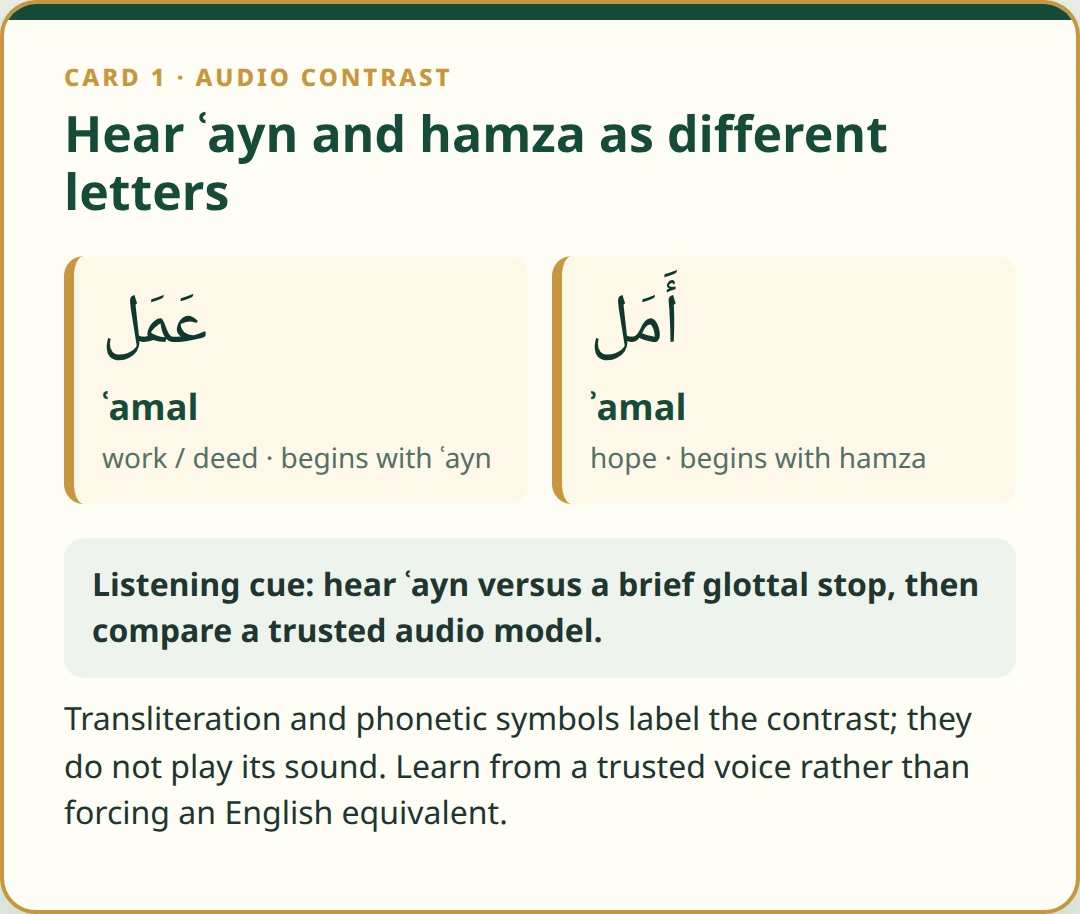
Compare the vowel-marked pair عَمَل ʿamal (“work” or “deed”) and أَمَل ʾamal (“hope”). The first begins with ʿayn; the second begins with hamza, shown here by ʾ. Their vowels are alike, but the opening consonants are not. If you replace ʿayn with a glottal catch, listeners may hear a different word. The goal is not to force a dramatic sound. It is to learn to hear and preserve the difference.
This listening-before-production order is also a sound teaching principle for English-speaking learners: a TESOL discussion of teaching ʿayn highlights discrimination and minimal-pair work before controlled production. Apply that idea gently. You do not need to squeeze, scrape, or push your throat. Listen for the contrast, keep your breathing easy, and let a qualified teacher refine the result.
See ʿayn in three word positions
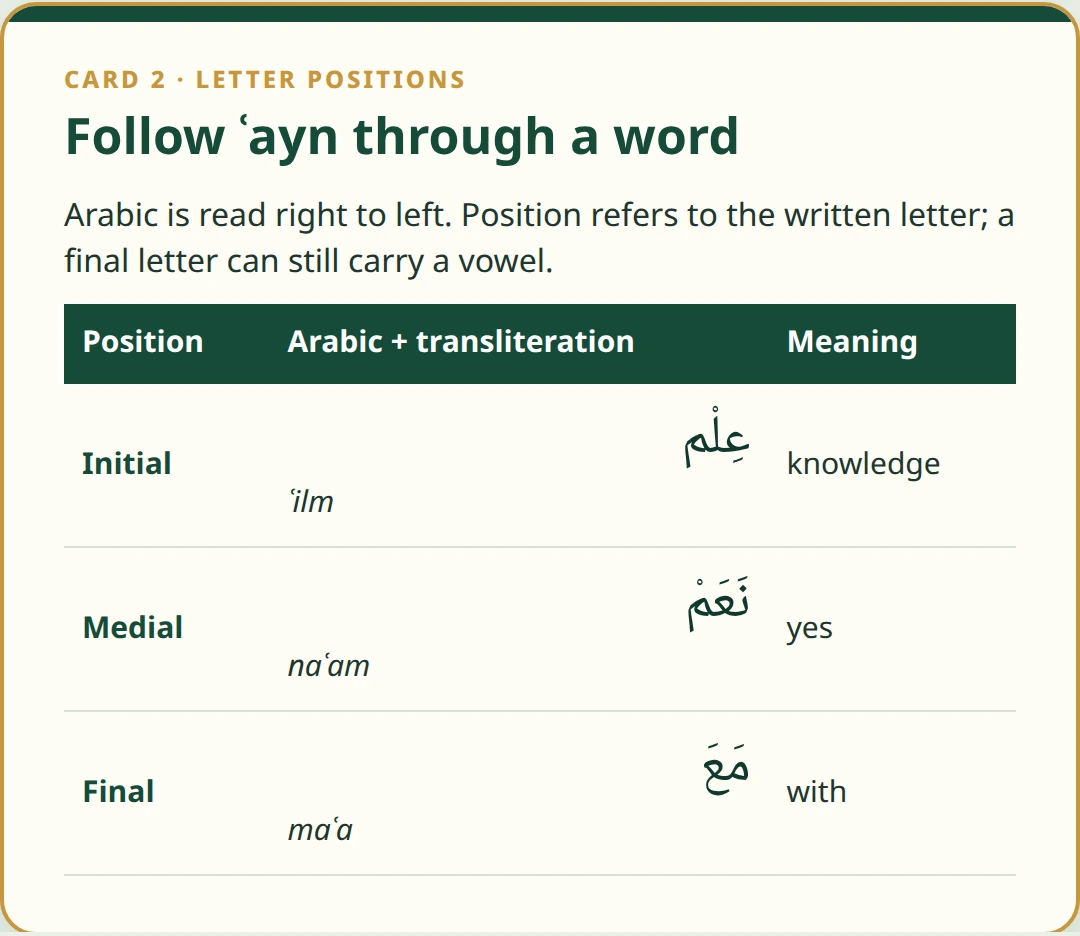
Arabic is read from right to left. In the examples below, the transliteration is only a learning cue. Position means the letter’s place in the written word; a final letter can still carry a vowel. Surrounding vowels affect what you hear.
- Initial: عِلْم — ʿilm — “knowledge.” Begin by hearing ʿayn before the short i vowel: عِ.
- Medial: نَعَمْ — naʿam — “yes.” Here ʿayn is between nūn and mīm, with short a vowels on either side of its sound.
- Final: مَعَ — maʿa — “with.” Hear the consonant between the two short a vowels: مَعَ.
Read each word slowly from the Arabic script, but do not let the Latin spelling become a substitute for audio. In ʿilm, the initial ʿayn is part of the word from its first moment. In naʿam, its transition between vowels matters. In maʿa, the repeated vowel pattern can tempt a learner to glide over the consonant. A short pause between attempts is fine; inserting an unintended hamza is what you are learning to notice and reduce.
A listening-and-imitation routine
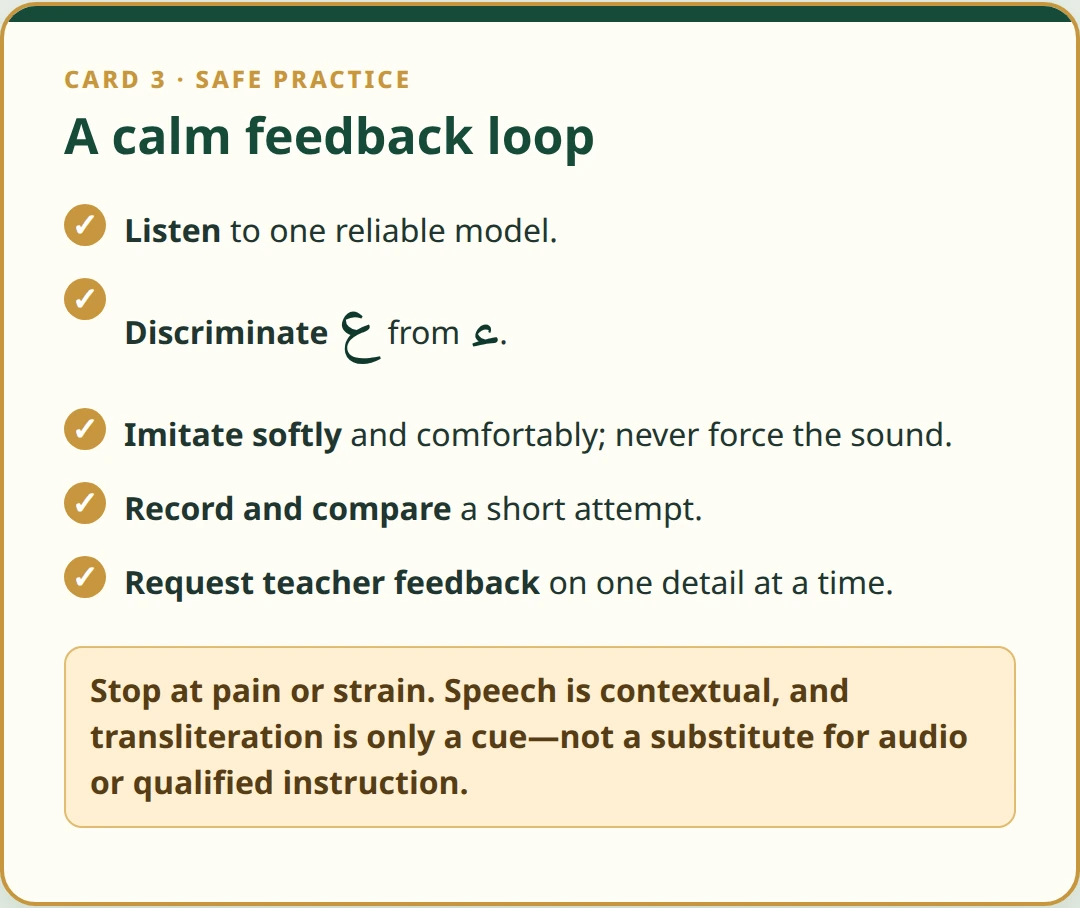
Use one trusted reciter, teacher, or carefully produced lesson audio for a short session. Avoid comparing many accents at once. Your first task is not to sound native; it is to build a stable listening category.
- Listen without reading. Hear ʿamal and ʾamal several times in random order. Write or point to the word you think you heard. If you cannot reliably tell them apart, stay here a little longer.
- Listen with the script. Reveal عَمَل and أَمَل. Notice that the written letters identify the contrast more safely than a guessed English spelling. Repeat the same exercise with عِلْم, نَعَمْ, and مَعَ.
- Shadow one syllable. After the model, imitate only the opening عَ, then عِ, without increasing volume. Keep your jaw and face loose and use ordinary, comfortable airflow.
- Expand to the word. Say عَمَل, then عِلْم, نَعَمْ, and مَعَ. Keep the vowels clear and avoid adding an extra vowel before ʿayn.
- Switch the contrast. Alternate عَمَل and أَمَل at a comfortable pace. The listener’s judgment matters more than an impressive-sounding effort.
- Use a short Quranic phrase only with guidance. Once the isolated words are comfortable, practise ʿayn in a phrase your teacher has selected. Preserve the vowels, timing, and stopping rules rather than treating one consonant as a separate performance.
Record, compare, and invite useful feedback
Make a brief phone recording in a quiet room: one model, one attempt, and one repeat. Leave a second of silence between words. Listen back at normal volume, then compare with the same model. Ask three questions: Did I hear a consonant where the model has ʿayn? Did I replace it with the catch of hamza? Did I add tension or change the vowel while concentrating?
Do not grade yourself by waveform shape or by whether a transliteration looks right. A recording helps you notice consistency, but an experienced Arabic or Quran teacher can hear details that a beginner cannot. Send a small, specific sample and ask for one correction at a time, such as “Is the initial consonant present in عِلْم?” A teacher can also tell you when a difference reflects dialect, register, or the conventions of Quran recitation rather than a simple error. For practical feedback habits, see this guide to recording Quran recitation for teacher feedback and these tips for asking a Quran teacher better questions.
A realistic practice plan
Try five to ten calm minutes, four days a week, for two or three weeks before judging progress. Spend about half the time on listening discrimination, a quarter on soft imitation, and a quarter on recording one or two words. Stop while the sound is still comfortable. Short, regular exposure usually teaches more than a long session in which you chase a difficult sensation.
Keep a simple log: date, audio model, words practised, what you heard, and the next question for your teacher. Rotate position only after you can hear the target in the current one. A broader pronunciation guide for English-speaking Quran learners can help you place this work within a wider plan, while a between-lessons Tajweed routine can keep practice sustainable.
If the Arabic script itself still feels slow, review the step-by-step Arabic alphabet guide and return to the vowelled examples here. Recognizing ع quickly makes it easier to give your full attention to the audio contrast.
Dialect, register, and Quran recitation
Arabic speakers differ by dialect, speaking rate, and level of formality. Classroom Arabic, Modern Standard Arabic, everyday dialects, and Quran recitation may not sound identical. The target in a Quran lesson is guided by the recitation tradition and your teacher’s model, not by a random online transliteration or one English speaker’s approximation. Listen to the same reliable model long enough to learn its pattern.
This article is an introduction, not a replacement for Tajweed or qualified Quran recitation instruction. For recitation practice, use a reliable Quran platform or a qualified teacher who can provide the exact passage, a consistent reciter, and correction in context. Quranytime’s overview of Quran in Tajweed is a useful next step for understanding why individual sounds belong inside a complete recitation framework. If you need structured support, you can book a free trial class and ask specifically for listening and feedback on ʿayn.
Watch: hear first, then practise
Use the accompanying video as a listening model, not as a test of how forcefully you can produce the sound. Pause after each example, identify ʿayn or hamza, and imitate only at a comfortable level.
Frequently asked questions
Is ʿayn the same as the “ayn” in an English word?
No. The spelling ayn, the mark ʿ, and /ʕ/ are conventions for pointing to an Arabic consonant. They do not encode a perfect English pronunciation. Let the audio and script work together.
Can I replace ʿayn with hamza while I practise?
It is a common early substitution, especially for English speakers. Notice it without panic, return to the contrast عَمَل versus أَمَل, and ask a teacher to check your recording.
How long will it take to master?
There is no responsible universal timetable. Progress depends on hearing experience, language background, the model you follow, and feedback. Aim for clearer discrimination and comfortable consistency, not a promised deadline.
What if my throat feels sore or strained?
Pause immediately. Do not squeeze, scrape, force, or use strained or medical manipulation to make ʿayn. Rest and resume only if speaking is comfortable. If pain, persistent discomfort, or voice change continues, consult a qualified Arabic teacher for technique and an appropriate clinician for a health concern.
The durable goal
To learn how to pronounce Arabic ʿayn well, begin by hearing it accurately, distinguishing it from hamza, and imitating a trustworthy model softly. Read the vowelled Arabic from right to left, practise initial, medial, and final examples, record short attempts, and invite patient feedback. With a safe routine, the sound can become more familiar without turning practice into a struggle.