
When you read the Quran, a small word can quietly change the grammar of an entire sentence. The family known as inna and its sisters, or inna wa akhawatuha (إِنَّ وأخواتها), is one of those families. These particles often introduce emphasis, explanation, hope, comparison, limitation, or a wish. More importantly for a learner, they change the case pattern of the nominal sentence that follows them.
This lesson gives you a practical way to recognize Arabic إن وأخواتها while reading Quranic Arabic. You will learn what to look for, how attached pronouns fit into the pattern, why a final vowel is not always obvious, and how context controls translation. The aim is not to force every particle into one English word; it is to help you read the structure accurately.
Start with the sentence before the particle
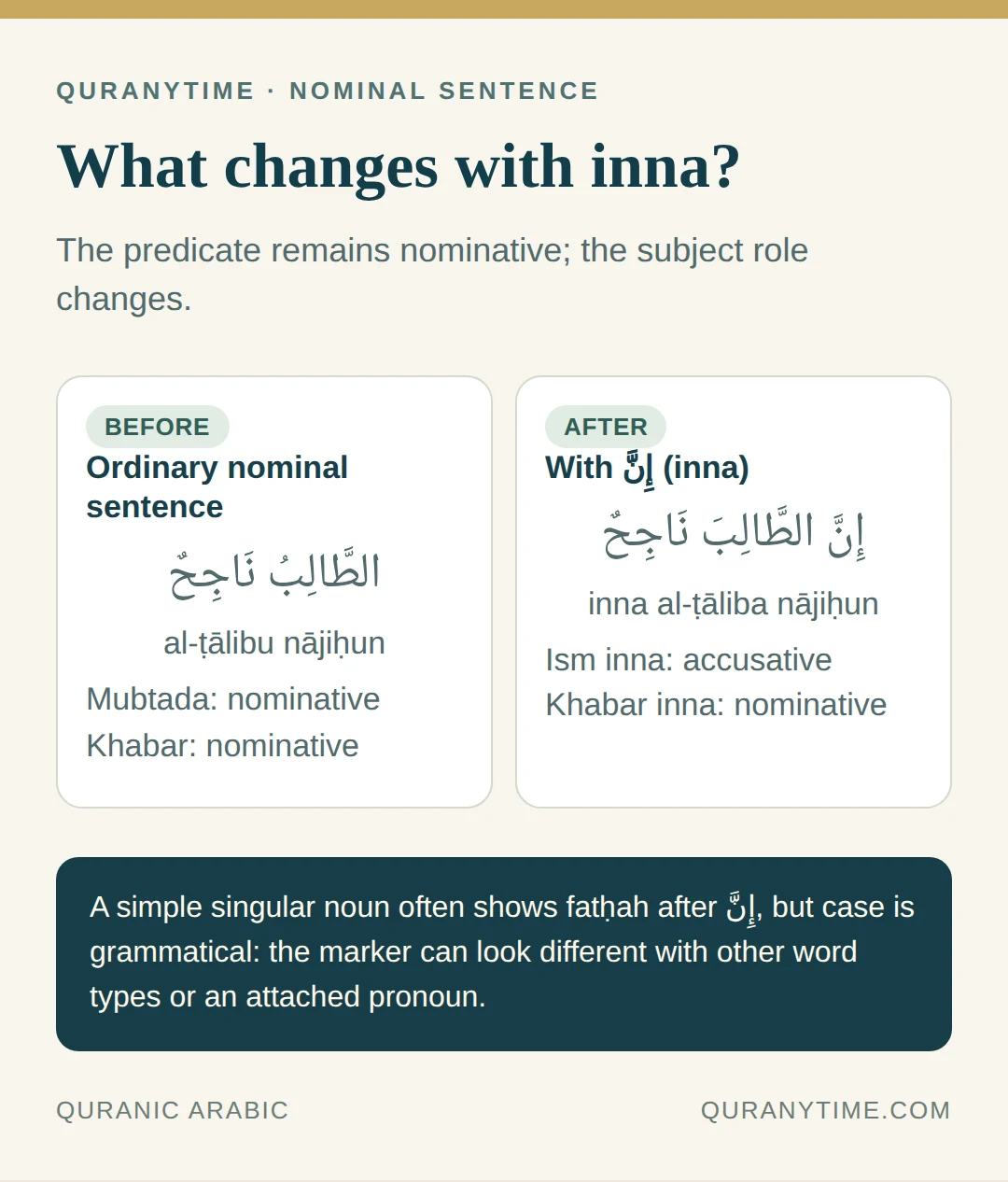
A basic Arabic nominal sentence normally begins with a mubtada (subject/topic) and a khabar (predicate). Both are normally marfūʿ, or nominative. For a refresher, review this nominal sentence foundation for Quranic reading. In a simple example, الطَّلَابُ مُجْتَهِدُونَ means “the students are hardworking”: الطَّلَابُ is nominative, and مُجْتَهِدُونَ is also nominative.
When one of the inna particles enters, the subject role changes: the ism inna becomes manṣūb (accusative), while the khabar inna remains marfūʿ (nominative). Think of the particle as announcing a new grammatical relationship, not merely as adding an English adverb.
The six members of inna wa akhawatuha
The traditional teaching list contains six particles. Their broad associations are useful, but the surrounding clause always matters. A context-sensitive reading is safer than memorizing one fixed translation.
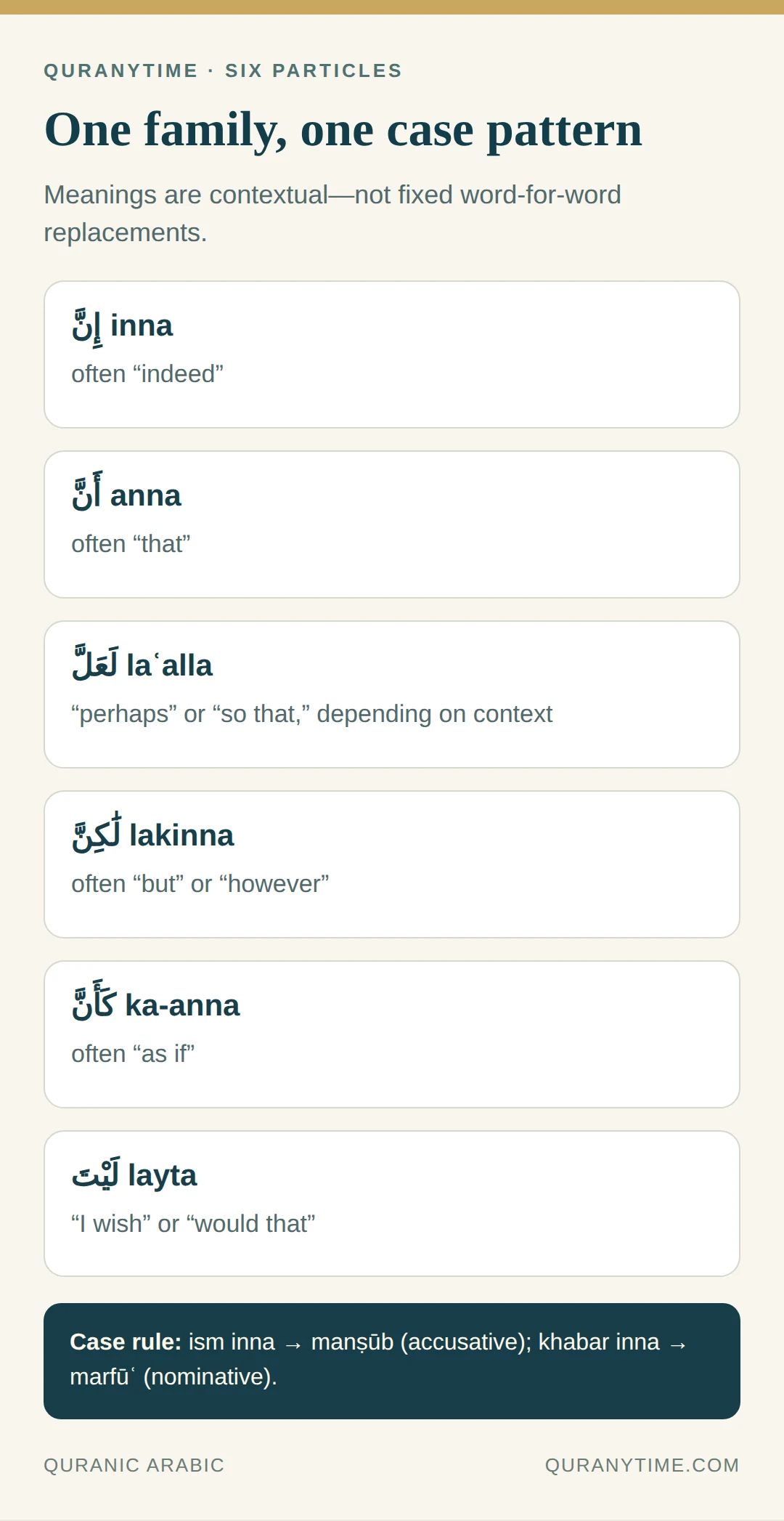
| Particle | Transliteration | Common contextual association |
|---|---|---|
| إِنَّ | inna | indeed, certainly, emphasis |
| أَنَّ | anna | that; often inside a larger clause |
| لَعَلَّ | laʿalla | perhaps, or a context-dependent “so that” sense |
| لَٰكِنَّ | lakinna | but, however, contrast |
| كَأَنَّ | ka-anna | as if, as though, comparison |
| لَيْتَ | layta | would that, I wish, an unattainable or poignant wish |
For a concise grammatical reference, consult the Quranic Arabic Corpus documentation on the particle inna. In actual reading, ask both “Which particle is this?” and “What job is it doing in this sentence?”
Read the rule in Quranic examples
1. إِنَّ: emphasis and a clear accusative noun
In Quran 100:6, the wording is إِنَّ الْإِنْسَانَ لِرَبِّهِ لَكَنُودٌ (inna al-insāna li-rabbihi la-kanūdun). The ism is الْإِنْسَانَ, marked accusative. The predicate is لَكَنُودٌ, marked nominative. Notice that the initial lām in لَكَنُودٌ is emphatic; it is not a preposition. The phrase لِرَبِّهِ, by contrast, contains the preposition lām and an attached pronoun.
2. أَنَّ: “that” inside a larger structure
Quran 9:3 has أَنَّ اللَّهَ بَرِيءٌ مِّنَ الْمُشْرِكِينَ (anna Allāha barīʾun mina al-mushrikīn). After أَنَّ, اللَّهَ is accusative, while بَرِيءٌ is nominative. The prepositional phrase مِّنَ الْمُشْرِكِينَ completes the meaning of the predicate. Do not mistake a long predicate phrase for a second case-changing particle.
3. لَعَلَّ: let the context guide the expectation
In Quran 28:29, Moses says لَعَلِّي آتِيكُم مِّنْهَا بِخَبَرٍ (laʿallī ātīkum minhā bi-khabar). The attached -ي is the ism of لَعَلَّ. The verbal clause that follows functions as its predicate. Depending on the wider context, a translator may use “perhaps,” “so that,” or another expression of expectation or purpose. The grammar is firm even when the best English gloss varies.
4. كَأَنَّ: comparison with an attached pronoun
Quran 37:49 reads كَأَنَّهُنَّ بَيْضٌ مَّكْنُونٌ (ka-annahunna bayḍun maknūnun). The attached هُنَّ is the ism of كَأَنَّ. بَيْضٌ is the nominative predicate, and مَّكْنُونٌ is its adjective, agreeing with it. The attached pronoun carries the grammatical role even though there is no separate noun with a visible final fatḥah.
5. لَيْتَ: a wish and its following content
In Quran 69:25, the lament is يَا لَيْتَنِي لَمْ أُوتَ كِتَابِيَهْ (yā laytanī lam ūta kitābiyah). The يَا is a separate vocative particle. The attached -نِي is the ism of لَيْتَ, and the following clause supplies the content of the wish. Keep the vocative separate when you parse the sentence.
6. لَٰكِنَّ: contrast, including Quranic attached forms
Quran 18:38 contains لَٰكِنَّا هُوَ اللَّهُ رَبِّي (lākinnā huwa Allāhu rabbī). This is a Quranic form with an attached pronoun. It is best to identify the particle and the attached element first, then read the following clause in its full discourse context rather than forcing a simplistic word-by-word diagram.
Case markers are clues, not a single visual formula
“Accusative” does not mean “the word must end in fatḥah.” A singular fully declinable noun often shows -a, but a dual noun, sound masculine plural, diptote, or certain pronouns can display another marker or no audible ending in ordinary writing. Review the wider system in this guide to Arabic case endings for Quranic reading, and use the lesson on dual-noun markers when the noun is dual.
The same caution applies to attached pronouns. An attached element may be the ism, as in لَعَلِّي, كَأَنَّهُنَّ, or لَيْتَنِي. To strengthen that skill, practice identifying forms with this guide to attached Arabic pronouns. First identify the word’s role; only then ask how its case is represented.
Also remember that “predicate” describes a function, not necessarily a single noun. The khabar may be a descriptive word such as بَرِيءٌ, a phrase introduced by a preposition, or a whole clause containing its own verb and objects. In a translation, that predicate can appear far from the particle because Arabic may place a phrase first for emphasis or rhythm. Keep the particle and its ism together in your mental parse, then gather the remaining information before deciding where the English predicate should appear. This prevents a common error: assuming the first noun after the particle must be the whole meaning of the sentence.
Do not confuse similar-looking particles
إِنَّ (inna) has a shadda and belongs to the case-changing family. إِنْ (in) has no shadda and often introduces a conditional clause. Their spelling, vowel marks, and clause function must be read together. See the guide to Arabic conditional sentences for that contrast.
Likewise, لَٰكِنَّ (lakinna) with shadda is the particle in this family, while لَكِنْ (lākinn) without the shadda is a conjunction meaning “but” and does not impose the same ism/khabar pattern. Recitation marks may make the distinction easier to hear, but context and clause function remain essential. Also compare this system with kāna and its sisters: the usual kāna-family pattern has a nominative ism and an accusative khabar, the opposite direction from inna.
A repeatable five-step reading checklist
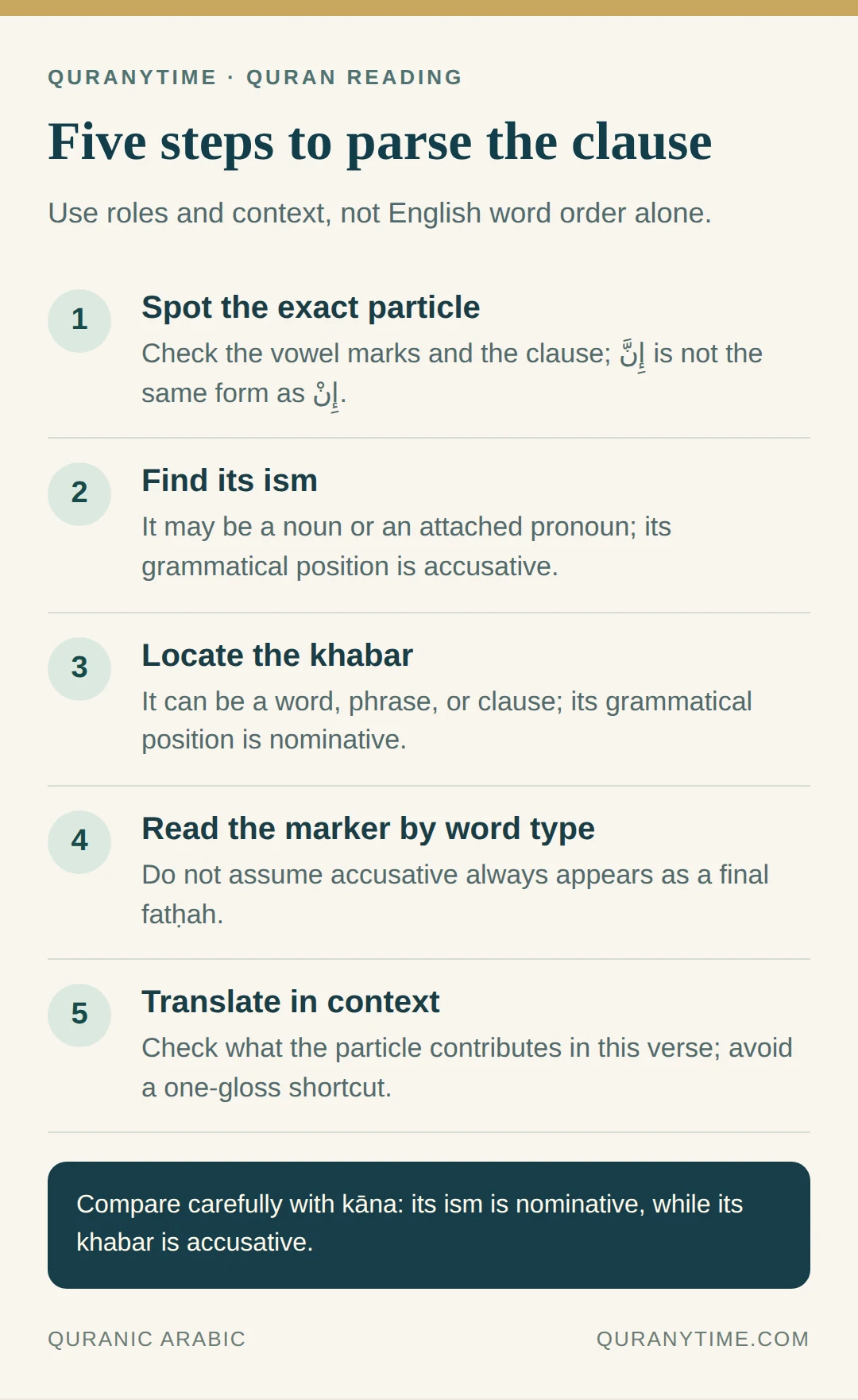
- Spot the particle: look for one of the six forms and check shadda, vowels, and attached letters.
- Identify the ism: find the noun or attached pronoun governed by the particle; expect an accusative role.
- Locate the khabar: it may be one word, a prepositional or adverbial phrase, or a complete verbal or nominal clause.
- Check the marker by word type: do not demand a final fatḥah; consider dual, plural, diptote, and pronoun behavior.
- Translate by context: preserve the relationship and discourse meaning before choosing a smooth English equivalent.
Short practice: parse before translating
Try these two questions without looking back. (1) In كَأَنَّهُنَّ بَيْضٌ مَّكْنُونٌ, what is the ism, and what is the khabar? (2) In يَا لَيْتَنِي لَمْ أُوتَ كِتَابِيَهْ, what is separate from لَيْتَ, and what carries the ism role?
Answers: (1) هُنَّ is the attached ism of كَأَنَّ; بَيْضٌ is the nominative predicate, with مَّكْنُونٌ as its adjective. (2) يَا is the separate vocative particle; -نِي is the ism of لَيْتَ, while the following clause expresses the wished-for content.
Conclusion: read the relationship, not just the gloss
Learning inna and its sisters becomes much easier when you stop treating them as an isolated vocabulary list. Notice the particle, identify its accusative ism, find the nominative khabar or predicate clause, and then let the context shape your translation. This method works whether the ism is a fully visible noun, a dual form, or an attached pronoun.
Read a few verses aloud, mark the two core roles, and compare your analysis with a reliable corpus. If you want guided practice with Quranic grammar and pronunciation, you can book your free Quran and Arabic trial class and work through these patterns with a teacher.
For listening practice, revisit the examples slowly and listen for the shadda and the case endings before translating. Keep the checklist beside your Quran until the pattern becomes automatic.