

When a teacher says a recitation includes lahn jali or lahn khafi, it can be hard to know what the terms mean—or what to practise next. They are commonly used to distinguish clear wording-level errors from subtler issues in applying Tajweed. They are learning labels, not a score of your ability or a verdict on your sincerity.
This guide explains the usual distinction, shows how to ask about a specific correction, and offers a calm practice sequence. A teacher should confirm what happened in the actual verse and reading tradition. The terms alone do not decide a religious ruling.
What does “lahn” mean in Tajweed?
In this context, lahn means a deviation from the intended recitation. It might concern the identity of a letter, a vowel or word form, or a feature such as a rule’s timing. The first useful question is not “How serious is my mistake?” but “What exactly did the listener hear?”
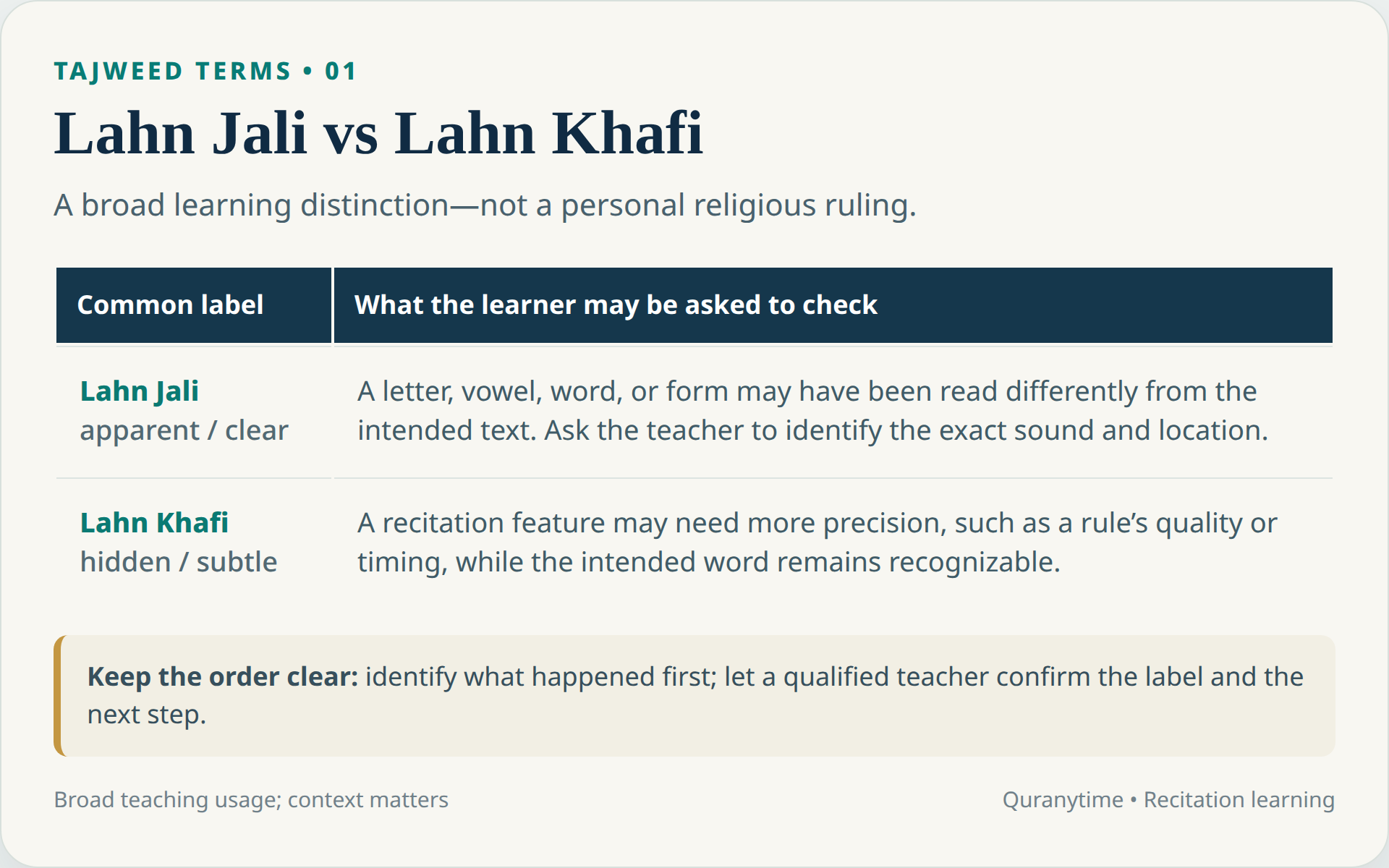
The usual Lahn Jali vs Lahn Khafi distinction can help describe the kind of issue. In broad teaching usage, jali means apparent or clear, while khafi means hidden or subtle. The labels are not a substitute for hearing the learner or checking the particular passage. Start with the sound itself, then let a qualified teacher explain it.
Lahn Jali: when the wording or letter is at issue
A teacher may use lahn jali for a clear mistake in a letter, vowel, word, or grammatical form. Examples of areas to check include replacing one letter with another, adding or omitting a letter, or changing a vowel so the word is read differently. “Clear” describes the kind of error in this teaching framework; it does not mean every listener will notice it immediately.
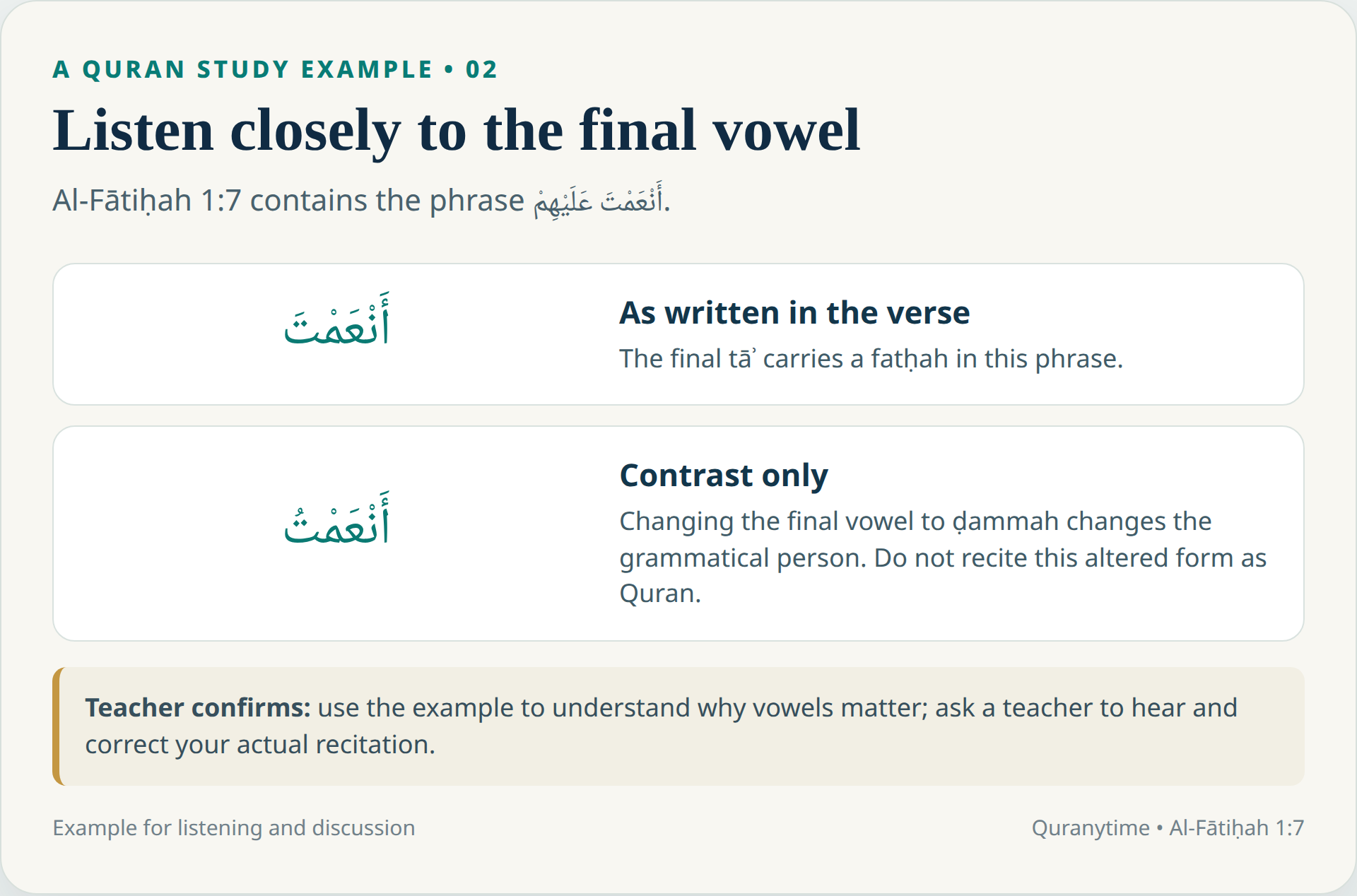
For a simple illustration, consider the phrase أَنْعَمْتَ عَلَيْهِمْ in Al-Fātiḥah 1:7. The final tāʾ in أَنْعَمْتَ has a fatḥah. If it were instead read with a ḍammah as أَنْعَمْتُ, the grammatical person changes. This is a contrast example for study, not an alternate form to recite. A teacher can explain the intended wording and help diagnose the learner’s actual sound.
Articulation is relevant when one Arabic letter is being produced as another. A sound that feels unfamiliar to an English-speaking learner is not automatically wrong, and accent alone is not a classification. Review the articulating place in Quranytime’s guide to Makharij al-Huruf and the distinct letter qualities in its Sifaat al-Huruf explanation, then ask a teacher to listen in context.
Lahn Khafi: when the issue is a subtle recitation feature
Lahn khafi is commonly used for a less obvious issue in the precision of a Tajweed feature while the intended word remains recognizable. A teacher might point out a required nasal quality, a measured prolongation, or a letter quality that needs more care. These are only example areas: whether a particular error fits the label depends on what was actually recited and on the teaching framework being used.
“Subtle” does not mean unimportant, and it does not mean a beginner should diagnose it alone. A small timing difference may be difficult for a learner to hear, while a trained teacher can explain what to notice. If a sound changes the letter or word itself, the issue may need to be described differently. Ask for the exact cue instead of guessing from a list of common mistakes.
For a wider map of areas to discuss with a teacher, see the Tajweed mistakes checklist. It is a broad practice aid; this page focuses on the difference between the two labels and how to follow up on a correction.
A careful way to tell the two descriptions apart
Use these questions to organize your conversation—not to issue yourself a Tajweed grade:
- Where did it happen? Mark the surah, verse, word, and whether you were reading slowly, connecting words, or stopping. A location lets the teacher hear the same context.
- What did the teacher hear? Ask whether the concern was a letter, a vowel, a word, or a rule feature. If you do not understand the correction, ask for a model and one thing to listen for.
- Could a recognized reading explain the difference? A valid riwāyah or recitation tradition is not an error merely because it differs from the version a learner usually hears. Check which reading you are studying before comparing examples.
- What should I practise first? Agree one small target. If the issue is confirmed, practise it in a short sound or word, then return to the complete phrase and ask the teacher to recheck it.
This process avoids a common trap: using “major” and “minor” as labels for how worried a learner should feel. Instead, write down what happened and what action was confirmed. A brief Quran recitation mistake log can help you remember the teacher’s wording and return to the same passage next lesson.
Why some cases need a teacher’s ear
Recitation happens in context. A sound heard in isolation may change when joined to neighbouring letters. A pause can affect the ending of a word. A letter’s weight, nasal quality, or duration must be judged in the specific rule and reading being practised. A text-only chart cannot hear whether the learner has actually changed the letter or whether the sound simply needs more polish.
There is also a difference between a recognized recitation and an accidental substitution. Do not “correct” a legitimate reading to match a recording from another riwāyah. If you are unsure, ask which transmission your teacher is using and follow that method. Quranytime’s Tajweed Guide can help you revisit terminology, while its Quran pronunciation practice guide covers sound contrasts and careful practice for English speakers.
Turn a correction into a useful practice plan
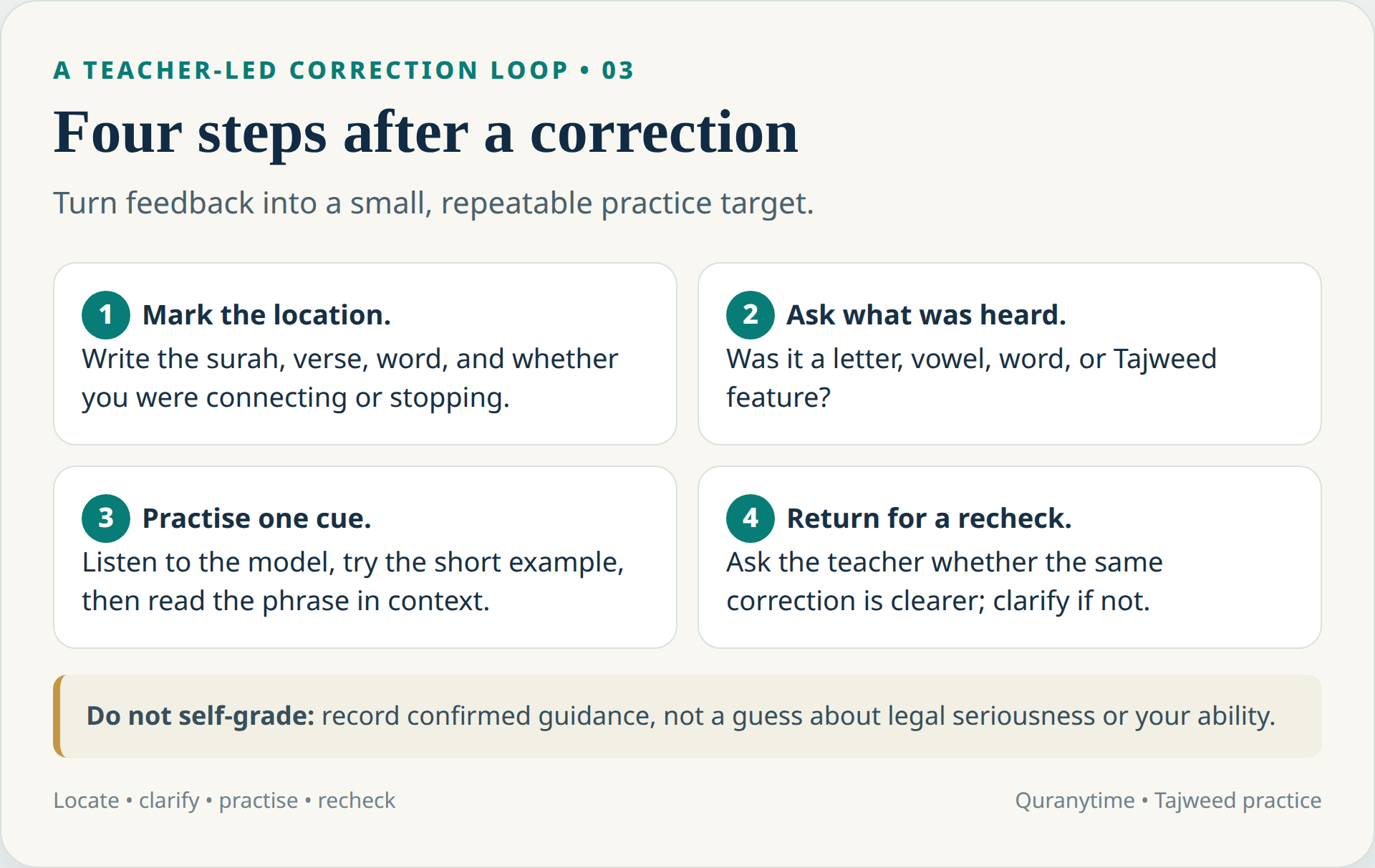
After the teacher confirms an issue, keep practice small and specific. First listen to the model at a comfortable speed. Then try the target sound or rule in the short example the teacher chose. Read the word, then the full phrase, and finally the surrounding line if you can keep the correction without rushing. If the sound becomes strained or you lose the place, pause and reset rather than repeating an uncertain version many times.
At the next lesson, return to the marked word and ask whether the correction is clearer. If it is not, ask what to adjust; do not promote your own impression into a diagnosis. A step-by-step Tajweed practice routine between lessons can support regular review without replacing live feedback.
If you would like an individual starting point, you can book a free Quran and Arabic trial class and ask a teacher to listen to a short passage. You do not need to know whether an issue is Jali or Khafi before asking for help. Describe where you felt uncertain and what you would like to improve.
These labels are not a personal religious ruling
A learning article can outline common terminology, but it cannot decide whether a particular recitation affects a prayer, what a person’s responsibility is, or how an individual case should be judged. Those are separate religious questions and may depend on details, ability, intention, and scholarly approach. This guide does not issue a fatwa. For a personal ruling, ask a qualified scholar; for a sound correction, ask a qualified Quran teacher.
For another learner-facing overview of how the two terms are used, see academic discussion of Lahn Jali and Lahn Khafi. Use it as an educational comparison, not as a personal religious ruling.
Frequently asked questions
Are Lahn Jali and Lahn Khafi the same as major and minor mistakes?
They are often explained that way in introductory material: Jali as apparent and Khafi as subtle. The shorthand can be useful, but it should not be used to decide a legal consequence. Ask the teacher to explain the exact sound and context.
Does a subtle mistake mean it does not matter?
No. A subtle issue may still be worth correcting as part of careful recitation. “Subtle” describes how the issue is commonly discussed, not whether a learner should ignore feedback.
Can I classify my own recitation by reading examples online?
Examples can help you ask a clearer question, but they cannot verify your sound. Make a note of the location, ask a qualified teacher to listen, and practise only the correction they confirm.
Does every difference between two recordings mean one is wrong?
No. A recognized recitation tradition may differ from the one you know. Confirm the riwāyah before comparing a detail, and follow the method your teacher has selected.
Video lesson
The following lesson introduces the terms and gives examples. It also discusses religious rulings from the presenter’s perspective; this article does not assess or endorse those rulings. Please consult a qualified scholar for a personal religious question.