
If you are searching for the qaf vs kaf pronunciation difference, begin with one simple idea: ق (Qaf) is made farther back than ك (Kaf). Both are back-of-the-tongue stop sounds, but they do not share the same contact point. In Quran recitation, the small shift matters because the Arabic letter must remain clear; English “q” and “k” are only rough labels, not a complete pronunciation lesson.
This guide compares the two sounds, shows them in short Quranic examples, and gives a careful practice routine. It builds on Quranytime’s broader guide to the makharij of Arabic letters, but keeps the focus here on just one useful contrast: how to hear and practise ق and ك without forcing the throat or changing the vowel.
Qaf and Kaf at a glance
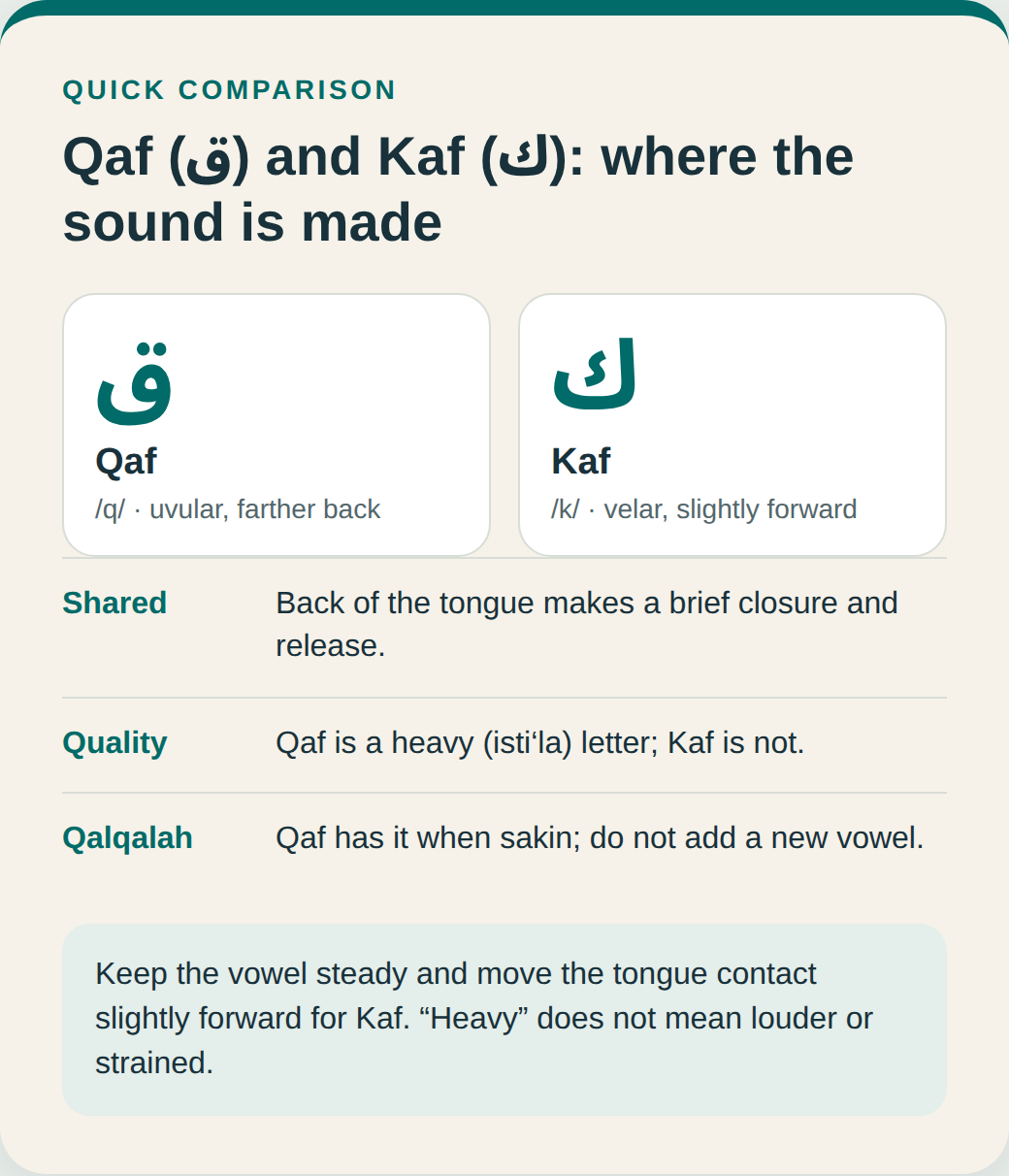
In a common classical articulation description, the back of the tongue rises toward the upper mouth for both letters. For Qaf, the contact is farther back, near the uvular area; for Kaf, it is slightly farther forward, at the velar area. Think “backer” and “forward of that,” not “throat versus lips.” The tongue makes a brief closure and release; the lips do not create either consonant.
The exact feel can vary with the surrounding vowel, a reader’s vocal tract, and their recitation tradition. The comparison is a starting map, not permission to make either sound painfully tight. Follow the pronunciation taught for your riwayah and use an experienced teacher when you are unsure.
Makhraj: where the difference begins
Makhraj means the articulation point: the place where the sound is formed. For both letters, the back of the tongue approaches the upper palate. Qaf is the more posterior of the pair. Kaf is made a little nearer the front of the mouth, though still well behind the teeth. Try to notice the movement as a small, controlled change in tongue contact rather than a completely different mouth shape.
A practical cue is to keep your jaw relaxed and the vowel steady while alternating the letters. If your “qa” and “ka” sound the same, slow down and listen again; do not compensate by swallowing Qaf or exaggerating Kaf. A general review of letter qualities (sifaat al-huruf) can help you separate the “where” of a sound from the “how.”
For a learner, the most important distinction is not a spelling trick. It is the audible result of a slightly more posterior closure for Qaf. In a 2025 phonetic study of Quranic recitation, researchers described /q/ as a uvular stop and /k/ as a velar stop; in their sample, spectral cues distinguished the two more consistently than segment duration. That finding supports paying attention to tongue placement, but it does not establish one universal listening test for every reciter. See the study, “Velar and Uvular Stop Production in Qur’anic Recitation”, for its methods and limits.
Letter qualities: heavy does not mean loud
Qaf is one of the letters of isti‘la, commonly taught among the heavy letters; Kaf is not in that group. “Heavy” describes a quality of articulation and resonance, not a louder voice, a longer consonant, or a strained throat. Keep the vowel natural. A useful next step is Quranytime’s explanation of heavy-letter levels.
Tajweed charts also describe other qualities, and terms such as jahr and hams belong to that technical system. Do not reduce the Qaf/Kaf difference to “one is voiced and one is voiceless.” The location of the closure is the clearer learner cue here. Qaf’s quality of qalqalah applies when Qaf is sakin; it does not mean adding an extra vowel every time the letter appears. See the site’s beginner guide to Tajweed for the broader framework.
Hear both letters in Quran words
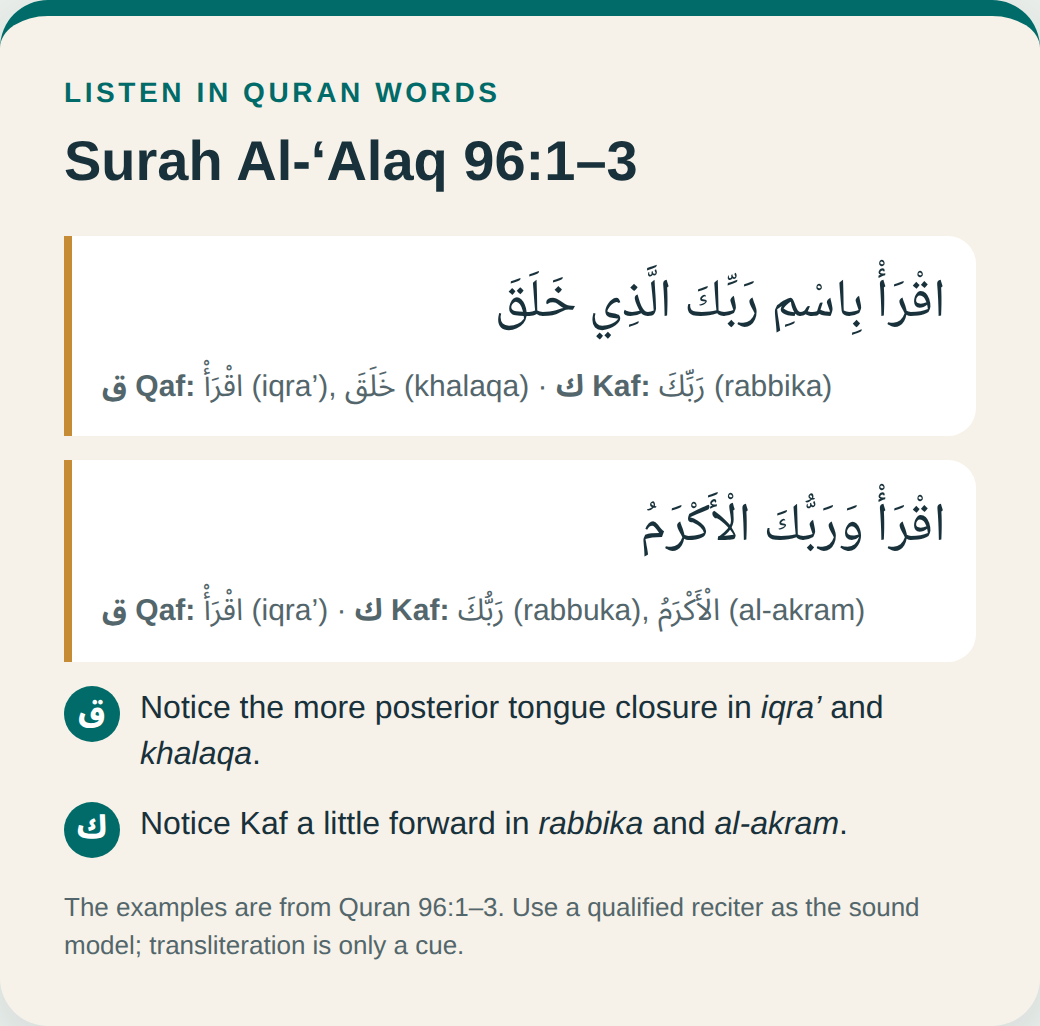
Surah Al-‘Alaq gives a short listening sequence. In verses 1–3, اقْرَأْ (iqra’) and خَلَقَ (khalaqa) contain Qaf. In the same passage, رَبِّكَ (rabbika) and الْأَكْرَمُ (al-akram) contain Kaf. Follow the Arabic text while listening; do not try to “hear an English q.” The video below is a male recitation with Quran text only, screened from beginning to end, so you can listen to those letters in connected reading.
Another useful line is Quran 2:21: رَبَّكُمُ الَّذِي خَلَقَكُمْ (rabbakumu alladhī khalaqakum). It contains Kaf in rabbakum, then Qaf and Kaf in khalaqakum. This is a helpful contrast in context, not a minimal pair: the words and meanings are different, so use it to listen for the two articulation points, not to compare identical word shapes.
Qaf and Kaf can be confused by learners for different reasons. Some English speakers bring the tongue contact too far forward for Qaf, making it resemble Kaf; others move Kaf too far back. These are practice clues, not a diagnosis of every learner. Quranytime’s English-speaker pronunciation guide explains why familiar English letter names and spellings can be unreliable guides.
A short Qaf-versus-Kaf practice routine
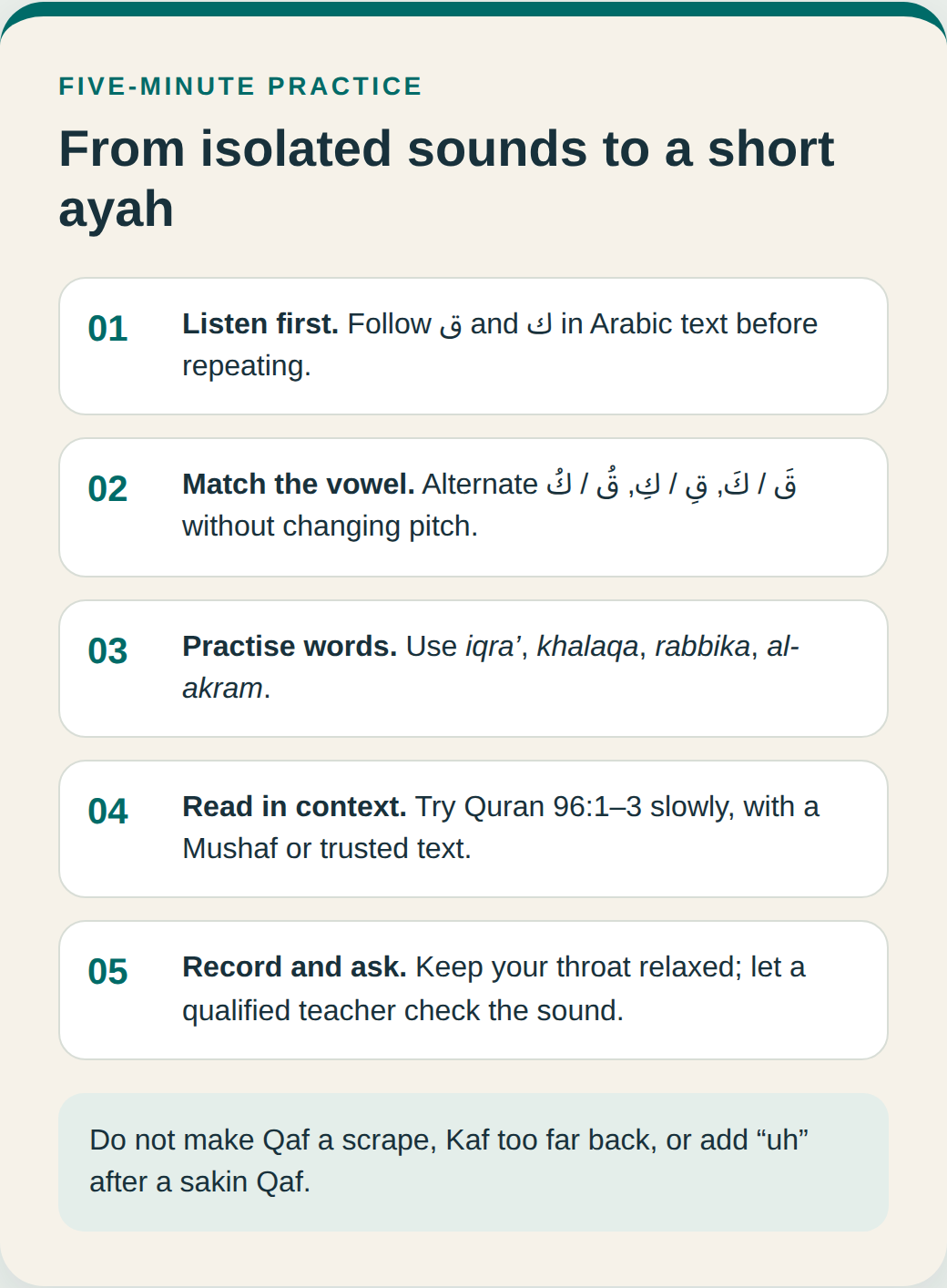
- Start with listening. Hear a careful Quran reciter say ق and ك in words you know. Follow the Arabic script and mark each occurrence before trying to imitate it.
- Keep the vowel matched. Alternate قَ / كَ, قِ / كِ, and قُ / كُ at a comfortable pace. Keep the vowel length and pitch similar so you can focus on the consonant location.
- Move into real words. Practise iqra’, khalaqa, rabbika, and al-akram from Surah Al-‘Alaq. Then read the 2:21 phrase above slowly with a Mushaf or trusted text.
- Record one short attempt. Listen back for whether Qaf sounds more posterior and Kaf slightly forward. Avoid judging only by “deep” or “sharp”; those impressions can be vague.
- Ask for feedback. A teacher can hear details a phone recording or transliteration may miss. Use consistent, unhurried practice rather than repeating a sound with tension. The related fluency guide explains why accuracy should come before speed.
Common mistakes to avoid
- Using English spelling as the rule. “Q” and “K” can help you remember which Arabic letter is written, but English speakers do not all pronounce those letters the same way. Return to Arabic listening and script.
- Pulling Qaf into the throat. The sound is formed with the back of the tongue; it is not a scrape or a painful constriction. Keep the release clear and relaxed.
- Making Kaf too far back. Kaf is posterior, but it is not formed at the same point as Qaf. Bring the contact slightly forward rather than changing the vowel.
- Adding a vowel to Qaf when sakin. If Qaf carries qalqalah, let the consonant release resonate briefly according to your teacher’s model; do not append an “uh” or “ah.”
- Copying a spoken dialect for Quran recitation. Arabic dialects may realize Qaf differently. Learn the Quranic reading convention you follow instead of assuming a colloquial form is the recitation target.
If you are also working on other difficult points of articulation, Quranytime’s focused Dhad pronunciation lesson shows how one letter-specific drill can build on a broader makhraj map without replacing teacher feedback.
Check the sound across vowels and word positions
Do not practise only one vowel or one isolated syllable. Try قَ / كَ, then قِ / كِ and قُ / كُ while keeping the vowel length comfortable and consistent. The tongue shape naturally adjusts around each vowel, so a sound that seems distinct in qa may need another listening check in qi or ku. Use the vowelled Arabic letters as the reference, not an English spelling.
Then move from single syllables to words: the Qaf in اقْرَأْ is heard within the word, while the Kaf in رَبِّكَ comes near its end. Finally, read خَلَقَكُمْ from Quran 2:21 slowly: the word contains Qaf followed by the Kaf of the attached pronoun. That makes it a useful sequence for noticing the tongue shift, although it is not a minimal pair. Keep the same pace and avoid adding extra vowels between letters.
Quick questions
Is Qaf just a stronger Kaf?
No. Qaf is farther back and has its own letter qualities. Making Kaf louder does not turn it into Qaf. Keep volume and tongue position separate.
Should Qaf sound like the English “g” or “k”?
Neither English sound is a dependable substitute. Depending on a learner’s accent, those comparisons may pull the tongue to the wrong place. Listen to a qualified Quran reciter and use the Arabic letter as the reference.
How can I check my pronunciation?
Text and transliteration cannot verify articulation. Ask a qualified teacher to listen to a short, accurate passage. If you want guided support, you can book a free Quran and Arabic trial class and request feedback on your recitation.
Remember the central cue: Qaf is the backer sound; Kaf is slightly forward. Practise them with the same vowel, then notice them in Quran words without forcing either sound. A teacher’s listening feedback is the best check when the distinction remains unclear.