

Quran learning for Deaf Muslims and hard-of-hearing learners works best when a class starts with the learner’s goal and preferred communication methods—not assumptions. Some people use sign language, others prefer writing, speech, captions, Arabic text, or a mix. Ask what works for this learner and revisit the plan if needed.
This guide covers practical access for Arabic reading and online Quran lessons; it is not a religious ruling. For a prayer-specific question about a limitation, see our guide to Quran reading when a sound is difficult and consult a qualified scholar who understands your circumstances.
1. Name the learning goal before choosing tools
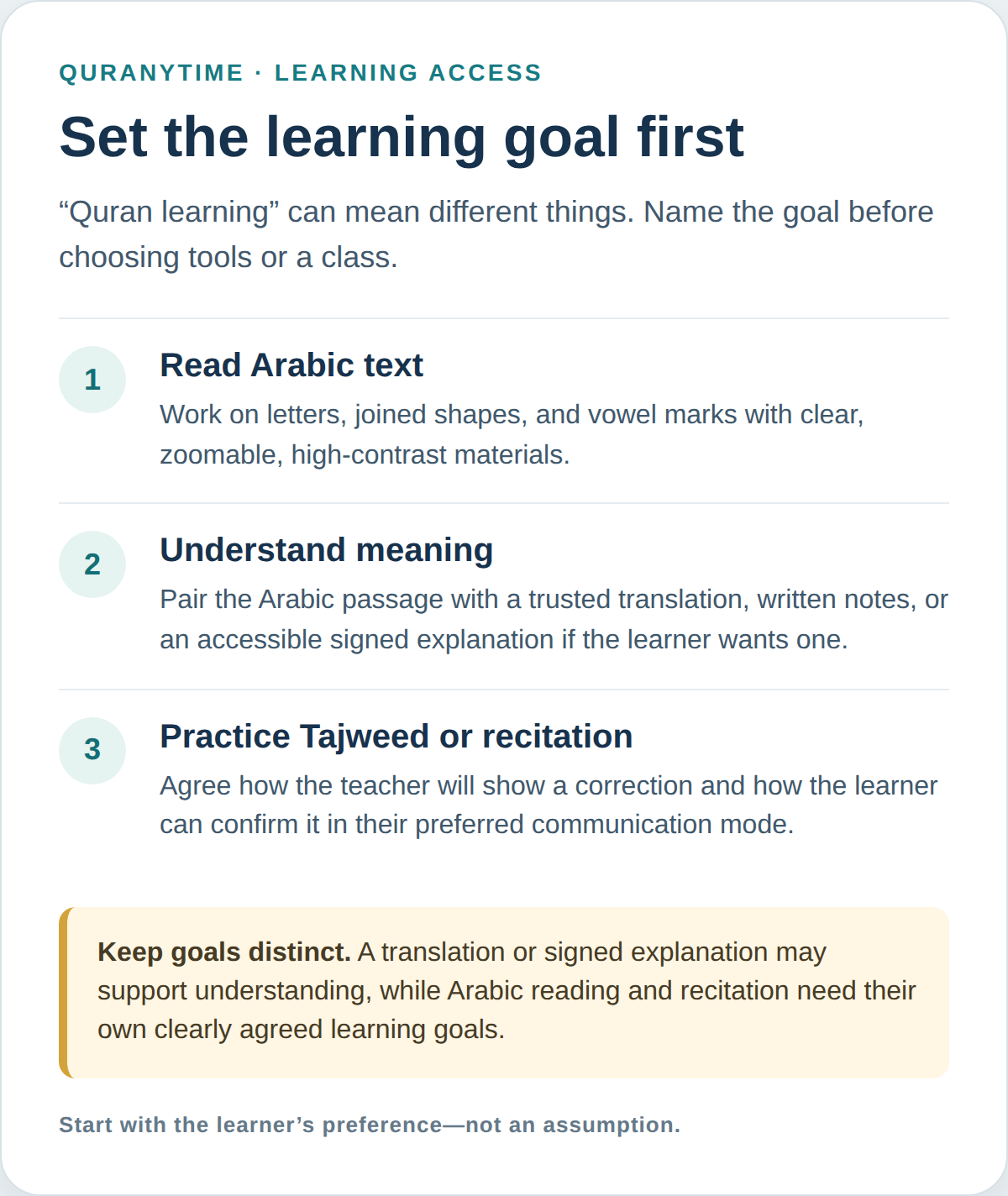
“Learning Quran” can mean recognizing Arabic letters, reading a passage, understanding its meaning, memorizing, or practicing Tajweed and recitation. These aims may overlap, but a useful lesson plan says which one matters today and how progress will be checked.
- Read Arabic text: recognize letters, joined shapes, and vowel marks using clear, zoomable examples.
- Understand meaning: connect Arabic words with a trusted translation, teacher notes, or an accessible signed explanation if the learner wants one. Keep the Arabic and explanation visibly distinct.
- Practice Tajweed or recitation: agree how a teacher will demonstrate a correction and how the learner can confirm it in their preferred communication mode. A colored page alone does not show whether a learning goal has been met.
For script foundations, use our Arabic alphabet and Tajweed guide or Arabic Letter Explorer. If the goal is understanding a passage, our guides to studying a Quran verse word by word and Arabic reading-comprehension practice address related but different skills.
2. Ask about communication preferences—not labels
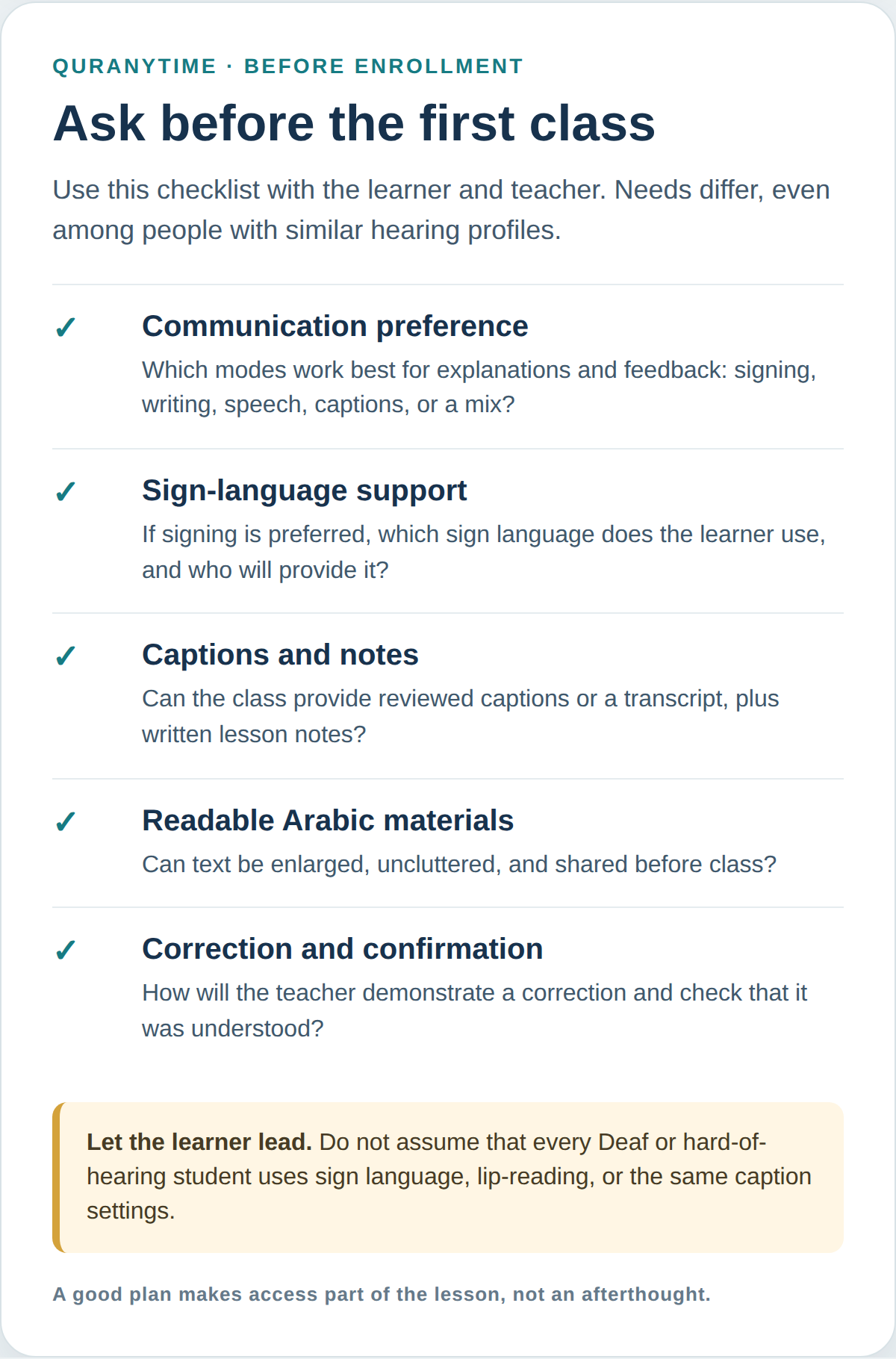
Deaf and hard-of-hearing people do not all communicate in the same way. Some use a local sign language, some do not; some prefer writing, speech, captions, or different combinations in different settings. Hearing level alone does not tell a teacher what works. Ask the learner directly, in their preferred language and format.
If signing is preferred, ask which sign language the learner uses and who will provide it. Do not assume sign languages are universal or interchangeable. For a child, include the learner in decisions as much as possible and agree how the teacher will communicate with the family.
For live or recorded lessons, ask whether captions or a transcript can be provided and reviewed. The National Deaf Center’s captioned-media guidance explains how captions represent spoken words and meaningful sounds in online videos and recorded classes. For Quranic Arabic, preview captions and correct names or specialized terms before relying on them as study text.
Also ask whether the learner wants vocabulary or an outline in advance, a shared chat or document, and a simple way to signal “pause,” “repeat,” or “please explain that another way.” These small agreements can make a video call easier to follow.
3. Make Arabic materials easy to see and revisit
Arabic pages can look dense when a learner is new to joined letter forms, vowel marks, or Tajweed symbols. Ask for a clean file that can be enlarged, strong text-background contrast, generous spacing, and a way to review one line at a time. Share preferred font size or screen setup before class.
A written reference can help the learner revisit letters between lessons. For articulation-point discussions, our Makhraj guide to Arabic letters offers a reference to discuss with a teacher. A diagram is a support, not a substitute for checking understanding. Ask how the teacher will demonstrate and confirm a correction in the learner’s chosen communication mode.
Camera framing may matter for a learner who uses visual communication: keep the teacher and relevant demonstration visible, avoid backlighting, and announce screen changes. Test these options with the learner; some may prefer captions or written chat instead, or may want different formats for different activities.
4. Check how the class handles captions and feedback
A class is not accessible simply because it meets online. Ask what happens before, during, and after the call. Find out whether captions are live, corrected, or automatic; whether Arabic names are checked in transcripts; and how an interpreter will coordinate turns if one is part of the learner’s plan.
Agree on a feedback loop. A teacher might mark a word, type a correction in chat, demonstrate a mouth position on camera if the learner finds that useful, or pause for a signed explanation. The learner should be able to say whether the explanation made sense and request another approach. For reading, point to the relevant letter or mark; for meaning, distinguish translation from Arabic text; for recitation goals, explain how the selected method checks the skill being practiced.
Agree on a backup plan. If live captions stop, the learner can signal a pause while the teacher writes a key term or switches to chat. If the camera freezes, share the Arabic line in a document. If an interpreter connection drops, pause new material and agree whether to reschedule or send a written summary. Ask what can realistically be fixed during class, whether a transcript is available later, and whom to contact. A predictable way to resume is better than asking the learner to explain the same access need each time.
The short video below, “Mark’s Story: Captioning Online Classes,” is a higher-education example from the National Deaf Center, not a Quran lesson. One student describes having captions arranged for an online class. Treat it as an example of requesting access, not a template for everyone.
5. Questions to ask before choosing a teacher
Ask concrete questions rather than relying on a general claim that lessons are “personalized.” A provider can explain what it offers; the learner can decide whether that arrangement fits.
- Which communication formats can the teacher support during a live lesson?
- If I use signing, can we confirm the sign language and interpreter arrangement?
- Can I receive reviewed captions, a transcript, or written notes, and how are Arabic terms checked?
- Can materials be enlarged or shared in advance?
- How will a correction be shown and understanding checked?
- What happens if captions, pacing, camera view, or an interpreter connection fails?
- How will we decide whether today’s goal is reading, meaning, memorization, or recitation practice?
Our page on online Quran classes for adults and the Quranytime Quran-reading and Tajweed overview are starting points for class questions. They are not a promise that a specific accommodation is already available; confirm the details with the provider before enrollment.
6. Make the first lesson a useful test
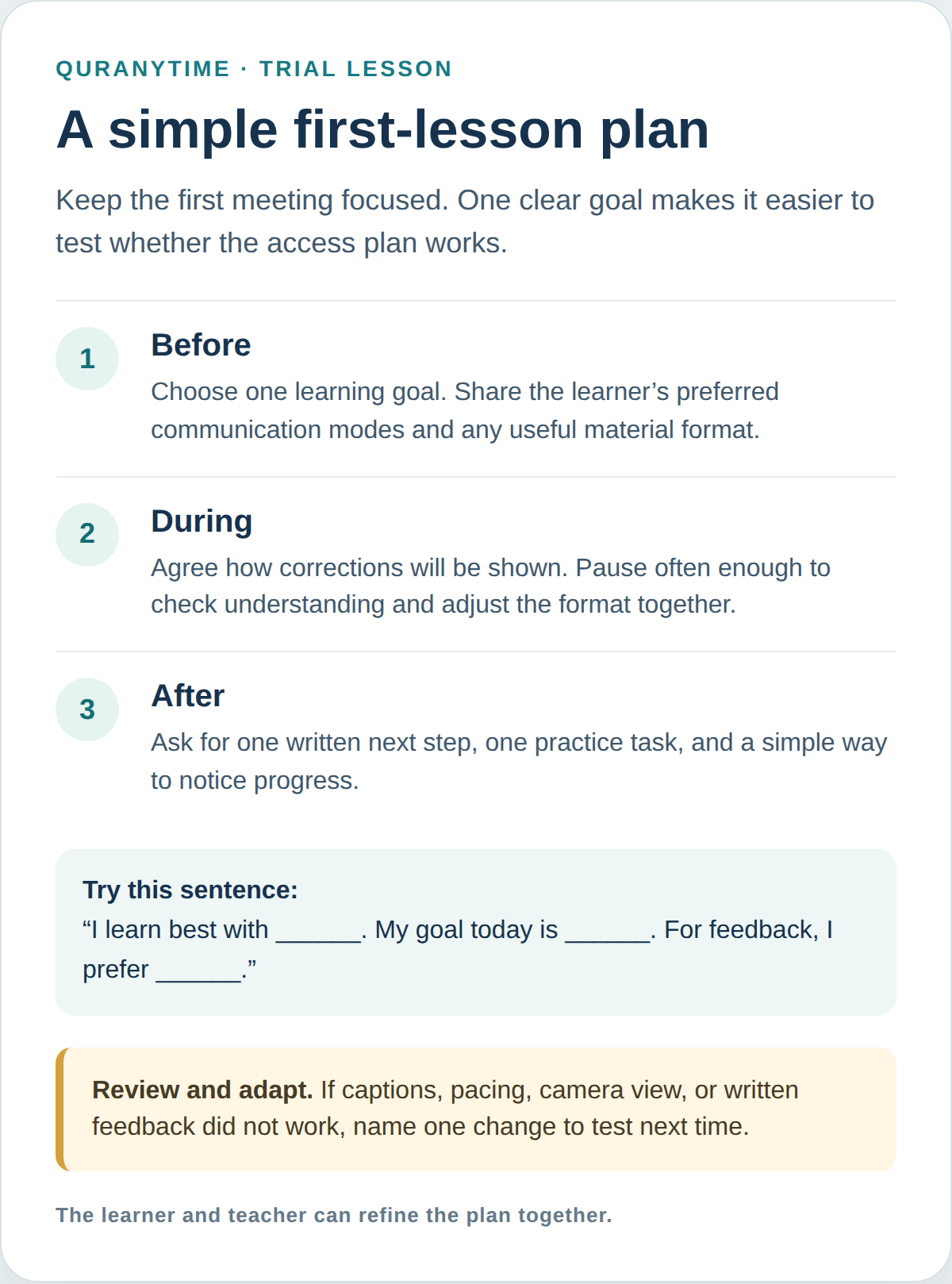
Choose one modest goal, such as recognizing a few letters, understanding a short passage, or reviewing one Tajweed concept. Share the learner’s communication preferences and materials in advance. If captions or an interpreter are part of the plan, confirm them before the meeting.
During class, pause after new ideas and check comprehension in the agreed way. At the end, ask for a short written summary: what was practiced, what went well, one next step, and how feedback will be provided next time. If something did not work, choose one change to test rather than blaming the learner or abandoning the goal.
A learner can use this introduction: “I learn best with ____. My goal today is ____. For feedback, I prefer ____.” A family member may help prepare it, but the learner’s preferences should guide the plan whenever possible.
Frequently asked questions
Do all Deaf Muslims use sign language?
No. Preferences vary by person and context. Ask whether the learner wants signing, writing, speech, captions, or a combination; do not infer a preference from a label or hearing level.
Can captions help in an online Quran class?
They can help some learners follow spoken instruction. Check that captions are available, synchronized, and reviewed, especially when Arabic terms appear. Captions support access to an explanation; they do not by themselves teach Arabic script or show that a recitation goal has been met.
Who should answer prayer-specific religious questions?
Ask a qualified Quran teacher about lesson goals and practice. For a personal religious ruling, consult a qualified scholar who understands the circumstances. This article offers access-planning questions, not a fatwa.
Plan the conversation before enrollment
Accessible Quran learning starts with three questions: what does the learner want to learn, how do they prefer to communicate, and what will useful feedback look like? A good arrangement is specific, respectful, and open to adjustment. To discuss a starting level and lesson goal, use Quranytime’s free Quran and Arabic trial class and explain the learner’s access preferences when arranging it.