
Surah Al-Asr meaning centers on a three-verse reminder that time passes and humanity is in loss except those marked by faith, righteous deeds, mutual counsel to truth, and mutual counsel to patience. Its message is personal and communal: live by what is true, practise it, and help one another persevere.
In brief: The surah opens with an oath by al-‘asr—often translated as time or the passing/declining day—then states a general loss, followed by an exception describing four qualities: faith, righteous deeds, mutual counsel to truth, and mutual counsel to patience. This is the central meaning of Surah Al-Asr. The exact shade of meaning in the oath is discussed by commentators, so “time” is a useful broad rendering rather than the only possible gloss.
Surah Al-Asr is the 103rd chapter of the Quran and has three verses. Quran.com identifies it as a Meccan surah in Juz 30. Though brief enough to memorize quickly, it is not merely a slogan about productivity. It describes what a meaningful life requires: belief, ethical action, commitment to truth, and steadfastness shared with others.
Surah Al-Asr meaning in context
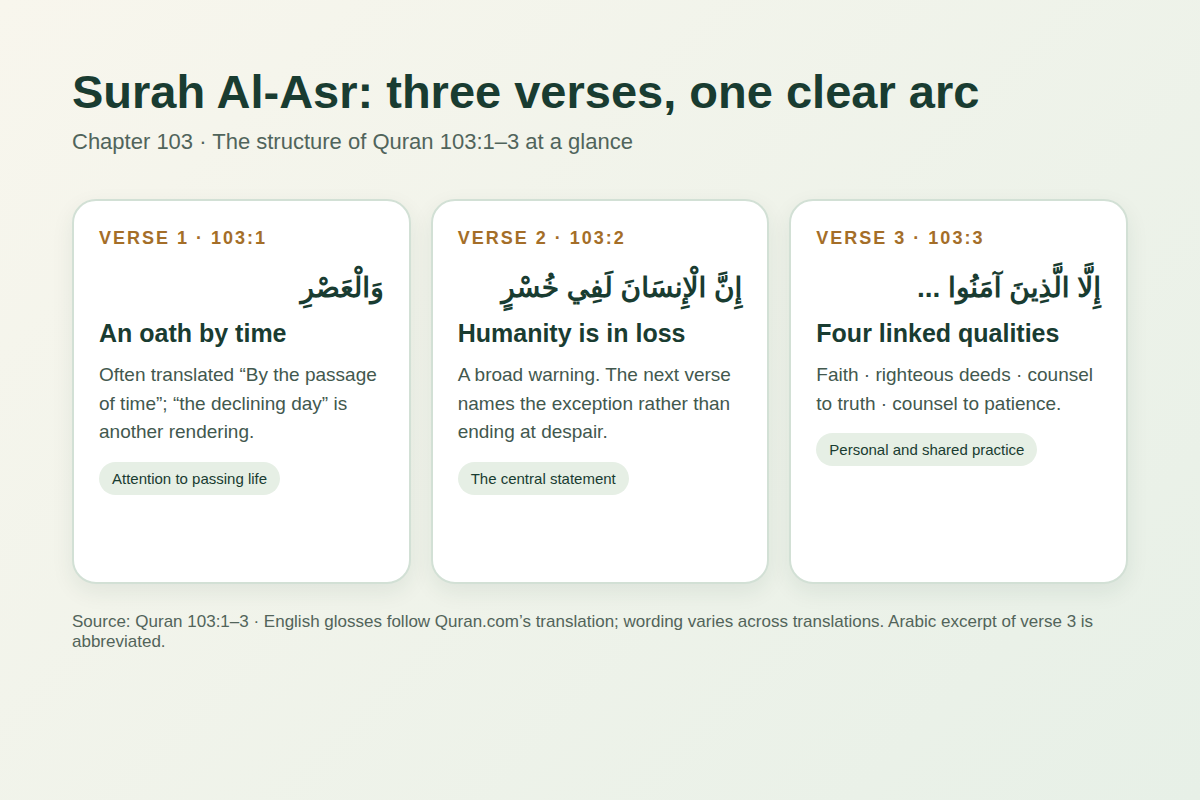
The chapter belongs to the short surahs near the end of the Quran, but its compactness should not obscure its argument. Verse 1 swears by time; verse 2 gives the sobering judgment that humanity is in loss; verse 3 narrows that sweeping statement with an exception. The answer is not one quality alone. The verse joins four: belief, good works, urging one another to truth, and urging one another to patience.
Classical commentary, including Ibn Kathir as presented through Quran.com’s Ma‘arif al-Quran commentary, treats the four qualities as a complete pattern of guidance, with the first two concerning one’s own faith and conduct and the latter two involving mutual counsel. This helps explain why the surah moves from individual commitment to relationships: it is not enough to admire truth privately if we never embody it or support others in holding to it.
Some readers ask whether the surah has a particular occasion of revelation. The chapter’s central teaching can be explained from its own words and the broader Quranic context; avoid presenting a specific historical incident as its confirmed cause without a reliable report.
Verse 1: “By time” — why begin with an oath?
وَالْعَصْرِ — “By the passage of time” is one common translation of the opening words. The Arabic noun al-‘asr has been rendered in English in more than one way, including “time” and “the declining day.” Quran.com’s displayed translation uses “By the passage of time!” Ma‘arif al-Quran discusses the relationship between the oath and the statement that follows: human life, activity, and change all unfold within time, so the passing of time makes human loss tangible.
An oath in the Quran draws attention to what follows; it is not a claim that time itself is divine. The surah’s point is not simply that every minute should be filled with tasks. Rather, our finite days are the setting in which choices, faith, and deeds take place. The Prophet’s saying in Sahih al-Bukhari 6412—that many people are deceived regarding two blessings, health and free time—offers a related reminder about not taking available capacity for granted. It is a supporting hadith, not a gloss that replaces the surah’s own wording.
There is an important balance here. Valuing time does not mean treating rest, illness, caregiving, or unavoidable constraints as moral failure. The surah does not give a schedule or rank people by busyness. It directs attention to the quality and orientation of life: what we believe, what we do, and how we encourage goodness. A thoughtful explanation can help readers follow those layers; compare with a context-first way to study a Quran verse word by word. For a separate Arabic reading exercise using this surah, see Arabic reading comprehension practice.
Verse 2: “Humanity is in loss”
إِنَّ الْإِنسَانَ لَفِي خُسْرٍ — “Indeed, humanity is in loss.” This is deliberately broad and emphatic. The verse does not say that every worldly setback proves someone is spiritually lost, nor does it label a particular individual’s final standing. It frames the human condition in relation to passing life and the need for the qualities named in the next verse.
Commentators explain loss in terms of wasted life and failure to attain lasting good. Ma‘arif al-Quran uses the image of life as capital that continually passes; this is an explanatory analogy, not a separate Quranic quotation. The surah then identifies the exception rather than leaving the reader with despair. Its structure is both warning and direction: recognize the risk, then learn the qualities that answer it.
That four-part answer matters. Faith without action is not the full description in verse 3; good deeds are not isolated from truth and patience; and the communal clauses prevent a narrowly self-focused reading. The message invites reflection, not a simplistic equation between visible success and divine approval.
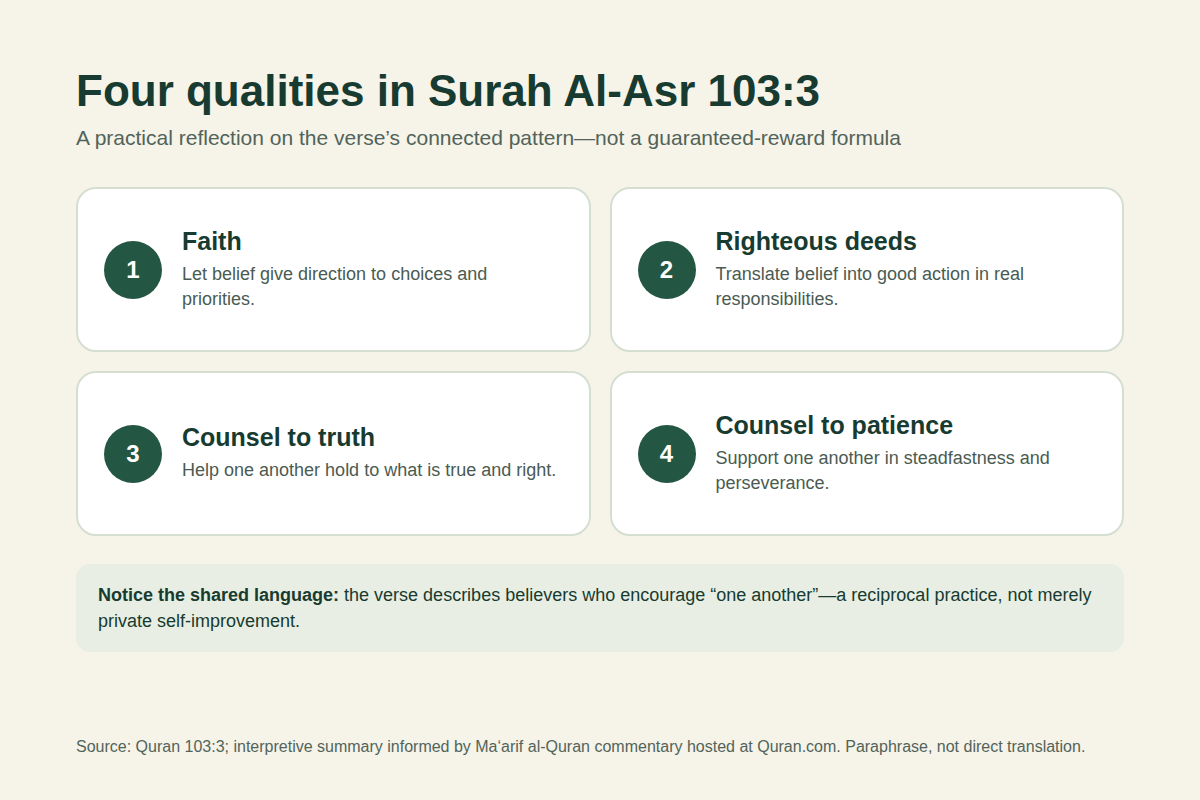
Verse 3: Four qualities that answer loss
1. Faith
The first quality is iman, belief. In context, faith is the foundation that gives direction to action. It is not merely a label or a passing feeling: it shapes what a person regards as true, worthwhile, and accountable before Allah. The surah names faith first, before mentioning deeds.
2. Righteous deeds
The second is ‘amilu al-salihat, doing righteous deeds. The wording is plural and broad; it does not provide an exhaustive checklist in this short chapter. It points to actions that are good and in keeping with faith. In practical terms, consider what honest worship, fulfilling responsibilities, kindness, fairness, and avoiding harm look like in your actual circumstances. For careful study of a short chapter’s words and structure, explore how to choose beginner-friendly tafsir books.
3. Mutual counsel to truth
The third quality is tawasi bil-haqq: they urge, counsel, or enjoin one another to truth. “One another” matters. The verse pictures a shared practice, not a one-way license to control or shame people. Truth is broader than winning an argument; commentators connect it with sound belief and right conduct. Counsel should therefore be sincere, informed, proportionate, and mindful of the other person’s dignity.
Because the instruction is reciprocal, each person is both a learner and a giver of counsel. We may need correction in one setting and offer a gentle reminder in another. The surah does not spell out every method or legal boundary for giving advice; those questions may depend on knowledge, circumstances, and scholarly guidance.
4. Mutual counsel to patience
The fourth quality is tawasi bis-sabr: they urge one another to patience or perseverance. Patience here should not be confused with passivity in the face of every harm, or with pretending difficulty does not hurt. In tafsir, sabr can encompass steadfastness in doing good and restraint from wrongdoing. In lived terms, it means helping each other persist in what is right through delay, pressure, or difficulty.
Truth and patience belong together. Truth without patience can become harshness or haste; patience without truth can lose direction. Together they describe a community that seeks what is right and helps one another stay committed to it.
What does Surah Al-Asr teach us today?
It teaches that faith is lived through action. Verse 3 does not stop at belief. Ask: what is one small action this belief should change today? A promise kept, a responsibility completed, an apology made, or a harmful habit resisted may be more meaningful than an ambitious plan that never begins.
It makes care for others part of the picture. The surah uses mutual counsel language twice. It points beyond private self-improvement toward relationships in which people help each other remain aligned with truth and patience. That can look like learning together, checking in without judgment, or offering a reminder at a suitable moment.
It encourages sustainable perseverance. Patience is not a demand to do everything at once. Choose a manageable good deed, keep it consistent where possible, and ask for support when you struggle. If Quran learning is one of your goals, a plan should account for capacity rather than turn the reminder about time into guilt.
It warns against empty busyness. A crowded day can still lack what the surah calls for, while a person with limited time or energy may act faithfully within real constraints. The passage invites honest review, not comparison. One useful prompt is: did my choices today reflect faith, good action, truth, and patience as far as I reasonably could?
Is there a special reward for reciting Surah Al-Asr?
Readers sometimes encounter sweeping claims about a specific reward for reciting this surah. This explanation does not assign a special number, guaranteed outcome, or exclusive reward to its recitation because no such claim is established here. The Quran’s general virtue and the value of reciting and reflecting on it should not be confused with a specific promise attributed to this particular chapter.
There are two narrower reports often discussed. Islam Question & Answer (IslamQA) explains that a statement attributed to Imam al-Shafi‘i about the surah being sufficient for people is transmitted in several wordings; it is a scholarly observation about the chapter’s concise guidance, not a prophetic promise of a special reward. Separately, IslamQA discusses a report from Abu Madeenah al-Darimi that two Companions would recite Surah Al-Asr to one another before parting. The answer cites al-Tabarani in al-Mu’jam al-Awsat and reports al-Albani’s grading of the narration as sound in al-Silsilah al-Sahihah 2648. The answer also quotes al-Albani’s inference that the Companions’ adherence points to a basis in what they learned from the Prophet by word, deed, or approval. That inference is distinct from a report directly quoting a universal prophetic command; it does not make recitation obligatory at every gathering. The same IslamQA answer distinguishes this report from the supplication for expiation of a gathering, for which it cites Abu Dawud 4859.
When sharing religious claims, check what a source actually says and whether a report is prophetic, a Companion practice, or a scholar’s comment. For another useful reading skill, see how to verify a Quran quotation before sharing it.
A simple way to reflect on the surah
- Read all three verses together, not just the opening phrase.
- Notice the transition from the broad statement of loss to the four-part exception.
- Choose one personal action that reflects faith and good conduct.
- Think of one respectful way to support another person in truth or perseverance.
- Return to the surah later and ask what you understand differently.
For the Arabic text and translation, use a trusted mushaf or an established Quran resource. The English translation is an aid to understanding; no single English phrase captures every shade of the Arabic. For more on locating and navigating chapters, see the Quran surah index guide.
Frequently asked questions about Surah Al-Asr
What is the main message of Surah Al-Asr?
It says that humanity is in loss except those characterized by faith, righteous deeds, mutual counsel to truth, and mutual counsel to patience (Quran 103:1–3).
How many verses are in Surah Al-Asr?
It has three verses and is chapter 103 of the Quran.
What does “Al-Asr” mean?
It is commonly translated as time or the passage of time; “the declining day” is another English rendering. Translation choices reflect interpretation, so consult tafsir for fuller discussion.
Is Surah Al-Asr Makki or Madani?
Quran.com classifies it as Meccan. As with other historical classifications, consult a Quran reference that identifies its basis if you need a detailed discussion of reports.
Does Surah Al-Asr promise a special reward for recitation?
This article does not repeat an unverified special-reward claim. The report about Companions reciting it before parting and the scholarly praise of its concise message are distinct from a specific prophetic promise of reward.
Did the Prophet teach the Companions to recite it before parting?
IslamQA cites a report from Abu Madeenah about two Companions reciting it before they parted and notes al-Albani’s grading. The report describes Companion practice. IslamQA also quotes al-Albani’s inference that the practice had a basis in what was learned from the Prophet by word, deed, or approval; the report itself does not quote a prophetic command.
Sources and further reading
- The Quran, Surah Al-Asr (103), Quran.com (text, translation, chapter information).
- Ma‘arif al-Quran, commentary on Surah Al-Asr, hosted by Quran.com.
- Islam Question & Answer 284278: What Imam ash-Shafa‘i said about Surat al-‘Asr.
- Islam Question & Answer 111808: Reciting Surah al-‘Asr Before Leaving a Gathering; discusses the Companion report and the separate gathering supplication reported in Sunan Abi Dawud 4859.
- Sahih al-Bukhari 6412, on health and free time.