
When you read the Quran and notice a small sajdah symbol near a verse, you may wonder whether it is a pause mark, a decoration, or an instruction. It is a sign that the passage is one of the places associated with Sajdah Tilawah, also called the prostration of recitation. The word tilawah relates to reciting or reading the Quran, while sajdah means prostration.
This guide explains the idea in everyday language without turning one school’s detailed practice into a universal rule. Questions about your own procedure, purification, direction, obligation, or what to do in a particular prayer can depend on the school and the situation. For those questions, ask your qualified Quran teacher or a trusted scholar. If you are still building your reading habits, you may also find our guide to a realistic Quran reading and Tajweed learning plan useful.
What is Sajdah Tilawah?
Sajdah Tilawah is a single prostration made in response to a designated Quran passage. It is not a separate daily prayer and it is not the same thing as the two prostrations that belong to a normal unit of salah. Its connection is specifically to Quran recitation: a person may encounter the passage while reading, reciting from memory, or listening to another reciter.
The spiritual meaning is straightforward. A reader reaches a verse connected with prostration and responds with humility before Allah. The moment can interrupt the rhythm of reading, but it also gives the learner a short opportunity to reflect on the passage rather than treating it as just another line on the page.
How do you recognize the prostration mark?
Printed Qurans commonly identify these passages with a sajdah label or symbol. One familiar sign is ۩; an edition may also use the Arabic word sajdah, an underline, or a symbol in the margin. The exact typography can vary between Uthmani, Indo-Pak, and other printed layouts. Look near the end of the relevant verse and in the margin, then confirm the mark with the teacher or edition you normally use.
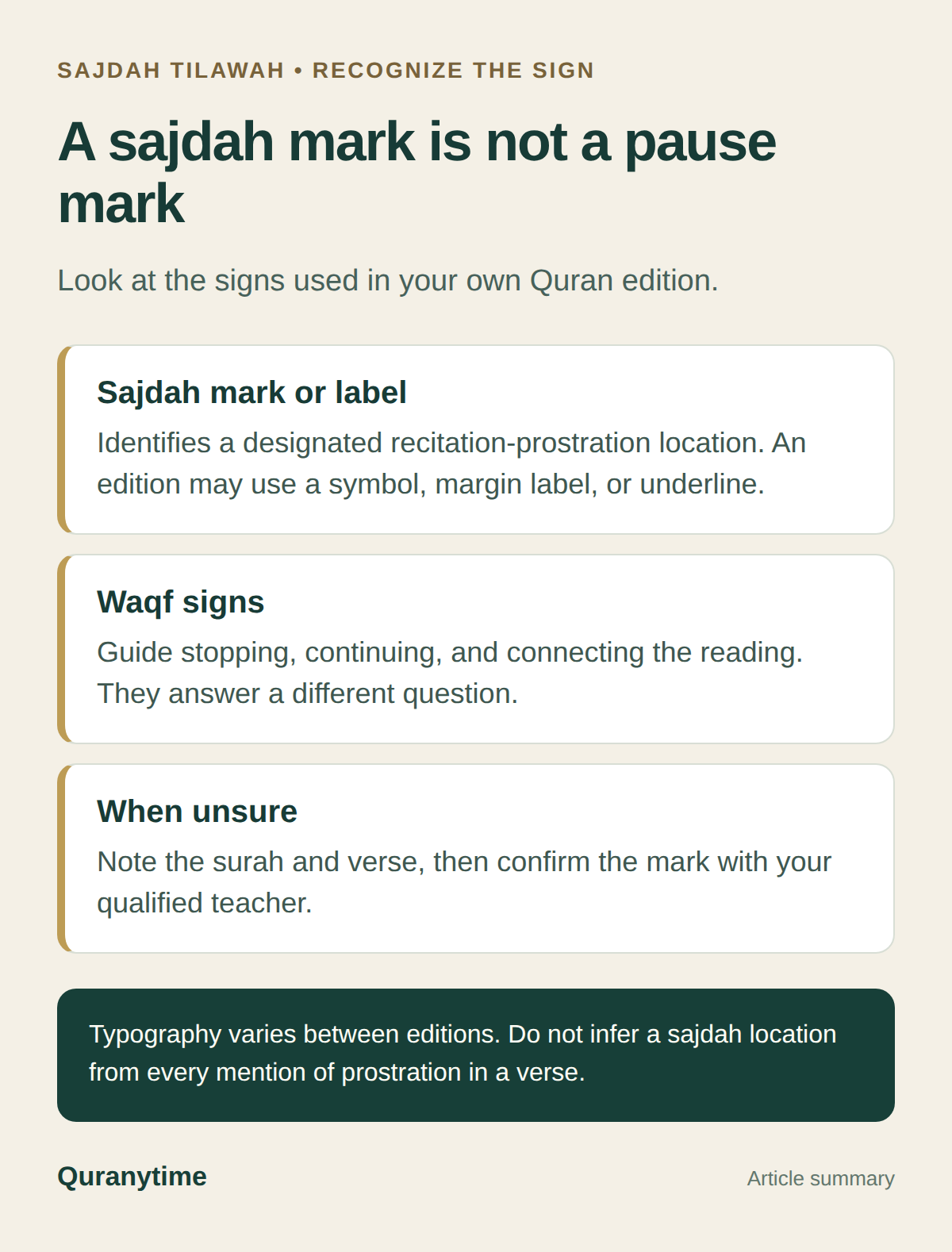
Do not confuse this mark with Quran waqf signs. Waqf signs guide a reader about stopping, continuing, or connecting the meaning of verses. A sajdah mark identifies a prostration location. The two kinds of signs may appear on the same page, but they answer different questions.
Why do some sources say 14 places and others say 15?
You may see a list of 14 sajdah locations in one Mushaf, lesson, or website and a list of 15 in another. This does not mean that a learner has counted badly. The difference comes from scholarly treatment of the evidence and, especially, how the location in Surah Sad is classified. Some counts also reflect how the two locations in Surah Al-Hajj are included.
Egypt’s Dar al-Ifta explains that the locations are established through transmitted evidence and the Prophet’s practice, and it records a narration identifying fifteen verses of prostration, including three in the shorter concluding surahs and two in Surah Al-Hajj. The same answer notes that printed Qurans mark these places for identification. Read the Dar al-Ifta explanation of places of prostration in Quran recitation for that source’s fuller discussion.
For a beginner, the practical lesson is not to argue with a different edition’s number. Follow the Mushaf and teaching tradition you are studying, and ask your teacher why its list uses 14 or 15. A careful article should report the difference rather than claim that one number is accepted identically by every school.
Where are the commonly marked locations?
Rather than memorizing a long table immediately, learners can recognize the surahs that commonly contain a marked location. They include Al-A‘raf, Ar-Ra‘d, An-Nahl, Al-Isra, Maryam, Al-Hajj, Al-Furqan, An-Naml, As-Sajdah, Sad, Fussilat, An-Najm, Al-Inshiqaq, and Al-‘Alaq. Al-Hajj is commonly listed twice in the 15-location enumeration. Your own Quran edition may present a 14-location count, so use its marks as your visual guide.
The mark belongs to a particular passage, not to every occurrence of the Arabic root for prostration. A verse can mention bowing or prostration without being one of the designated Sajdah Tilawah locations in your edition. This is one reason a printed Mushaf and teacher’s correction are more reliable than guessing from a word you notice.
What happens when you read or hear one?
If you encounter the mark during personal reading, pause and follow the practice taught by your qualified teacher. If you are reciting aloud to a group, tell listeners what you have reached so everyone knows why the recitation has paused. If you are listening to another person, whether in a lesson or a live recitation, ask how your teacher wants the group to respond.
Listening situations are not all identical. A person following an imam, a student in a one-to-one lesson, someone hearing a live reciter, and someone who catches a verse in a recording may have different circumstances. The source cited above discusses the Prophet’s practice of reciting a chapter containing a prostration verse and prostrating, with companions following. It does not settle every modern recording or classroom question. Do not treat a short online checklist as a universal answer for all of those cases.
Inside salah, the prostration is part of the prayer and must be handled according to the imam and the fiqh method being followed. Outside salah, details such as whether to stand, which words to say, how to descend and rise, and whether a condition applies can be taught differently. This guide intentionally does not present a single “one size fits all” sequence.
How is it different from ordinary prayer prostration?
Ordinary prayer prostration is one of the repeated physical parts of salah. It appears within the structure of a rak‘ah and is paired with the other actions and recitations of prayer. Sajdah Tilawah is linked to reaching a designated Quran passage. It is one prostration connected to recitation, not a replacement for the prostrations required within salah.
That distinction matters when you are reading outside prayer. You are not automatically starting a new salah, and you should not assume that every prayer rule has exactly the same application here. Conversely, if you encounter a marked verse while praying behind an imam, do not act independently in a way that conflicts with the congregation. Ask your teacher to demonstrate the practice for your school and prayer setting.
Beginner questions to take to your teacher
New learners often ask, “Do I have to make wudu?”, “Must I face the qiblah?”, “Is the prostration obligatory or recommended?”, “What if I cannot prostrate immediately?”, or “What if I only heard the verse?” These are legitimate questions, but they are not answered identically across all fiqh approaches and circumstances. Bring them to a qualified teacher or scholar who knows which method you follow.
It is also worth asking about your physical circumstances. If you have an injury, are on a journey, are in a public place, or are learning through a screen, do not copy a stranger’s confident instruction without checking. Write down the question and the exact context. Our article on asking your Quran teacher better questions can help you describe it clearly.
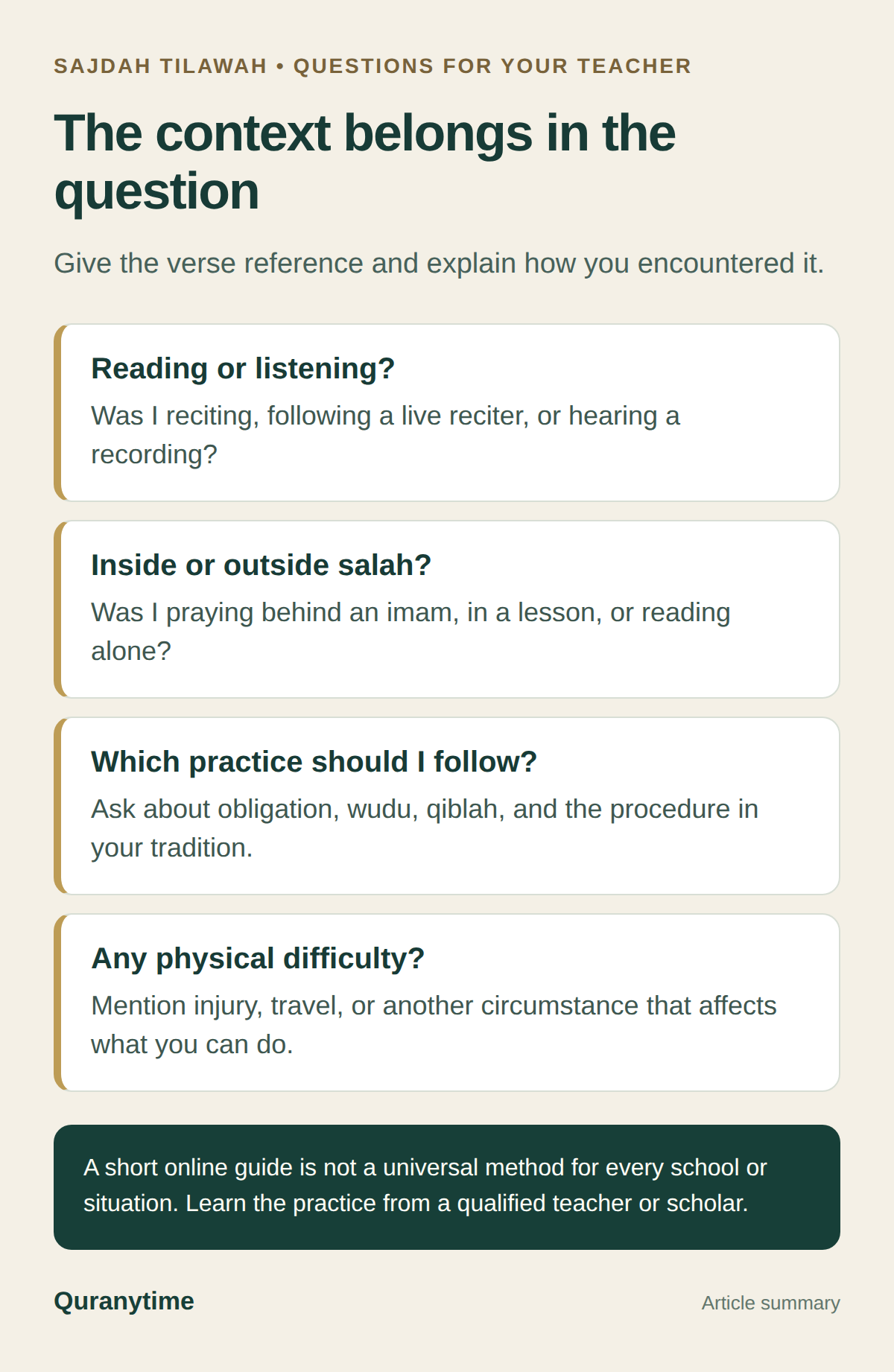
If you are unsure whether you actually reached a marked location, do not panic or stop learning. Note the surah and verse, check the symbol in your edition, and ask at your next lesson. A short question is better than building a personal rule from conflicting posts.
A simple way to learn the marks
Start with the Quran you use regularly. Turn to one marked location with your teacher and learn what the symbol looks like in that edition. Then add the surah and verse reference to your study notes. On a later review, practice reading the surrounding passage so the mark has a context rather than becoming an isolated icon.
You can also connect this exercise with Tajweed practice between Quran lessons. The goal is not to race through a list or imitate an unfamiliar procedure. It is to read accurately, recognize the sign, pause thoughtfully, and know whom to ask when a fiqh detail is unclear. If you record practice for feedback, our guide to recording Quran recitation for a teacher may help you prepare a useful question without treating a recording as a substitute for guidance.
Key takeaways
- Sajdah Tilawah is a single prostration associated with designated Quran passages.
- A sajdah symbol or label in a printed Mushaf helps you find the location; it is not a waqf sign.
- Reliable lists may say 14 or 15 because scholars differ in classification, especially around Surah Sad and related counting conventions.
- Reading, hearing, participating in congregational prayer, and listening to a recording are different contexts.
- For wudu, qiblah, obligation, physical procedure, and recording or listener questions, follow a qualified teacher or scholar in your tradition.
The most helpful first step is simple: open your own Mushaf, find its sajdah mark, and ask your teacher to explain what your learning tradition does at that point. Once the symbol is familiar, the moment can feel less like a surprise and more like a calm, informed response to the Quran.