
Quran reading fluency is not a contest to finish a page quickly. It is the ability to read familiar written Arabic accurately and with a connected, comfortable flow, while keeping meaningful pauses and intended stopping in place. A reader may know the letters and still lose their place, restart a phrase, or break every word apart. The useful goal is not to erase every pause. It is to reduce avoidable hesitation without trading away pronunciation, attention, or correct stopping.
In general literacy education, fluency is often described through accuracy, rate, and expression, and choppy word-by-word decoding is distinguished from more connected reading. This Reading Rockets overview of reading fluency is a general literacy source, not a Quran-recitation standard. School reading metrics and targets should not be treated as Quran-recitation standards. A qualified Quran teacher remains the guide for recitation accuracy, pronunciation, and where a reader should stop.
First identify what is causing the hesitation
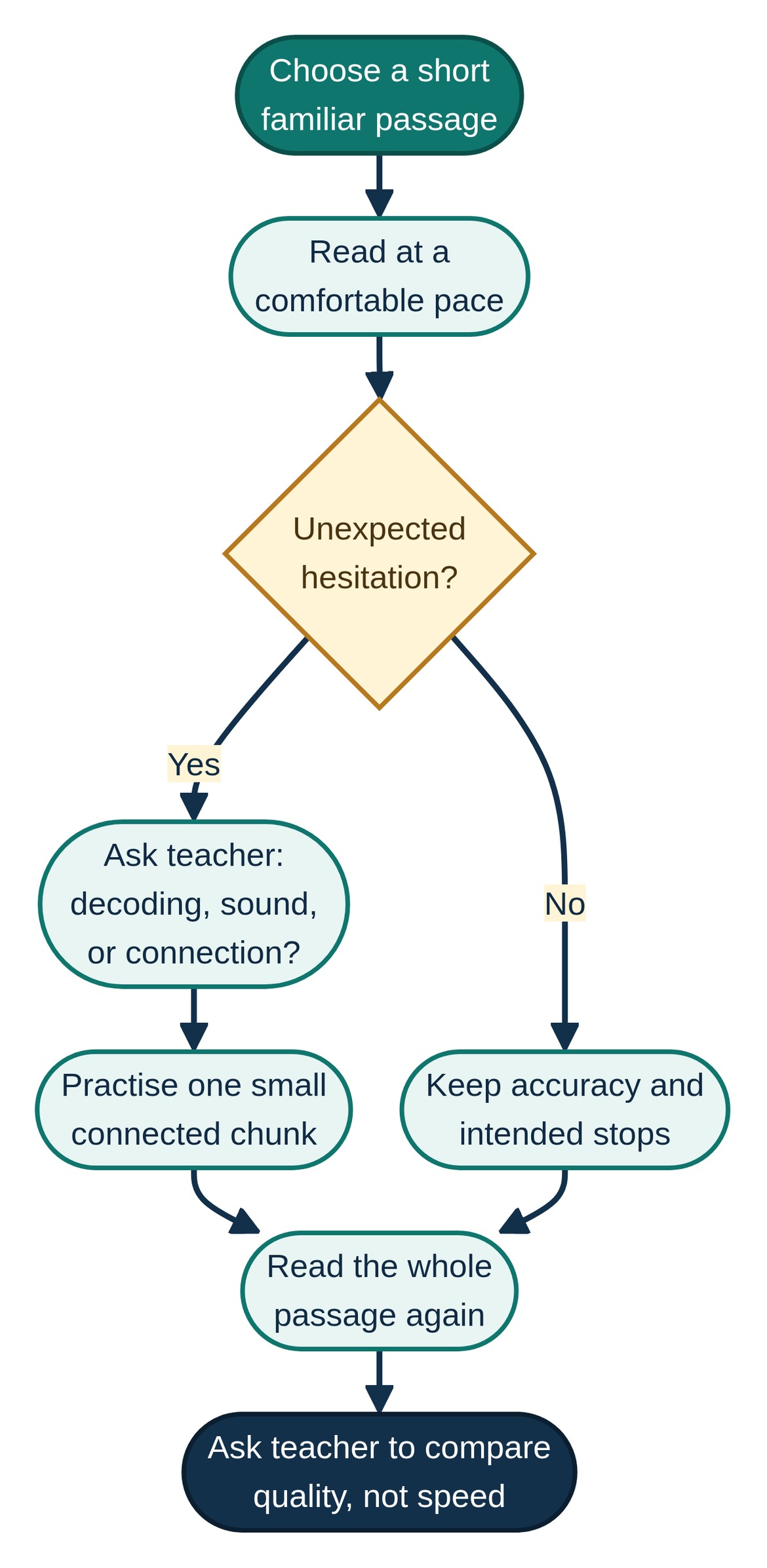
“I read slowly” can describe several different problems. Read a brief, familiar passage once at a comfortable pace, with the text visible. Notice the first point where the flow changes, then ask what happened immediately before the pause.
| What you notice | What it may indicate | Useful next question |
|---|---|---|
| You sound out letters or vowel marks one by one. | Decoding hesitation | Can the teacher help you recognise this written pattern as a connected unit? |
| You continue, but stop to check a sound or articulation. | Pronunciation uncertainty | Which sound needs correction before you seek more speed? |
| You reach a word, go back, and restart the phrase repeatedly. | A repeated restarting habit | Can you mark the point, continue carefully, and review it after the passage? |
| You pause at a meaningful, indicated stopping point. | A valid stop, not necessarily a fluency fault | Is the stop supported by the script and your teacher’s guidance? |
This table is a practice aid, not a clinical diagnosis. One pause can have more than one cause, and the same reader may show different causes on different lines. If you are unsure whether a pause is a valid stop or a sign of uncertainty, ask a qualified teacher rather than forcing the phrase together.
A focused sequence for more connected reading
1. Choose a short, familiar baseline
Select a passage short enough to hold attention, but not a single isolated word. A few connected lines you already recognise are usually more useful than a long page. Read it once naturally. Do not time yourself, count words, or try to produce a “before” recording. Simply notice where you lose your place, restart, or become unsure.
If you need to understand your starting point, a teacher can help you assess your Quran reading level with the right context.
2. Isolate one manageable connected chunk
Ask your teacher to select a short chunk within that passage. The endpoint should make sense for the written text and the intended stopping guidance; it should not be an arbitrary cut made only to create a tiny exercise. Keep the text in front of you. This is connected reading practice, not a test of how much you can recite from memory.
Stopping signs and their context matter. Review the guide to Quran waqf signs and their six marks with a teacher when a boundary is unclear. Do not join words across a place where the recitation should stop, and do not invent a stop inside a verse merely because it makes the drill easier. The exercise should make avoidable hesitations smaller, not remove pauses that carry recitation meaning or correctness.
3. Listen to a teacher model the chunk
Have the teacher read the selected chunk at a comfortable, accurate pace. Listen for how the words connect, where the voice naturally prepares to stop, and how pronunciation remains clear. If your page layout or script is unfamiliar, clarify that before practising. For example, comparing Uthmani and Indo-Pak Quran scripts may help explain why a familiar word or mark looks different; it does not mean one script removes the need for instruction.
Ask the teacher to identify one or two specific points: perhaps a word you decode too late, a sound you hesitate over, or a place where you restart unnecessarily.
4. Read with the text, then reconnect the passage
Read the chunk with the page visible. Keep your eyes slightly ahead of your voice without rushing them. If you meet a pronunciation uncertainty, slow enough to say it correctly and ask for correction. If you make a harmless stumble, avoid automatically returning to the beginning of the chunk; mark the location mentally, finish the selected unit, and review the point with the teacher.
Some readers who use English regularly need extra care with Arabic sounds that are not familiar from English. A targeted explanation of pronunciation challenges for English speakers can help you name the issue, but it should not replace a teacher hearing your actual recitation. Do not turn a sound correction into a speed exercise.
After the chunk feels more connected and remains accurate, return to the whole short passage. Keep every appropriate stop. Read it once comfortably, then compare the flow with your first attempt in words such as “fewer restarts” or “less word-by-word decoding,” not a speed score. If the full passage becomes less accurate, make the chunk smaller or revisit the pronunciation point.
Keep practice precise between lessons
Between teacher sessions, use the same selected passage only long enough to understand the correction and reconnect it to the whole. Guidance on practising Tajweed at home between lessons can support careful work, but this article’s focus is narrower: connected reading with correct stopping. Do not turn the task into a daily quota, a fixed number of repetitions, or a race against yesterday.
If possible, ask the teacher how to capture feedback in a way that protects your attention. Recording Quran recitation for teacher feedback may be useful when it is permitted and the recording has a clear question attached. A short sample can show whether a restart or pause is recurring, while live correction remains important for details a recording cannot explain.
Likewise, a Quran recitation mistake log is not required for this method. If you already use one, keep it narrow: note the passage, the type of hesitation, and the teacher’s correction. Do not collect a long list that pulls your attention away from reading. The aim is better decisions during recitation, not more paperwork.
Check whether the improvement transfers
Familiarity can make a passage feel smoother even when the underlying reading skill has not changed. Later, with teacher agreement, read a different short sample of comparable difficulty. Keep the text visible and use the same comfortable approach. Compare broad qualities: Did you stay with the line? Did you restart less? Did pronunciation remain dependable? These are informal self-observations, not a formal assessment.
A new sample may reveal that the original passage was simply memorised or over-practised. That is useful information, not failure. Return to the teacher with the exact point where flow broke down. The next chunk may need a different boundary, clearer script orientation, or pronunciation work.
A fictional example
Imagine an adult reader, Samira, who can read several familiar surahs but repeatedly returns to the start of a line after hesitating over one word. Her teacher chooses a short connected chunk ending at an appropriate stopping point, models it, and asks her to read with the page open. Samira first works on recognising the word pattern and saying one uncertain sound accurately. She then rejoins the chunk to the surrounding lines. Her progress is described as fewer unnecessary restarts while preserving the intended stop, not a particular speed. When she tries a comparable unfamiliar sample later, the teacher listens for whether the smoother approach carries over without new errors.
Frequently asked questions
Should I try to remove all pauses?
No. Some pauses are appropriate and some are needed for correct stopping. The goal is to reduce avoidable hesitation, not to flatten the recitation into an uninterrupted stream.
How fast should Quran reading fluency become?
There is no universal words-per-minute target for this practice. A comfortable pace that protects accuracy, pronunciation, and stopping is more useful than a number. Your teacher can tell you when a pace is becoming rushed.
Should I memorise the chunk before practising it?
Not for this exercise. Keep the text visible so your eyes and voice practise connecting the written words. Memorisation may be valuable for other aims, but it can hide decoding hesitations.
What if I keep restarting?
Mark the location mentally, continue to the teacher-approved endpoint if accuracy is safe, and discuss the cause afterward. If continuing would repeat an error, stop and seek correction. Do not force a line simply to appear fluent.
A careful next step
Bring one short, familiar passage to your next lesson and ask your teacher to identify a suitable connected chunk, its correct stopping boundary, and the main cause of your hesitation. Read it with the text, reconnect it to the whole passage, and later compare your approach on a different short sample. That sequence keeps Quran reading fluency tied to accurate recitation rather than speed.