
Qalqalah in Tajweed: Make the Echo, Not an Extra Vowel
Short answer: Qalqalah is a brief, clear echo on one of five letters—ق ط ب ج د—when that letter is sakin (without a vowel). You release the sound with a small bounce, but you do not add a short a, i, or u sound. The skill is not to make a new syllable. It is to make a stopped consonant audible and crisp.
The key to using qalqalah well is hearing the difference between continuing and stopping. This guide focuses on the five letters, when the rule applies, and how to check that your “echo” has not turned into an extra vowel.
What does qalqalah mean in recitation?
Qalqalah is a controlled bouncing or echoing quality that helps a sakin letter stand out. A sakin letter has no fatḥah, kasrah, or ḍammah attached to it. If you simply cut off the voice, the letter may become unclear; if you open the mouth too much after it, you may accidentally pronounce a different syllable. Qalqalah sits between those two mistakes: a quick release, with no added vowel.
For a technical explanation of why qalqalah is not fatḥah, ḍammah, or kasrah, and why it should not involve a vowel-like movement of the mouth or jaw, see AboutTajweed’s explanation of the qalqalah mechanism. Use that explanation alongside a qualified teacher’s listening feedback, because the difference is easier to hear and correct than to describe in writing.
The five qalqalah letters
The five letters are commonly memorised in the phrase قُطْبُ جَدٍّ (often written as Qutb Jad). In letter order, they are:
- ق — Qaf
- ط — Ṭa
- ب — Ba
- ج — Jim
- د — Dal
The phrase is a memory aid, not a command to read those letters as a word. The rule applies only when one of these letters is sakin. A letter from the same group with a written vowel is not automatically a qalqalah letter at that moment. For a quick overview of related rules and symbols, keep the Tajweed rules chart nearby while you practise.
When does qalqalah apply?
1. A qalqalah letter is already sakin
Look for a qalqalah letter carrying sukūn, or for a letter whose state becomes sakin when you stop at an appropriate place. When you continue reading, the letter’s original marking matters. When you stop, the final vowel is dropped, so a qualifying final letter can become sakin because of the pause.
2. Continuing and stopping are not the same
This continuation-versus-stop contrast is more useful than trying to memorise one loudness scale. While continuing, make the small release on the sakin letter and move directly into the next letter. When stopping on a suitable end, the final letter becomes still, so the release can be more noticeable. Teaching frameworks use different names for levels such as lesser and greater qalqalah; the practical distinction is whether you are continuing or stopping, not how dramatically you can bounce the sound.
Never stop merely to create a stronger example if the pause would impair the meaning or conflict with the recitation signs. Learn the six common waqf signs and how to use them, and follow a teacher’s guidance for passages where stopping or joining needs care.
Three examples to hear and practise
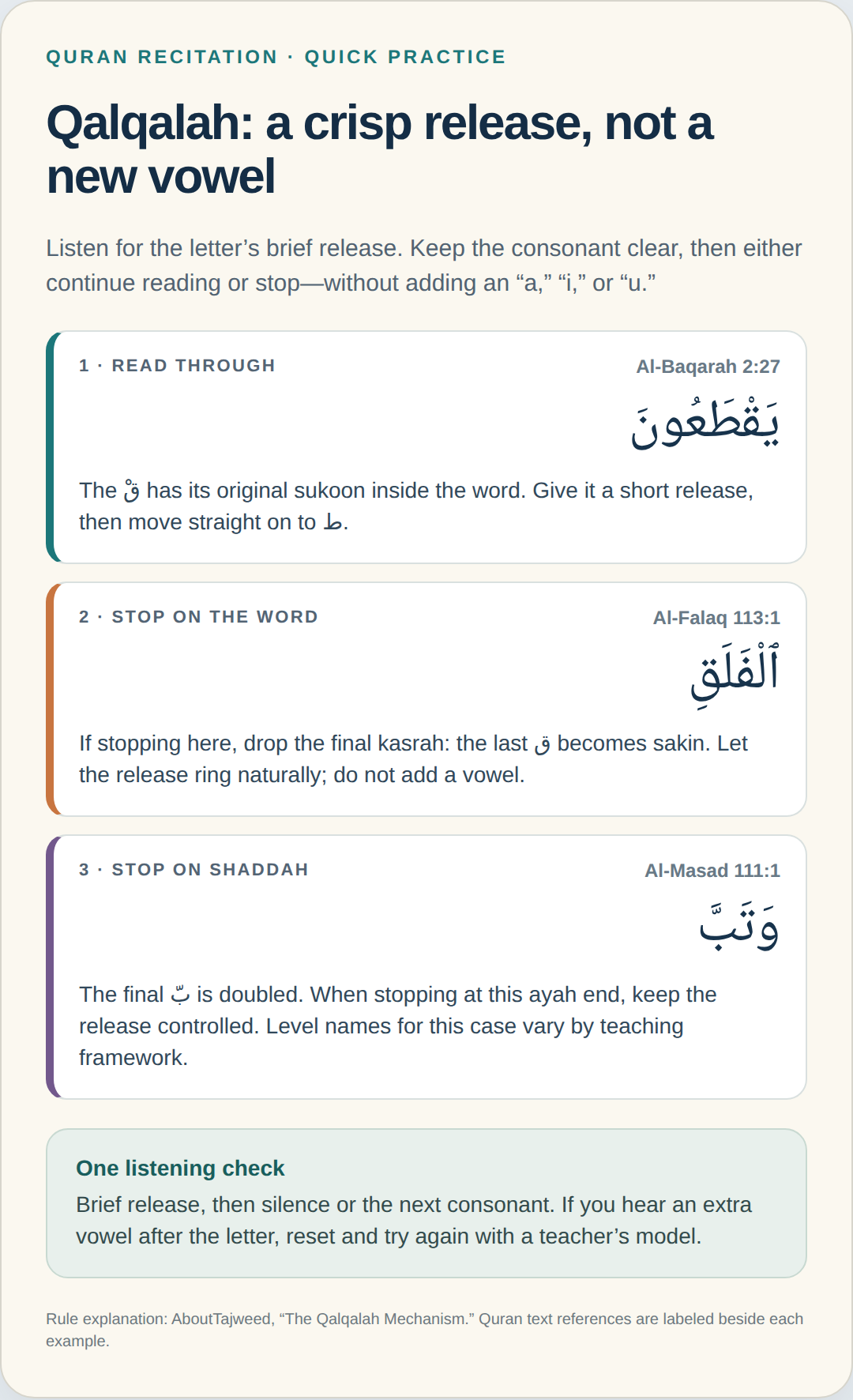
- Continuing through a midword Qaf: وَيَقْطَعُونَ / يَقْطَعُونَ (Al-Baqarah 2:27). The Qaf has its original sukūn in the middle of the word. Give it a short release, then continue to the next letter. Do not say “yaq-aṭaʿūna” with a separate short vowel after Qaf; keep the release compact and move on.
- Stopping on a single final Qaf: ٱلْفَلَقِ (Al-Falaq 113:1). If you stop at the end, the final kasrah is dropped and Qaf becomes sakin. Release the Qaf clearly at the stop, without turning it into “falaqi” or “falaqu.”
- Stopping on a doubled final Ba: وَتَبَّ (Al-Masad 111:1). At the end of the ayah, the final doubled Ba is a stronger stop case. Keep the closure and release firm, but do not add “a,” “i,” or “u” after it. Names for levels vary among teaching frameworks, so listen for the stop effect rather than chasing a label.
For guided listening, use the video slot below, reserved for the native embed.
How to pronounce qalqalah without an extra vowel
Start with the letter, not the echo
First form the letter accurately: close the lips for Ba, place the tongue correctly for Dal or Ṭa, and keep the back-of-the-tongue contact for Qaf. Then release the contact. The echo is the result of that controlled release; it is not a new vowel placed after the letter.
Keep the release short
Imagine a tiny bounce, not a full beat. The sound should be audible enough that the sakin letter does not disappear, yet short enough that the next letter—or the silence of a stop—arrives immediately. If your jaw drops or your mouth reshapes as though beginning a new syllable, the release is probably too large.
Use a no-vowel self-check
Record one example twice: once while continuing and once while stopping only where the text permits. Play it back slowly and ask three questions:
- Can I identify the qalqalah letter clearly?
- Did I hear an extra “a,” “i,” or “u” after it?
- Did I make the stop case clearer without making it theatrical?
A useful test is to hold the final consonant in your mind and then release it into silence. If the sound becomes “ba-a,” “qa-i,” or “da-u,” reset and reduce the mouth movement. Qalqalah does not require you to swing the jaw or open into a vowel-like position. It is a brief consonant release.
A five-minute practice loop
- Read: Choose one line containing a Qaf, Ṭa, Ba, Jim, or Dal with sukūn. Mark whether you will continue or stop at an appropriate sign.
- Isolate: Say the letter alone with its stillness, then add only the small release. Do not attach a made-up vowel.
- Connect: Read the whole word and move immediately into the next letter when continuing.
- Record: Make a short recording, using the Quran audio repeat practice approach: listen, repeat, and compare one target sound at a time.
- Correct: Note one issue only—missing release, added vowel, or excessive bounce—and repeat the same word three times.
Between lessons, use this at-home Tajweed practice routine to keep the exercise consistent. Send a focused clip using recorded Quran recitation for teacher feedback, asking: “Did I add a vowel after the qalqalah letter, and is my continuing release shorter than my stopping release?”
Common qalqalah mistakes
- Adding a vowel: “Qaf-a” or “Ba-u” creates an extra syllable. Return to the consonant and release without opening into a new vowel.
- Making every letter bounce: Qalqalah is not applied to every letter with a heavy sound, every pause, or every letter in the phrase Qutb Jad. Check that the qualifying letter is sakin.
- Overdoing the stop: A stronger stop effect does not mean shouting, stretching, or inserting a second sound. Keep the articulation controlled.
- Ignoring what follows: During continuation, the release must move naturally into the next letter. Do not let the echo interrupt the word.
- Stopping for practice in the wrong place: A demonstration is not a reason to disregard the text’s stopping guidance. Practise the stop case at an appropriate end.
Use this Tajweed mistakes checklist after recording yourself. It can help you separate a qalqalah issue from a broader articulation or stopping issue.
Frequently asked questions
Is qalqalah a vowel?
No. It is a brief echo or release on a qualifying sakin consonant. If you can hear a clear short a, i, or u after the letter, you are likely adding a vowel.
Do all five letters always have qalqalah?
No. The letter must be sakin in the relevant reading moment—because it is marked with sukūn while continuing, or because a permitted stop makes a final vowel drop. A qalqalah letter carrying an ordinary vowel is not automatically treated as qalqalah.
Is the stop version always louder?
It may be more noticeable because the final letter is made sakin at the stop, but louder is not the goal. Aim for a clean, controlled release. Terminology for levels varies, so do not let labels encourage exaggeration.
Can I pause after any qalqalah letter to practise?
No. Practise a stop only where the recitation guidance and meaning allow it. For a broader foundation, start with this beginner’s guide to what Tajweed is, then build the specific skill with a qualified teacher.
What should I do if I still cannot hear the difference?
Slow down, compare a continuing example with an appropriate stopping example, and ask for one targeted correction. A structured learn Tajweed Quran online option can provide regular listening and feedback rather than leaving you to guess from a written description.
Make the echo small, clear, and faithful
Qalqalah becomes manageable when you ask: which of the five letters is sakin right now, and am I continuing or stopping? Form the consonant, release it briefly, and check that no vowel has appeared. The best qalqalah is not dramatic; it makes the letter clear while preserving the word and meaning.