
When you read the Arabic definite article الـ in the Quran, the spelling stays the same—but the sound of its lām changes according to the first letter of the word that follows. With a sun letter, the lām blends into that letter. With a moon letter, you pronounce the lām clearly. Learning this small pattern helps you read familiar words more smoothly without changing their written form.
This guide shows the difference through Quran examples, explains how the rule works in connected reading, and gives you a practical way to check your own recitation. If you are still learning the Arabic letter shapes, first review this guide to the Arabic alphabet; the rule depends on recognizing the first consonant after الـ.
What are the sun and moon letters?
Arabic calls the two groups al-ḥurūf ash-shamsiyyah (sun letters) and al-ḥurūf al-qamariyyah (moon letters). The names come from two useful examples: الشَّمْس (ash-shams, “the sun”) and الْقَمَر (al-qamar, “the moon”). In the first, the initial shīn takes the sound of the article’s lām; in the second, the lām remains audible before qāf.
The Arabic spelling keeps the definite article الـ in both cases. The difference is in how you pronounce the word, not in whether you write the lām. Michigan State University’s Elementary Arabic I lesson on the definite article explains the same 14-and-14 division and the core assimilation rule.
The 14 sun letters and 14 moon letters
The sun letters are:
ت، ث، د، ذ، ر، ز، س، ش، ص، ض، ط، ظ، ل، ن
They are tāʾ, thāʾ, dāl, dhāl, rāʾ, zāy, sīn, shīn, ṣād, ḍād, ṭāʾ, ẓāʾ, lām, and nūn. When one begins a noun carrying الـ, the article’s lām is assimilated to it. In fully vocalized text, a shaddah on the sun letter signals that doubled consonant sound.
The moon letters are:
أ، ب، ج، ح، خ، ع، غ، ف، ق، ك، م، ه، و، ي
They are hamzah/alif, bāʾ, jīm, ḥāʾ, khāʾ, ʿayn, ghayn, fāʾ, qāf, kāf, mīm, hāʾ, wāw, and yāʾ. Before these, say the lām distinctly. In teaching text, the lām is commonly marked with sukūn, as in الْقَمَر. Lists may name the first group member as hamzah or alif; the practical check is the consonant sound at the start of the noun after the article.
How to read a sun-letter word
Look at الشَّمْس. Its written letters include alif, lām, and shīn, but you do not pronounce a separate “l” before the shīn. The sound is ash-shams, not “al-shams.” The shīn is doubled: begin it with the brief closure that a shaddah requires, then continue into its vowel. Do not insert a pause between the assimilated lām and the shīn.
The same pattern appears with other sun letters. In النَّاس (an-nās), nūn is doubled; in الرَّحْمَٰن (ar-Raḥmān), rāʾ is doubled; and in الصِّرَاط (aṣ-ṣirāṭ), ṣād is doubled. Notice the key point: the sounds differ, but the article’s lām remains in the written word. This is one reason it helps to learn both letter recognition and correct doubled-consonant reading; see the site’s lesson on how shaddah changes a Quran letter’s sound.
A useful edge case is a noun that begins with lām itself. Since ل is a sun letter, the article’s lām assimilates into the noun’s lām. In اللَّيْل (“the night”), the sound is a doubled /l/, not two separately spaced l sounds; in Quran 92:1, وَاللَّيْلِ is read wal-layli. The written article is still there, and the shaddah signals the merged consonant.
How to read a moon-letter word
Now compare الْقَمَر. Here qāf is a moon letter, so you hear the article’s lām: al-qamar. The next consonant is not doubled by the article, and no shaddah is added to qāf. The lām’s sukūn indicates that it closes cleanly before you move to the qāf.
Other familiar examples include الْحَمْد (al-ḥamd), where ḥāʾ is a moon letter, and الْكِتَاب (al-kitāb), where kāf is a moon letter. Keep the two choices separate: moon letter means pronounce the lām; it does not mean stretch it, add a vowel, or pause before the noun. The article remains attached as one written word. For a broader refresher on recitation terms and rules, use this beginner’s explanation of Tajweed.
Quran examples: compare the words in context
Surah Ash-Shams gives a memorable pair. In 91:1, وَالشَّمْسِ begins with a sun letter, shīn. After the attached wāw, the word is read smoothly as wash-shamsi: the article’s lām is not heard separately, and shīn carries the shaddah. In 91:2, وَالْقَمَرِ begins with the moon letter qāf. Read it wal-qamari, keeping the lām audible.
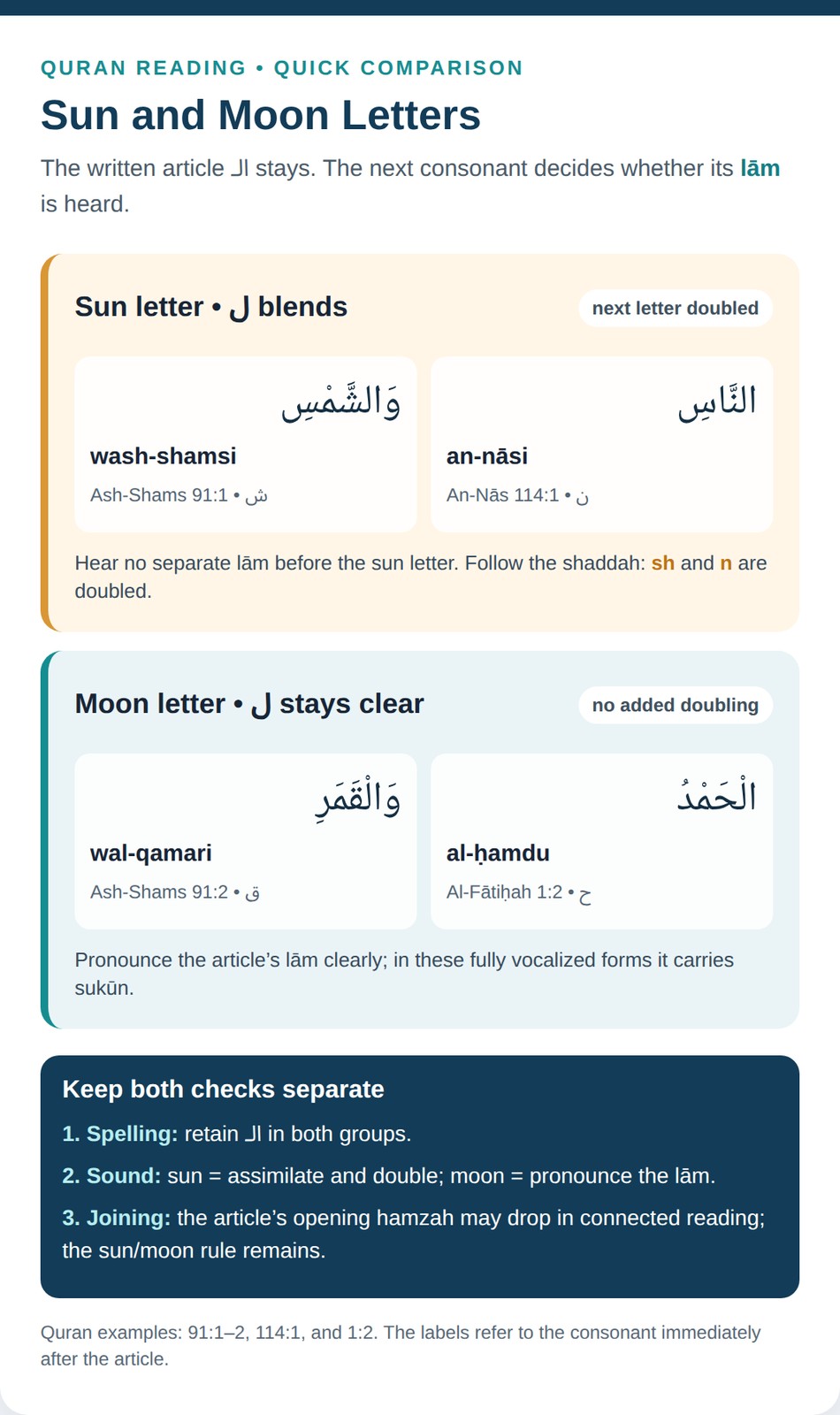
You can hear the sun-letter form again in An-Nās 114:1: بِرَبِّ النَّاسِ, where النَّاس is an-nās. A moon-letter example appears in Al-Fātiḥah 1:2: الْحَمْدُ, read al-ḥamdu. These examples show that the rule applies to the letter immediately after the article—not to the whole verse or to every word beginning with the same sound.
Starting a word versus continuing the line
There are two pronunciation decisions that learners sometimes combine by mistake. First, decide whether the article’s lām assimilates: check the first letter of the noun for the sun/moon rule. Separately, decide whether you are starting after a stop or continuing from a preceding word. The initial alif in الـ carries hamzat al-waṣl. When you begin with the word, its opening vowel is heard: al-qamar or ash-shams. In connected recitation after a preceding vowel, that initial hamzah is not pronounced, while the sun/moon treatment of lām still applies.
That is why the paired Quran examples above are useful: they are joined to wāw, yet the contrast remains clear—wa-l-qamari has a pronounced lām, while wa-sh-shamsi has assimilation and a doubled shīn. Romanization conventions vary slightly, so use the Arabic marks and the sound pattern as your guide. For the separate rules governing when the initial hamzah is heard, review Hamzat al-Waṣl in Quran reading.
Common mistakes to avoid
- Deleting the written lām: assimilation changes pronunciation, not spelling. Keep الـ in the word.
- Pronouncing a separate lām before a sun letter: in ash-shams, move directly into the doubled shīn.
- Suppressing the lām before a moon letter: in al-qamar and al-ḥamd, make the lām clear.
- Forgetting the shaddah: a sun letter is doubled in sound; do not make it a single light consonant.
- Applying the rule to a letter everywhere: a consonant is called a sun letter only for its behavior after the definite article. The letter shīn itself is not “silent.”
- Confusing the article’s rule with other Tajweed rules: first locate الـ, then identify the next consonant. Other nearby rules may need their own analysis; the Tajweed rules chart can help you keep those categories organized.
A short listen-and-check practice routine
- Find الـ in a word, and keep its spelling visible in your mind.
- Circle the first consonant after the article. Is it in the sun list or the moon list?
- If it is a sun letter, look for the shaddah and prepare to double that consonant without a separate lām. If it is a moon letter, keep the lām clear.
- Read the word once after a pause, then read it in the connected Quran phrase. Notice the hamzat al-waṣl change without changing the sun/moon decision.
- Listen to the lesson below and repeat a few examples. Then check the same rule in a short passage rather than racing through a long reading.
For a calm practice pace, pair this check with a fluency routine that avoids rushing and the site’s guide to measured, careful Tartil. If you notice a repeated mistake, record the word and consonant in your Quran-reading mistake checklist. The goal is not to memorize names alone; it is to make the written cues change what your mouth does.
Keep the rule simple
For sun letters, the article’s lām is assimilated into the next consonant, which is doubled in sound and marked with shaddah in vocalized examples. For moon letters, pronounce the lām clearly. In both cases, keep the written article الـ. When reading connected Quran text, handle hamzat al-waṣl as a separate step: it may drop in sound after a preceding vowel, but that does not turn a moon letter into a sun letter—or the reverse.
Practice with the familiar pair ash-shams and al-qamar, then revisit the contrast in their Quranic contexts in 91:1–2. As you become comfortable, use the same three checks—spelling, next letter, connected reading—on other words throughout your recitation. For the letter rāʾ, which belongs to the sun-letter group but has its own heavy/light rules in other contexts, see when rāʾ is heavy or light.