
Arabic pronouns are the short words and endings that tell you who is speaking, who is being addressed, and who or what an action refers to. In Quranic Arabic, you will meet forms that stand alone, endings attached to a word, and subjects understood from the verb. Learning to tell these apart makes a verse easier to follow without turning every word into a separate vocabulary item.
This guide focuses on the personal pronouns most useful to a beginner reading Arabic: the independent subject forms, common attached endings, and the clues that help you recognize them in context. If you are still learning letter shapes, keep an Arabic alphabet reference nearby. The forms below are written in Modern Standard Arabic and Quranic Arabic; everyday dialects may use different pronunciations or forms.
What are Arabic pronouns?
A pronoun refers to a person or thing without repeating its name. Arabic personal pronouns change according to person (first, second, or third), number (singular, dual, or plural), and, in many forms, gender. The dual is especially helpful to notice: Arabic has forms for exactly two people or things, not only one and more than one.
For reading, it is useful to group pronouns by how they appear. Detached pronouns stand as separate words, such as أنا (anā, “I”) and هو (huwa, “he”). Attached pronouns join to a noun, verb, or preposition as a suffix, as in كتابه (kitābuhu, “his book”). A third kind is sometimes called a hidden pronoun: the verb ending identifies its subject even when no separate pronoun is written.
Madinah Arabic’s free lesson on pronouns and their types is a useful reference for the distinction between detached and attached forms. The key for a new reader is not to memorize every grammatical label at once. First notice whether the pronoun is a separate word, joined to another word, or carried by the verb.
Arabic personal pronouns: a quick chart
The chart shows the common detached forms used as subjects or for emphasis. Transliteration is an approximate reading aid; listening to a qualified teacher or reciter will help you hear the vowels clearly.
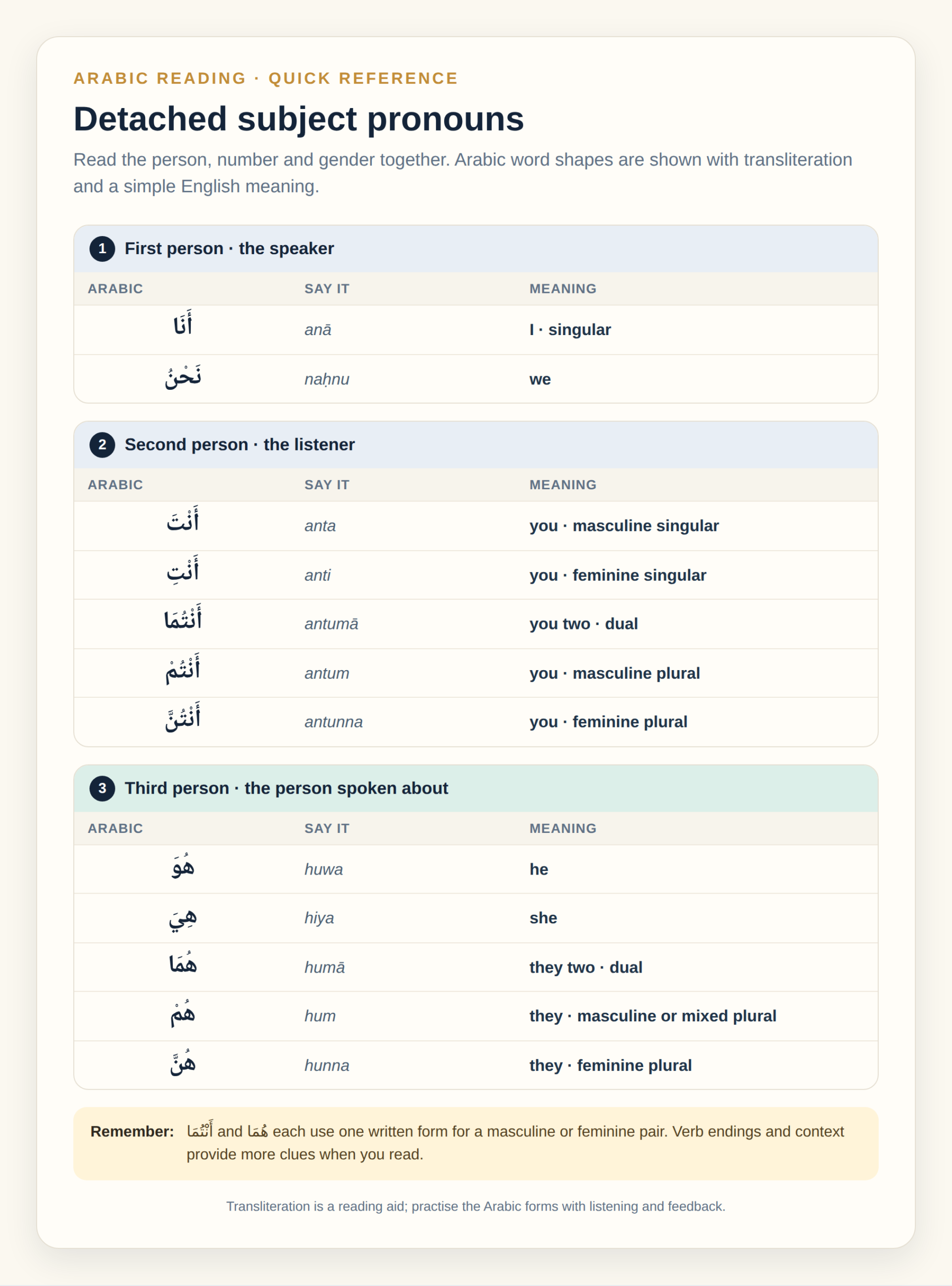
There are 12 distinct written forms in this chart. Some classroom charts speak of 14 pronoun slots because they list masculine and feminine dual categories separately, even though each pair uses the same written form. The main point is to recognize the shared dual أنتما (“you two”) and هما (“they two”), then use the surrounding verb or noun for any additional information.
Detached pronouns: who is the subject?
Detached subject pronouns can make the person doing the action explicit. For example, أنتَ تقرأ (anta taqraʾu) means “you [masculine, singular] read,” while أنتِ تقرئين (anti taqraʾīna) means “you [feminine, singular] read.” The pronoun makes the intended “you” clear before you reach the verb.
Arabic does not always need a separate subject pronoun. A verb’s form often gives a strong clue about its subject, so the pronoun may be omitted when the context is clear. That is why a reader should look at the whole phrase rather than expect every English “I,” “you,” or “they” to appear as a separate Arabic word. An explicit subject may also be used for emphasis, contrast, or clarity.
For example, نحن نقرأ (naḥnu naqraʾu) says “we read.” In a connected sentence, the verb can carry the subject information itself. Learning this pattern alongside basic Arabic grammar helps you avoid translating word by word.
Attached pronouns in Arabic: the ending changes the meaning
Attached pronouns are suffixes, not freestanding words. Their role depends partly on the word they join. A single ending can point to a possessor after a noun, an object after a verb, or the object of a preposition. Read the base word and ending together.
- After a noun: كِتَابِي (kitābī) means “my book”; كِتَابُهُ (kitābuhu) means “his book.” The ending tells you whose book it is.
- After a verb: سَأَلْتُهُ (saʾaltuhu) means “I asked him.” Here ـهُ is the object of the verb, not a possessive attached to a noun.
- After a preposition: لَهُ (lahu) means “for him” or “to him.” The preposition and suffix form one written unit.
In Quranic reading, this is a practical way to notice relationships between words. In رَبَّنَا (rabbanā, “our Lord”), the ending ـنا carries “our.” In Al-Fātiḥah 1:5, إِيَّاكَ نَعْبُدُ (iyyāka naʿbudu, “You alone we worship”) uses an explicit object form before the verb. These examples show why a pronoun may be a full word in one place and a small ending in another.
When you learn a new ending, practise it in more than one environment instead of assuming it always translates the same way. Compare a noun, a verb, and a preposition. If a vowel mark or ending is unclear in a particular mushaf, follow the printed text and ask a qualified teacher rather than guessing from an unvowelled spelling.
How to spot a pronoun while reading
- Look at the word boundary. Is the form written separately, or does it appear at the end of a noun, verb, or preposition? A joined ending is a useful first clue.
- Ask what the base word is doing. A noun plus a suffix often signals possession; a verb plus a suffix may signal its object; a preposition plus a suffix usually points to the preposition’s object.
- Check the verb before adding a subject. Person and number can be built into the verb. Do not add an extra “he” or “they” to your translation unless the Arabic or context supports it.
- Use the sentence around it. Gender, number, and meaning become clearer from nearby words. If you are unsure, mark the form and return to it after reading the full phrase.
If you are studying pronunciation as well as grammar, a guide to Quranic Arabic and Modern Standard Arabic can help you keep reading forms distinct from regional speech. You can also build a steady study routine with this Quranic Arabic vocabulary plan and review how Arabic question words work in a sentence.
Common mistakes beginners can avoid
Mixing up أنتَ and أنتِ. Both can be translated as “you,” but one addresses a masculine singular listener and the other a feminine singular listener in standard Arabic. Their short-vowel distinction matters in fully vocalized text.
Treating every ending as “his.” The suffix ـه can mean “his” on a noun, “him” after a verb, or “him/it” after a preposition. Identify the base word first.
Expecting Arabic to repeat the subject. A subject pronoun can be understood from the verb or surrounding context. A missing standalone word does not automatically mean something is missing from the sentence.
Forgetting the dual. The forms أنتما and هما refer to two. They are not simply alternate spellings of a plural.
Transferring dialect forms into a Quranic reading lesson. Everyday Arabic varieties may sound different from the standard forms shown here. Keep this chart as a reading aid, and use a separate resource for conversational dialects or local pronunciation.
A short practice routine
Try this five-minute routine with a short, familiar passage or a beginner sentence. First, circle each detached form such as أنا or هو. Next, underline any word ending that may be a pronoun suffix. Finally, look at each verb and ask whether its subject is stated separately or carried by the verb. Keep the questions small: “Who is speaking?” “Who is addressed?” “What does this ending refer to?”
Then read the phrase aloud slowly, without forcing an English word into every Arabic position. If you use English transliteration while learning, compare it with this guide to reading Quran with transliteration, remembering that transliteration is a temporary aid rather than a replacement for Arabic script.
For a quick self-check, identify the pronoun function in each item: هُوَ is a detached subject form; كِتَابُهَا has a possessive ending (“her book”); سَأَلْتُهُ has an object ending (“I asked him”); and إِيَّاكَ is an explicit object form. If you want feedback on how you read a passage aloud, you can record your Quran recitation for teacher feedback and ask about the pronoun you found difficult.
Keep the forms in context
Arabic pronouns become easier when you connect their shape to their job. Start with the detached chart, recognize the dual, then practise attached endings after nouns, verbs, and prepositions. As you read, check what the verb already tells you before inserting a separate subject into your understanding.
This is a foundation, not a complete course in Arabic morphology. Continue with short passages, listen to careful recitation, and ask a teacher to explain any case where the form or meaning is uncertain. A few well-understood pronouns in context are more useful than a long list memorized without examples.