

If you have read the words rabbi al-ʿālamīn or māliki yawmi al-dīn, you have already met iḍāfa (إضافة): an Arabic noun construction that often means “X of Y” or “Y’s X.” Learning to spot it helps you connect Quranic words into phrases instead of translating each one alone.
This guide explains idafa in Quranic Arabic as one search topic: the two parts, the key case and definiteness clues, attached pronouns, and longer chains. We will work through short Quran examples, then use a repeatable checklist. The aim is grammatical recognition, not a replacement for tafsir or a complete analysis of every verse. For a wider sequence of language study, see the Quranic Arabic learning roadmap.
What does iḍāfa mean?
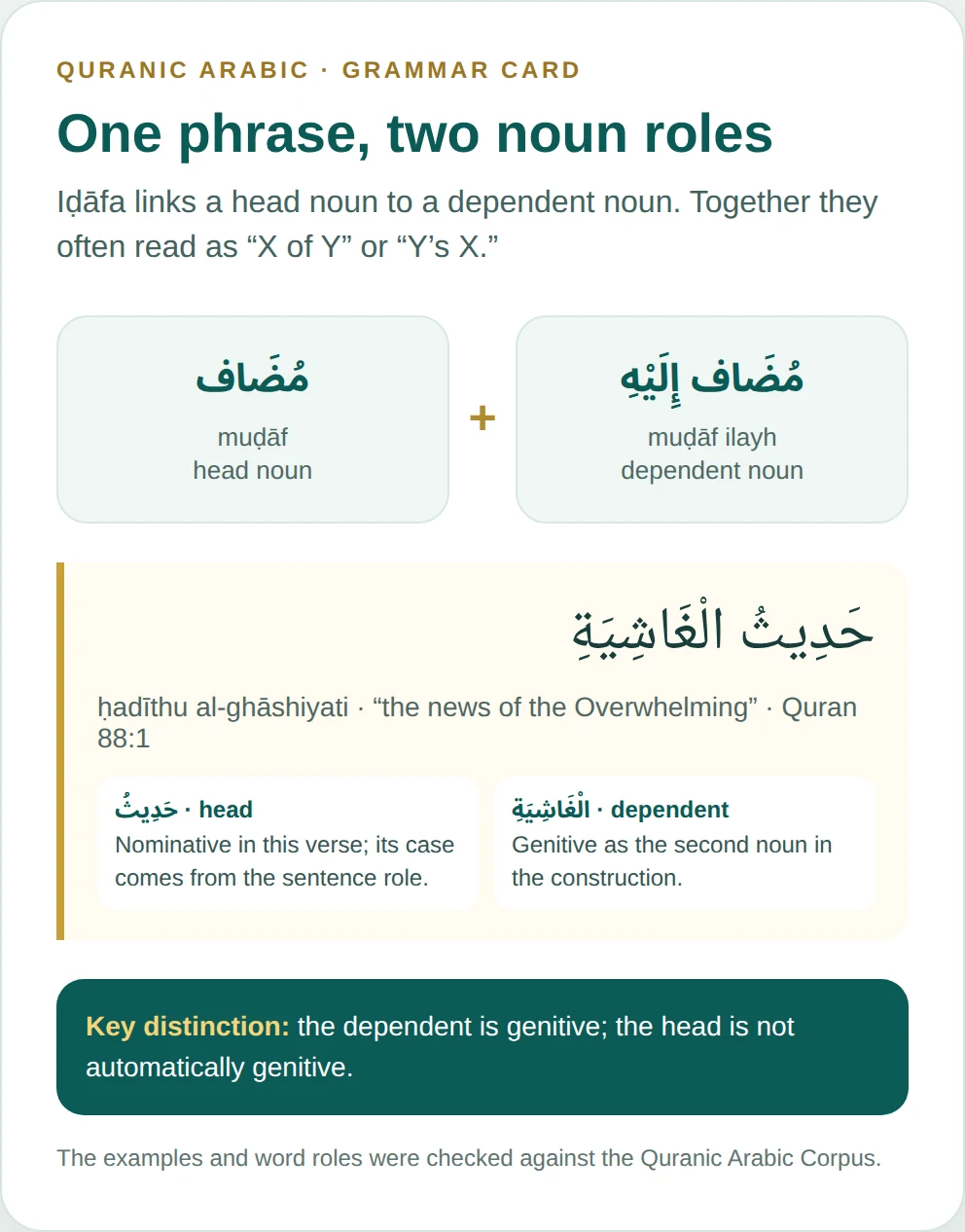
An iḍāfa links two nouns in a relationship. English often expresses the relationship with “of,” an apostrophe-s, or a compact compound. The first noun is the muḍāf (مضاف), the head: the thing being related. The second is the muḍāf ilayh (مضاف إليه), the dependent noun that completes the relationship. In a simple classroom example, kitābu al-ṭālibi (كِتَابُ الطَّالِبِ) means “the student’s book” or “the book of the student.”
The relationship is not always literal ownership. It can identify a part, a source, a time, a category, or another close connection. Context tells you which natural English rendering fits. A translation that uses “of” may help you notice a possible construction, but the English word alone does not prove that the Arabic is iḍāfa.
When you read an Arabic phrase, label the two nouns before choosing an English translation. Ask: what is the head noun, and what noun narrows or completes its meaning? This keeps a possessive phrase distinct from a verb phrase or a string of unrelated vocabulary.
The two main clues to recognize
1. The head noun does not take al- or tanwīn while it is in the construction. The first noun is not written with the definite article al-, and it does not carry tanwīn (the doubled short-vowel ending). In kitābu al-ṭālibi, the head is kitāb, not al-kitāb and not kitābun.
2. The dependent noun is genitive. The second noun is called majrūr (مجرور). In a fully vowelled text, the genitive may be visible as a final kasrah, although endings vary with a noun’s form. A dual or sound masculine plural, for example, does not show the same surface ending as a regular singular noun. Learn the role first; then check the form appropriate to that noun.
Those clues belong together. The iḍāfa does not mean that both words must always have a final kasrah. The head noun’s case is determined by the role of the complete phrase in its sentence. It may be nominative, accusative, or genitive. The Quranic Arabic Corpus’s guide to the Arabic possessive construction documents these restrictions and explains that the dependent is genitive while the head follows its syntactic role.
Read the clues in Quranic examples
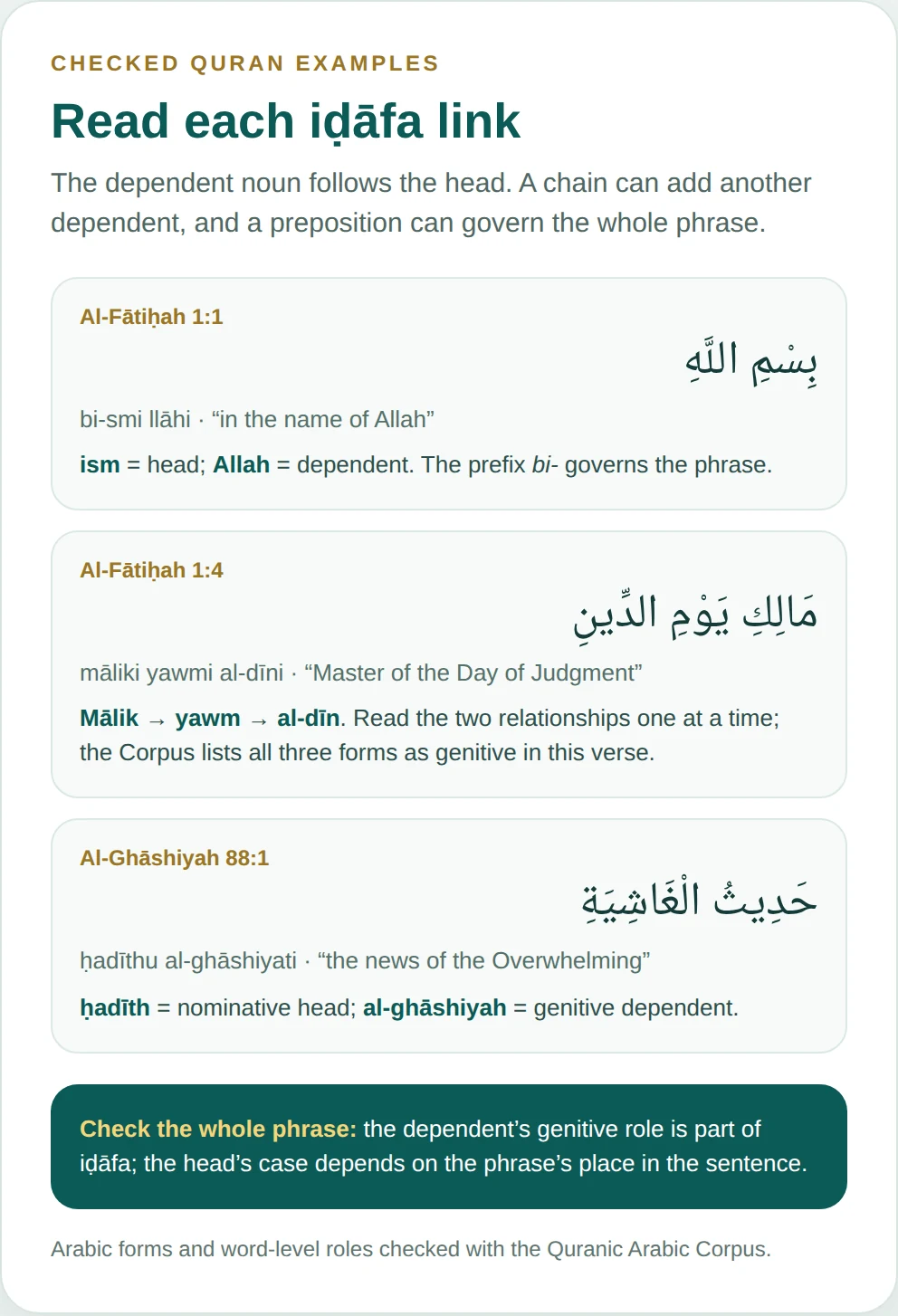
In the opening phrase bi-smi llāhi (بِسْمِ اللَّهِ), “in the name of Allah” (Al-Fātiḥah 1:1), ism (“name”) is the head and Allāh is its dependent. The prefix bi- is a preposition attached to “name,” so the full phrase is prepositional; within it, the two nouns still form iḍāfa. The rest of the familiar opening, al-Raḥmāni al-Raḥīmi, should not be automatically folded into that pair: in the Corpus word-by-word analysis, those words are adjectives describing Allah.
Al-Fātiḥah 1:4 gives a useful chain: māliki yawmi al-dīn (مَالِكِ يَوْمِ الدِّينِ), commonly translated “Master of the Day of Judgment.” The first relationship is “master of the day”; the next is “day of judgment.” In other words, the second noun can become the head of another link. When you meet a chain, read it one connection at a time rather than treating all three nouns as one unexplained label.
Compare that with Al-Ghāshiyah 88:1, ḥadīthu al-ghāshiyati (حَدِيثُ الْغَاشِيَةِ), “the news of the Overwhelming.” The Corpus marks ḥadīthu as nominative and al-ghāshiyati as genitive. Here the head is nominative, not genitive; the dependent is genitive because it is the second noun of the construction. This is a practical reminder to ask what the whole phrase is doing in the sentence before naming the head’s case.
When the dependent is an attached pronoun
The dependent is not always written as a separate noun. Arabic can attach a possessive pronoun to the head. For example, Maryam 19:3 includes nāda rabbahu (نَادَىٰ رَبَّهُ), “he called on his Lord.” The word rabbahu contains the noun rabb (“Lord”) plus the attached pronoun -hu (“his”). The Corpus analysis treats the noun as accusative in its sentence role and the attached pronoun as genitive through the possessive relation.
This example helps separate two questions: what case does the head noun have in the sentence, and what role does the suffix have inside the construct? Do not assume that a possessive suffix makes the entire word genitive. It is the dependent pronoun that completes the possessive link; the head noun’s ending still reflects its wider grammatical role. If suffixes are unfamiliar, review the site’s Quranic Arabic pronoun chart.
Do not confuse iḍāfa with an adjective
An adjective describes a noun; an iḍāfa dependent forms a relationship with it. In a simple learning example, al-kitābu al-jadīdu means “the new book.” The adjective al-jadīdu agrees with the noun in definiteness and, in standard agreement patterns, in gender, number, and case. In kitābu al-ṭālibi, by contrast, “the student” is a dependent noun, not a description of the book. The first noun lacks al-, and the dependent is genitive.
The distinction matters in Quran reading because adjacent nouns may fill different roles. A word after a noun is not automatically an adjective, and a word that follows another noun is not automatically part of an iḍāfa chain. Check its form, meaning, and relationship to the preceding word. For a fuller modifier comparison, see Arabic adjective agreement.
A five-step scan for a verse
Use this short routine when you suspect a possessive or “of” phrase:
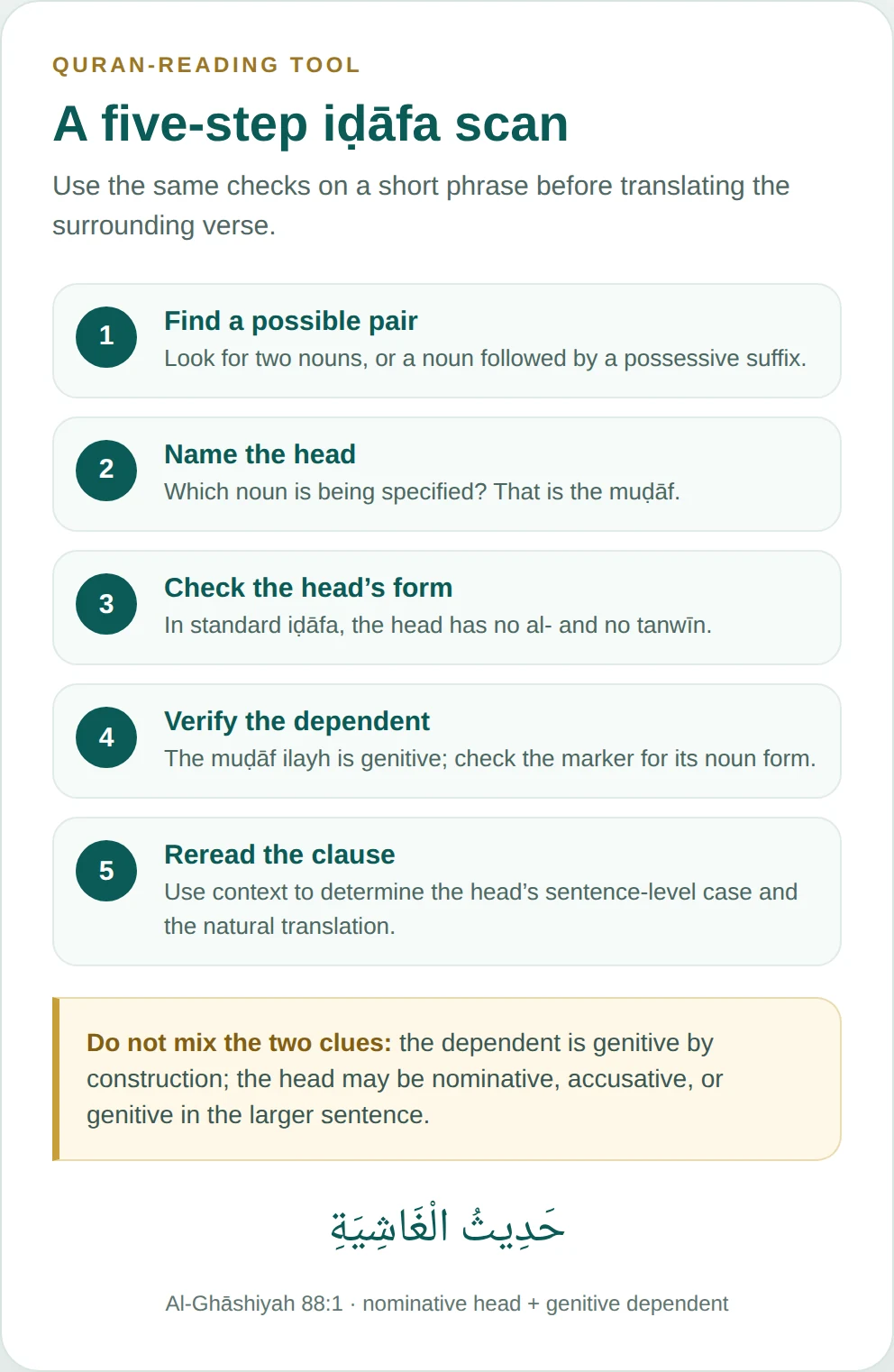
- Mark a possible noun pair. Find two nouns or a noun followed by a possessive suffix.
- Name the head. Ask which word is the main thing or idea being specified.
- Check the head’s form. In a standard iḍāfa, it does not carry al- or tanwīn while it is the head in the construction.
- Check the dependent. Look for the genitive form, including the correct ending for a dual, plural, or attached pronoun.
- Read the whole clause again. Decide the head’s sentence-level case from context, and translate the relationship naturally rather than mechanically inserting “of.”
It can help to keep a small notebook with three columns: verse phrase, head and dependent, and the clue that confirmed your reading. Start with a short phrase rather than parsing an entire verse at once. Compare your first pass with a trusted grammar resource or teacher, especially when a particle, ellipsis, or larger chain affects the surrounding clause.
Common mistakes to avoid
Calling the head genitive every time. The dependent is genitive by construction; the head gets its case from the whole phrase’s sentence role. The nominative ḥadīthu in Al-Ghāshiyah 88:1 shows why the distinction matters.
Putting al- on both nouns. The head does not take the definite article while it is functioning as the first member of standard iḍāfa. The dependent can be definite, and its definiteness can make the whole phrase specific.
Equating iḍāfa with ownership only. The relation can express more than possession. Likewise, English “of” is only a translation clue; confirm the Arabic structure instead of translating word by word.
Missing the chain. In māliki yawmi al-dīn, yawm is not the end of the analysis: it also links to al-dīn. Resolve each pair and then read the complete phrase.
Confusing a possessive suffix with the noun’s sentence case. In rabbahu, the suffix expresses “his,” while the head noun can carry a case required by its role in the clause. Keep the inner relationship and outer sentence structure separate.
Make the construction useful for Quran reading
Once you can identify the head and its dependent, Arabic phrases become easier to group and translate. Iḍāfa also connects naturally with the rules you have already met: a preceding Arabic preposition may govern the phrase, a following adjective may describe one noun, and a pronoun suffix may complete a possessive link. The related lesson on mubtada and khabar helps you place the whole phrase inside a clause rather than reading it in isolation.
As you build vocabulary, connect repeated noun forms with the site’s guide to Quranic Arabic roots and patterns and its beginner vocabulary study plan. These are complementary skills: vocabulary helps you recognize the nouns, while iḍāfa shows how the nouns relate.
Iḍāfa is a compact structure, but its clues are dependable: identify the head, look for the dependent, verify the genitive relationship, and let the sentence determine the head’s case. Practise those steps on short Quran phrases, then reread the wider clause. That habit turns “X of Y” from a memorized label into a tool for careful reading.
Watch a focused lesson
This separate lesson reinforces the same two-noun structure with on-screen examples.